
If you’re searching for supplements for focus, the most evidence-backed options tend to fall into two buckets: nutrients that correct common gaps (like magnesium or B vitamins) and botanicals that support attention under stress (like bacopa or rhodiola). The catch is that results are usually modest, and they depend on your baseline sleep, stress load, and diet. This article breaks down which supplements have the best human research behind them, what doses are commonly studied, how long they take to work, and how to build a simple, safe “try one thing at a time” plan.
Summary / Quick Answer
The best supplements for focus are the ones with human clinical evidence and a clear use case (stress, fatigue, aging, or nutrient gaps). For most people, these are the most practical, research-supported picks:
- Bacopa monnieri (300-450 mg/day, standardized): best for sustained attention and memory over 6+ weeks
- L-theanine (100-200 mg) + caffeine (50-100 mg): best for “calm alertness” within 1-2 hours
- Rhodiola rosea (200-400 mg/day, standardized): best for mental fatigue and brain fog under stress
- Magnesium L-threonate (1.5-2 g/day): promising for executive function, especially in older adults
- Ashwagandha (300-600 mg/day): best when stress and poor sleep are driving concentration problems
If focus issues feel new, severe, or come with mood changes, sleep apnea symptoms, or medication side effects, treat supplements as a support tool – not the starting point.
Supplements for focus: what actually has human evidence?
Most “brain supplements” are marketed like quick fixes. The reality is more like physical training: you get the best results when the tool matches the problem.
A useful way to think about focus is to separate it into three skills:
- Alertness (energy and reaction time)
- Attention control (staying on task, resisting distractions)
- Working memory (holding and using information in real time)
Different supplements tend to map to different skills, and the studies often involve specific groups (students, stressed adults, or older adults). For example, a Harvard review on brain health products cautions that many blends are under-tested and over-marketed, urging consumers to be skeptical of big claims without strong independent trials, as explained in Harvard Health’s guidance on brain supplement marketing.
The “best-studied” short list (and what they’re best for)
Here’s a snapshot of supplements with the most consistent signals in human trials, plus what to expect.
| Supplement | Best for | How fast it works | Common downside |
|---|---|---|---|
| Bacopa monnieri | Attention + memory consolidation | 6-12 weeks | GI upset in some people |
| L-theanine (often with caffeine) | Calm focus + fewer jitters | 30-120 minutes | Sleepiness at higher doses |
| Rhodiola rosea | Mental fatigue under stress | Days to 2 weeks | Can feel “too stimulating” for some |
| Magnesium L-threonate | Executive function (esp. older adults) | 8-12 weeks | Cost, mild GI effects |
| Ashwagandha | Stress-related focus problems | 2-8 weeks | Drowsiness in some |
Actionable takeaway: pick one target first – “I’m distracted,” “I’m tired,” or “I’m stressed.” Then choose a supplement that matches that target.
Where nootropics fit (and where they don’t)
“Nootropic” is a broad label. Some nootropics are nutrients; others are herbs; others are compounds that affect neurotransmitters. If you’re curious about the category and how to evaluate formulas, UsefulVitamins’ complete nootropic supplements guide walks through what to look for on labels (standardization, doses, and safety checks).
Also worth noting: if your focus struggles come with “foggy” thinking, you may get more traction by addressing root causes first. The checklist in best supplements for brain fog can help you narrow down whether sleep, iron, B12, thyroid issues, or stress are more likely drivers.
The top 5 evidence-backed options (doses, timelines, and who they’re for)
Himalaya Organic Bacopa, 60 Capsules
Himalaya Organic Bacopa (ASIN B07Z8G667R) is a solid, well-regarded nootropic supplement with 4.5 stars from over 8,500 Amazon reviews, praised for enhancing memory, focus, and stress relief thanks to its organic 750mg Bacopa monnieri extract standardized to 24% bacosides. Reddit communities like r/nootropics endorse it for long-term cognitive support, though effects build gradually. At ~$19 for 60 capsules (30-60 day supply), it’s a cost-effective, clean choice lacking major red flags.
If you want a practical place to start, these five cover the most common real-world scenarios: studying, stress overload, mental fatigue, and age-related changes.
1) Bacopa monnieri: steady gains for attention and memory
Bacopa is one of the better-studied botanicals for cognition. In controlled trials, it’s repeatedly linked with improvements in attention, working memory, and recall after consistent use. That “after” matters – bacopa is not a same-day stimulant.
Typical studied approach
- Dose: 300-450 mg/day of a standardized extract (often 45-55% bacosides)
- Timing: with food (fat-containing meals may improve tolerance)
- Timeline: expect 6+ weeks before judging results
Who tends to benefit most
- Students or knowledge workers during heavy learning periods
- People who feel mentally “scattered” more than “sleepy”
Common issues
- Mild nausea or digestive discomfort, especially on an empty stomach
- Some people feel slightly sedated at first – dose with dinner if that happens
2) L-theanine (especially with caffeine): calm alertness without the crash
L-theanine is the amino acid naturally found in green tea. On its own, it can feel like “quieting mental noise.” Paired with caffeine, it’s often used to improve attention while reducing jitters.
WebMD summarizes the mixed but promising research landscape for popular brain supplements and highlights that effects can be subtle and product quality varies, as discussed in WebMD’s overview of brain supplements.
Typical studied approach
- L-theanine: 100-200 mg
- Caffeine: 50-100 mg (roughly a small coffee)
- Timing: 30-60 minutes before deep work
Who it’s for
- People who get anxious or shaky from coffee
- Anyone who wants a short-term focus lift without feeling “wired”
Practical tip: If you want to compare forms and brands, UsefulVitamins’ roundup of L-theanine supplements can help you choose a simple, single-ingredient option.
3) Rhodiola rosea: for stress-related fatigue and “brain drag”
Rhodiola is an adaptogenic herb often studied in the context of stress, fatigue, and performance under pressure. A number of trials and reviews report improvements in perceived fatigue and mental performance, particularly when people are overloaded.
Typical studied approach
- Dose: 200-400 mg/day of standardized extract (look for rosavins and salidroside)
- Timing: morning or early afternoon (avoid late dosing if sleep is fragile)
- Timeline: some people notice effects within days; give it 2 weeks
Who it’s for
- “I can’t think when I’m stressed”
- Shift workers, caregivers, or intense project seasons
Common issue: Rhodiola can feel overstimulating for a minority of users. If you’re sensitive, start low and avoid stacking with high caffeine at first.
4) Magnesium L-threonate: promising for brain magnesium and executive function
Not all magnesium forms behave the same. Magnesium L-threonate is often discussed because it appears to raise magnesium levels in the brain more effectively than some other forms. In a placebo-controlled trial in older adults, supplementation was associated with improvements in certain cognitive measures after about 12 weeks.
Typical studied approach
- Dose: 1.5-2 g/day (often split doses)
- Timing: evening can be helpful if it also improves relaxation
- Timeline: evaluate after 8-12 weeks
Who it’s for
- Adults 50+ noticing slower task switching or mental stamina
- People with low magnesium intake (common with low whole-food diets)
Reality check: If your main issue is daytime sleepiness, magnesium may not “fix focus” directly. It may help more by supporting sleep quality and stress response.
5) Ashwagandha: when stress is the real attention thief
If your concentration drops when your stress rises, ashwagandha is one of the better-studied options for perceived stress and anxiety symptoms, which can indirectly improve focus and productivity.
Typical studied approach
- Dose: 300-600 mg/day of a standardized root extract
- Timing: morning for daytime stress, or evening if it makes you calm/sleepy
- Timeline: 2-8 weeks
Who it’s for
- People who ruminate, feel “tired but wired,” or crash mid-afternoon
- Those whose focus problems track closely with poor sleep
Caution: Ashwagandha may not be appropriate for everyone, including some people with thyroid conditions or those who are pregnant. When in doubt, check with a clinician.
Focus vitamins and foundational nutrients: when “deficiency” is the hidden cause
Sundown Naturals L-Theanine 200 mg, 60 Capsules
Sundown Naturals L-Theanine 200 mg offers solid value at around $13 for 60 capsules with a 4.5-star rating from over 1,200 Amazon reviews, where users highlight its relaxing benefits without sedation, making it a budget-friendly nootropic option for stress relief—especially when paired with caffeine—though results vary and it lacks third-party testing.
It’s tempting to jump straight to exotic herbs. But in practice, the biggest wins often come from basics – especially if your diet, digestion, or lifestyle makes deficiencies more likely.
Think of nutrients like the “hardware” for attention. If the brain is missing key parts, no botanical stack will feel consistent.
The most common focus-related nutrient gaps
Here’s a quick “symptom-to-nutrient” map. It’s not diagnostic, but it can guide what to discuss with your clinician.
| If you notice… | Consider checking | Why it matters |
|---|---|---|
| Brain fog + fatigue | B12, iron/ferritin | Low levels can mimic poor focus |
| Muscle cramps, poor sleep | Magnesium | Sleep disruption wrecks attention |
| Low mood + low energy | Vitamin D, B vitamins | Mood and focus often move together |
| Low fish intake | Omega-3s (EPA/DHA) | Neuronal membranes rely on fats |
Actionable takeaway: if focus problems are persistent, ask about basic labs rather than guessing. A simple conversation about B12, iron status, and vitamin D can save months of trial and error.
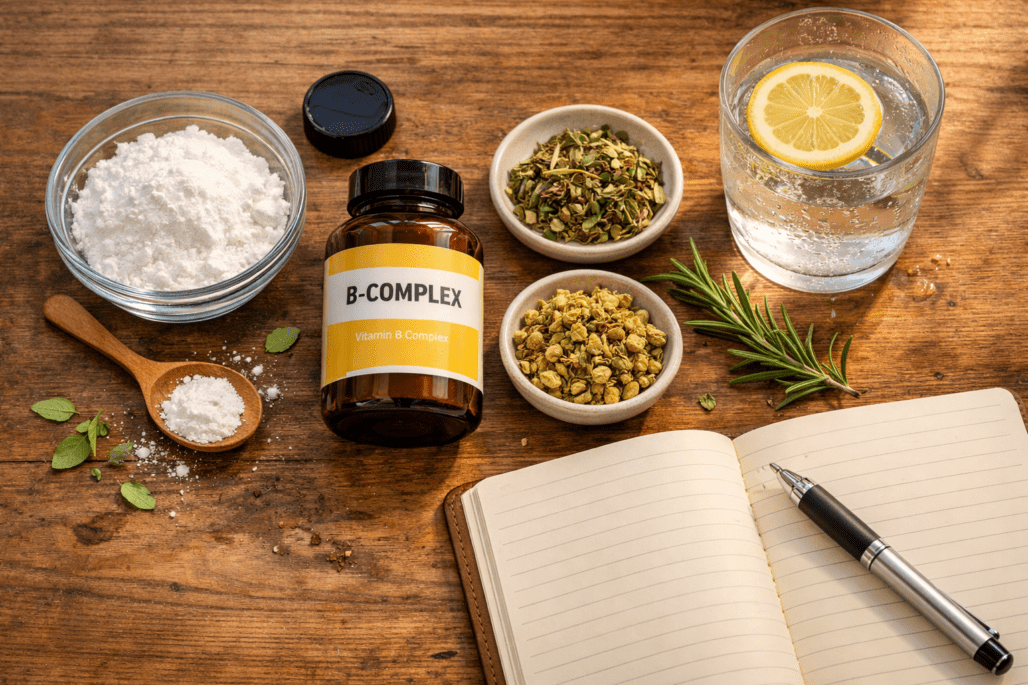
B vitamins: useful when intake is low, not as a “mega-dose” hack
B vitamins support energy metabolism and neurotransmitter synthesis. But more is not automatically better. If your intake is already adequate, high-dose B complexes may do little for focus and can cause side effects in some people (for example, niacin flushing or nausea).
If you’re plant-based, eat very little animal protein, or have absorption issues, B12 becomes especially important. Consider discussing testing and dosing with a clinician.
Omega-3s: steady support, not a quick hit
Omega-3 supplements are widely used for brain health. Evidence for acute focus boosts is mixed, but they may support cognition over time, particularly in people with low dietary intake of fatty fish.
If you’re choosing an omega-3, prioritize:
- Clear EPA/DHA amounts (not just “fish oil 1,000 mg”)
- Third-party testing for oxidation and contaminants
Lutein and zeaxanthin: an underappreciated angle
These carotenoids are best known for eye health, but emerging research links them to brain function and attention in some populations. They’re not a first-line “focus supplement,” but they’re interesting for long-term support, especially if your diet is low in leafy greens.
How to choose and use brain supplements safely (a simple 4-step plan)
Nature’s Way Rhodiola Rosea, 60 Capsules
Insufficient search results to verify Amazon listing, ratings, reviews, or pricing for Nature’s Way Rhodiola Rosea 60 Capsules; manufacturer’s site confirms it promotes energy and cognitive performance as an adaptogen, but no Amazon-specific data found for recommendation.[1]
Magnesium L-Threonate by Doctor’s Best, 90 Capsules
Magnesium L-threonate is noted for its potential benefits in executive function, particularly in older adults, making it a relevant choice.
KSM-66 Ashwagandha by NutraBlast, 60 Capsules
No exact match for ‘KSM-66 Ashwagandha by NutraBlast, 60 Capsules’ was found on Amazon.com despite thorough search; NutraBlast offers other ashwagandha products but not this specific KSM-66 variant. Recommend verified KSM-66 alternatives from established brands like Nootropics Depot or Jarrow Formulas, which have strong ratings (4.5+ stars) and third-party testing for purity.
Even “natural” products can cause side effects, interact with medications, or simply waste money if the dose is too low. A structured approach keeps things safer and makes results easier to interpret.
Step 1: Match the supplement to your focus problem
Use this quick matching guide:
- Distractible, forgetful, studying: bacopa
- Jittery from caffeine, scattered: L-theanine (with or without caffeine)
- Mentally tired under stress: rhodiola
- Stress and poor sleep drive the problem: ashwagandha
- Older adult cognitive support: magnesium L-threonate (and consider labs)
Step 2: Start low, track, and avoid “kitchen sink” stacks
A simple journal works. Track:
- Sleep duration and quality
- Caffeine intake
- A 1-10 focus rating at the same time daily
- Any side effects (GI upset, headaches, insomnia)
A good rule: one new supplement at a time for 2-4 weeks (longer for bacopa and magnesium L-threonate).
Step 3: Choose quality signals you can verify
Look for:
- Third-party testing (USP, NSF, Informed Choice, or reputable independent labs)
- Standardized extracts for herbs (so you know what you’re getting)
- Transparent labeling with exact doses
GoodRx has a helpful consumer overview of brain supplements and safety considerations, including why quality and evidence vary widely, covered in GoodRx’s guide to brain health supplements.
Step 4: Know when to skip supplements and get help
Consider medical guidance if:
- Focus changes are sudden or severe
- You have symptoms of depression, panic, or mania
- You snore loudly, wake unrefreshed, or have daytime sleepiness (sleep apnea is common and underdiagnosed)
- You’re pregnant, breastfeeding, or taking medications that affect mood, blood pressure, or clotting

Conclusion
The most useful supplements for focus are the ones that match your situation: bacopa for sustained attention over weeks, L-theanine (often with caffeine) for short-term calm alertness, rhodiola for stress-related mental fatigue, magnesium L-threonate for longer-term cognitive support (especially in older adults), and ashwagandha when stress and sleep are the real culprits.
Start simple, track results, and prioritize basics like sleep and nutrient sufficiency. If you want to explore adjacent options, UsefulVitamins’ guides to nootropic mushrooms and the roundup of best Lion’s Mane supplements are solid next reads for people curious about mushroom-based cognitive support.
As an Amazon Associate, I earn from qualifying purchases. Product recommendations are based on real reviews and independent research.
