
A seltzer is easy to drink like an ordinary soft drink. That familiarity can make a “fast-acting” claim sound more predictable than it is. The format alone cannot tell you when the THC will affect you or when its effects will end.
Keep three times separate: first noticeable effects, full effects and effects that remain afterward. Confusing those stages can lead someone to consume more before the earlier amount has fully taken effect.
This article does not recommend a THC amount or a redosing interval. It explains why timing claims need limits and why a clock cannot establish that a person is fit to drive.
Onset, peak and duration are different
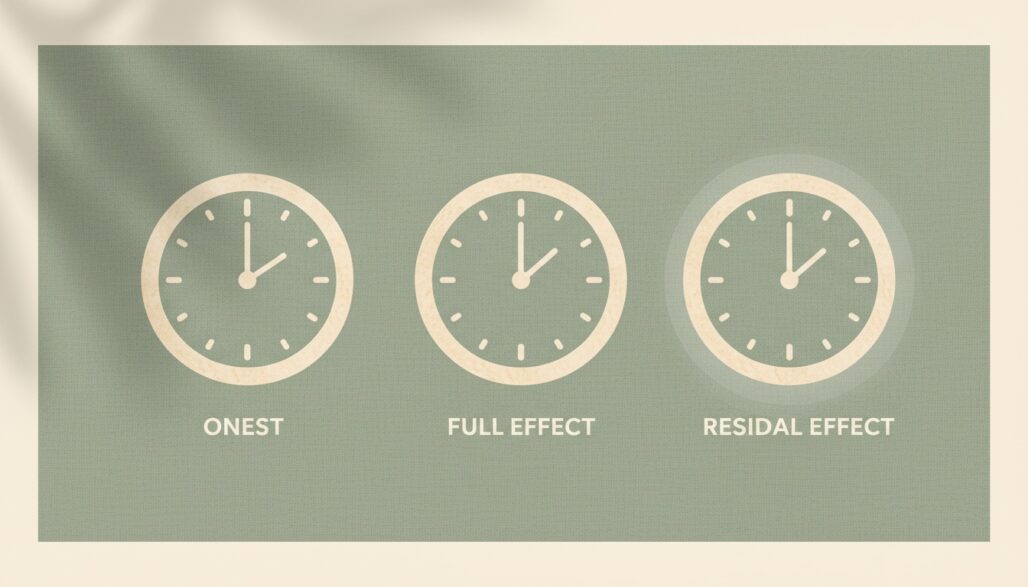
Health Canada's guidance for ingested cannabis groups eating and drinking together. It describes an onset of 30 minutes to two hours, up to four hours to feel full effects, effects lasting up to 12 hours and some residual effects lasting up to 24 hours.
These are broad consumer-safety ranges, not an individual prediction or a formulation-specific trial. They should not be read as “nothing can happen before 30 minutes” or “everyone is unimpaired after 12 hours.”
| Timing term | What it means | Common mistake |
|---|---|---|
| Onset | First noticeable effects | Assuming the first sensation is the strongest effect |
| Full effects | The more complete effect after absorption and processing | Taking more because early effects seem mild |
| Duration | How long effects continue | Assuming every product ends on the same schedule |
| Residual effects | Effects remaining after the main experience | Treating a fading high as proof of normal performance |
“Peak” can also mean the highest measured blood concentration in a pharmacokinetic study. That measurement is not automatically the moment of greatest subjective effect or the moment impairment ends. Read what a study actually measured before treating its graph as a personal timetable.
How a seltzer and a gummy compare
Both are usually swallowed. The CDC includes cannabis-infused foods and drinks in its edible-cannabis guidance. A liquid container does not turn oral exposure into the same route as inhalation.
| Feature | THC seltzer | Solid edible such as a gummy |
|---|---|---|
| Ordinary route | Ingestion | Ingestion |
| What the format tells you | It is a drink | It is a solid food product |
| What still needs checking | Formulation, cannabinoids, serving and container amounts | Formulation, cannabinoids, serving and package amounts |
| Reliable universal onset? | No | No |
| Automatic driving clearance from a label? | No | No |
This does not mean every drink and gummy behave identically. It means a category comparison cannot replace data for the exact formulation. A finding about one preparation should not be promoted into a guarantee about all beverages.
Check the container amount as well as the timing claim. One can may be labeled as more than one serving, just as one edible pouch may contain several portions. Read the total container amount rather than assuming the most prominent milligram number always describes the whole package.
What to do with a fast-acting claim
Words such as “nano,” “water-soluble” or “fast-acting” may describe a formulation or marketing claim. They do not, by themselves, show a study of the finished product, the range of responses or how long impairment lasts.
Ask what evidence supports the specific claim. Was the tested preparation the same as the drink? Was the study in people? Did it measure blood concentration, subjective effects or driving-related performance? How many participants were included, and were they tested with food?
Look closely at the outcome the study measured. Faster appearance in blood would not alone prove a shorter period of impairment. An average onset would not tell you the earliest or latest response among individuals.
The NCCIH overview of cannabis research describes a varied evidence base across cannabinoid products and uses. For this article, we did not identify evidence that supports one universal drink-versus-gummy clock across commercial products.
Why the same clock does not fit everyone
Food, the amount consumed, previous cannabis experience, health circumstances and other substances can complicate the response. Health Canada notes that the same person can respond differently on different occasions.
Medication and CBD content deserve particular attention. In a controlled cannabinoid interaction experiment, a high-CBD preparation given with THC increased THC exposure compared with the THC-only condition. The experiment used brownies and specific amounts, so it is not a direct test of canned seltzers. It gives a reason to include the other cannabinoid when assessing the product.
The study's DOI link and PubMed record identify that evidence. Its results do not give a safe consumer schedule or predict the effect of every low-amount drink.
Do not infer that a product with CBD will reliably cancel THC or make the experience shorter. The composition and context need to be assessed together. If you use medication, consult a pharmacist before combining it with a cannabinoid product.
A timing chart cannot clear you to drive
The CDC's driving guidance describes impaired coordination, slower reactions and altered judgment. It also notes the difficulty of connecting a particular THC concentration to an individual's driving impairment.
A product's advertised onset is therefore the wrong tool for deciding when to drive. So is the moment you stop feeling strongly affected. This article does not provide a “wait this many hours” clearance rule.
Arrange transportation that does not depend on you driving after THC. Avoid adding alcohol or other intoxicating products. Alcohol-free on the front of a can describes alcohol content, not the absence of impairment.
The same caution applies to tasks requiring alertness and coordination. A shorter-feeling experience is not a test of normal reaction time or decision-making.
If effects are stronger or later than expected
Do not use a missed marketing deadline as a reason to consume more. Delayed effects are a recognized concern with ingested cannabis, and additional consumption can accumulate before the earlier amount is fully felt.
If the situation is concerning, keep the packaging and seek advice. In the United States, call Poison Control at 1-800-222-1222 for suspected poisoning. Call 911 for an emergency, including difficulty breathing or a person who cannot be awakened. Do not drive yourself if impaired.
A child consuming a THC beverage needs prompt poison-control advice. Store these products securely, away from children and pets, and do not leave them mixed with ordinary soft drinks. Familiar packaging and flavors can make an intoxicating drink easy to mistake for something else.
If the goal is simply an alcohol-free drink
You do not need a cannabinoid to create a social drinking ritual. Our mushroom drinks instead of alcohol guide examines nonalcoholic formats and explains why the whole ingredient list matters.
Mushroom-only and THC formulas can appear under the same brand name. Check the exact product. A mushroom illustration on the can does not establish that it is cannabinoid-free.
If the timing evidence does not fit the product, leave that uncertainty in the decision. An easy-to-sip format is no reason to assume a predictable response.
FAQ
Are THC drinks considered edibles?
Public-health guidance includes cannabis-infused drinks among ingested or edible cannabis products. The liquid format does not remove delayed-effect concerns.
Do THC seltzers always work faster than gummies?
No universal rule is established here. Exact formulation and individual circumstances matter, and a brand claim should not be generalized to the entire category.
If I feel nothing at the advertised onset, should I have more?
Do not use an advertised deadline as a redosing instruction. Effects may be delayed, and the full effect can occur later than the first noticeable change.
Can I drive once the main effects seem to wear off?
A subjective impression or timing chart cannot establish driving fitness. Arrange transportation that does not require you to drive after THC.
This is a safety comparison, not a product recommendation or dosing guide. Images are AI-generated educational illustrations. Sources were reviewed September 25, 2026.
