
A jar can list 2,000 mg of mushrooms, a 10:1 extract and 30% polysaccharides without telling you how many milligrams of beta-glucans are in a serving. The numbers look useful together, but they describe different things. Multiplying them would not give a valid beta-glucan amount.
Here is how to work out which numbers can be used. The calculation will still tell you only what the label declares, not whether a product works or contains the stated amount. Our supplement review method keeps those questions separate.
The three numbers people confuse
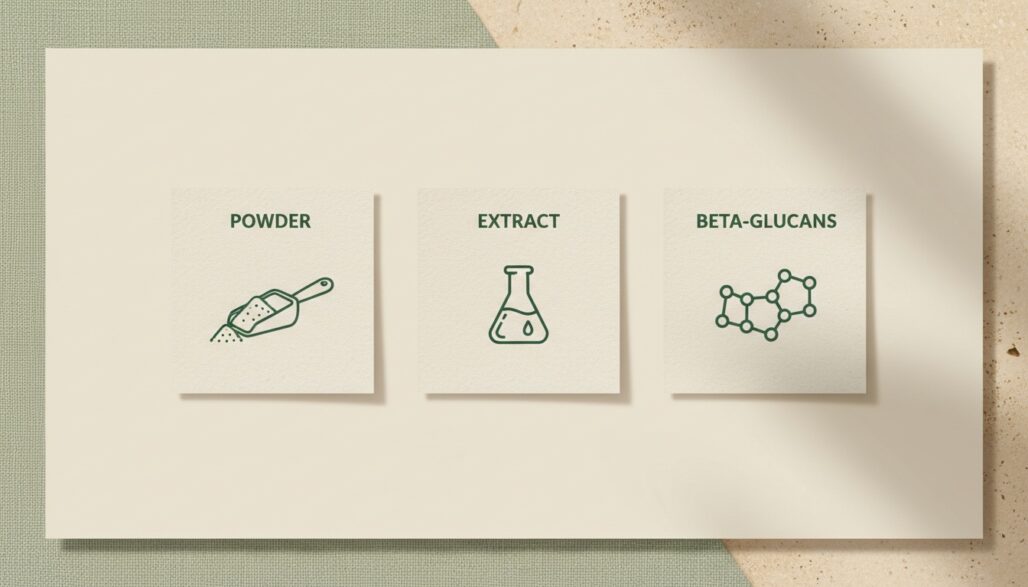
First, find the name of the material beside the number. “Mushroom” may describe a powder, an extract ingredient or one component of a larger drink mix. The serving weight of the finished coffee or sparkling drink is another number again.
| Label field | What it describes | Can it determine beta-glucans per serving? |
|---|---|---|
| Mushroom powder or blend weight | Mass of the named material | No, not by itself |
| Extract ratio, such as 10:1 | A stated relationship between starting material and extract | No |
| Total polysaccharides | A broad carbohydrate measurement or specification | No, unless beta-glucans are separately specified |
| Beta-glucans as a percentage | A fraction of the material identified by the claim | Yes, if its mass per serving and measurement basis are known |
| Beta-glucans in mg per serving | A direct amount declaration | Yes, as a label claim |
Beta-glucans are a class of glucose polymers. The word “polysaccharides” is broader. A product containing starch can have carbohydrate material that is not the beta-glucan fraction the consumer is trying to compare.
This is why the McCleary and Draga analytical paper on mushroom and mycelial products measured total glucan and alpha-glucan separately, then determined beta-glucan by subtraction. The full paper describes the laboratory method. Its assay results are not a clinical trial of health benefits.
The calculation works only on a shared basis
Consider a hypothetical serving with 500 mg of one extract standardized to 20% beta-glucans. If the percentage applies to that same extract, the calculation is:
500 mg × 20 ÷ 100 = 100 mg beta-glucans per serving.
Now change the label. Suppose a 6 g drink mix contains that 500 mg extract plus coffee, flavorings and other ingredients. Multiplying the whole 6 g serving by 20% would give 1,200 mg, twelve times the supported result. That error comes from using the drink mix weight instead of the extract weight.
A second mismatch occurs when a supplier report uses dry weight but the package amount describes a material on a different moisture basis. Do not assume those are interchangeable. Ask the manufacturer or laboratory to explain the conversion before calculating.
If the specification says at least 20%, the supported answer is at least 100 mg, not exactly 100 mg. If the percentage is a typical value, the result inherits that uncertainty. More decimal places do not improve the underlying measurement.
What fruiting body and mycelium tell you
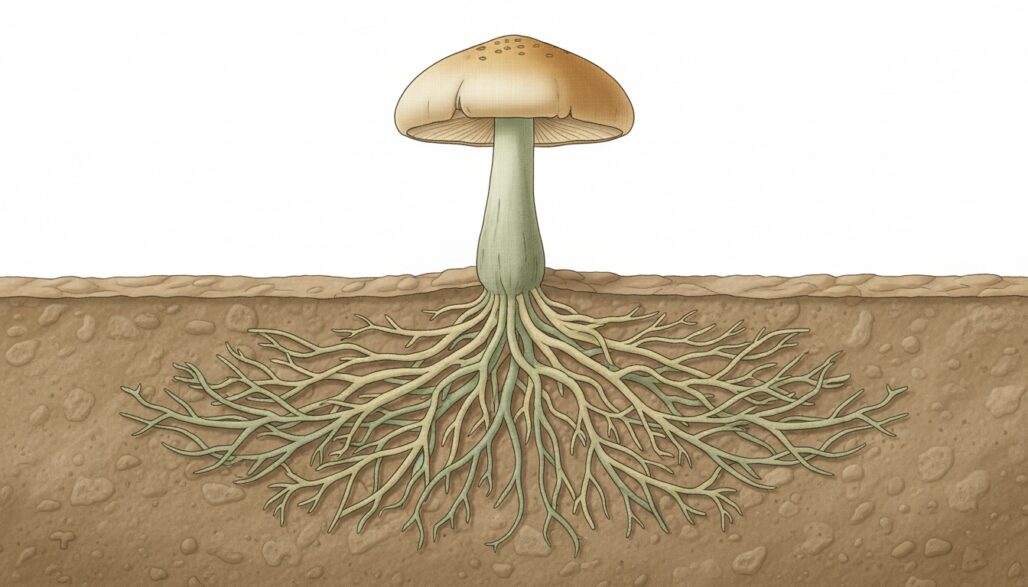
The fruiting body is the mushroom structure people usually recognize. Mycelium is its network of fungal filaments. Those descriptions identify source material; they do not supply a beta-glucan percentage.
The analytical paper above includes mushroom and mycelial products. It is useful evidence that preparation and substrate matter to composition. It is not a representative survey proving that most mushroom drinks sold today are low-quality grain products.
A mycelium-on-grain ingredient can include growth substrate, so ask how the finished ingredient is characterized and tested. A fruiting-body label still needs a relevant assay if you want a quantified beta-glucan claim. You would still need human evidence to assess a health claim.
Some brands disclose the substrate plainly. For example, the MUD/WTR Original ingredient panel reviewed September 25, 2026 describes mushrooms and mycelium cultured on organic oats and/or sorghum. That is a reason to read the complete panel, not to accuse every brand of concealing grain.
Our mushroom supplements guide gives broader product context. For calculation, the narrower question remains: which exact material does the percentage describe?
Why an extract ratio is not a potency multiplier
A 10:1 statement does not mean 10 times the beta-glucans of any other product. It does not tell you which constituents were recovered, their concentration in the final ingredient or whether the ratio describes a native extract or an ingredient containing carriers.
Do not turn 500 mg of a 10:1 extract into 5,000 mg of “active ingredients.” At most, the manufacturer's ratio describes its stated input-to-output relationship. It still needs an explanation of how that relationship was defined.
For a buyer, a direct measured constituent claim is easier to interpret than a large raw-material-equivalent number. It is also easier to check against a report. That does not make the constituent a proven treatment; it simply improves the clarity of the composition claim.
Read a certificate of analysis without guessing
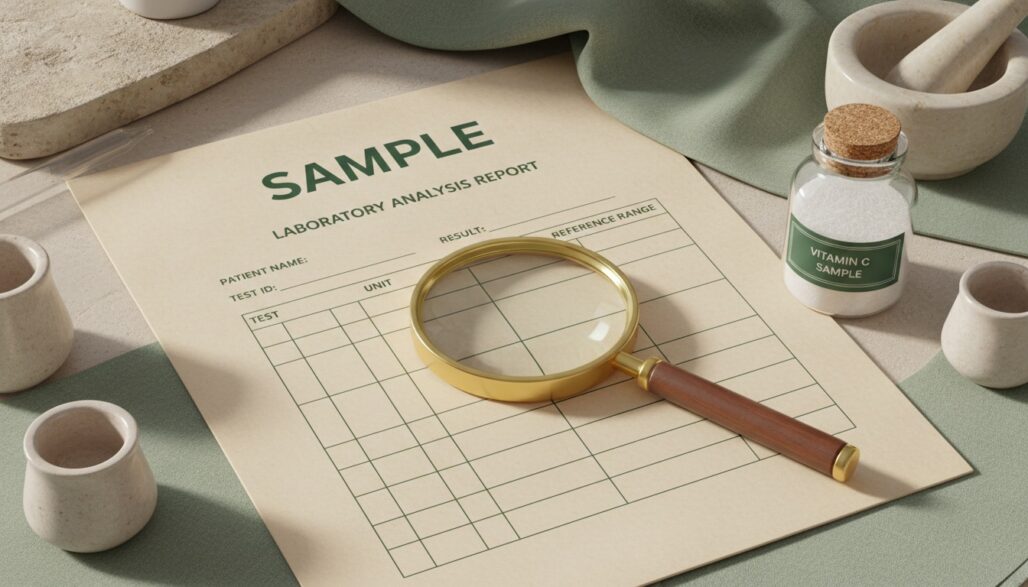
A certificate of analysis, often called a COA, is useful when you can identify the sample and understand what was measured. A page of numbers for a different lot or a supplier's raw ingredient cannot automatically verify your finished drink.
Ask for the product and lot identifier, sample description, test date, laboratory, method, units and whether the result is on a dry or as-received basis. If the document gives only a pass/fail result, find out the specification it passed. If it reports a minimum rather than a measured value, keep that distinction in your notes.
The assay developer's mushroom and yeast beta-glucan method page explains that its method accounts for alpha-glucan and other components. In a mixed food or drink, the laboratory still needs to select and interpret a method suitable for that sample. Do not assume any test called “beta-glucan” identifies the source of every measured molecule.
A report measuring beta-glucans is not necessarily a report on heavy metals, microbes or other contaminants. Look for those tests separately if a brand says its product has been “third-party tested.” The phrase does not tell you the scope of testing.
A higher percentage is not a clinical score
A 30% extract does not automatically work better than a 20% extract. Serving mass may differ, as may species, extraction and the rest of the formula. Even an accurate milligram comparison would describe composition rather than a validated health outcome.
The NIH's Office of Dietary Supplements explains what quality testing can and cannot establish. A quality seal does not guarantee that a supplement is safe or effective. Similarly, the FDA's supplement guidance distinguishes marketed products from preapproved medicines.
Human research must match the claim being made. The 2023 lion's mane pilot trial, for example, tested a particular capsule preparation. It did not validate a universal beta-glucan target for mushroom beverages. The PubMed record identifies the paper so you can inspect that distinction yourself.
What to ask when the label is incomplete
You can send the manufacturer this question:
For one labeled serving, what is the beta-glucan amount in milligrams? If you report a percentage, which ingredient does it apply to, how much of that ingredient is in the serving, and what test and measurement basis support it?
Ask for the answer for your exact flavor and formula. If the company provides only a blend weight or extract ratio, record the beta-glucan amount as unknown. Write down “unknown” rather than assigning zero or a guessed average.
The NCCIH consumer guidance also cautions that “standardized” or “certified” wording does not necessarily guarantee consistency. Transparent numbers are useful, but they remain one part of evaluating a product.
FAQ
Can I convert total polysaccharides into beta-glucans?
No reliable conversion is provided by that label statement alone. Beta-glucans need their own relevant measurement or declaration.
Does a 10:1 extract have ten times the beta-glucans?
The ratio does not establish that. You need the beta-glucan amount or a percentage tied to the specific extract mass.
Is missing beta-glucan information the same as zero beta-glucans?
No. It means the amount cannot be calculated from the information provided. Treat it as unknown.
Does a higher beta-glucan number prove a better health effect?
No. Composition arithmetic cannot establish clinical benefit, safety or an appropriate dose for an individual.
Numerical examples are hypothetical. Images are AI-generated editorial illustrations, not real laboratory reports or product certificates.
