
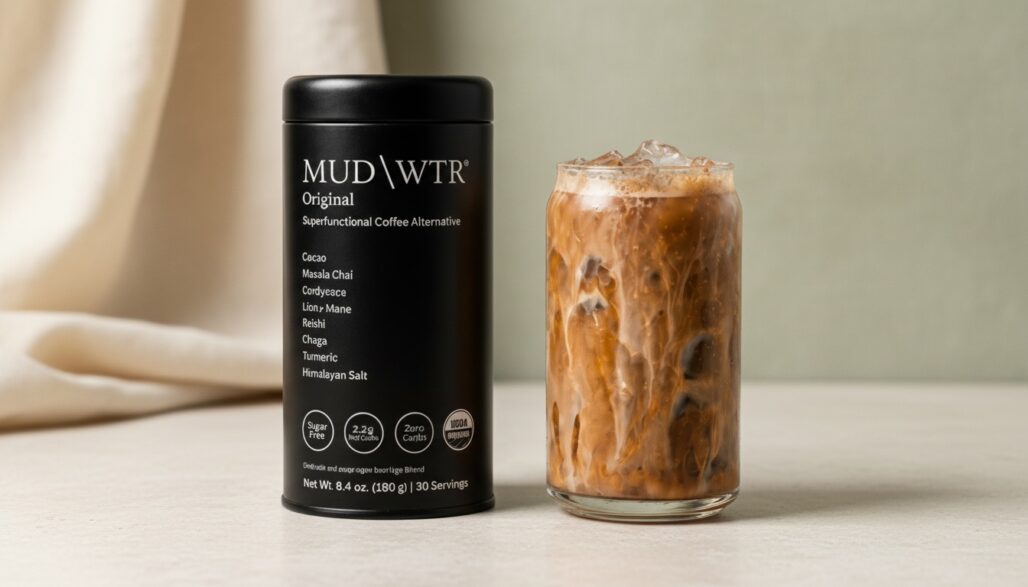
Would you drink a cacao and chai blend every morning at the regular refill price? That is where the MUD/WTR decision starts. Original may suit someone cutting caffeine, but its mushroom content gives us much less reason to expect better concentration.
Our verdict: consider it for the drink; the claimed health upgrade has not been established here. This is a label and evidence review of MUD/WTR Original, not its Matcha, Rest or seasonal formulas. We checked the manufacturer's US page on September 25, 2026. We have not taste-tested the powder or independently tested its contents.
What the regular refill actually costs
The MUD/WTR Original product page displayed a $34 introductory subscription kit, a $40 refill every four weeks and a $60 one-time starter purchase. Each price below uses 30 servings. Shipping, tax and anything you add to the drink can change your total.
| Purchase shown | Price | Cost per labeled serving | What to notice |
|---|---|---|---|
| Introductory subscription kit | $34 | $1.13 | First-order price, not the refill price |
| Automatic refill | $40 | $1.33 | Every four weeks on the checked offer |
| One-time starter purchase | $60 | $2.00 | Avoids recurring shipment on that option |
These are calculations from the displayed offer, rounded to cents. They are not a promise that the offer will remain available. A free frother or seasonal gift belongs to the first-order calculation; it should not make the recurring powder look cheaper.
Check the shipment interval as well as the price. Four weeks means 28 days, while one serving a day would make a 30-serving bag last 30 days. That small mismatch can accumulate if you leave the default schedule unchanged. If you drink it only on weekdays, it lasts longer still.
Before ordering, check the final order summary for the selected quantity, next shipment date and refill charge. Save that summary. The easiest price to compare with your current drink is the cost of the order you will keep paying for after the welcome offer ends.
Try setting the mushroom claims aside for a moment. Would you still want a cacao and chai drink at roughly $1.33 per cup? If yes, the purchase has a beverage reason. If no, the research would have to do much more work to justify it.
Read the Original formula closely
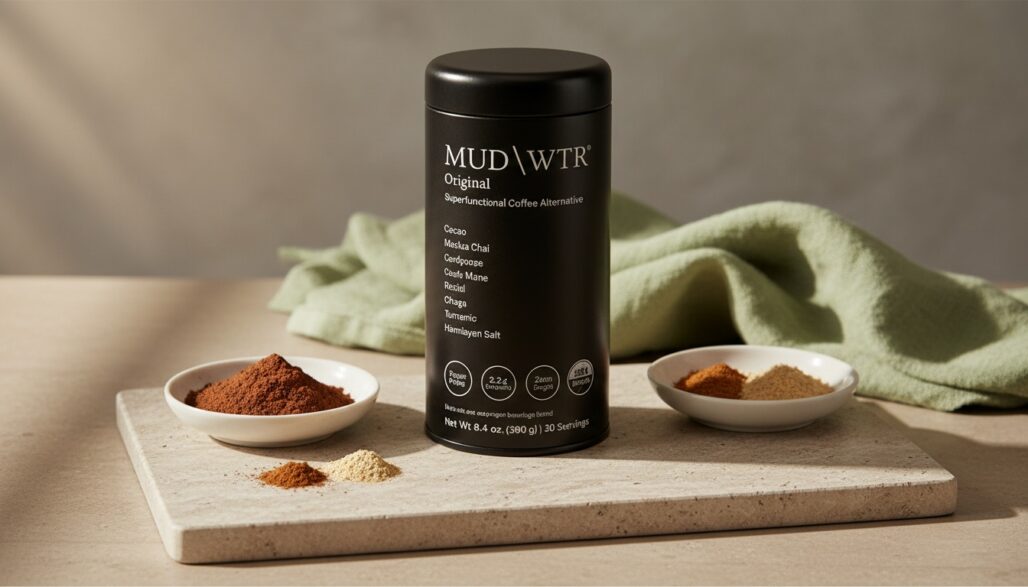
The checked nutrition panel lists a 6 g serving, 35 mg caffeine and 2,240 mg of mushrooms. The ingredients include cacao, chai spices, black tea powder and a blend of chaga, reishi, lion's mane and cordyceps. It describes mushrooms and mycelium cultured on organic oats and/or sorghum.
The disclosure rules out describing it as simply a pure fruiting-body extract. It also does not mean that all 2,240 mg is beta-glucan. The page describes both mycelial biomass and fruiting bodies. We did not identify a beta-glucan percentage tied to the consumed serving in the panel we reviewed.
| Label statement | What it supports | What it does not establish |
|---|---|---|
| 35 mg caffeine per serving | A stated caffeine amount for Original | That every MUD/WTR formula has this amount |
| 2,240 mg mushrooms | A declared mushroom amount | 2,240 mg of beta-glucans or clinically effective compounds |
| Named species and growth substrate | Better ingredient identification | Clinical equivalence to an extract studied elsewhere |
| Cacao and chai ingredients | A reason to consider the flavor format | Our personal tasting verdict |
We would not fill the missing beta-glucan field with an estimate from another product, a generic mushroom average or the number of species. We would leave that field unfilled.
For a broader explanation of preparations and species, see our medicinal mushroom guide. A brand verdict still needs to stay attached to the exact formula in the bag.
Is 35 mg of caffeine the right tradeoff?
Original is not caffeine-free. Whether it reduces your intake depends on the drink it replaces and how many servings you use. Two labeled servings supply 70 mg by arithmetic; replacing one low-caffeine drink with two servings would not automatically reduce anything.
The FDA's caffeine guidance emphasizes differences in sensitivity and caffeine across beverages. Its general adult guidance is not a personal target, particularly for someone with a medical reason to limit caffeine.
Count the whole day, including coffee, tea, energy products and other sources. Also check the serving you actually prepare. A heaped spoon or an extra scoop makes a label-based comparison less reliable.
A lower-caffeine drink may fit your routine without being a treatment for fatigue, anxiety or poor sleep. If those are persistent problems, buying a more expensive powder is not a substitute for finding out what is causing them.
What the mushroom research can tell you
One frequently relevant paper is a 2023 randomized pilot trial of lion's mane in healthy young adults. It studied capsules over 28 days, not MUD/WTR. The investigators reported a task-specific acute finding, a trend in stress scores and other null or unfavorable findings. The small study does not establish a reliable improvement in everyday focus from this drink.
You can open the published paper through its DOI or its PubMed record, PMID 38004235. The preparation, amount and study design are more useful than a headline saying lion's mane was “clinically studied.”
Before applying the finding to Original, we would need to know whether its preparation and intake were comparable. A result on one cognitive test would still fall short of a promise of clearer thinking all day. We did not identify a controlled trial of this exact Original beverage formula in the evidence reviewed for this article.
The NIH's guidance on supplement evidence makes the same general distinction: products sold to consumers can differ from those used in research. That is a reason to narrow the claim, not to declare that every mushroom ingredient is useless.
Who is likely to find it worth the price?
MUD/WTR makes the most sense for someone who likes the idea of cacao and chai, wants a stated caffeine amount and can afford the refill without needing a medical benefit in return. An enjoyable preparation ritual can be a legitimate reason to buy a drink.
It makes less sense if you expect it to taste exactly like brewed coffee, need a caffeine-free evening drink or want a quantified beta-glucan supplement. We have not tasted it, so the first of those is about the ingredient format rather than our sensory judgment. The caffeine label and missing assay information answer the other two questions.
For an evening social drink, our guide to mushroom drinks instead of alcohol addresses a different job. There is little reason to force a morning cacao powder into that comparison just because both products contain mushrooms.
Safety and the final buying decision
Bring the full ingredient list to a pharmacist if you take regular medicines or have been told to avoid particular supplements. Check allergens and the current package rather than relying on a review of an older formula. A concentrated botanical blend merits more attention than the word “natural” suggests.
Do not read a supplement-style disclaimer as proof of effectiveness. The FDA explains that dietary supplements are not approved for safety and effectiveness before marketing. That regulatory explanation concerns supplements; it is not a declaration that every mushroom coffee is legally classified as one.
For a reorder, we would check the refill bill and caffeine amount, then ask whether we wanted another cup. We would not buy Original expecting it to treat a condition or deliver the results of a capsule trial. Keep the first order small enough to judge the drink on its own merits.
FAQ
Is MUD/WTR Original caffeine-free?
No. The manufacturer listed 35 mg per labeled serving on the Original page checked September 25, 2026. Other formulas need their own label check.
How much does MUD/WTR cost after the first order?
The checked offer showed a $40 automatic refill every four weeks for 30 servings, about $1.33 per serving before any additional costs. Confirm your selected offer at checkout.
Does the mushroom amount tell me the beta-glucan dose?
No. Mushroom blend mass is not a beta-glucan measurement. A relevant percentage or direct milligram declaration would be needed.
Has this review proved that MUD/WTR improves focus?
No. The ingredient research discussed here did not test this exact drink formula. Our verdict is about beverage fit, label transparency and price.
Images are AI-generated editorial illustrations based on product references, not photographs of products we tested. Product facts and prices were checked September 25, 2026.
