Why the number alone can be misleading
Two herbal supplements can both say 1,000 mg and still describe materially different preparations.
Two turmeric labels illustrate this. Each declared 1,000 mg per two-capsule serving. One described a turmeric extract standardized to 95% curcuminoids. The other described a curcumin extract–phospholipid complex standardized to a minimum of 18% total curcuminoids, or 180 mg. Both servings weighed 1,000 mg, but those milligrams represented very different preparations.
A milligram is simply a measure of mass. Before comparing two products, you need to know what material each milligram figure actually measures. Serving size matters, as do the plant part, the type of preparation, and any percentage that describes constituents within it. Two identical-looking numbers can therefore carry quite different meanings.
Finding a milligram figure on a label is usually the easy part. The harder part is establishing exactly what it measures.
That is why it is best to start with the Supplement Facts panel. FDA regulations require the Supplement Facts panel to identify the serving size and provide quantitative information for dietary ingredients, subject to specific rules for proprietary blends. This may not match the quantity stated on the front of the bottle or in the product name.
Milligrams per capsule and milligrams per serving are different math
One ashwagandha product had 450 mg in its product name. Its Supplement Facts panel listed a serving size of two capsules and 900 mg of ashwagandha per serving. This was not a conflict: each capsule contained 450 mg.
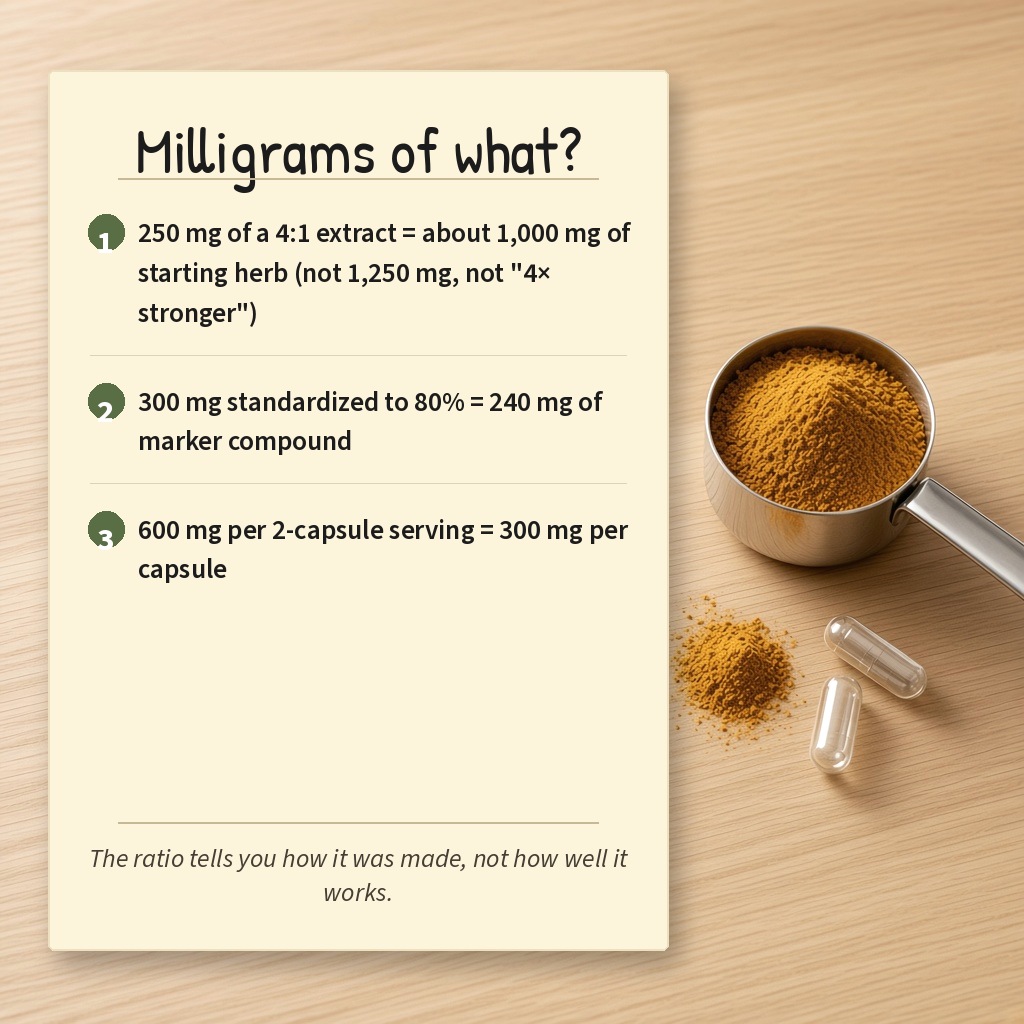
The same arithmetic applies to a simpler example. If a product states 600 mg per serving and the serving is two capsules, then each capsule contains 300 mg. This does not mean that you should take 300 mg. The directions may call for more than one serving, or for servings at different times of day. The calculation only tells you how much is in each capsule.
This small calculation prevents a common comparison error. Product A may advertise 600 mg per serving of two capsules, while Product B lists 500 mg per one capsule. Comparing 600 with 500 makes Product A look larger. Comparing per capsule gives 300 with 500. Comparing what a person would actually take in a day may produce yet another pair of numbers.
None of those calculations tell you which botanical preparation is more effective, safer, or higher quality. They only make the units comparable. With botanicals, that is the beginning of the job.
Plant powder, extract, and herb equivalent are three different measurements
What a milligram value refers to depends on whether a capsule contains powdered plant material or a dry extract, and on whether the label also states an herb equivalent.
The first type is ground or powdered herb: plant material that has simply been ground down.
The second is an extract. Extracts are made by using solvents such as water or alcohol to draw out soluble constituents, which can then be concentrated or dried. Under FDA labeling guidance, a dried extract is declared by the weight of the dried extract. NIH also explains that extracts differ from other plant-based preparations.
The third is an herb equivalent: manufacturers may state how much of the original herb the extract represents.
One milk thistle product, for example, stated 250 mg of a 4:1 extract, equivalent to 1,000 mg of milk thistle seed. The capsule therefore does not contain 1,250 mg of milk thistle; it contains 250 mg of finished extract. The 1,000 mg figure is the amount of original seed the manufacturer states the extract is equivalent to.
Plant-to-extract ratios can be confusing. A 4:1 ratio does not mean four times the potency or effect of the unextracted herb. As Monagas and colleagues explain in Frontiers in Pharmacology, a plant-to-extract ratio does not fully define an extract. The plant material, the solvent used, the processing conditions, and any added excipients can all affect the final product. Interpreting the ratio also depends on whether it refers to the native extract or to a finished extract that includes excipients.
Another milk thistle label shows a different pattern. It listed 250 mg of seed extract and 250 mg of ground seed. The two preparations contribute 500 mg in total, but describing them simply as “500 mg of milk thistle” would conceal an important difference. Half of that declared weight is extract, and half is ground seed. Neither portion can be understood fully from its weight alone.
What standardization percentages actually tell us
Standardization adds a different kind of number.
One milk thistle product stated 300 mg of extract standardized to contain 240 mg (80%) silymarin flavonoids. This simply means that 80% of the 300 mg of extract is silymarin flavonoids.
This calculation is only safe when it is clear that the percentage applies to the weight you are working with. Suppose a 2,000 mg blend contains an extract standardized to 20%, but the label does not state how much of the blend is that extract. Multiplying 2,000 mg by 20% would create a constituent amount that the label does not support.
The term “standardized” should be used carefully. According to NIH, standardization means that manufacturers identify and measure specific chemicals, often called markers, to help keep their amounts consistent from batch to batch. This does not mean that the marker is necessarily the active compound in the botanical. NIH also notes that for many botanicals, the constituents responsible for their effects are unknown.
A product standardized to 80% gives you information about its composition. It does not mean that it is 80% effective. A higher standardization percentage does not make a product better, safer, or more clinically useful. Clinical conclusions require evidence relevant to the specific preparation, dose, population, and outcome being discussed.
A simple method for comparing two botanical labels
A useful comparison is less about finding the largest number than about putting each number in the right column. I use six checks:
- Start with the serving size, and convert to a common basis only when the arithmetic is justified.
- Confirm the botanical identity, including the Latin species name when the label provides it.
- Record the plant part exactly as stated.
- Identify the preparation type: whole or ground plant material, extract, concentrate, or a named complex.
- Record any extract ratio or starting-herb equivalent separately from the finished preparation weight.
- Record standardized constituents separately, including the percentage or amount and the material that specification refers to.
Return to the two turmeric labels from the opening. Both used two-capsule servings and both declared 1,000 mg. That makes the serving-size arithmetic easy, but the similarity ends there.
Label A described 1,000 mg of turmeric extract standardized to 95% curcuminoids. Label B described a 1,000 mg curcumin phytosome complex that included phospholipids and specified a minimum of 18% total curcuminoids, or 180 mg per serving. Both identified Curcuma longa, but the plant-part wording also differed: one said root, the other rhizome.
What can you compare? You can say that both labels declare 1,000 mg per two-capsule serving. You can compare the standardized constituent information, because each label states what the percentage applies to. You can also see that the second 1,000 mg figure covers a carrier-containing complex rather than the same kind of extract described by the first label.
What remains unknown from those numbers alone is at least as important. The labels do not establish that equal milligram weights are chemically equivalent, that one preparation will be absorbed the same way as the other, or that either will produce a better clinical result. Those questions require evidence beyond label arithmetic.
Once the labels are rewritten in this form, the biggest milligram figure loses its shortcut status. It becomes one data point among several: serving, species, plant part, preparation, extract relationship, and constituent specification.
The milligrams still matter. They become useful when you can finish the sentence: milligrams of what?
Sources
- U.S. Food and Drug Administration. Dietary Supplement Labeling Guide, Chapter IV: Nutrition Labeling.
- NIH Office of Dietary Supplements. Botanical Dietary Supplements: Background Information.
- Monagas M, Brendler T, Brinckmann J, Dentali S, Gafner S, Giancaspro G, et al. Understanding plant to extract ratios in botanical extracts. Frontiers in Pharmacology. 2022;13:981978. doi:10.3389/fphar.2022.981978.
- Swanson Vitamins. Full Spectrum Ashwagandha, 450 mg. Product page and Supplement Facts.
- Nutricost. Milk Thistle Capsules, 250 mg. Product page and Supplement Facts.
- Swanson Vitamins. Milk Thistle – Features 80% Silymarin. Product page and Supplement Facts.
- NOW Foods. Milk Thistle Extract, Double Strength 300 mg Veg Capsules. Product page and Supplement Facts.
- Doctor’s Best. High Absorption Curcumin, 1,000 mg per serving. Product page and Supplement Facts.
- Doctor’s Best. Curcumin Phytosome with Meriva, 1,000 mg per serving. Product page and Supplement Facts.
Manufacturer label details were checked against the product pages on November 3, 2026. Product formulations can change.