
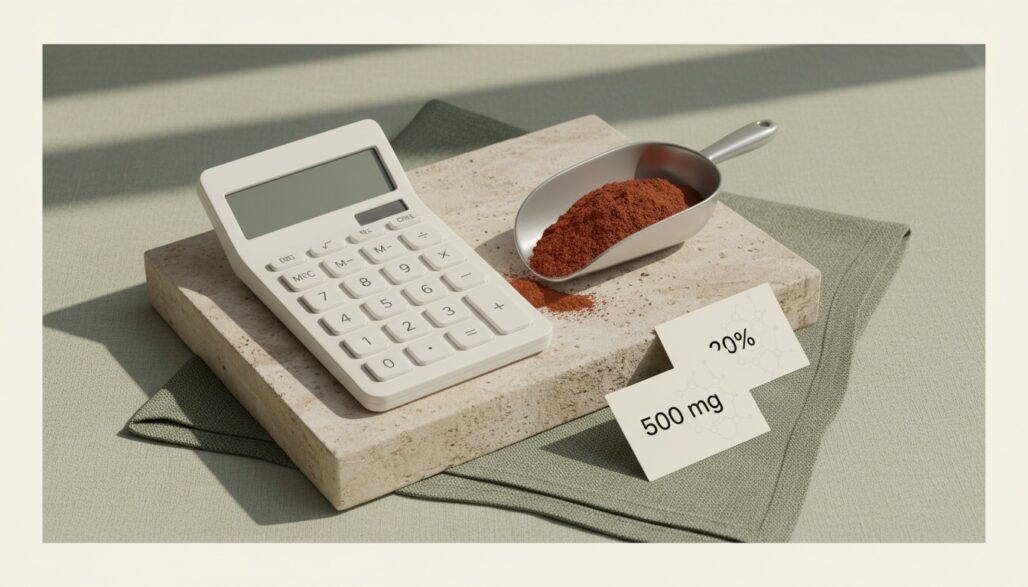
Find the ingredient named beside the beta-glucan percentage, then enter its amount per serving. For a coffee mix, that may be one extract inside the scoop rather than the weight of the whole scoop.
If your label gives beta-glucans directly in milligrams per serving, choose that option instead. If it lists only total polysaccharides, an extract ratio or a mushroom blend weight, the correct result is insufficient information.
What does your label disclose?
Estimate label-declared beta-glucans per serving. This cannot measure the contents of your drink or tell you whether it will work.
Example: 500 mg of one extract x 30% beta-glucans = 150 mg per serving. If the label says at least 30%, the result is at least 150 mg.
A percentage without its ingredient mass is insufficient. A proprietary blend cannot be split equally by the number of mushrooms. This tool provides no dose recommendation.
Which label information works
The tool accepts two kinds of information. The first is a beta-glucan percentage paired with the mass of that same ingredient per serving. The second is a direct beta-glucan milligram declaration. The result relies on those declarations; we have not measured the product.
| What your label shows | Choose in the tool | What the result means |
|---|---|---|
| 500 mg extract, 20% beta-glucans for that extract | Percentage and ingredient mass | 100 mg based on the declaration |
| At least 20% beta-glucans in 500 mg extract | Percentage, then minimum | At least 100 mg based on the declaration |
| 120 mg beta-glucans per serving | Direct milligrams | Restates 120 mg per serving |
| 30% total polysaccharides | Only total polysaccharides | Cannot calculate beta-glucans |
| 10:1 extract or 2 g proprietary blend | Only ratio or blend weight | Cannot calculate beta-glucans |
The percentage option requires confirmation that both numbers use the same basis. Use it only when you can match the two figures. If you cannot confirm the basis, leave it unchecked and ask the manufacturer for clarification.
The form works in your browser. It asks for product-label quantities, not your health conditions or medication list. It does not recommend brands or use your result to choose a dose.
Worked examples
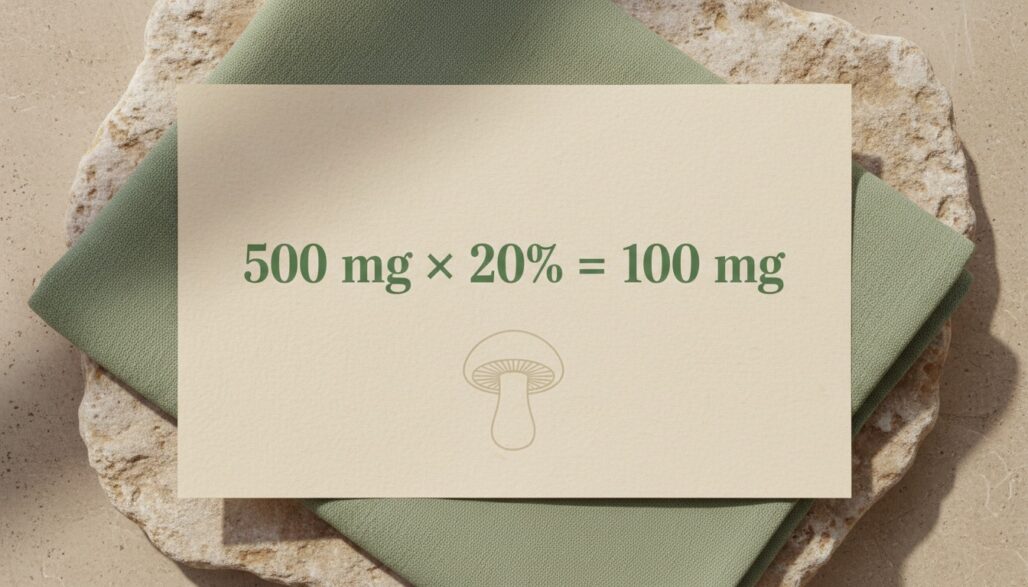
Example 1: an extract with a declared percentage. A hypothetical label lists 500 mg of extract per serving and 20% beta-glucans in that extract. Multiply 500 by 0.20. The result is 100 mg per serving.
Example 2: grams instead of milligrams. A label lists 1.5 g of the relevant material and 25% beta-glucans. Convert 1.5 g to 1,500 mg first, then multiply by 0.25. The result is 375 mg per serving. The form performs the unit conversion when you choose grams.
Example 3: a minimum specification. The same 1.5 g material is described as containing at least 25% beta-glucans. The supported output is at least 375 mg. Reporting exactly 375 mg would remove an important part of the claim.
Example 4: the wrong weight. A 6 g coffee mix contains 500 mg of a 20% extract. The extract calculation gives 100 mg. Multiplying all 6,000 mg of coffee mix by 20% would give 1,200 mg, but the percentage never described the whole mix. That result is invalid.
Example 5: a blend you cannot split. A 2,000 mg blend names four mushrooms but gives no individual amounts or beta-glucan specification. Dividing by four does not reveal the dose of each mushroom, and it does not reveal beta-glucans. The calculator refuses that inference.
All five examples are invented to illustrate arithmetic. None describes a tested commercial product or a recommended daily intake.
What the result cannot establish
The arithmetic cannot catch an inaccurate label, an old formula or a misunderstood serving size. This tool cannot detect those problems. Keep a copy of the package or report you used, particularly when comparing reformulated products.
The result does not establish absorption, clinical effectiveness, product safety or the presence of other mushroom constituents. It cannot tell you whether the ingredient matches a preparation used in a human trial. A number such as 100 mg is a composition estimate, not an instruction to consume that amount.
The NIH's consumer fact sheet on supplements explains that quality seals do not guarantee safety or effectiveness. A laboratory composition result still does not answer the clinical question.
Likewise, the NCCIH notes that marketed products may differ from research preparations. Matching one reported constituent does not establish that two products are clinically interchangeable.
For the surrounding mushroom evidence, see our medicinal mushrooms guide. For beverage choices, our mushroom drinks instead of alcohol guide focuses on ingredients and the role of the drink, without treating this number as a score.
Why polysaccharides and extract ratios are rejected
“Polysaccharides” describes a broader group than beta-glucans. It cannot be substituted into the percentage field just because the label presents it as a potency claim.
The published mushroom beta-glucan assay method separates total glucan and alpha-glucan measurements to determine beta-glucan by difference. The method developer's current description gives the analytical context. Neither source supplies a universal multiplier from total polysaccharides to beta-glucans.
An extract ratio is also not a percentage. A 10:1 claim describes a stated relationship between starting material and extract. It does not say that 10%, 20% or any other fraction of the extract is beta-glucan. Entering the number 10 as a percentage would invent information.
The same restriction applies to a blend weight. The number of named species does not tell you their proportions. The form therefore stops rather than supplying a guessed number.
Check a lab report before entering its numbers
Confirm that the report describes the exact ingredient or finished product in your serving. Look for the sample name, batch, units, method and whether the result is on a dry-weight or as-received basis. A supplier's extract report may be relevant, but only if you know how much of that extract the final serving contains.
If the formula contains more than one source of beta-glucans, a laboratory may need to explain what its assay measures in that mixture. The calculator cannot attribute the measured amount to a particular species or distinguish fungal material from other sources by arithmetic alone.
The FDA's explanation of supplement regulation is another reason not to read a label claim as a premarket endorsement of effectiveness. Product category and the evidence behind a claim still matter.
How to compare a number with missing information
You might compare two products and get 150 mg for one while the other cannot be calculated. That does not prove the second contains less. It means one label supports a numerical comparison and the other does not.
A practical note can be as simple as: “Product A declares at least 150 mg per serving. Product B discloses a blend weight but no usable beta-glucan value.” This leaves the missing information visible without implying that Product B failed a laboratory test.
If you take medication or are considering a concentrated mushroom supplement for a health problem, discuss the actual product with a qualified health professional. The calculator is not designed to clear interactions or make treatment decisions.
FAQ
Can I use the whole drink's weight in the percentage calculation?
Only if the beta-glucan percentage explicitly applies to the whole drink on the same measurement basis. Usually you need the mass of the particular ingredient the percentage describes.
Why does the calculator refuse my 10:1 extract label?
An extract ratio does not disclose a beta-glucan percentage or amount. There is no supported conversion from that ratio alone.
Does the output tell me how much to take each day?
No. It reports a label-based amount per serving. It provides no recommended intake, treatment dose or safety threshold.
Can I compare minimum and exact declarations directly?
Keep the wording visible. “At least 150 mg” is a lower-bound claim, while “150 mg” is a declared amount. Neither is a new laboratory measurement by this tool.
Images illustrate hypothetical labels and calculations. They are not certificates of analysis or endorsements of a particular intake.
