
Would you still buy the drink if the mushroom health claims disappeared? That question gets to the main value issue. Taste and convenience may justify the price even when the added benefit remains uncertain.
A cold social drink has a different place in the day from an instant coffee or cacao powder. Comparing them by the number of mushroom species misses the reason someone would choose one in the first place.
Our category verdict: buy the beverage only if it earns its price without an unproven health promise. This is an editorial assessment of labels and evidence, not a tasting competition or a list of the “best” products. We have not independently tested the drinks.
Pay for the job the drink actually does
| Your reason for considering a drink | What would make it worthwhile | What would weaken the case |
|---|---|---|
| Replace a coffee habit | A format and caffeine amount you prefer | Paying for mushrooms when ordinary coffee changes would meet the same goal |
| Have something social without alcohol | A drink you enjoy and a clear ingredient list | Expecting an alcohol-like feeling from mushroom claims |
| Obtain a known mushroom constituent amount | A relevant amount declaration and supporting test information | Treating total blend weight as beta-glucan dose |
| Improve a health symptom | Product-specific evidence relevant to that symptom | Using a beverage instead of seeking appropriate assessment |
Judge the drink at its regular price. If you need the promised health effect to make the cost acceptable, check whether evidence for that exact product supports it.
For the evening-drink question, our guide to mushroom drinks instead of alcohol looks at Hiyo, Little Saints Mojito, BRĒZ FLOW and Curious Zero as distinct label-based examples. It does not treat them as interchangeable or pretend their flavors were tested by our team.
Real brands illustrate different decisions
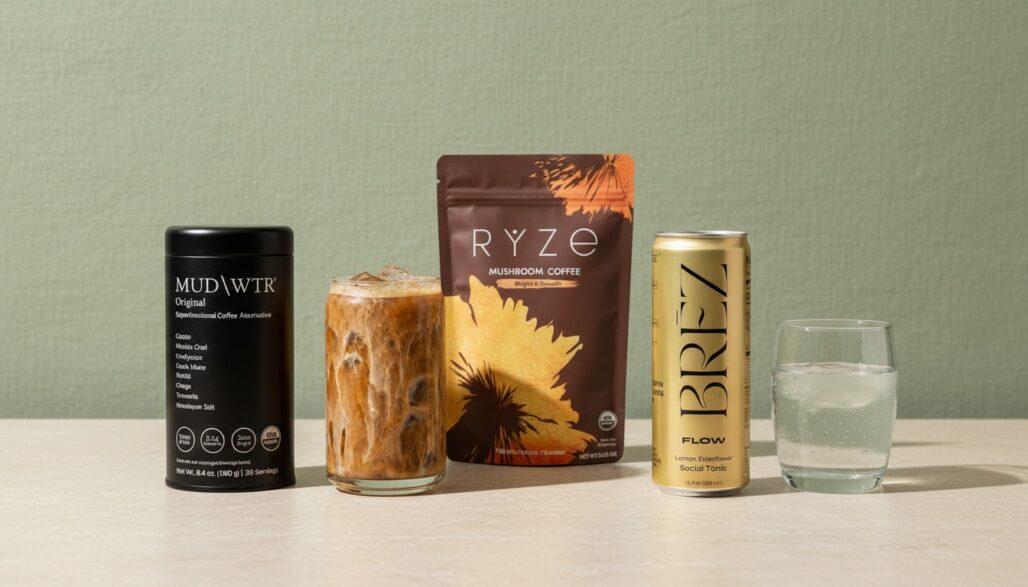
MUD/WTR Original is a cacao and chai coffee alternative. Its checked product page listed 35 mg caffeine and a $40 recurring refill for 30 servings. That is about $1.33 per labeled serving, before any added costs. Its use case is a morning beverage preference, not proof that its mushroom blend improves cognition.
RYZE Medium Roast contains coffee. The checked single-bag offer listed a $36 refill for 30 servings, about $1.20 per serving. The manufacturer's FAQ distinguished the caffeine in Medium Roast from Dark Roast. A verdict on one version should not quietly become a verdict on every product carrying the brand.
BRĒZ FLOW is relevant here only as the specific product described as THC- and CBD-free on the FLOW product page. The broader brand includes different formulas, so FLOW should not be shortened to a brand-wide recommendation. A mushroom beverage containing THC belongs to a different safety discussion.
We would not choose one winner among these different formats. A person replacing morning coffee and a person looking for an evening drink are making different purchases. The right comparison starts with the intended use and exact formula.
What the extra mushroom money buys
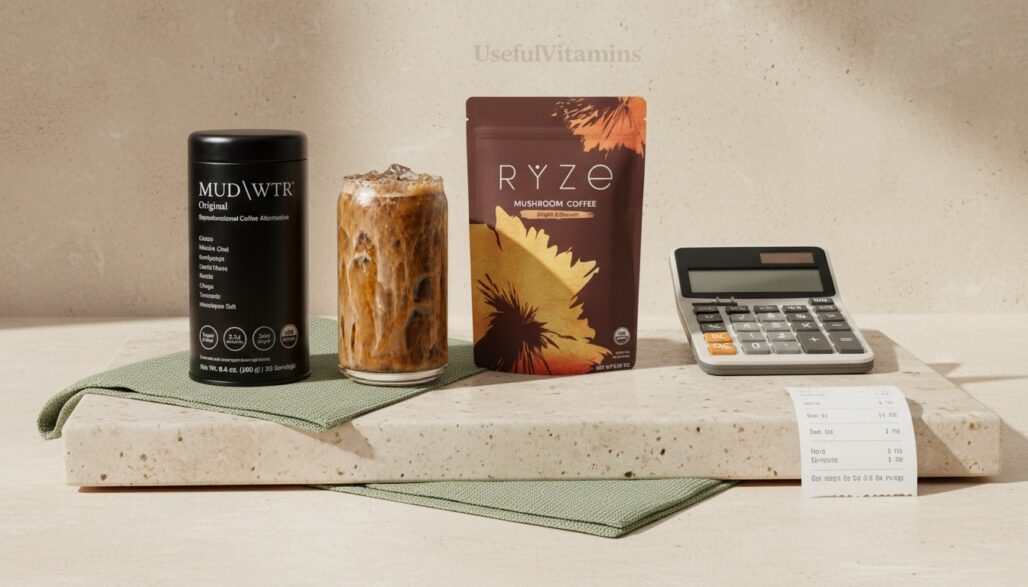
A recurring cost is easier to assess than a bundle full of welcome gifts. Divide the amount you will pay again by the number of labeled servings, then consider how many servings you actually use. Do not use an introductory discount as the permanent price.
For example, $40 divided by 30 gives about $1.33 per serving. If you use two servings in a day, that day's powder cost is about $2.67. This arithmetic says nothing about whether consuming two servings is appropriate; it simply prevents a serving-size assumption from hiding the cost.
Shipping, tax, milk, sweeteners and wasted product may change the comparison. Your alternative also matters. A home coffee, plain sparkling water and a restaurant mocktail have different costs, so choose the comparison that reflects your own routine.
Convenience or an enjoyable preparation ritual can be enough reason to pay more. It should not be described as a clinically effective dose merely because a powder is expensive or names several species.
How much evidence belongs to the finished drink?
One commonly cited example is a 2023 randomized pilot trial of lion's mane. It studied a capsule preparation, found a mixture of outcomes and had a small sample. It did not test a mushroom mocktail, an instant coffee blend or an alcohol-replacement effect.
The published paper and PubMed record let a reader check the study rather than rely on the phrase “backed by science.” The preparation, participants, outcomes and duration need to match the claim a seller makes.
The NCCIH's evidence guidance notes that consumer products can differ substantially from research preparations. A blend of several ingredients adds another attribution problem: even if someone reports a change, that report cannot identify which ingredient caused it.
The evidence reviewed for this cluster leaves the health-benefit case unresolved for these finished drinks. That is a narrower conclusion than saying mushrooms can never have benefits.
A transparent label helps, but it is not a benefit guarantee
A useful label names the species, identifies the material and states amounts clearly enough to understand a serving. A beta-glucan percentage is useful only when it applies to a known amount of the same ingredient on the same measurement basis.
The published analytical method for mushroom beta-glucans illustrates why beta-glucans and total polysaccharides should not be treated as the same measurement. Extract ratios and total mushroom blend weights do not supply a missing percentage.
The NIH Office of Dietary Supplements explains the limits of quality seals: testing does not by itself prove safety or effectiveness. A good assay can improve confidence in composition while leaving the clinical question unanswered.
Ask for relevant testing when a brand charges a premium for quantified constituents. If it provides only general statements, keep that information as unknown. Do not assume zero, but do not award an evidence-based value advantage either.
Our mushroom supplements guide provides wider context for evaluating preparations. The number of species is less useful here than knowing what one serving supplies.
Our verdict by reason for buying
For a preferred coffee routine: potentially worthwhile. Check the exact caffeine amount and recurring price, then judge whether you like the product enough to keep it. The FDA's caffeine guidance is a reminder that sensitivity and total intake matter more than the word “mushroom.”
For a social drink without alcohol: potentially worthwhile if the full formula fits that intention. Check alcohol content, caffeine and any added cannabinoids. A relaxing ritual does not require a claim that mushrooms reproduce intoxication.
For a known beta-glucan amount: only if the label supplies the necessary information. Even then, the number describes composition rather than a clinically validated target for you.
For treatment of fatigue, anxiety, insomnia or another persistent symptom: not justified by the evidence reviewed here. Seek an appropriate assessment rather than relying on the beverage's marketing promise.
Whether you reorder should depend on the job you bought it for.
When to be more cautious
Review the full formula if you use medication, have a known allergy or are considering concentrated ingredients during pregnancy or breastfeeding. A familiar beverage format does not establish that every added botanical has been evaluated for your circumstances.
If you are changing a heavy, long-standing alcohol habit, seek medical guidance before stopping suddenly. The NIAAA warns that alcohol withdrawal can be dangerous. A mushroom drink cannot manage that risk.
You can also decide that plain sparkling water, decaffeinated coffee or another ordinary beverage does the job. There is no need to add a mushroom drink if another beverage already suits you. Buy it when the drink itself appeals to you and the price remains acceptable after the promotional offer ends.
FAQ
Are mushroom drinks a waste of money?
Not necessarily. They can be worthwhile as enjoyable beverages. The weaker case is paying extra specifically for a health effect that has not been established for the finished product.
Does more mushroom blend mean better value?
Not by itself. Blend weight does not reveal individual ingredient amounts, beta-glucans or clinical effectiveness.
Are all drinks from a mushroom brand free of THC?
No assumption should be made at brand level. Check the exact formula and cannabinoid information, especially when a brand sells multiple product types.
What should decide whether I reorder?
Whether you enjoy the drink, its actual recurring cost, the suitability of its ingredients and realistic expectations. A welcome discount or an ingredient study alone is not a strong reason to keep paying.
Product examples and prices were checked September 25, 2026. Images are AI-generated editorial illustrations based on references, not photographs of tested products.
