
If you take mealtime insulin and still struggle with blood sugar spikes after meals, you may have been told there is nothing else left to try. Is that actually true? And if another FDA-approved injectable exists for exactly that situation, why has almost no one heard of it? Pramlintide — sold as Symlin — has been on the market since 2005, carries a boxed warning that demands your attention, and has a clinical story that is more nuanced than most diabetes drug reviews let on. Verdict: pramlintide is a legitimate, FDA-approved adjunct therapy for people already on mealtime insulin, but its modest HbA1c benefit, meaningful hypoglycemia risk, and awkward injection routine have kept it firmly at the edge of mainstream diabetes care.
Summary
Pramlintide (Symlin) is a synthetic analog of the pancreatic hormone amylin, approved by the FDA in 2005 as an adjunct to mealtime insulin for adults with type 1 diabetes and for insulin-using adults with type 2 diabetes. It lowers post-meal glucose by slowing gastric emptying, suppressing glucagon, and reducing appetite — but it must never be mixed in the same syringe as insulin, and its combination with mealtime insulin carries a boxed warning for severe hypoglycemia.
- Best for: Adults with T1D or insulin-using T2D who remain above HbA1c targets despite optimized insulin therapy and want additional post-meal glucose control, ideally under close prescriber supervision.
- Not ideal for: Anyone with hypoglycemia unawareness, confirmed gastroparesis, or unwillingness to reduce mealtime insulin by 50% at initiation — the drug's safety profile depends on that reduction.
- What to look for: SymlinPen 60 (for T1D) and SymlinPen 120 (for T2D) are the current pen-injector formats; a separate syringe from insulin is required every time.
- Decision shortcut: The modest HbA1c reduction — roughly 0.34% placebo-adjusted in pivotal trials — means pramlintide is rarely a first choice when GLP-1 receptor agonists are an option. Discuss the risk-benefit trade-off explicitly with your prescriber before starting.
What Pramlintide Is: A Synthetic Copy of Amylin
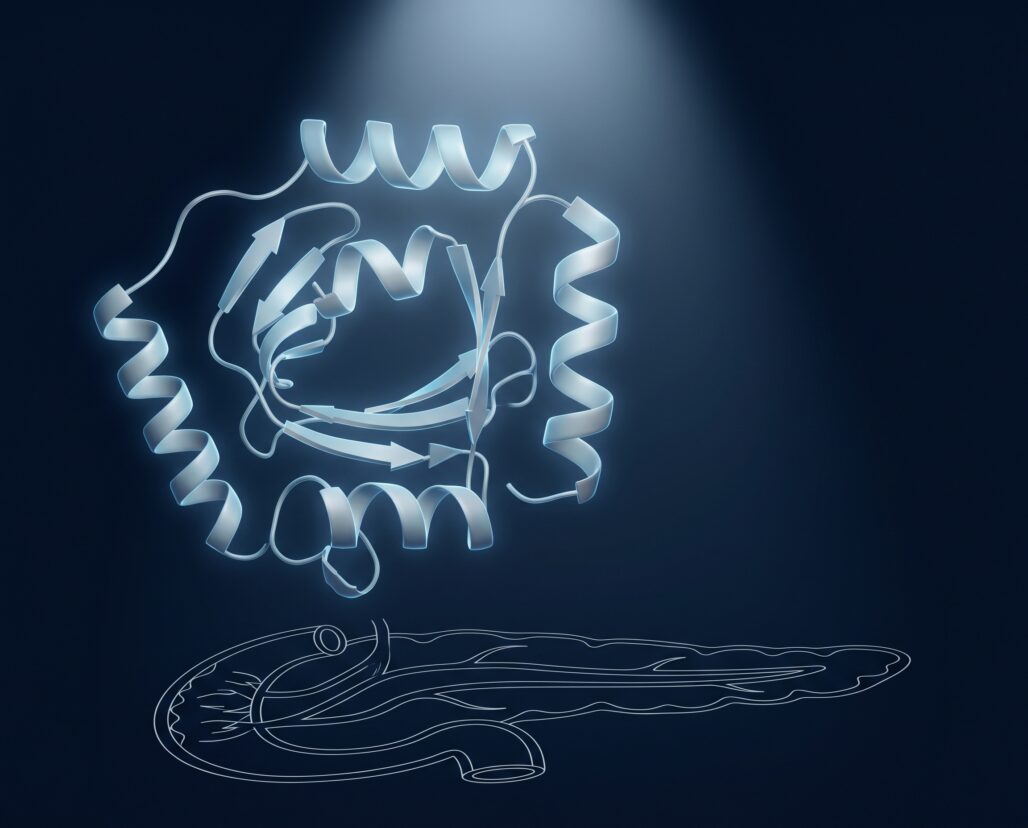
Amylin is a 37-amino-acid peptide hormone secreted by the same pancreatic beta cells that produce insulin. It is co-released with insulin in response to meals, and it acts as a kind of second messenger that smooths the post-meal glucose curve. In type 1 diabetes, where beta cells are destroyed by the immune system, amylin secretion drops to near zero alongside insulin. In type 2 diabetes, amylin secretion is blunted and dysregulated. Either way, the hormonal signal that would ordinarily slow the rush of glucose from the gut goes missing at the exact moments it is needed most.
Pramlintide is a synthetic amylin analog — a 37-amino-acid peptide engineered to be stable enough for clinical use. Native amylin is fibrillogenic: it aggregates into amyloid-like deposits when formulated at high concentrations, which ruled out using the native molecule directly as a drug. Pramlintide replaces three amino acids (positions 25, 28, and 29) with proline residues, which disrupt fibril formation without eliminating receptor activity. The result is a molecule that binds amylin receptors — multi-subunit G protein-coupled receptors found throughout the central nervous system and gastrointestinal tract — with similar affinity to native amylin, but does not clump in the vial.
Amylin Pharmaceuticals — later acquired by AstraZeneca — developed the molecule through the 1990s and accumulated the clinical evidence for FDA submission. For a broader look at where pramlintide fits among approved peptide drugs, see the FDA-approved peptides overview and the insulin explained guide.
How It Works: Three Mechanisms That Flatten the Post-Meal Spike
Pramlintide works through three actions that are distinct from insulin's mechanism, which is why the two drugs function as complements rather than duplicates.
Slowing gastric emptying. After a meal, the stomach empties its contents into the small intestine quickly, producing a glucose rise that fast-acting insulin analogs often cannot match. Pramlintide slows that process by activating amylin receptors in the brainstem and enteric nervous system, giving mealtime insulin time to act as nutrients arrive gradually. The effect peaks roughly 30 minutes after injection — which is why pramlintide must be administered immediately before a meal, not after.
Suppressing glucagon. In diabetes, post-meal glucagon suppression is impaired, and the liver adds glucose to the bloodstream at the worst possible time. Pramlintide restores some of that glucagon suppression, reducing hepatic glucose output and blunting the resulting spike. Clinical pharmacology data from the DailyMed Symlin label confirm that pramlintide reduces 24-hour glucose fluctuations beyond what insulin alone achieves.
Reducing caloric intake centrally. Amylin receptors in the hypothalamus and area postrema influence satiety signals. When pramlintide binds those receptors, it reinforces the feeling of fullness, reducing caloric intake by roughly 21 to 23% compared to placebo in controlled studies. This caloric reduction translates into a small but real weight loss: approximately 0.8 to 1.6 kg in T1D trials and 1.4 to 1.6 kg in T2D trials over 26 to 52 weeks, compared to weight gain in the placebo groups. That weight difference matters because insulin therapy is frequently associated with weight gain, and pramlintide partially offsets it.
FDA Approval: Adjunct Therapy for T1D and Insulin-Using T2D
The FDA approved pramlintide in March 2005 under New Drug Application (NDA) 021332. The approved indication is specific: adjunctive therapy for adults with type 1 diabetes or for adults with type 2 diabetes who use mealtime insulin and have not achieved desired glucose control despite optimal insulin therapy. It is not approved as monotherapy, and it is not approved as a replacement for insulin. The drug replaces the missing amylin signal; insulin must still be used in parallel.
The pivotal trials enrolled adults across 26- to 52-week periods. Pramlintide produced a placebo-adjusted HbA1c reduction of approximately 0.34% in both T1D (0.58% vs. 0.25% placebo) and T2D (0.66% vs. 0.32% placebo). A 2005 review in Clinical Therapeutics (PMID 16330288) characterized these improvements as statistically significant but clinically modest, noting that the drug's strongest contribution is to post-meal glucose rather than overall HbA1c.
Post-meal glucose reductions were more striking: pramlintide cut one-hour post-meal glucose by 4.4 to 7 mmol/L and two-hour post-meal glucose by 3.6 to 4.8 mmol/L in T1D studies. For patients whose HbA1c is largely driven by post-prandial spikes rather than fasting hyperglycemia, that is a clinically meaningful difference.
Boxed Warning: Severe Hypoglycemia When Combined with Mealtime Insulin
This section cannot be buried or softened. The FDA prescribing label for Symlin carries a bolded boxed warning: Symlin use with insulin increases the risk of severe hypoglycemia, particularly in patients with type 1 diabetes, with severe episodes occurring within three hours following a Symlin injection. Injuries from severe hypoglycemia have occurred. The label specifically warns against operating vehicles or heavy machinery without appropriate precautions.
Why is the risk elevated? Pramlintide alone does not lower blood glucose — it has no direct glucose-lowering mechanism. But it works alongside mealtime insulin, and its gastric-emptying delay changes the timing of glucose absorption. If a patient takes their usual mealtime insulin dose alongside pramlintide, the insulin acts before glucose from the slowed meal arrives, pushing blood sugar dangerously low. The solution mandated by the label is a 50% reduction in mealtime insulin at the point of pramlintide initiation, followed by careful titration upward only after hypoglycemia-free tolerance is established. That reduction protocol is not optional — it is the pharmacological basis for the drug's safe use.
In pivotal trials, severe hypoglycemia occurred in 16.8% of T1D patients taking pramlintide in the first three months, versus 10.8% in the placebo group; T2D rates were 8.2% versus 2.1%. A LiverTox review (PMID 31644254) confirms that nausea is the most common adverse event (28 to 48% of patients, vomiting in 8 to 11%), but hypoglycemia is the event most likely to cause serious harm.
Two additional safety rules carry equal clinical weight. First, pramlintide must never be mixed in the same syringe as any insulin formulation — the combination alters both drugs' pharmacokinetics unpredictably. Second, pramlintide slows gastric emptying, which delays absorption of oral medications. Any drug that requires rapid absorption — including certain analgesics, antibiotics, and other diabetes medications — should be taken at least one hour before or two hours after a pramlintide injection.
Practical Use: Timing, Dose Ramp, and Pen vs. Syringe
The dose ramp protocol differs by diabetes type, and both versions require patience. Neither can be rushed without substantially increasing hypoglycemia risk.
For type 1 diabetes: The starting dose is 15 mcg subcutaneously immediately before each major meal. Every three to seven days, the dose can be increased by 15 mcg increments as tolerated, targeting a maintenance dose of 30 to 60 mcg per meal. Most patients find 60 mcg to be the effective ceiling for T1D. Mealtime insulin must be reduced by 50% on the day pramlintide starts and held at that reduced level until hypoglycemia risk is established and glucose response is known.
For type 2 diabetes: The starting dose is 60 mcg before major meals, with titration to 120 mcg per meal if the 60 mcg dose is tolerated for at least three to seven days without significant nausea. Again, mealtime insulin is reduced by 50% at initiation.
Injection site matters. The label recommends the abdomen or thigh — absorption from the upper arm is variable and not recommended. Pramlintide cannot be co-injected at the same site as insulin immediately before a meal.
The current formulation comes as the SymlinPen 60 (for T1D) and SymlinPen 120 (for T2D), each delivering fixed dose increments. Before these pens existed, patients used conventional syringes calibrated in units rather than micrograms — a scale mismatch that caused dosing errors. The pens eliminated that risk, though the drug still requires a separate device and a separate injection timed precisely to every major meal.
Actionable takeaways for anyone considering pramlintide:
- Have a frank conversation with your prescriber about your current insulin regimen before starting — the 50% mealtime insulin reduction is a structural change that needs to be planned, not improvised.
- Keep fast-acting glucose (glucose tablets or gel) accessible during the first several weeks, particularly within the three-hour post-injection window where severe hypoglycemia is most likely.
- Expect nausea, especially at initiation. For most patients it is mild to moderate and decreases within the first few weeks, but for some it is persistent enough to require stopping.
- Time oral medications carefully if you take any drug that relies on rapid gastrointestinal absorption.
Why Pramlintide Never Became Mainstream
Pramlintide was approved at a moment when the diabetes drug landscape was about to transform. In 2005, the first GLP-1 receptor agonist (exenatide, Byetta) also received FDA approval, and the two drugs addressed overlapping populations — insulin-using patients wanting better post-meal control — through partially overlapping mechanisms.
The comparison was not flattering for pramlintide. GLP-1 agonists were eventually shown to reduce HbA1c by 1 to 2%, compared to pramlintide's 0.34% placebo-adjusted benefit. GLP-1 agonists produced larger weight losses, evolved from twice-daily injections to once-weekly dosing, and did not require a simultaneous 50% insulin reduction to be used safely. By 2017, liraglutide and semaglutide had demonstrated cardiovascular mortality reductions in large outcomes trials — a benefit pramlintide has never been tested for. A 2011 review in Expert Opinion on Pharmacotherapy (PMID 21564002) noted that pramlintide's clinical niche remained narrow and that newer research was pivoting to combination amylin-plus-GLP-1 strategies rather than amylin alone.
Nausea rates of 28 to 48% at initiation meant a meaningful fraction of patients stopped before reaching a therapeutic dose, and the multi-injection, multi-device routine added cognitive load for a population already managing complex daily regimens. None of this means pramlintide is without value: for patients with type 1 diabetes, GLP-1 agonists lack an explicit T1D adjunct label, and pramlintide remains one of the few options with that approval. For patients whose post-meal glucose spikes are the primary driver of out-of-target HbA1c, the drug's targeted mechanism and modest weight benefit point in the right direction.

Frequently Asked Questions
Can pramlintide be used in type 1 diabetes? Yes. The FDA approved it specifically for T1D as an adjunct to mealtime insulin, starting at 15 mcg per meal and titrating in 15 mcg steps — one of the few areas where pramlintide has an advantage over GLP-1 agonists, which lack an explicit T1D adjunct label.
Does pramlintide cause weight loss? It produces a modest reduction of roughly 0.8 to 1.6 kg in T1D trials and 1.4 to 1.6 kg in T2D trials over 26 to 52 weeks, compared to weight gain in the placebo groups. That is substantially smaller than GLP-1 agonist weight losses, but it offsets insulin-related weight gain rather than adding to it.
What happens if I skip the 50% insulin reduction when starting? The gastric-emptying delay shifts the glucose absorption curve so that mealtime insulin acts before glucose arrives. Without the dose reduction, severe hypoglycemia risk in the first three hours is substantially elevated — which is why the boxed warning exists.
Is pramlintide safe during pregnancy? Data are insufficient. Insulin is the preferred glucose-lowering therapy in pregnancy with a long safety record, and pramlintide should not be used unless your prescriber has explicitly assessed the risk-benefit balance for your situation.
Why must it be a separate injection from insulin? Mixing pramlintide with insulin in the same syringe alters both drugs' pharmacokinetics unpredictably. The two agents must be injected separately, at separate sites, immediately before each major meal.
Conclusion
Pramlintide is a real, FDA-approved peptide drug with a clear mechanism, a documented clinical profile, and a specific patient population it serves. It replaces an amylin signal that is absent or impaired in diabetes, doing so through three complementary mechanisms that insulin alone cannot cover. The boxed warning about severe hypoglycemia is not boilerplate — it reflects a real pharmacological interaction — and the mandatory 50% mealtime insulin reduction at initiation is the cornerstone of safe use. The 0.34% placebo-adjusted HbA1c benefit is modest, and GLP-1 agonists typically outperform it across most metrics. But for patients with type 1 diabetes whose post-meal glucose is the dominant problem, pramlintide's targeted post-prandial mechanism and its explicit T1D label give it a role that overlapping drugs do not fully cover. That role requires careful prescriber guidance, consistent glucose monitoring, and a realistic understanding of what the drug can and cannot do.
The information in this article is for educational purposes only and does not constitute medical advice. Pramlintide is a prescription medication with a boxed warning for severe hypoglycemia. Do not start, stop, or adjust any diabetes medication without guidance from a licensed healthcare provider familiar with your full medical history.
This article is for informational purposes and not medical advice. Peptides, especially those marketed for therapeutic use, can interact with medications and health conditions. Consult a licensed physician before starting any supplement, particularly if you are pregnant, nursing, taking prescription medications, or managing a chronic condition.
