
Thymosin alpha-1 and thymosin beta-4 share a name but they are not the same peptide, not the same mechanism, and not the same regulatory category. Both were originally isolated from thymic tissue, which is why the "thymosin" prefix stuck to each. That is roughly where the similarity ends. The honest answer to "which thymosin should I get" starts with "which thymosin are they actually selling you" — because grey-market vendors, online communities, and even some wellness practitioners consistently conflate the two in ways that obscure meaningfully different risk and evidence profiles. This comparison exists to fix that.
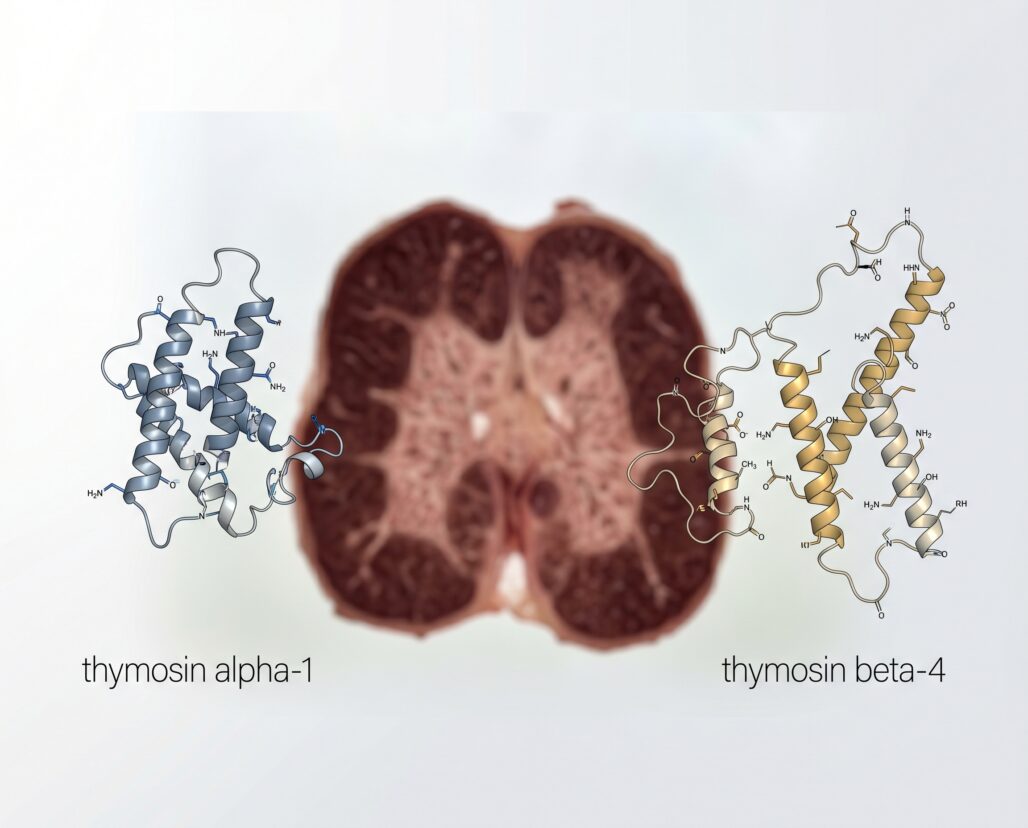
If you want the full evidence deep-dive on either peptide individually, the thymosin alpha-1 explainer covers the hepatitis approval history and T-cell mechanism, and the TB-500 and thymosin beta-4 deep dive covers the actin-binding biology, WADA prohibition, and human-evidence gaps.
Before you decide: the key differences
Thymosin alpha-1 (Tα1) is a 28-amino-acid synthetic peptide that works on the immune system. It has been approved in more than 35 countries under the brand name Zadaxin for hepatitis B and hepatitis C, has two decades of peer-reviewed clinical trial data, and a documented safety record spanning tens of thousands of patients. It is not FDA-approved in the United States and cannot be legally compounded by 503A pharmacies under current FDA guidance. If you obtain it through a US grey-market vendor, you are getting an unapproved drug outside any regulatory oversight.
Thymosin beta-4 (Tβ4) is a 43-amino-acid protein that works on cell movement and tissue repair. It is research-stage in humans — no version has received FDA approval for any indication, though a pharmaceutical-grade ophthalmic formulation called RGN-259 has completed Phase 2 trials for dry eye disease. TB-500, the product sold on grey-market sites, is not thymosin beta-4. It is a synthetic 7-amino-acid fragment of that protein — the N-terminal acetylated residues 17-23, Ac-LKKTETQ — produced without FDA oversight, prohibited by the World Anti-Doping Agency under Section S2.3, and carrying no peer-reviewed human trial data of its own.
These are distinct compounds at every level that matters clinically: amino acid sequence, molecular target, tissue of effect, regulatory status, and evidentiary foundation.
Why These Two Get Confused: The "Thymosin" Problem
Both peptides carry the thymosin label because both were isolated from thymic extracts during the foundational era of thymic peptide research in the 1960s and 1970s. In that environment, structurally unrelated proteins received thymosin names based on origin rather than mechanism. Thymosin alpha-1 and thymosin beta-4 share a prefix the way "star" appears in both "starfish" and "star anise" — same label, unrelated biology.
The confusion compounds online for three reasons. Sellers in grey-market channels list products under broad "thymosin" categories without specifying which one. Forum discussions cite evidence for one compound in threads discussing the other. TB-500 is itself a fragment of thymosin beta-4, adding a third layer: thymosin beta-4 (full protein), TB-500 (synthetic fragment), and thymosin alpha-1 (entirely different peptide) are treated as interchangeable in non-clinical contexts.
If a vendor's product page references "thymosin," "immune support," and "tissue repair" in the same description without specifying which compound is in the vial, treat that as a red flag about information quality.
Origin and Discovery: Same Starting Point, Different Biology
Thymosin alpha-1 was first isolated from bovine thymic tissue in the 1970s and shown to restore immune function in animals with impaired thymic activity. The natural peptide is cleaved from prothymosin alpha, a precursor found in the thymus and lymphoid tissue. The synthetic version replicates the 28-amino-acid sequence at pharmaceutical purity and is functionally thymic: it drives the maturation of immune cells that the thymus normally programs.
Thymosin beta-4 was also found in early thymic extracts — hence the name — but is present in essentially every nucleated cell in the body. It is not a thymic molecule in any functional sense. A 2020 review in Current Medicinal Chemistry (Bjorklund et al., PMID 31333080) describes Tβ4 as "a major pleiotropic actin-sequestering protein" involved in cardiac repair, wound healing, and angiogenesis. The thymus connection is historical label, not biological function. TB-500, the synthetic fragment sold online, was synthesized and characterized in a 2012 Drug Test Analysis paper (Esposito et al., PMID 22962027) that identified it as the N-terminal acetylated residues 17-23 of thymosin beta-4 (Ac-LKKTETQ) — a 7-amino-acid peptide, not the full 43-amino-acid protein — found in a product suspected of doping potential.
A claim that "thymosin is approved in 35 countries" is true of alpha-1 and false of beta-4. Both use "thymosin" as their subject.
Mechanism: Immune Modulation vs. Cellular Repair
The most important structural difference between these two peptides is what they target in the body — and those targets produce fundamentally different clinical effects.
Thymosin alpha-1 works on the immune system. Its primary mechanism is enhancing T-cell maturation and differentiation. Immature T-cell precursors from bone marrow enter the thymus and undergo selection to become antigen-specific mature T-cells; thymosin alpha-1 mimics the signals that drive this process. A 2015 Expert Opinion on Biological Therapy review (Wu et al., PMID 25640173) describes thymosin alpha-1 as an immunomodulatory agent that strengthens T-cell-mediated antiviral responses in chronic hepatitis B — corrective in immunocompromised populations rather than indiscriminate stimulation in healthy individuals.
Thymosin beta-4 works on cell movement. Its primary role is actin sequestration: binding free G-actin monomers and regulating the filament assembly that cells use to migrate toward an injury site. The Vitamins and Hormones review by Sosne et al. (PMID 27450739) documents this dual action in ocular tissue: Tβ4 enables re-epithelialization through cell migration while modulating inflammatory signaling — addressing the wound repair process, not the immune cascade.
These systems do not overlap. Thymosin alpha-1 does not bind actin. Thymosin beta-4 does not drive T-cell maturation. Any vendor suggesting the two thymosins work together on the same mechanism has not read the primary literature.
Regulatory Status: A Wide Divergence
The regulatory gap between these two compounds is the most practically important difference for anyone considering either one.
Thymosin alpha-1 (Zadaxin) has a genuine approval record. More than 35 countries — primarily in Asia, the Middle East, Latin America, and parts of Europe — have approved Zadaxin for chronic hepatitis B, hepatitis C in combination with interferon, and adjunct immune restoration in immunocompromised populations. China includes it in national hepatitis B treatment guidelines.
In the United States, thymosin alpha-1 is NOT FDA-approved. The FDA granted orphan drug designation for hepatocellular carcinoma — a development incentive, not an approval. As of the FDA Category 2 503A bulk-drug-substance interim listing, US compounding pharmacies cannot legally compound thymosin alpha-1 for human use. A physician prescription filled by a 503A compounder is not a legally compliant path. The only compliant route is through a physician in a country where Zadaxin is on the market.
Thymosin beta-4 and TB-500 have no approved human use anywhere. The most advanced pharmaceutical form is RGN-259, an ophthalmic formulation from RegeneRx Biopharmaceuticals that completed Phase 2 trials for dry eye disease — but has not been approved in any country. TB-500, the synthetic Ac-LKKTETQ fragment sold online, is categorically different from RGN-259. It is NOT FDA-approved as a drug or dietary supplement and is sold as a research chemical not for human use. The World Anti-Doping Agency Prohibited List names it explicitly under Section S2.3, Growth Factors and Growth Factor Modulators: "Thymosin-beta4 and its derivatives, e.g. TB-500." The prohibition is year-round, Non-Specified Substance status — a standard two-year ban applies, with no provision for reduced sanctions.
A grey-market vendor who lists "thymosin" while implying Zadaxin's approval record is either uninformed or deliberately misleading. Zadaxin is thymosin alpha-1. The fragments sold online are a different class of compound with a different regulatory history.
Use-Case Differences: Who Each Peptide Is Designed For
The clinical rationale for each compound — where it exists — targets completely different patient populations.
Thymosin alpha-1 clinical rationale applies to patients with documented immune deficiency: those with chronic hepatitis B inadequately controlled on antivirals, those on chemotherapy or dialysis who mount poor vaccine responses, and patients in sepsis-related immune paralysis explored by Asian clinical guidelines. A meta-analysis in Antiviral Research (Yang et al., PMID 18078676) across 199 hepatitis B patients found that interferon-alpha showed stronger end-of-treatment responses, but thymosin alpha-1 produced substantially better outcomes at 6-month follow-up: virological response OR 3.71 (95% CI: 2.05 to 6.71), complete response OR 2.69 (95% CI: 1.47 to 4.91). A 2001 pharmacological review (Ancell et al., PMID 11381492) reported hepatitis C combination therapy with interferon achieved 65% viral RNA clearance versus 29% for interferon alone. These are results in immunocompromised patient populations, not general immune optimization.
Thymosin beta-4 and TB-500 are claimed for a different set of problems entirely. The animal literature centers on connective tissue repair — Achilles tendon models, corneal wound healing, cardiac repair after infarction. The cellular mechanism is plausible: actin-regulated cell migration is a genuine requirement of wound closure. The problem is that every major study uses full-length Tβ4 or pharmaceutical-grade RGN-259, not the synthetic Ac-LKKTETQ fragment sold online. No peer-reviewed randomized controlled trial has tested TB-500 in human subjects for any indication. The forum-based use case is extrapolated across species, peptide length, and research context simultaneously — not a small gap to jump.
For a grounded look at the evidence in injury recovery contexts, the guide to peptides for injury recovery covers the evidence hierarchy.
Side-by-Side Comparison Table
| Property | Thymosin alpha-1 (Tα1) | Thymosin beta-4 / TB-500 (Tβ4) |
|---|---|---|
| Amino acid length | 28 aa (full synthetic peptide) | 43 aa native protein; 7 aa synthetic fragment (TB-500, residues 17-23) |
| Natural source | Thymus (prothymosin alpha precursor) | Present in virtually all nucleated cells |
| Primary mechanism | T-cell maturation, immune modulation | Actin sequestration, cell migration |
| Primary target tissue | Immune system (thymus-derived T-cells) | Connective tissue, wounds, cardiac tissue |
| Brand name | Zadaxin (SciClone Pharmaceuticals) | RGN-259 (RegeneRx) — NOT TB-500 |
| Approved markets | 35+ countries for hepatitis B/C | None (RGN-259 Phase 2 complete, not approved) |
| FDA status | NOT FDA-approved; Category 2 503A ban | NOT FDA-approved; TB-500 not approvable for compounding |
| WADA status | Not prohibited (immune research stage) | S2.3 prohibited year-round: "Thymosin-beta4 and its derivatives, e.g. TB-500" |
| Human RCT evidence | Yes — hepatitis B/C, vaccine response | RGN-259 in dry eye Phase 2; none for TB-500 fragment |
| Dosing route (clinical) | 1.6 mg subcutaneous twice weekly | Ophthalmic drop (RGN-259); TB-500 subcutaneous route unvalidated |
| Safe in pregnancy/nursing | No — insufficient data, avoid | No — insufficient data, avoid |
| Grey-market availability | Yes — unapproved, unverified source | Yes — unapproved, unverified source |

Frequently Asked Questions
If I want immune support, which thymosin is relevant?
Thymosin alpha-1, not thymosin beta-4 or TB-500. Tβ4 and TB-500 work on cell movement, not immune programming. They are not interchangeable for immune purposes.
Grey-market sellers use "thymosin" on product labels without specifying alpha or beta. Is that a problem?
Yes. Verify which thymosin is actually in any product before considering use. If the vendor cannot provide a certificate of analysis naming the specific peptide and its purity, that is a meaningful accountability gap.
Is Zadaxin available in the United States?
No. Zadaxin is not FDA-approved. As of the Category 2 interim 503A listing, US compounding pharmacies cannot legally produce it for human use. There is no compliant US supply chain.
Is TB-500 the same as thymosin beta-4?
No. Native thymosin beta-4 is a 43-amino-acid protein. TB-500 is a synthetic 7-amino-acid fragment (Ac-LKKTETQ, the acetylated residues 17-23) of one region of that protein. They differ in molecular weight, pharmacokinetics, and research profile. RegeneRx's pharmaceutical trials on native Tβ4 do not validate the grey-market fragment.
Can pregnant or nursing individuals use either peptide?
No. Neither compound has been studied in pregnant or nursing populations. Both should be avoided during pregnancy and lactation.
Actionable Takeaways
1. "Thymosin" is an incomplete label. Any seller or forum post that does not specify alpha-1 or beta-4 is withholding information that materially changes the risk and evidence picture.
2. For immune function, the relevant compound is thymosin alpha-1 — accessed through a physician in a country where Zadaxin is approved, not a grey-market US source. The US Category 2 503A designation closes the compounding route. No grey-market product matches pharmaceutical-grade Zadaxin's quality controls.
3. For tissue repair, no thymosin peptide has validated human evidence. TB-500 carries a concrete anti-doping risk for any athlete under WADA code; the biology of native Tβ4 is interesting, but the lab-to-grey-market product gap is large and unresolved.
4. If a provider cannot distinguish thymosin alpha-1 from thymosin beta-4, that is a signal about information quality. Different approvals, different mechanisms, different risk profiles — conflating them is not a terminology issue, it is a clinical error.
For the broader autoimmune context around immune-modulating peptides, the peptides for autoimmune conditions article covers how evidence in this category is evaluated.
Conclusion
The naming collision between thymosin alpha-1 and thymosin beta-4 is an accident of 1970s nomenclature. Thymosin alpha-1 is an immune peptide with genuine international approvals and two decades of clinical data — none of which applies in the US, where it lacks FDA approval and cannot be legally compounded. Thymosin beta-4 is a structural signaling protein with promising animal data and an incomplete clinical pipeline; TB-500, the grey-market fragment, is not the pharmaceutical-grade molecule in those trials and carries WADA prohibition with zero human RCT evidence.
The practical hazard is not that either compound lacks interesting biology. It is that the conflation — driven by shared naming, grey-market marketing, and forum-level evidence standards — leads people to cite evidence for the wrong compound. Zadaxin's hepatitis approvals do not validate TB-500 injection. They are different molecules, different diseases, and different regulatory contexts.
Know which thymosin you are actually asking about before acting on any claim attached to it.
Medical Disclaimer: This article is for informational purposes only and does not constitute medical advice, diagnosis, or treatment. Thymosin alpha-1 (Zadaxin) is approved for hepatitis B, hepatitis C, and certain adjunct indications in more than 35 countries but is NOT FDA-approved in the United States and has been placed on the FDA Category 2 503A bulk drug substance interim list, meaning US compounding pharmacies cannot legally compound it for human use. Thymosin beta-4 (RGN-259) is research-stage with no approved indication in any country. TB-500 is a synthetic fragment of thymosin beta-4 that is NOT FDA-approved, is sold as a research peptide not for human use, and is explicitly prohibited by the World Anti-Doping Agency under Section S2.3 year-round. Grey-market sellers sometimes conflate thymosin alpha-1 and thymosin beta-4; verify which thymosin is actually in any product before considering use. Neither compound has been studied in pregnant or nursing populations — both should be avoided during pregnancy and lactation. Do not self-source either compound from grey-market vendors. Patients with hepatitis, immune deficiency, or related conditions should consult a hepatologist or infectious disease specialist. Always seek the guidance of a qualified healthcare professional before beginning, modifying, or discontinuing any medical treatment.
