
Functional gum is chewing gum that carries an active ingredient, most often caffeine, in the gum base so that part of the dose is absorbed through the lining of the mouth while you chew. Gummies are candy-format supplements swallowed and digested like food, and pills are the tablets, capsules and softgels that hold most of the supplement market. We pulled labels from the NIH supplement label database and brand sites, opened the pharmacokinetic trials for each format, and ran the price per dose, with no relationship to any brand named here. Search engines rewrite most "X gum" queries into gummies, so this page sorts out which format fits which ingredient and points to the deeper page for each.
Before you decide
Some readers should not be choosing between these formats at all. If you are pregnant or breastfeeding, the European Food Safety Authority caps caffeine from all sources at 200 mg per day, and a single 100 mg piece of military-style gum is half of that allowance. If you are under 18, caffeine gum and melatonin products are not for you without a doctor's say-so; caffeine gum brands write their dosing advice for adults.
Anyone with a heart rhythm disorder, an anxiety or panic disorder, or a blood pressure prescription should clear caffeine in any format with a clinician first. The same applies to melatonin if you take sedatives, blood thinners or immunosuppressants, and to creatine if you have kidney disease. This is general information, not medical advice; your doctor or pharmacist outranks any website, including this one.
This page is for healthy adults deciding whether to buy a supplement as gum, as a gummy or as a pill, and who want to know what changes with the format besides the price. Speed, dose accuracy and sugar all move with the format, and they move differently for each ingredient. The caffeine gum pharmacokinetic trial run for the US Army is the reason gum exists as a category; the 2023 JAMA analysis of melatonin gummies is the reason to be careful with the gummy aisle.
What functional gum actually is
A piece of functional gum is a gum base, sweeteners, flavor and an active ingredient released as you chew. The active only helps if the molecule can cross the lining of the mouth, which caffeine does well and most vitamins do not. That is why nearly every functional gum is a caffeine gum, and why "vitamin gum" and "B12 gum" barely exist as products.
Doses in caffeine gum cluster around two numbers. Consumer gum commonly runs 40 mg per piece, which is what one widely sold nootropic gum brand lists on its product page alongside 60 mg of L-theanine and zero sugar. Military-supplied gum runs 100 mg per piece, one of the three doses the Army research tested. We rate the consumer version in our full review of Neuro Gum and compare all the caffeine gums we could find in our best caffeine gum roundup.
The other gum with a real evidence base is mastic gum, the dried resin of a Mediterranean tree, chewed for stomach complaints rather than energy; we cover it in whether mastic gum is worth buying and in our look at the jawline claims. Everything else sold as "gum" for melatonin, vitamins or creatine is, on inspection, a gummy.
Which format fits which ingredient
This is the table we wish existed when we started. Every figure comes from the trials linked in the text, the NIH Dietary Supplement Label Database and the brands' own label pages, checked in September 2026.
| Ingredient | Gum | Gummies | Pills or powder | What the evidence says | Go deeper |
|---|---|---|---|---|---|
| Caffeine | Best fit. 40 mg (consumer) or 100 mg (military) per piece | Rare, no absorption advantage | Fine, slower onset | Gum reached peak blood level in 44 to 80 min vs 84 to 120 min for capsules in 84 men | Caffeine dose calculator |
| Melatonin | Not a real product; searches resolve to gummies | Label accuracy problem. 22 of 25 products missed label by more than 10 percent | Best fit for dose control. About $0.07 per 3 mg tablet | Actual melatonin ran 74 to 347 percent of label in gummies | Melatonin gummies vs pills vs liquid |
| Creatine | Not a real product | 1 to 1.5 g each, so 3 to 5 per dose; about half of 12 tested brands failed label claim | Best fit. Powder about $0.05 per gram vs $0.31 to $0.44 in gummies | Degrades to creatinine in a moist gummy matrix | Best creatine gummies |
| Vitamin D3 | Not a real product | Absorbed better than tablets in one crossover trial; about $0.26 per 2000 IU serving | Cheapest. About $0.12 per 2000 IU | Gummy AUC 1474 vs 774 ng h per mL for tablets, n=31 | Are gummy vitamins as good as pills |
| Vitamin B12 | Not a real product | 1000 mcg per 2 gummies with 3 g sugar on the label we opened | Fine; pill, spray and sublingual all reach the blood | Format matters less than dose and whether you absorb B12 at all | B12 spray vs sublingual vs pill |
| Multivitamin | Not a real product | Usually no iron, no or low minerals, 3 g sugar per 2 gummies on the labels we opened | Complete formulas, lowest cost | Gummies trade completeness for taste | Olly vs Vitafusion |
| Collagen | Not a real product | Typically far below the 2.5 to 10 g used in trials | Powder is the only format that holds a trial-sized dose | Dose per gummy is the whole story | Do collagen gummies have enough collagen |
Read the table by column and a pattern shows up. Gum wins exactly once, for caffeine, the one common supplement ingredient that crosses the mouth lining fast enough to matter. Pills or powder win wherever the dose is large (creatine, collagen) or must be precise (melatonin). Gummies win on taste and on one absorption result for vitamin D, and lose wherever the active is bulky or unstable in a moist candy.
Absorption speed, dose accuracy and cost

Speed first, because it is the only thing gum does better. The Army pharmacokinetic trial randomized 84 healthy men to 50, 100 or 200 mg of caffeine as gum or capsules and sampled blood for 29 hours. Mean time to peak was 44 to 80 minutes for gum against 84 to 120 minutes for capsules, and the absorption rate constant was roughly twice as high for gum. The authors read that as absorption through the buccal mucosa, the mechanism every caffeine gum brand now quotes.
The same trial also holds the number the brands leave out. Relative bioavailability of the gum was 64, 74 and 77 percent of the capsule at 50, 100 and 200 mg, and only 85 percent of the caffeine left the gum base at all. A 40 mg piece therefore delivers somewhat less total caffeine than a 40 mg capsule on those bioavailability figures (a gap the authors did not find statistically significant), but delivers it sooner. If you want the peak earlier, chew; if you want every milligram, swallow. Our caffeine dose calculator lets you add gum pieces to coffee and cans and see where you land against the daily limit.
Dose accuracy is where gummies get into trouble, and melatonin is the clearest case. The 2023 JAMA research letter bought 25 melatonin gummy products sold in the US and measured them. Twenty-two of the 25 (88 percent) were inaccurately labeled, the actual melatonin ranged from 74 to 347 percent of the stated amount, and only 3 products were within 10 percent of their label. One product contained no detectable melatonin at all. A supplement trade group called the letter a false alarm because the rules allow overages, but a gummy carrying three times its label is a dosing problem whatever the rules say.
For melatonin that means a tablet with a printed dose behaves like a dose, and a gummy behaves like an estimate. We go through the evidence in whether sleep gummies actually work and the format head-to-head in melatonin gummies vs pills vs liquid. If you are titrating down toward 0.5 to 1 mg, buy something you can cut in half.
Creatine has the opposite dose problem: the molecule is too bulky for candy. A standard maintenance dose is 3 to 5 g a day, and the gummies we have reviewed carry 1.5 g each (Create), 1.25 g each (Lemme, compared with Create here) or 1 g each (Bear Balanced). You need three to five gummies to match one small scoop of powder, and each of them brings sugar or sugar alcohols along. Our Create vs Bear Balanced comparison shows how "per serving" labels hide that arithmetic.
Then there is stability. In 2024 a large supplement manufacturer tested 12 creatine gummy brands by HPLC and, per trade coverage of the results, roughly half fell short of label claim. The failing products held little to no creatine, and every one of them showed creatinine, the breakdown product of creatine in water. Trade reports differ on whether five or six of the twelve failed, and the manufacturer said none of the outside labs it usually uses could test gummies. Creatine is stable as a dry powder and unstable in a moist gummy, so the cheapest format is also the most reliable one. We rank the gummies that passed in best creatine gummies and list powder and capsule swaps in creatine gummy alternatives on Amazon.
Vitamin D is the one row where the gummy has a real absorption result on its side. A 2019 crossover trial in Nutrients gave 31 healthy adults a single 20,000 IU dose of vitamin D3 as gummies or tablets and, after a two-week washout, the other form. Area under the curve was 1474 ng h per mL for the gummies against 774 for the tablets, and peak concentration was 47.3 versus 23.4 ng per mL, both with p under 0.0001. That is one trial of 31 people at a single large dose, not a rule for every gummy, but it does mean "gummies absorb worse" is an unsafe assumption for fat-soluble vitamins. We work through what it does and does not prove in are gummy vitamins as good as pills.
Now the cost, on brand-site prices as of September 2026. One company sells melatonin 3 mg as 120 tablets for $8.49, about 7 cents a dose, and as 60 time-release gummies for $17.99, about 30 cents a dose. Its vitamin D3 2000 IU is 90 softgels for $10.99, about 12 cents a dose, against 90 gummies for $11.69 where a serving is two gummies, so about 26 cents a dose. Within one brand, the gummy costs roughly twice as much per dose for vitamin D and four times as much for melatonin. Creatine is the extreme case: our creatine gummies vs powder cost page puts powder at about 5 cents per gram (its range is 2 to 7 cents), and the two gummy brands priced in our Lemme vs Create comparison came in at 31 to 44 cents.
Caffeine gum sits between the two. A 54-piece pack of 40 mg gum at $24.99 as of September 2026 works out to about 46 cents a piece, or roughly $1.16 per 100 mg of caffeine; we did not price caffeine tablets for this page, so that comparison is not checked here. You pay for onset time and the ability to chew while driving. Whether that premium is worth it is the question our Neuro Gum review answers.
Sugar goes on the cost line too. On the labels we opened in the NIH database, an adult multivitamin gummy carries 3 g of total sugar in a two-gummy serving, a B12 1000 mcg gummy carries 3 g per two gummies, and a melatonin sleep gummy listing 4 mg per two-gummy serving carries 2 g of total sugars. The creatine gummies run 2 to 4 g of added sugar per serving because the serving is three or four pieces, and prenatal gummies sit in the same range while usually skipping iron, a tradeoff we lay out in Olly vs SmartyPants prenatal gummies. Two to four grams a day is small next to a soda, but it is a standing daily habit, and "sugar-free" gummies swap in sugar alcohols that can upset the gut at creatine-sized servings. Caffeine gum is usually sugar-free, like ordinary chewing gum, though the 100 mg military gum is built on sugar and dextrose.
Side effects, allergy and who should not use it
Caffeine side effects do not change with the format, but faster onset means a sharper peak in sensitive people. The EFSA opinion puts a single dose of 200 mg and a daily total of 400 mg as the amounts that raise no safety concern for healthy adults, sets 200 mg a day as the ceiling in pregnancy, and notes that even 100 mg close to bedtime may affect sleep duration and patterns in some adults. Two pieces of 100 mg military gum is a full single dose, and ten pieces of 40 mg gum is the whole day's allowance. Jaw soreness from long chewing is the one side effect unique to gum.
Gummies bring the risks of candy rather than the risks of the active. The gelling agent is gelatin or pectin, so vegetarians need to read the label, and a few products use carmine for color, a known allergen for some people. Sugar-free versions rely on maltitol, sorbitol or xylitol, which cause bloating and loose stools at the multi-gummy servings that creatine and collagen demand. Children are the other gummy-specific risk: gummies look like sweets, so melatonin gummies belong on a high shelf like any medicine. For younger children the format question has its own answer in our guide to gummies versus liquid for kids.
Pills have the fewest format-specific problems. Large tablets are hard for some people to swallow, softgels carry oil and sometimes soy, and capsules can be gelatin, but none of that changes the dose. If you can swallow a pill, the pill is the format with the least in it besides the active.
Skip caffeine in every format if you are under 18, if you are pregnant and already at the 200 mg allowance, have a heart rhythm disorder or an anxiety disorder that caffeine aggravates, or your doctor has asked you to limit it. Skip melatonin gummies specifically if you need a reliable dose, which includes anyone using it for a diagnosed sleep disorder. Skip creatine gummies if you have kidney disease or have been told to watch your creatinine, since a degraded gummy delivers the breakdown product directly.
Interactions with medications
Format does not create new drug interactions, so this section is about the ingredients, and it is short where the research is short. Caffeine interacts with a long list of drugs through the liver enzyme CYP1A2: fluvoxamine and ciprofloxacin slow its clearance and can make a normal dose feel like an overdose, while smoking speeds it up. It also adds to the stimulant load of ADHD medication and decongestants, and anyone on blood pressure medication should ask a pharmacist before adding a caffeine product. Nobody has studied whether the faster gum peak changes any of these interactions; assume it makes them arrive sooner and plan around that.
Melatonin interacts with sedatives and sleep medication (additive drowsiness), with warfarin and other anticoagulants (reports of altered bleeding), with immunosuppressants and with some blood pressure and diabetes drugs. Because the gummy dose is unreliable, a melatonin gummy makes every one of those interactions harder to predict than a tablet would. If you take any of those drug classes, talk to a pharmacist before you pick a format.
Creatine has no well-documented drug interactions in healthy adults; the standard caution is about kidney disease and nephrotoxic drugs rather than any specific pairing. Vitamin D interacts with thiazide diuretics (higher calcium), with some seizure medications and steroids (lower vitamin D), and with orlistat and cholestyramine, which reduce its absorption. No study has asked whether the higher gummy absorption in the 2019 crossover trial changes any of those interactions. Mastic gum has one caution of its own: people who test positive for H. pylori need a doctor's plan first, because chewing resin is not a treatment.
FAQ
Are gummy vitamins as good as pills?
For most vitamins the active is the same molecule; the differences are dose completeness and sugar. Gummy multivitamins usually leave out iron and carry 3 g of sugar per two gummies. The 2019 vitamin D crossover trial even found gummies absorbed better than tablets, so absorption is not the reason to avoid them; cost and dose are.
Does caffeine gum work faster than caffeine pills?
Yes. In the Army pharmacokinetic trial, caffeine gum reached peak blood levels in 44 to 80 minutes against 84 to 120 minutes for capsules, because part of the dose crosses the mouth lining. Total caffeine delivered was somewhat lower for gum, 64 to 77 percent of the capsule, since about 15 percent stays in the gum base.
Is there such a thing as melatonin gum or vitamin gum?
Almost never as a real product. Search engines treat "melatonin gum" and "vitamin gum" as gummies, and the reason is chemistry: melatonin and most vitamins do not cross the mouth lining fast enough to make chewing worthwhile. Caffeine gum and mastic gum are the two functional gums with a trial record; everything else is a gummy wearing a shorter name.
How many creatine gummies equal a scoop of powder?
Usually three to five. The gummies we have reviewed carry 1 g, 1.25 g or 1.5 g of creatine each, against a 3 to 5 g daily dose from one small scoop. Powder runs about 5 cents per gram on our cost-per-gram comparison, and the two gummy brands we priced individually came in at 31 to 44 cents. Roughly half of 12 tested brands missed their label.
Can I take caffeine gum with blood pressure or anxiety medication?
Ask your prescriber first. Caffeine can blunt some blood pressure drugs for hours after a dose and adds to the stimulant load of ADHD medication, and gum delivers its peak sooner than a pill. The EFSA opinion frames 200 mg as a safe single dose for healthy adults, which says nothing about adults on interacting medication.
Which format is best for kids?
For older children who can swallow a tablet, a tablet, because the dose is exact and there is nothing to mistake for candy. For younger children a liquid or a chewable is usually the practical answer, and we walk through the tradeoffs in our kids' format guide. Melatonin gummies should be stored like medicine wherever there are small children.
The bottom line
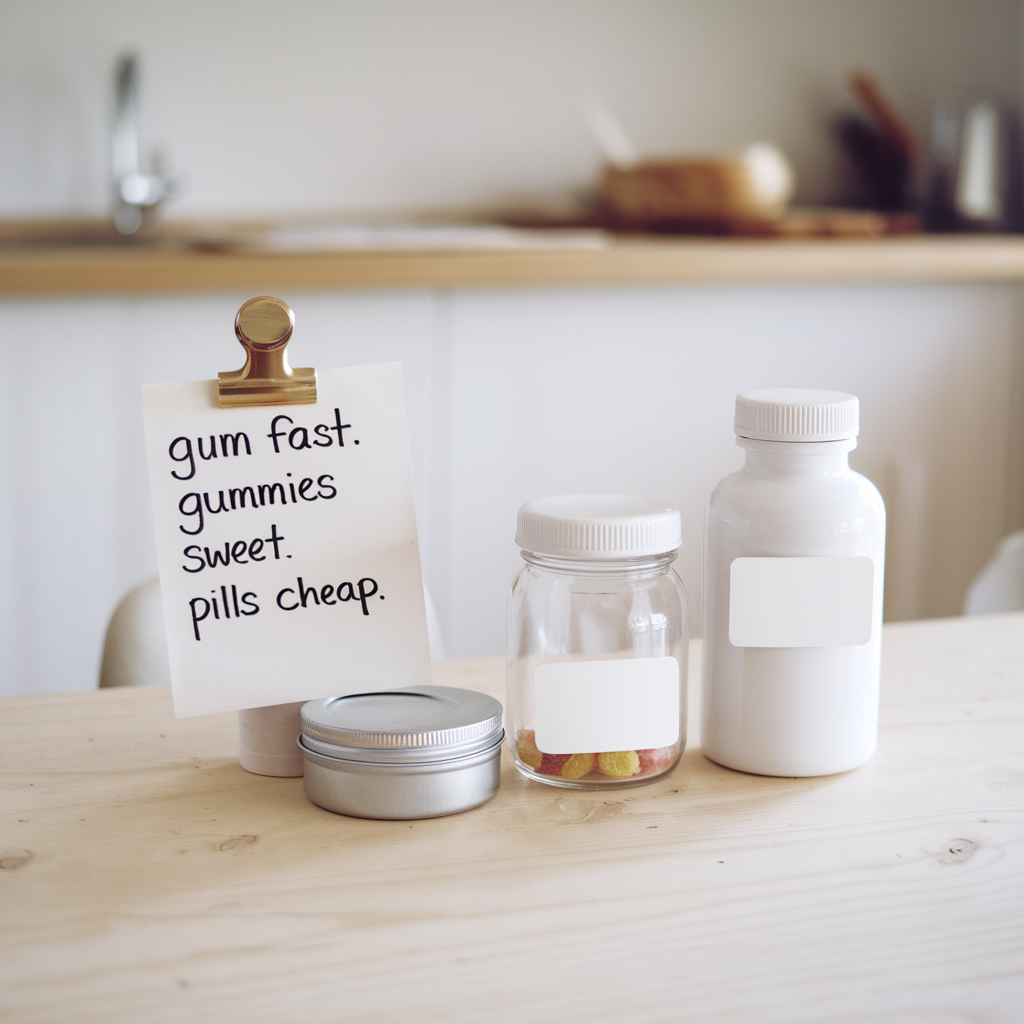
Gum fast, gummies sweet, pills cheap; the ingredient decides which matters. Caffeine is the one case where gum earns its price: peak blood level in 44 to 80 minutes instead of 84 to 120, with relative bioavailability of 64 to 77 percent, a gap the trial did not find statistically significant. Melatonin belongs in a tablet, because 22 of 25 gummies in the JAMA analysis missed their label and one held no melatonin at all. Creatine goes in powder: a gummy holds 1 to 1.5 g, costs six to nine times more per gram and can degrade to creatinine on the shelf.
Gummies keep two honest jobs. If a vitamin only gets taken when it tastes like candy, the gummy is the format that works, and for vitamin D one crossover trial of 31 people found the gummy absorbed better. Pay the two-to-four-times price premium knowingly, check the sugar line, and store them away from children. Skip caffeine gum entirely if you are pregnant, under 18, or managing a heart rhythm or anxiety disorder, and take the format question to a pharmacist if you are on any of the medications above.
