
Affiliate disclosure: this article contains affiliate links. As an Amazon Associate, UsefulVitamins.com earns from qualifying purchases at no extra cost to you.
Why B12 absorption makes the format argument mostly moot
Marketing for sprays and dissolving tablets leans on one idea: skip the gut and get more into your blood. The biology does not really support that for everyday use.
Your body absorbs small, food-level amounts of B12 through a carrier protein called intrinsic factor, made in the stomach. That pathway is efficient but it saturates fast. According to the NIH Office of Dietary Supplements, intrinsic factor can only handle roughly 1.5 to 2 mcg of B12 per meal, and absorption is around 50 percent at those tiny doses.
Push the dose higher and a second route takes over. A small, fixed fraction crosses the gut wall by passive diffusion, no intrinsic factor required. That fraction is only about 1 to 2 percent, but 1 to 2 percent of a 1,000 mcg pill is still around 10 to 20 mcg – far more than you need. The same passive mechanism is what a sublingual tablet or spray relies on under the tongue.
So the question is not really "which format gets more in." It is "which one you will keep taking, and which chemical form you buy."
What the studies actually show about spray and sublingual
This is one of the few supplement debates with clean head-to-head data, and the data is fairly boring in a good way.
A randomized trial found that sublingual and oral B12 at 500 mcg were equally effective at correcting blood levels over eight weeks. There was no winner. A 2025 systematic review and meta-analysis in Frontiers in Pharmacology went further and pooled oral, sublingual, and even intramuscular injection together.
The headline number: no statistically significant difference between routes for raising serum B12 (p = 0.270) or for lowering homocysteine (p = 0.485). All three routes raised cobalamin by a similar pooled amount, about +403 pg/mL.
In plain terms: in people who can absorb B12 normally, a spray is not beating a pill, and a pill is holding its own against an injection. The "sublingual bypasses digestion" pitch sounds clever, but the trials do not show a real-world edge for healthy adults.
If you want the deeper read on which products are well-formulated rather than just well-marketed, our roundup of the top-rated B12 supplements breaks down dose and form by brand.
The thing that matters more than spray vs pill: the form
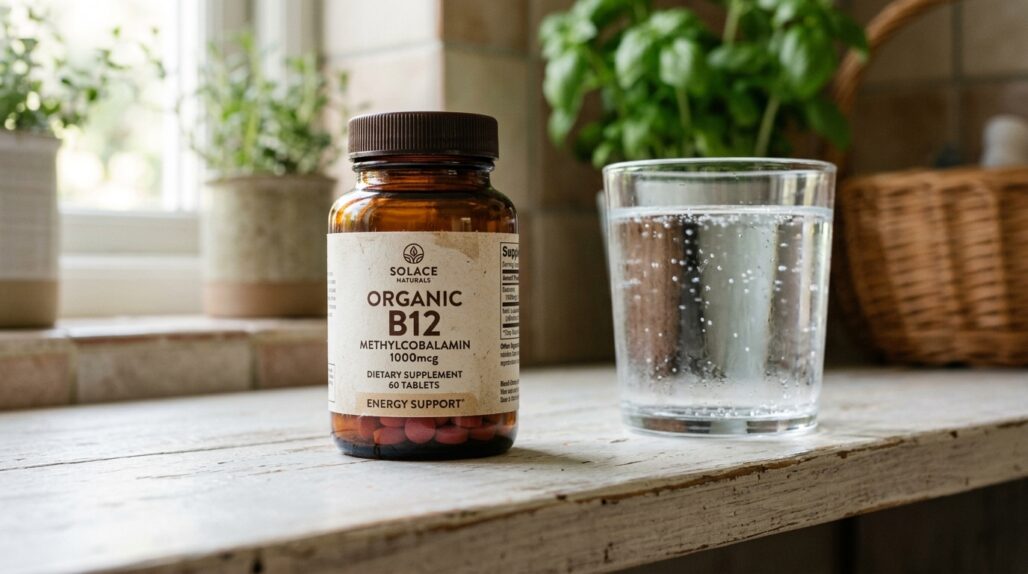
Here is where your money is better spent paying attention. B12 comes in different chemical forms, and that choice has more behind it than the delivery method.
The two you will see most are cyanocobalamin (the cheap, very stable synthetic form) and methylcobalamin (a body-ready "active" form). A third, hydroxocobalamin, shows up mostly in injections.
The evidence here is genuinely mixed and modest. Older absorption work suggested the forms absorb at roughly similar rates at low doses, while some data hints that methylcobalamin may be retained slightly better, with less excreted in urine, per a review of the cobalamin forms by Vegan Health. Cyanocobalamin contains a trace cyanide molecule released on conversion, which is harmless at supplement doses for almost everyone.
Practically: cyanocobalamin is cheaper and rock-stable, methylcobalamin is the form many people prefer and is easy to find sublingually. Neither is a clear knockout. We compared them side by side in our guide to methyl vs cyano B12 bioavailability if you want the long version.
The takeaway is simple. Spend two minutes choosing a form you are comfortable with, then stop overthinking whether it sprays or swallows.
How the formats actually compare
Each format does win on something – just not usually on absorption. Here is the honest side-by-side.
| Format | Absorption vs a pill | Best for | Watch out for |
|---|---|---|---|
| Standard tablet or capsule | Baseline – works for most people at 500 to 1,000 mcg | Value and simplicity | Nothing really; cheapest per dose |
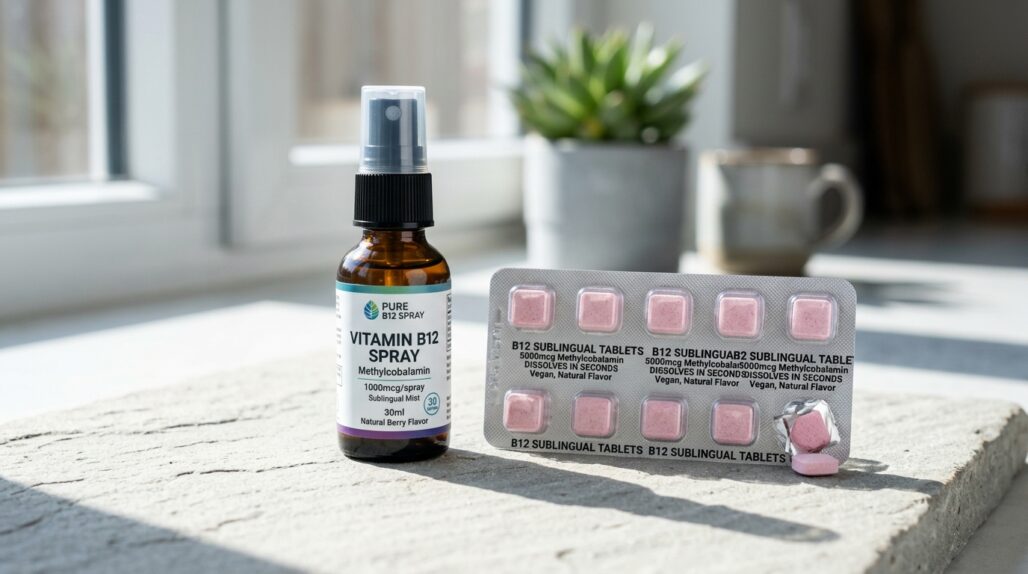
| Sublingual tablet or lozenge | No measurable edge in trials | People who dislike swallowing pills | Must dissolve fully under the tongue; often costs more |
| Oral spray | Emerging data, no proven advantage | Convenience, travel, no water needed | Premium price; check the per-spray mcg dose |
| Injection (prescription) | Bypasses the gut entirely | True malabsorption, severe deficiency | Needs a doctor; not a DIY format choice |
Notice the pattern. Tablets, sublinguals, and sprays cluster together on effectiveness; the injection is the only one that does something genuinely different, and it is the one you do not pick off a shelf.
Who actually benefits from a non-oral route
For a minority of people, the route really does change the outcome – and it is usually injections, not a switch from pill to spray.
People with pernicious anemia make little or no intrinsic factor, often from an autoimmune attack on stomach cells. They can still use the passive 1 to 2 percent pathway, and research shows that 1,000 mcg of oral B12 daily can maintain levels in many of these patients, per a report on oral B12 for pernicious anemia in PMC. But that same work cautions that injections are often the safer choice to start treatment in someone severely deficient.
Other groups where absorption is genuinely impaired:
- Bariatric or gastric surgery: sleeve gastrectomy and gastric bypass cut B12 uptake, and the British Dietetic Association describes a typical regimen of an injection every three months.
- Atrophic gastritis and older adults: less stomach acid means less B12 freed from food; the NIH notes this affects a notable share of older adults.
- Long-term metformin or acid-reducing drugs: both are linked to lower B12 over time.
- Strict vegans and vegetarians: no reliable food source, so a daily supplement of any format is the fix.
If you fall into one of these groups, the smart move is testing and a plan with a clinician, not guessing at a format. For everyone else trying to land on the right number, our B12 dosage guide walks through typical maintenance doses.
Which form to buy
Match the product to your situation, not to the loudest label claim. To skip the guesswork on dose entirely, run your numbers through our B12 dose-by-form calculator, which tailors the amount to the format you pick rather than making you do the math here.
- Most people, best value: a plain 1,000 mcg tablet. Cheapest per dose, fully effective.
- Pill-averse or want the active form: a sublingual methylcobalamin. No proven absorption edge, but pleasant and easy.
- Convenience and travel: a spray, if you will use it consistently and do not mind paying more per dose.


As an Amazon Associate, UsefulVitamins.com earns from qualifying purchases at no extra cost to you.
UsefulVitamins may earn a commission from purchases made through links on this page, at no extra cost to you. We only recommend products that fit the evidence above.
One last sizing note: there is no Tolerable Upper Intake Level set for B12 by the NIH, because the body sheds the excess and toxicity is not a known concern at supplement doses. That is why a 1,000 mcg pill is routine even though you absorb a sliver of it.
FAQ
Is sublingual B12 really better absorbed than a pill? Not in the trials. A randomized study and a 2025 meta-analysis both found no significant difference between sublingual and oral routes for raising blood B12 in people who absorb it normally.
Does a B12 spray work? It can deliver B12 fine, but the evidence does not show it beats a tablet or sublingual. Choose a spray for convenience, not for a supposed absorption advantage, and check the mcg per spray.
Should I take methylcobalamin or cyanocobalamin? Both work. Cyanocobalamin is cheaper and very stable; methylcobalamin is the active form some prefer and may be retained a bit better. The difference is small for most people – see our methyl vs cyano comparison.
How much B12 should a healthy adult take? The RDA is only 2.4 mcg, but supplements use 500 to 1,000 mcg because you absorb roughly 1 to 2 percent of a high dose. There is no established upper limit, though more is not better once you are replete.
Can a pill fix B12 deficiency if I have pernicious anemia? High-dose oral B12 maintains levels in many people with pernicious anemia through passive absorption, but injections are often used to start treatment. This is a decision to make with a doctor, not by switching supplement formats on your own.
Do older adults need a different format? Usually a higher oral dose rather than a different format, since stomach changes reduce B12 freed from food. A 1,000 mcg supplement of any format generally covers it; testing helps if symptoms are present.
The bottom line
For the vast majority of healthy people, B12 spray vs sublingual vs pill is a tie. At the doses these products use, your body absorbs B12 the same passive way regardless of where it dissolves, and the trials back that up.
Pick the format you will take every day, choose a form you are comfortable with, and put a 1,000 mcg dose on autopilot. The format only changes the outcome for people with real malabsorption – pernicious anemia, gut surgery, certain medications – and those situations call for testing and a clinician, often with injections rather than a shelf swap.
If you are not sure where you stand, the next step is a blood test and a conversation, not a more expensive bottle.
This article is general education, not medical advice. It is not a diagnosis or a treatment plan, and it cannot replace your own clinician. Do not start, stop, or change any supplement or prescription based on it – talk to a pharmacist or doctor about your situation.
Reviewed by the UsefulVitamins Editorial Team.
