
If you're searching "ashwagandha and thyroid," you're likely in one of two situations: you have a thyroid condition and want to know whether this herb is safe, or you've read that ashwagandha could help normalize thyroid levels and want to know if that's real. The honest answer is: ashwagandha does appear to influence thyroid hormone output, and that's precisely why it requires caution, not celebration, for most people with a thyroid diagnosis. This article breaks down the one human RCT that measured thyroid outcomes, the case reports of thyrotoxicosis that followed, what the hypothalamic-pituitary-thyroid (HPT) axis mechanism actually means for you, and exactly which populations should not take this herb. You'll also get a clear look at the levothyroxine interaction and how to stop ashwagandha safely if you're already taking it.

Summary: the quick answer on ashwagandha and thyroid health
What you'll find in this guide
- How ashwagandha affects the thyroid: the HPT axis mechanism
- What the human research actually shows
- Who should and should not take ashwagandha with a thyroid condition
- Drug interactions: levothyroxine, methimazole, and more
- Hashimoto's thyroiditis: the autoimmune caution
- Frequently asked questions
How ashwagandha affects the thyroid: the HPT axis mechanism
The thyroid gland sits at the bottom of a three-tier feedback loop called the hypothalamic-pituitary-thyroid (HPT) axis. The hypothalamus releases TRH, which prompts the pituitary to release TSH, which signals the thyroid to produce T3 and T4. When T3/T4 rise, they suppress TSH via negative feedback. TSH, in other words, is a thermostat reading: high means the body wants more thyroid output; low means it's already satisfied.
Ashwagandha's active compounds — principally withanolides and withaferin A — appear to stimulate this axis. A 2023 narrative review (Wiciński et al.) synthesizing 2010-2023 research found that "active substances from W. somnifera cause an increase in the secretion of T3 and T4 by the thyroid gland and a decrease in TSH levels." Proposed mechanisms include direct withanolide activity on thyrocyte receptors and stress-hormone crosstalk: chronic cortisol elevation suppresses T3 conversion, so ashwagandha's cortisol-lowering effect (well documented in RCTs) may also allow T3 to rise indirectly.
Actionable takeaway: The HPT axis stimulation is not a bug in ashwagandha's pharmacology. For subclinical hypothyroid patients it may be the intended effect. The problem is that the same stimulatory signal doesn't turn off at a predictable threshold — which is why the case reports of thyrotoxicosis exist.
What the human research actually shows
The Sharma 2018 RCT: subclinical hypothyroidism
The most directly relevant human trial is a 2018 double-blind, randomized, placebo-controlled study (Sharma, Basu, Singh, n=50). Participants had documented subclinical hypothyroidism — a condition defined by elevated TSH with T3 and T4 still in the normal range — and received either 600 mg of ashwagandha root extract daily or a starch placebo for 8 weeks. At the end of the trial, the treatment group showed statistically significant improvements across all three thyroid markers: TSH (p<0.001), T3 (p=0.0031), and T4 (p=0.0096) versus placebo.
The researchers concluded that ashwagandha treatment "may be beneficial for normalizing thyroid indices in subclinical hypothyroid patients." The safety profile was favorable: only 4 of 50 participants (8%) reported mild, temporary adverse effects, and notably, three of those four were in the placebo group.
Two important caveats from the trial design: the study enrolled only subclinical hypothyroid patients, not people with normal thyroid function or overt hypothyroid disease on medication. And n=50 across 8 weeks is a small, short pilot — the authors themselves called for larger replication studies.
Thyroid stimulation in people without hypothyroidism
A 2014 placebo-controlled trial (Gannon, Forrest, Chengappa, n subset=10) gave ashwagandha to bipolar patients to test cognitive outcomes — not thyroid effects. Researchers nonetheless flagged that all three participants in the ashwagandha group showed T4 increases from baseline (7%, 12%, and 24%), while most placebo participants showed T4 decreases. The authors described these as "subtle changes" but called for vigilance about hyperthyroidism, confirming that thyroid stimulation is not limited to hypothyroid patients.
Case reports of thyrotoxicosis
Case reports are not proof of mechanism, but they are a real safety signal. The first published case appeared in 2005 (van der Hooft et al.): a 32-year-old woman with no prior thyroid history developed thyrotoxicosis after increasing her ashwagandha dose for chronic fatigue. Values normalized after stopping. The authors called this the first documented human case and noted animal data had already predicted the risk.
In 2022, a more serious case followed (Kamal et al.): a 73-year-old woman presented with supraventricular tachycardia at 173 bpm and significantly suppressed TSH after two years of self-administering ashwagandha root extract to self-treat hypothyroidism. Full resolution occurred over two months after discontinuation.
Actionable takeaway: The RCT data are promising for subclinical hypothyroidism. The case-report data are a real signal for healthy and hyperthyroid individuals. These aren't contradictory — they're the same mechanism operating in different thyroid contexts.
Who should and should not take ashwagandha with a thyroid condition
Potentially appropriate (with physician monitoring)
Subclinical hypothyroidism, no medication: The Sharma 2018 trial specifically enrolled this population. If your TSH is mildly elevated (typically 4-10 mIU/L range), your T3/T4 are in normal range, and you are not on any thyroid replacement therapy, discussion with your physician about ashwagandha as an adjunct is reasonable. Insist on TSH monitoring at 6 to 8 weeks after starting.
Clear contraindications
Any active hyperthyroidism or Graves' disease: Adding a thyroid-stimulatory adaptogen to a thyroid that is already overproducing hormones is a direct counter-effect to treatment. The NCCIH ashwagandha fact sheet explicitly flags that ashwagandha "is not recommended for people who have autoimmune or thyroid disorders" — Graves' disease falls squarely in both categories.
Currently taking levothyroxine (Synthroid, Tirosint, Euthyrox): See the drug-interactions section below. The interaction risk is direct and the monitoring need is high.
Overt hypothyroidism (TSH >10 mIU/L or symptomatic) on medication: Adding ashwagandha on top of a prescription thyroid dose introduces an uncontrolled second variable. Your physician cannot correctly adjust your levothyroxine dose if the herb is simultaneously pushing T3/T4 upward.
Pregnancy and breastfeeding: The NCCIH ashwagandha fact sheet states that ashwagandha "should be avoided during pregnancy and should not be used while breastfeeding." Animal studies have flagged potential abortifacient effects at higher doses, and the thyroid-hormone window during fetal development is particularly sensitive: even small perturbations in maternal T3/T4 carry developmental risk.
Drug interactions: levothyroxine, methimazole, and more
This section covers the four interaction categories that matter most for thyroid patients.
Levothyroxine (Synthroid, Tirosint, Euthyrox, generic)
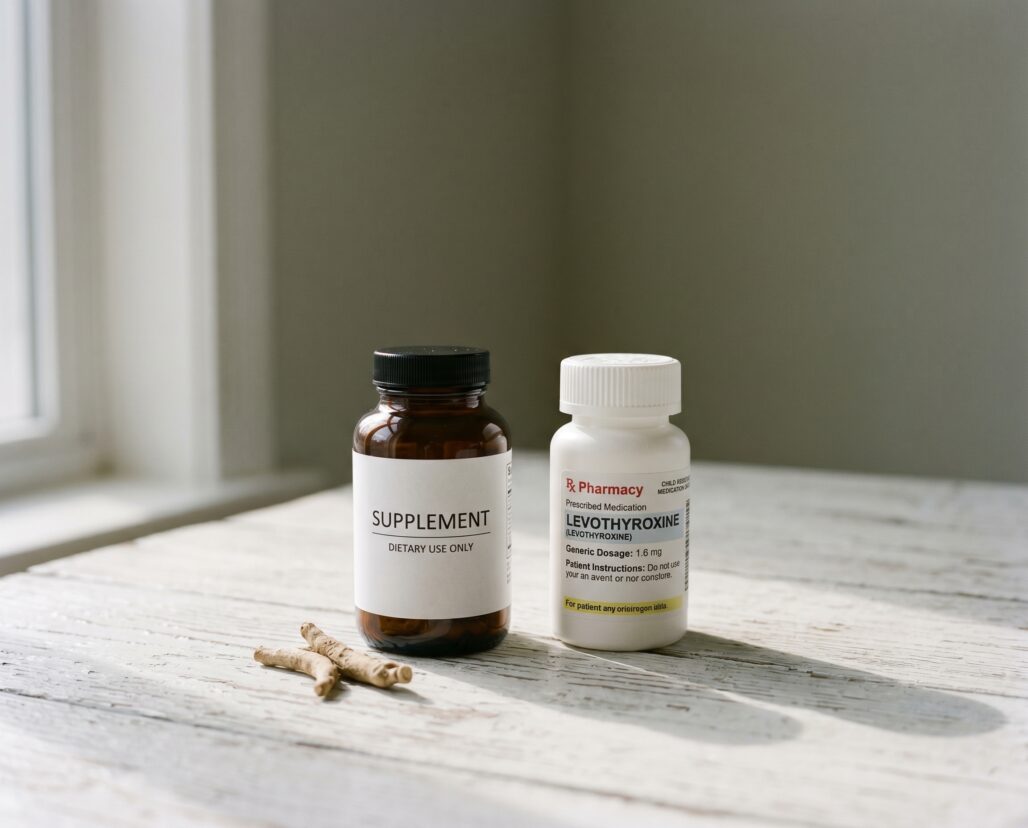
Levothyroxine replaces or supplements T4 in patients whose thyroid cannot produce sufficient output. When ashwagandha simultaneously stimulates endogenous T4 production — as documented in both the Sharma trial and the bipolar study — the combined effect can push total T4 above the therapeutic range. The result: symptoms of hyperthyroidism (palpitations, heat intolerance, anxiety, weight loss) and a suppressed TSH on your next lab draw.
Per Memorial Sloan Kettering's integrative herbs database, ashwagandha "may increase thyroxine levels," and multiple case reports document thyrotoxicosis on ashwagandha. The practical risk for a levothyroxine user is a dose-stacking effect where the prescriber cannot distinguish herb-driven T4 from medication-driven T4 — and may incorrectly lower your prescription dose.
Bottom line on this interaction: Do not combine without explicit physician oversight and a TSH/Free T4 lab check at 4 to 6 weeks.
Methimazole and propylthiouracil (PTU)
Methimazole and PTU are antithyroid drugs prescribed to slow down an overactive thyroid in conditions like Graves' disease or toxic nodular goiter. Ashwagandha's stimulatory effect on thyroid hormone output works in the opposite direction. The interaction is a direct pharmacological counter-effect: the drug is trying to suppress T3/T4; the herb is trying to raise them. This is not a subtle interaction. The combination makes adequate antithyroid titration unreliable.
Liothyronine (Cytomel) and combination T3/T4 therapies
Liothyronine is synthetic T3, prescribed when T4-to-T3 conversion is insufficient. The Gannon 2014 study found T4 increases in ashwagandha users, but the net effect on T3 levels in people already supplementing T3 is less studied. The same monitoring principle applies: any herb with documented thyroid-axis activity should not be added to a T3-based regimen without lab follow-up.
Immunosuppressants (tacrolimus, cyclosporine, biologics)
This is a second interaction category relevant to Hashimoto's patients who may also be on immunosuppressive therapy. Per the MSK integrative herbs database, ashwagandha acted as a moderate inducer of CYP3A4 in laboratory studies. CYP3A4 is the primary metabolic pathway for tacrolimus and cyclosporine; induction accelerates their clearance and can push drug concentrations below therapeutic levels — which in transplant patients has been associated with organ rejection (one case was documented). If you take any immunosuppressant, treat ashwagandha as a CYP3A4 interaction risk until more clinical data are available.
Actionable takeaway: If your medication list includes any of the above drugs, bring the ashwagandha question to your prescribing physician before starting. The relevant phrase for the conversation: "I understand this herb may stimulate thyroid hormone output and could alter drug metabolism through CYP3A4 — can we check labs at 4 to 6 weeks if I try this?"
Hashimoto's thyroiditis: the autoimmune caution
Hashimoto's thyroiditis is the most common cause of hypothyroidism in developed countries. The immune system produces antibodies (TPO and thyroglobulin antibodies) that progressively destroy thyroid tissue. Here's why ashwagandha is a poor fit for this population.
Ashwagandha's withanolides have documented immune-modulatory properties. Marketing frames this as "immune support," but that framing is dangerous in an autoimmune condition. Hashimoto's pathology is not immune suppression — it is misdirected immune activation targeting the thyroid. Amplifying that activation is not beneficial.
No human RCT has tested ashwagandha specifically in Hashimoto's patients. The NCCIH fact sheet explicitly lists "autoimmune disorders" as a category where ashwagandha "is not recommended." Hashimoto's is an autoimmune disorder, by definition.
There is also the thyroid-function fluctuation problem: Hashimoto's patients cycle between normal function, subclinical hypothyroid, and occasionally transient hyperthyroid phases (Hashitoxicosis, caused by antibody-damaged follicles releasing stored hormone). Adding an herb with thyroid-stimulatory effects to this unstable baseline is an unpredictable second variable. For most Hashimoto's patients, that risk-benefit calculation doesn't favor ashwagandha.
Frequently asked questions
Can ashwagandha raise TSH levels?
No — ashwagandha's documented effect is to lower TSH, not raise it. In the Sharma 2018 RCT, subclinical hypothyroid patients taking 600 mg daily for 8 weeks saw significant TSH reductions (p<0.001), consistent with the herb stimulating T3/T4 output and triggering the normal negative-feedback suppression of TSH. For someone whose TSH is already low (hyperthyroid, Graves' disease), this is the wrong direction.
Is ashwagandha safe if I have hypothyroidism but I'm not on medication?
Possibly, with caveats. If your hypothyroidism is subclinical (elevated TSH, normal T3/T4, no symptoms requiring treatment), the Sharma 2018 trial is directly relevant. Discuss with your physician, get a baseline TSH/T3/T4 before starting, and repeat labs at 8 weeks. Do not use ashwagandha as a replacement for evaluating whether you need medication.
Can ashwagandha interact with levothyroxine?
Yes, and the interaction mechanism is straightforward: ashwagandha appears to stimulate endogenous thyroid hormone production, while levothyroxine adds exogenous T4 on top. The combination can push total T4 above the therapeutic range, producing hyperthyroid symptoms. Your physician needs to know you're taking or considering ashwagandha so your prescription dose can be monitored against current labs, not historical baselines set without the herb.
Can I use ashwagandha if I have Hashimoto's?
The NCCIH recommends against ashwagandha use in autoimmune disorders, which includes Hashimoto's. The herb may stimulate immune activity in a condition already defined by misdirected immune activation against thyroid tissue. Its thyroid-stimulatory effect also introduces an unpredictable variable in a condition where function can fluctuate between hypothyroid, normal, and transiently hyperthyroid phases. No human RCT has tested ashwagandha specifically in Hashimoto's patients.
How do I stop taking ashwagandha if I'm already using it?
Stop abruptly — there is no evidence for a required taper, and all published case reports used abrupt cessation with complete recovery within 2 to 8 weeks. Schedule TSH/Free T3/Free T4 labs 4 to 6 weeks after stopping. If you are on levothyroxine, ask whether your current dose was calibrated while you were also taking ashwagandha. If the herb was raising your T4 during the last dose adjustment, stopping it may shift your thyroid function enough to need a prescription review.
Related reading
- Ashwagandha: The Complete Evidence Guide (Benefits, Risks, and Best Forms) — the full single-ingredient deep-dive covering cortisol, stress, and evidence tiers
- Ashwagandha Side Effects: What Liver, Sleep, and Hormonal Reports Actually Show — the broader adverse-effect profile beyond thyroid
- Adaptogens and Medications: The Complete Interaction Reference — full drug interaction guide covering ashwagandha, rhodiola, ginseng, holy basil, and more
Taking this alongside other products? StackMyMed (our companion app) logs your full stack, finds the optimal timing for each dose, and flags interactions, so you are not tracking it all by hand.
Conclusion: the bottom line on ashwagandha and thyroid
Ashwagandha is not a safe default for anyone with a thyroid condition. The Sharma 2018 RCT showed real, measurable changes in TSH, T3, and T4 — which is precisely the point. This herb moves thyroid markers. For most people with a diagnosed thyroid condition or a prescription thyroid drug, marker movement is a problem, not a benefit.
The thyrotoxicosis case reports and the subclinical hypothyroid RCT involve the same underlying mechanism: HPT axis stimulation via withanolides. Understanding that single mechanism explains both the potential benefit and the genuine risk — who might gain from it, and who is genuinely at risk.
Next steps:
- Subclinical hypothyroidism, no medication: bring the Sharma 2018 RCT to your physician as a conversation starting point — not a self-prescription rationale.
- On levothyroxine, methimazole, PTU, liothyronine, or any immunosuppressant: do not add ashwagandha without an explicit lab monitoring plan.
- Hashimoto's, Graves' disease, or any autoimmune thyroid condition: review the NCCIH recommendation against use before proceeding.
- For the full evidence base across stress, cortisol, and sleep, see the Ashwagandha Complete Evidence Guide.
This article is for informational purposes and not medical advice. Herbal adaptogens — even traditional ones — can interact with thyroid medication, antidepressants, anticoagulants, immunosuppressants, blood-pressure drugs, and more. Consult a licensed physician before starting any adaptogen, particularly if you are pregnant, nursing, taking prescription medications, or managing a chronic condition.
