
Affiliate disclosure: this article contains affiliate links. As an Amazon Associate, UsefulVitamins.com earns from qualifying purchases at no extra cost to you.
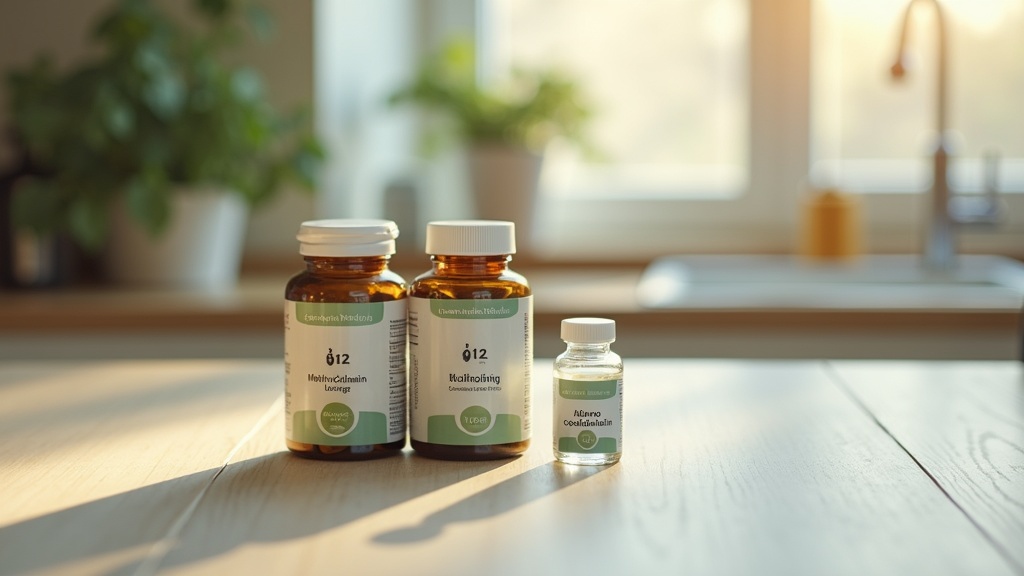
If you searched for b12 methylcobalamin bioavailability, you are probably trying to figure out whether the $40 sublingual methyl bottle does anything the $6 drugstore cyano tablet does not, and whether the "active B12" label on the front is a real biochemical advantage or a marketing line.
Before you decide
Who should NOT pick B12 by feel: anyone with suspected pernicious anemia, anyone on long-term metformin or chronic acid suppression with new fatigue or paresthesia, anyone with a personal or family history of Leber's hereditary optic neuropathy, and any adult with B12 under 200 pg/mL or elevated methylmalonic acid. These are physician calls.
Do this first before buying anything: ask your doctor about a serum B12 with a methylmalonic acid and homocysteine, and if you are vegan, vegetarian, on long-term metformin, on a chronic proton-pump inhibitor or H2 blocker, over 60, or post-bariatric surgery, ask whether a holotranscobalamin (active B12) test makes sense for sensitive detection. Without a number on the page you are guessing.
What bioavailability means for B12
B12 is the most absorption-gated of all the water-soluble vitamins, and that single fact drives the entire form debate. Dietary B12 is bound to protein in food. Stomach acid and pepsin free it, R-binders in saliva carry it through the stomach, pancreatic enzymes hand it off in the duodenum to intrinsic factor, a protein made by parietal cells in the stomach lining, and the intrinsic-factor–B12 complex is then absorbed by the cubilin receptor in the terminal ileum. The whole machine has a saturable ceiling. Active absorption maxes out at roughly 1.5 to 2 mcg per meal regardless of how much B12 was in the bite. Beyond that, only about 1 percent of the additional oral dose is taken up by passive diffusion across the gut wall, and that diffusion route does not need intrinsic factor.
This is why a 1000 mcg oral tablet still works in people without intrinsic factor: 1 percent passive diffusion of 1000 mcg is 10 mcg, well above the 2.4 mcg/day adult RDA per the NIH ODS B12 fact sheet. It is also why a single 5 mcg tablet is not as bioavailable as a 1 mcg dose: the receptor is saturated quickly. Splitting smaller doses across the day captures more total B12 than one large daily tablet in an intact gut.
Once B12 is inside a cell, the form printed on the label stops mattering. All four cobalamins are converted intracellularly into the two active cofactors the body actually uses: methylcobalamin for the cytosolic methionine synthase reaction that recycles homocysteine to methionine, and adenosylcobalamin for the mitochondrial methylmalonyl-CoA mutase reaction that processes propionate and certain amino acids. The trial proxy metrics that matter are serum B12, methylmalonic acid (a sensitive marker that rises in true cellular deficiency), homocysteine, and holotranscobalamin, which measures the active fraction bound to its delivery protein.
The forms compared

Cyanocobalamin
Cyanocobalamin is the synthetic form created during industrial purification and is the form used in nearly every published RCT, every NIH ODS dose recommendation, and every food fortification program in the US. The cobalt atom is bound to a cyanide group, which the body removes during intracellular conversion to the active cofactors. The cyanide load from a 250 to 1000 mcg supplemental dose is trivial in healthy adults. It is cheap at $0.02 to $0.05 per dose, stable on the shelf, and the literature default. Tablets at 250, 500, and 1000 mcg are standard.
Methylcobalamin
Methylcobalamin is one of the two active cofactors found inside cells, so the marketing claim is that it bypasses a conversion step and works immediately at the methionine synthase enzyme. This is technically true and biologically uninteresting in healthy adults, because the intracellular conversion of cyano to methyl is fast and not rate-limiting. Methyl tablets and sublinguals run $0.15 to $0.40 per dose at 1000 mcg. The cases where the methyl preference holds up clinically are narrow: heavy smokers who already carry a chronic cyanide load, the Leber's hereditary optic neuropathy population, and a subset of patients with severe MTHFR polymorphisms convinced they benefit. The general population does not need to pay the premium.
Adenosylcobalamin
Adenosylcobalamin, sometimes sold as dibencozide, is the second active cofactor and the one used by the mitochondrial methylmalonyl-CoA mutase enzyme. It is often paired with methylcobalamin in "complete active B12" or "dual active" products, sometimes with hydroxocobalamin too. The biochemical argument for taking both active forms together is real on paper, since cells need both. Whether the paired product moves clinical markers better than plain cyano at the same total dose in healthy adults is not established in head-to-head trial data. Cost runs $0.20 to $0.50 per dose.
Hydroxocobalamin
Hydroxocobalamin is the prescription form used as an intramuscular or subcutaneous injection. It is the standard for pernicious anemia (autoimmune destruction of intrinsic factor) and for confirmed B12 deficiency where oral absorption is uncertain. It binds more tightly to plasma proteins than IM cyanocobalamin, which extends its retention and lets clinicians dose less often during maintenance, typically every 2 to 3 months after the initial repletion schedule. In the US it is also stocked in emergency departments as the antidote for cyanide poisoning. It is not a consumer product. The IM form is dispensed by prescription and administered by a clinician.
Sublingual lozenges, sprays, and patches
Sublingual and intranasal delivery routes are heavily marketed on the premise of bypassing the gut entirely. The evidence does not support a meaningful absorption advantage for the sublingual route over a swallowed tablet of the same dose in adults with intact gut absorption. The Bulent et al. 2013 trial compared sublingual to oral cyanocobalamin in deficient patients and found both effective at moving serum B12 back into the normal range. Patches and gummies sit in the same evidence space, with sponsor data and limited independent trial work. Pay sublingual prices only if you have a swallowing issue or a clear personal preference, not because the route itself is superior.
| Form | Relative bioavailability vs oral cyano | Typical supplemental dose | Cost per dose (US) | Notes |
|---|---|---|---|---|
| Cyanocobalamin oral | 1.0x (reference) | 250 to 1000 mcg | $0.02 to $0.05 | Cheap, trial-tested, default |
| Methylcobalamin oral or sublingual | ~1.0x in healthy adults | 1000 mcg | $0.15 to $0.40 | Pre-activated, narrow clinical edge |
| Adenosylcobalamin (dibencozide) | ~1.0x in healthy adults | 1000 mcg, often paired with methyl | $0.20 to $0.50 | Mitochondrial cofactor, paired use is biochemically logical |
| Hydroxocobalamin IM | Not directly comparable, full systemic delivery | 1000 mcg per injection | $5 to $15 per shot, clinician administered | Pernicious anemia standard, long plasma retention |
| Sublingual methyl or cyano | ~1.0x vs oral at same dose | 1000 mcg | $0.15 to $0.40 | Route marketing, no proven advantage over swallowed |
The RCT evidence per form
The direct comparative trial evidence in humans is smaller than the supplement aisle implies, and most of the work focuses on whether high-dose oral B12 can replace injections in true deficiency, not on whether methyl beats cyano in healthy adults.
The high-dose oral case rests on the Kuzminski et al. 1998 trial, which randomized 38 newly diagnosed B12-deficient patients to either 2000 mcg oral cyanocobalamin daily or the standard 1000 mcg intramuscular schedule. After 4 months the oral arm had higher serum B12 and equivalent improvement in symptoms. The signal is consistent with the passive-diffusion math: 1 percent of 2000 mcg is 20 mcg/day, well above the daily requirement even without intrinsic factor.
The Andres et al. 2005 work in elderly patients with food-cobalamin malabsorption confirmed that lower oral doses around 650 to 1000 mcg/day corrected most cases of deficiency in this population, again with cyanocobalamin. The Wang et al. 2018 Cochrane review of oral vs intramuscular vitamin B12 pulled together the trial-level evidence and concluded that high-dose oral cyanocobalamin produces comparable hematological and neurological responses to IM dosing in most patients, with the caveat that severe neurological deficiency and clear malabsorption are still managed by injection in the initial phase.
The methyl-vs-cyano comparative data is much thinner. There is no large, well-powered RCT in general supplementation populations showing that oral methylcobalamin produces better serum B12, methylmalonic acid, homocysteine, or functional outcomes than oral cyanocobalamin at the same dose in healthy adults. The methyl preference in MTHFR-variant carriers is theoretical, extrapolated from the methylation cycle diagram rather than from head-to-head trials. That does not make it wrong, but it does mean the price premium is paid on mechanism plausibility rather than on outcome data.
Actionable takeaway: the evidence-based default for most adults is oral cyanocobalamin at 250 to 500 mcg daily, with the move to high-dose oral 1000 to 2000 mcg or to injectable hydroxocobalamin reserved for confirmed deficiency under physician care.
Cost-vs-bioavailability decision matrix
Here is the honest math. A 500 mcg oral cyanocobalamin tablet at $0.03 works out to $0.00006 per mcg on the label. A 1000 mcg sublingual methylcobalamin at $0.30 is $0.0003 per mcg, roughly 5 times more per microgram. If functional absorption and intracellular conversion are equivalent in a healthy adult, the cyano dose closes the same gap for one fifth the cost.
When does the premium form pay off? In a small set of cases. Heavy smokers carrying a chronic background cyanide load, anyone with a personal or family history of Leber's hereditary optic neuropathy, and patients managing severe combined MTHFR polymorphisms under a clinician's guidance have a defensible reason to choose methyl. Pregnant patients have no required form preference and should follow their OBGYN's prenatal recommendation rather than self-select an "active" stack.
When is plain cyano fine? General adult daily supplementation, vegan or vegetarian baseline cover, post-meal top-off in older adults with food-cobalamin malabsorption, and most deficiency repletion in the high-dose oral 1000 to 2000 mcg/day range under physician supervision.
When is injectable hydroxocobalamin the right answer? Pernicious anemia, severe deficiency with neurological symptoms, post-gastrectomy or post-bariatric malabsorption that has failed high-dose oral, and any patient in whom oral absorption cannot be relied on. This is a physician decision, not a consumer one.
How to choose the right form for your goal
If you are a generally healthy omnivore looking for baseline insurance
You probably do not need a B12 supplement. The 2.4 mcg/day adult RDA per the NIH ODS B12 fact sheet is covered by about a half-cup of milk, an egg, and a 3-ounce serving of fish or meat across a typical day. If you want a low-cost insurance dose, 250 to 500 mcg cyanocobalamin a few times a week is more than sufficient.
If you are vegan or vegetarian
You need a deliberate B12 plan, because plant foods do not reliably supply it. Two evidence-grounded options: 250 to 500 mcg cyanocobalamin daily, or 1000 mcg cyanocobalamin or methylcobalamin twice weekly. Fortified nutritional yeast and fortified plant milks help, but a supplement is the reliable backstop. Brands like Jarrow Methyl-B12 and NOW Foods B-12 are widely available at the studied doses. Ask your doctor about a baseline serum B12 and methylmalonic acid before assuming you are low.
If you are over 60 with a typical diet
Food-cobalamin malabsorption rises with age because of lower gastric acid output. A 500 to 1000 mcg cyanocobalamin tablet daily, taken between meals so it relies on passive diffusion, is a defensible move whether or not your serum B12 is borderline. Confirm with a serum B12 plus methylmalonic acid through your physician.
If you are on long-term metformin or chronic acid suppression
Per the NIH ODS B12 fact sheet, long-term metformin lowers B12 status in a meaningful share of patients, and chronic proton-pump inhibitor or H2 blocker use impairs the acid-dependent release of B12 from food. Ask your physician about a baseline serum B12 and methylmalonic acid, and discuss adding 500 to 1000 mcg cyanocobalamin daily if your numbers are borderline or low.
If you are a heavy smoker or have a personal or family history of Leber's hereditary optic neuropathy
Skip cyanocobalamin and choose methylcobalamin or hydroxocobalamin instead. The cyanide load is biologically trivial in healthy adults but is the wrong default for these specific subgroups. This is a small population, and it is also a clinician conversation rather than a consumer pick.
If you suspect pernicious anemia or have B12 under 200 pg/mL with elevated methylmalonic acid
This is a physician case. Hydroxocobalamin injection is the standard repletion path for confirmed pernicious anemia. High-dose oral cyanocobalamin at 1000 to 2000 mcg/day is the trial-supported alternative in patients without severe neurological involvement. Do not self-manage active deficiency. Consult your physician.
If you are pregnant
The B12 RDA in pregnancy is 2.6 mcg/day per the NIH ODS B12 fact sheet. Most prenatals already meet this. If you are vegan or vegetarian and pregnant, talk to your OBGYN about whether the prenatal B12 dose plus your diet pattern is enough or whether a stand-alone B12 add-on is appropriate. Consult your OBGYN before adding B12 beyond the prenatal.
FAQ
Is methylcobalamin worth the extra money? For most healthy adults, no. The intracellular conversion of cyano to the active methyl and adeno forms is fast and not the rate-limiting step in B12 metabolism. The narrow exceptions are heavy smokers, Leber's optic neuropathy carriers, and patients on a clinician-guided methylation protocol.
I have an MTHFR variant. Do I need methyl-B12? The MTHFR-methyl logic is biochemically plausible and clinically unproven. Comparative trials in MTHFR-variant carriers showing better outcomes from methyl-B12 vs cyano at the same dose are not well established. If you are convinced you benefit, 1000 mcg methyl daily is harmless if not necessary. Save the conversation about a serious supplementation protocol for a clinician familiar with your full panel.
Why does the trial dose differ from the label dose? Repletion trials use 1000 to 2000 mcg/day specifically to overwhelm the saturable intrinsic factor pathway and rely on passive diffusion. Daily maintenance doses on supplement labels are usually 250 to 1000 mcg because they are aimed at adults with intact absorption, where smaller daily amounts work fine.
Does B12 interact with my medications? Yes, in specific ways. Per the NIH ODS B12 fact sheet and the Drugs.com cyanocobalamin interactions monograph, long-term metformin lowers B12 status in many patients and warrants periodic B12 monitoring, chronic proton-pump inhibitor and H2 blocker use impairs B12 absorption from food, and the antibiotic chloramphenicol can suppress the bone-marrow response to B12 in patients being treated for anemia. Review your full med list with your pharmacist or prescriber.
Can I overdose on B12? The risk is very low. There is no tolerable upper intake level set for B12 because excess oral B12 is poorly absorbed and the kidneys clear what does make it through. Megadose marketing is not biologically harmful in healthy adults, just unnecessary. The concern is the opposite case: high-dose B12 can mask the hematological signs of folate deficiency, so do not self-prescribe an aggressive B12 regimen without your folate status checked too.
Conclusion: the bottom line on B12 bioavailability
For most adults with a healthy gut, plain cyanocobalamin at 250 to 500 mcg daily, or 1000 mcg a couple of times a week, is the right answer. It is functionally equivalent to methylcobalamin at the receptor once your cells convert it, it is the form used in nearly every published trial and in the NIH dose recommendations, and it costs a fraction of the premium active-form products. Methylcobalamin and adenosylcobalamin earn their price in a small set of cases: heavy smokers, Leber's carriers, severe MTHFR polymorphisms, and patients on a clinician-guided methylation protocol. Hydroxocobalamin injection is the standard for pernicious anemia and severe deficiency, and it is a prescription product administered by a clinician, not a consumer pick.
Before any of this, ask your doctor about a serum B12 with a methylmalonic acid and homocysteine, especially if you are vegan, on long-term metformin, on chronic acid suppression, over 60, or post-bariatric surgery. B12 is one of the few supplements where blood work decisively changes the recommendation, and where the difference between a 250 mcg daily tablet and a clinician-managed injection schedule is the difference between insurance and active treatment.
Next steps
- Read how we review supplements to see what testing standards we use to vet brands.
- Read the complete guide to B vitamins for the broader picture on the whole B-complex, the folate-B12 interaction, and how to read a B vitamin label.
- See more from Sarah Thompson, RD for the rest of the vitamin and mineral coverage.
This article is for informational purposes and not medical advice. B12 supplements and status are affected by long-term metformin use, chronic proton-pump inhibitor or H2 blocker use, and the antibiotic chloramphenicol. Consult a licensed physician before starting any supplement, particularly if you are pregnant, nursing, taking prescription medications, or managing a chronic condition, and especially before self-treating suspected B12 deficiency.
Reviewed by Sarah Thompson, Registered Dietitian, focused on vitamin and mineral nutrition.
Recommended Products


As an Amazon Associate, UsefulVitamins.com earns from qualifying purchases at no extra cost to you. We only recommend products supported by published research or third-party testing.
