
Affiliate disclosure: this article contains affiliate links. As an Amazon Associate, UsefulVitamins.com earns from qualifying purchases at no extra cost to you.
What you are actually choosing between
The format question feels like the whole decision, but for a healthy child it usually is not. A kid eating a reasonable spread of food rarely needs a daily multivitamin in the first place, and the American Academy of Pediatrics holds that healthy children on a balanced diet do not need vitamins beyond the recommended dietary allowances. So before you compare gummies to drops, the honest first move is to ask whether the supplement is needed at all.
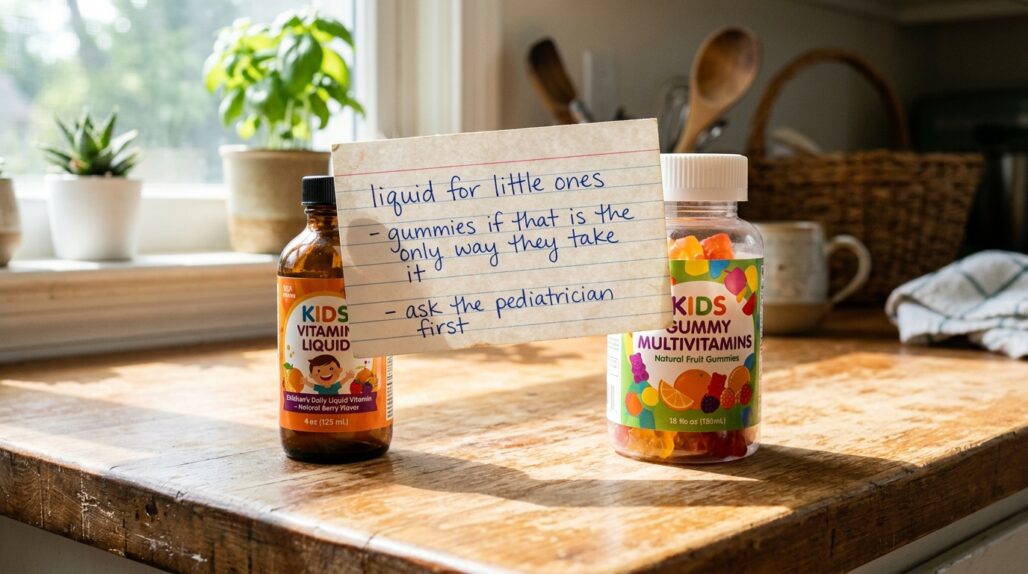
Where a supplement does make sense, the real trade-offs are willingness, dosing accuracy, sugar, and safety. Gummies win cooperation. Liquids win precision for the smallest kids. Chewables sit in the middle. None of them is automatically "best."
That is why this page is a decision guide, not a single verdict. If you want help deciding whether a daily multi earns its place, our breakdown of whether multivitamins are worth the money is the better starting point.
Gummies: best for willingness, worst for sugar and safety optics
The case for gummies is simple. A child who fights a spoonful of liquid will often take a gummy without a word, and the supplement a kid actually takes beats the one that ends up in the sink. For picky eaters, that adherence advantage is real.
The cost shows up in three places. First, sugar. A typical gummy vitamin carries roughly 2 to 8 grams of sugar per serving, usually as glucose syrup or sucrose. Sticky, sweet products that cling to teeth raise cavity risk when brushing is inconsistent, which is why pediatric dentists flag them.
Second, dosing accuracy. Gummies have historically tested over and under their label claims more than tablets do, so the number on the panel is less reliable than it looks. Third, and most important, gummies look and taste like candy. That is the whole problem.
A child who sees a jar of fruit-shaped vitamins does not see medicine. They see a treat, and a treat is something you eat as much of as you can reach. So the format that wins on willingness is also the one most likely to be over-eaten if it is left within reach.

Liquid: the easiest format to dose for little kids
For infants and young toddlers, liquid drops are the most flexible and titratable format. You can give a fraction of a milliliter to a six-month-old or scale up for a four-year-old, which capsules and gummies cannot do. This is why nearly every infant vitamin D product is a liquid.
There is a real caveat the FDA has flagged. In a 2010 alert, the agency warned that some infant vitamin D droppers can hold far more than the 400 IU an infant should get in a day, which makes an accidental overdose easy if you measure by eye. The fix is boring and effective: use only the dropper that comes with the product, and never substitute a kitchen spoon.
Liquids do have downsides. They can taste bitter, they stain, and an opened bottle does not last forever. But for the youngest children, the ability to dial in an exact dose outweighs all of that.
Chewables: the middle ground for older kids
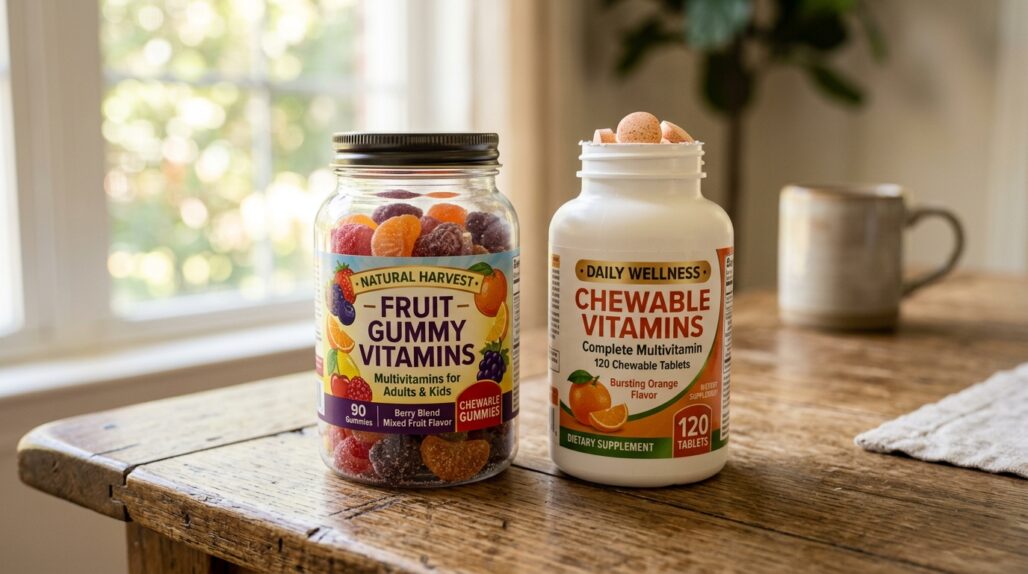
Chewable tablets split the difference. They carry less sugar than most gummies, hold their stated dose more reliably, and feel less candy-like, which slightly lowers the "eat the whole jar" temptation.
The catch is age. Chewables are generally only appropriate for children who can chew hard pieces without choking, usually around age three or older. For a one- or two-year-old, a chewable is a choking risk and a liquid is the safer call.
Chewables also still contain flavor and sometimes sugar or sugar alcohols, so they are not a free pass on dental care. Brushing after, or at least rinsing, still matters.
How the formats compare at a glance
Here is the practical side-by-side. Read it as a starting filter, not a prescription, and confirm the specifics with your pediatrician.
| Format | Best for | Dosing accuracy | Sugar / dental | Main safety watch-out |
|---|---|---|---|---|
| Liquid drops | Infants and young toddlers | High – titratable by the drop or mL | Usually low sugar | Use only the supplied dropper; bottle can overfill a dose |
| Chewable tablet | Kids roughly 3 and older | Good and consistent | Moderate; some have sugar or sugar alcohols | Choking risk below age 3 |
| Gummy | Picky kids who refuse anything else | Lower; tends to vary from the label | Highest; sticky and cavity-prone | Looks like candy; easy to over-eat if reachable |
Notice what the table does not say: it does not name a single winner. The right format depends on the child's age, the nutrient, and whether cooperation is the bottleneck.
The overdose angle you cannot skip
This is the part that moves the kids supplement question into genuine health territory. The danger is not the daily dose. It is the child finding the bottle.
Iron is the one to respect most. A one-time accidental dose of a low-iron multivitamin usually causes nothing worse than an upset stomach, but iron is different. Per the StatPearls toxicology review, ingesting under 20 mg/kg of elemental iron is generally non-toxic, 20 to 60 mg/kg causes moderate symptoms, and above 60 mg/kg can cause severe toxicity. In a small child, an adult or prenatal iron pill stash can reach that range fast.
History backs this up. The National Capital Poison Center notes iron was once the leading cause of poisoning deaths in young children, partly because the tablets look like chocolate candy. That is exactly why the FDA later required warning labels on iron-containing products and, for a time, pushed unit-dose blister packaging for products with 30 mg or more of iron per dose.
Iron is not the only fat-soluble worry. Vitamin A can build up too. The NIH Office of Dietary Supplements sets the preformed vitamin A upper limit at 600 mcg/day for the youngest children, climbing with age, and a child already eating vitamin-A foods can edge toward that line once a supplement is added.
The practical rules:
- Store every supplement locked or high and out of sight, the same as medicine, not on the breakfast table.
- Never call them candy to coax a child into taking them.
- Treat iron-containing products with extra caution and keep adult and prenatal bottles entirely separate from the kids' shelf.
- If your child takes magnesium or another mineral for a specific reason, our note on magnesium supplements for kids covers why dose and form get decided with a pediatrician, not guessed.
If a child does eat more than their dose, call Poison Control at 1-800-222-1222 right away, even if they seem fine. Iron in particular can look calm for hours before turning serious.

Which kids format to buy
The honest framing: buy the format that fits your child's age, then let willingness break the tie. For a baby or a toddler under three, that means a liquid. For an older child who tolerates it, a chewable keeps sugar and dosing in check. A gummy is the right buy only when it is genuinely the difference between your child taking a needed supplement and refusing everything else.
Whatever you choose, pick a product that is third-party tested, skip iron unless a pediatrician specifically recommended it, and check the sugar line on gummies. The brand matters less than the fit and the storage.

As an Amazon Associate, UsefulVitamins.com earns from qualifying purchases at no extra cost to you.
UsefulVitamins may earn a commission from purchases made through links on this page, at no extra cost to you. We only suggest formats; your pediatrician confirms the choice.
If you are stacking several products on top of a daily multi, it is worth a quick gut-check with our supplement self-audit on taking too many before adding more to a child's routine. And if you are choosing a family multi for yourself at the same time, our guide to the best multivitamin for women keeps the adult bottle separate from the kids' shelf, which is exactly where it should stay.
FAQ
Are gummy vitamins bad for kids? Not inherently, but they carry more sugar, tend to vary from their label dose, and look like candy, which raises both cavity and over-eating risk. A low-sugar gummy can still be reasonable for a child who refuses every other format, as long as it is stored out of reach.
What is the best vitamin format for a toddler under three? A liquid, in most cases. Drops let you give a precise small dose and avoid the choking risk that chewables and gummies pose to very young children. Use only the dropper the product comes with.
Can a child overdose on gummy vitamins? A one-time accidental dose of a low-iron children’s multivitamin usually causes only mild stomach upset, but iron-containing products are far more dangerous and can cause serious toxicity. If your child eats more than their dose, call Poison Control at 1-800-222-1222 regardless of how they look.
Do healthy children even need a multivitamin? Often no. The American Academy of Pediatrics holds that healthy kids eating a varied diet generally meet their needs without a daily multi, with exceptions like vitamin D and iron in specific situations. Ask your pediatrician before starting anything.
Why is iron singled out as the big risk? Iron tablets look like chocolate candy to a child, and a small body reaches a toxic dose quickly; ingesting more than 60 mg/kg of elemental iron can cause severe toxicity. It was historically a leading cause of poisoning deaths in young children, which is why iron products carry strong warning labels.
Is sugar-free better for kids’ teeth? It helps, but sugar-free gummies still contain citric acid and sticky binders that can erode enamel and cling to teeth. Brushing or rinsing after any chewable or gummy, sugared or not, is the more reliable habit.
The bottom line
The best kids supplement format is the one that matches the child's age and gets taken reliably without becoming a safety hazard. Liquid for the littlest kids, chewable for older ones who can handle it, gummy only when willingness is the real barrier – and a pediatrician's input before any of it. The format is a small lever; the bigger levers are whether the supplement is needed, what dose is right, and where the bottle lives.
Keep iron-containing products away from children entirely unless a doctor said otherwise, store everything locked and out of sight, and save the Poison Control number. Then pick the format your child will actually take.
This article is general education, not medical advice for your child. Dosing and the decision to supplement at all belong to your pediatrician, who knows your child's diet, weight, and health. Never start, stop, or change a supplement or prescription based on a web page.
Reviewed by the UsefulVitamins Editorial Team.
