
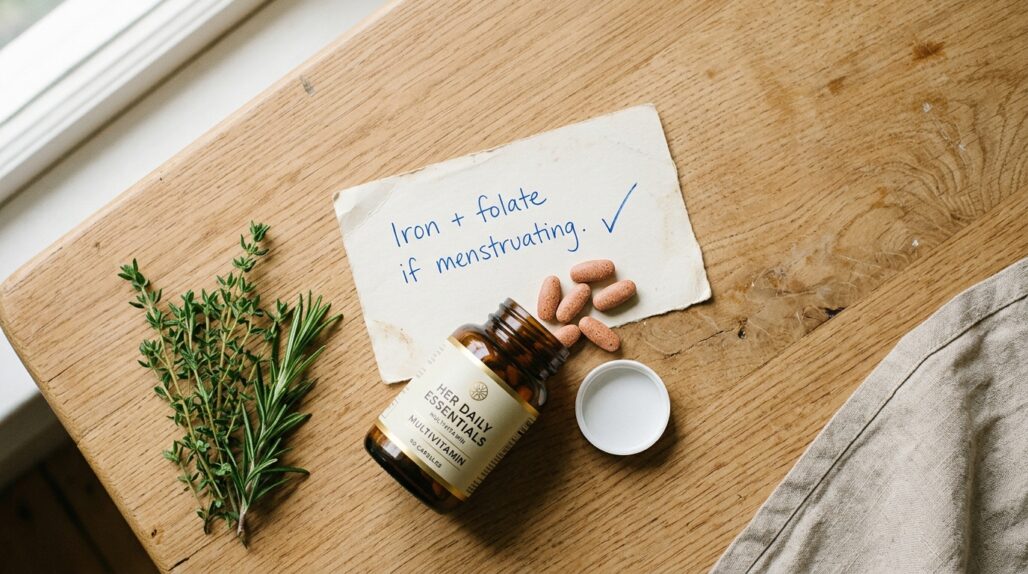
If you're standing in front of a wall of "women's" multivitamins trying to figure out which one is worth it, here's the part the marketing buries: most of what's printed on a pink label is the same multivitamin sold to everyone, with two nutrients dialed up. Those two are the only genuinely female-specific levers, and they're what I'd actually check before paying a premium. The picks at the end are the ones I keep in my own family's cabinet for exactly this reason.
This guide sorts the two nutrients that change by sex and life stage from the dozen that don't, so you buy for your body rather than for the packaging.
Affiliate disclosure: this article contains affiliate links. As an Amazon Associate, UsefulVitamins.com earns from qualifying purchases at no extra cost to you.
Before you decide

A multivitamin is insurance, not a diagnosis. If you're tired, your periods are heavy, or you suspect you're low on something, the most useful thing you can do is ask your doctor for a blood test before guessing which pill to buy.
Iron is the clearest example. Persistent fatigue with heavy menstrual bleeding is the classic picture of iron deficiency, but it can also signal thyroid problems, B12 deficiency, or other issues a multivitamin won't fix. A ferritin and a basic blood count answer the question a supplement only papers over.
A few women should not casually add iron at all. If you've been told you have hereditary hemochromatosis, or you're a postmenopausal woman with no clear deficiency, extra iron is a risk, not a benefit. I'll come back to why below.
If none of that applies and you eat reasonably well, a women's multi is a low-stakes way to cover small gaps. You can see how I weigh the evidence and conflicts of interest on the how we review supplements page, and if you want the broader picture across all life stages, start with my complete guide to multivitamins.
What a woman's multi should contain
Strip the branding away and a women's formula is a standard multivitamin with the iron and folate turned up. Almost everything else, the vitamin C, zinc, B-complex, vitamin E, is the same dose you'd find in a unisex product.
Iron is the real headline. Because menstruation loses iron every cycle, the NIH Office of Dietary Supplements sets the RDA at 18 mg/day for women aged 19 to 50, versus just 8 mg/day for men and postmenopausal women. A multi that delivers around 18 mg of iron is doing the one thing a "women's" label should.
The catch is dietary intake. NIH data put the average woman's intake at roughly 12 to 14 mg of iron a day, below the 18 mg target, which is exactly the gap a women's multi is designed to close, not a reason to megadose.
How big the menstrual gap gets depends on your flow, and that's where a lot of women are quietly running on empty. In one screening study of young women with heavy menstrual bleeding, about half were iron deficient (ferritin under 20 ng/mL), yet fewer than half of those cases showed up on a standard blood count alone, as the review on iron deficiency without anemia documents. Your hemoglobin can read normal while your stores are scraping bottom.
That distinction matters for how you use a multi. Iron deficiency without anemia is the early stage, and it's the one a daily 18 mg multi is well-suited to cover, because you're topping up depleted stores rather than treating a diagnosed anemia, which usually needs a higher therapeutic dose your doctor prescribes. If your periods are genuinely heavy, a multi's iron is a floor, not a fix, and ferritin is the number to ask about.
Folate is the second lever, and it matters most for women who could become pregnant. The neural tube closes within the first month after conception, often before a woman knows she's pregnant, which is why folate has to already be on board.
The CDC recommends that all women capable of becoming pregnant get 400 mcg of folate daily to reduce the risk of neural tube defects. A women's multi at this dose is one of the few supplement recommendations with truly strong public-health evidence behind it.
The timing is the whole reason this is a daily habit, not a once-pregnant errand. The neural tube becomes the brain and spinal cord, and defects like spina bifida trace to that early closure, so folate has to be at adequate levels before conception, not started at the first positive test. Because roughly half of pregnancies are unplanned, the recommendation deliberately covers every woman who could conceive, planned or not.
This is also where the methylfolate marketing usually gets oversold. You'll see premium "women's" multis charge extra for L-methylfolate on the promise that it bypasses the common MTHFR gene variant, but the CDC is explicit that folic acid raises blood folate regardless of MTHFR genotype and does not recommend testing for the variant. Methylfolate is a fine form if you prefer it, but for neural-tube protection it is a preference, not a medical necessity that ordinary folic acid fails to deliver.
| Nutrient | Why it’s the female-specific lever | Target on the label |
|---|---|---|
| Iron | Menstrual losses raise the requirement; intake often falls short | ~18 mg while menstruating; 0 mg after menopause |
| Folate | Protects a future pregnancy before it’s known | 400 mcg DFE for childbearing-age women |
| Vitamin D | Common shortfall, but not female-specific | 600 IU (1-70), 800 IU (over 70) |
| Calcium | Matters for bone health, but absorption is dose-limited | Best from food or a separate split dose |
Vitamin D deserves a mention because it's the gap many women actually have. The NIH puts the RDA at 600 IU for ages 1 to 70 and 800 IU after 70, but it isn't sex-specific, so it's a multivitamin feature, not a "women's" one.
When to switch
This is the part most roundups skip, and it's the single most important decision in this whole category: the multivitamin that's right for you at 30 is the wrong one at 60.
The trigger is menopause. Once menstrual losses stop, the iron RDA drops from 18 mg back down to 8 mg, the same as for men, because you're no longer shedding iron every month.
Here's the physiology that makes this matter. The body has no active way to excrete excess iron; the only routes out are bleeding and the slow shedding of gut cells, as the StatPearls review on iron toxicity lays out. Lose the monthly bleed, keep taking an iron-heavy "women's" multi, and iron quietly accumulates.
That's not a hypothetical. A clinical case series documented iron overload in people who took iron supplements for years without a real deficiency, including women who continued an iron formula long after menopause. For most postmenopausal women, the correct supplement is a multivitamin labeled "iron-free" or "for adults 50+."
The drop happens even without supplements, which is exactly why adding iron on top is the wrong direction. Once the monthly bleed stops, iron stores climb on their own; research tracking the menopausal transition shows ferritin rises sharply in the year around the final period, and average postmenopausal ferritin runs more than double the premenopausal level, per the data on body iron stores in postmenopausal women. Your body is already moving from "losing iron monthly" to "banking it," so the formula should follow.
There's a practical wrinkle in the transition itself: perimenopause is messy. Periods can stay heavy or erratic for years before they stop, so the switch to an iron-free multi isn't a birthday you can mark in advance, it's a decision to make once cycles have genuinely ended, ideally confirmed with a ferritin check rather than guessed from the calendar. If you're unsure where you are, that's the time to test rather than assume.
Pregnancy moves the dial the other way. Iron needs jump to 27 mg/day and folate becomes non-negotiable, which is why prenatal formulas exist as a separate category. If you're pregnant or trying, that's a conversation with your OB, not a shelf decision.
I cover the post-menopause transition in much more depth, including bone and B12 considerations, in my guide to the best multivitamin for women over 50.
What to look for when buying

Once you know your iron-and-folate target, the rest of the label sorts itself quickly. Three features separate a serious product from a marketing one.
First, the folate form. You'll see either "folic acid" or "folate (as L-methylfolate)." For neural tube protection, the CDC is clear that folic acid works, and works regardless of MTHFR gene status, so don't let "methylfolate" marketing scare you into thinking the standard form fails you.
Methylfolate is a reasonable choice and may sit better with some people, but the CDC explicitly states there's no recommendation to test for MTHFR or to take a different folate based on it. Either form, at 400 mcg, does the job; pick on price and tolerance, not on fear.
Second, the iron form and amount. Iron from a multi is usually ferrous fumarate, gluconate, or bisglycinate. Bisglycinate (chelated iron) tends to be gentlest on the gut, which matters if standard iron leaves you constipated, while the amount should land near 18 mg for menstruating women and zero for everyone past menopause.
Third, third-party testing. Supplements aren't pre-approved by regulators, so a USP, NSF, or ConsumerLab seal is your independent check that the bottle contains what the label claims. It's the cheapest insurance on the whole purchase.
One timing note that ties the category together: calcium blocks iron absorption. A study in postmenopausal women found calcium meaningfully reduced iron uptake, and since the NIH notes calcium absorbs best in doses of 500 mg or less, a big calcium-plus-iron "women's" pill is working against itself. Take calcium separately, ideally from food.
The size of that interference is dose-dependent, which is the part worth understanding. Single-meal absorption work found that even modest calcium amounts can cut iron uptake from that meal by roughly half, with the inhibition rising as the calcium dose climbs, per the research on calcium and nonheme- and heme-iron absorption. It's the calcium and iron sitting in your gut at the same moment that causes the clash, not your daily total.
The fix is just spacing, not avoidance. If you're a menstruating woman who needs both, take your iron-containing multi at one time and any calcium supplement, or the big dairy serving, at another, a few hours apart. Pairing iron with a little vitamin C, on the other hand, pushes absorption the right way, which is why a multi often lists both together.
Recommended Products
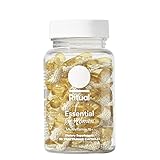


As an Amazon Associate, UsefulVitamins.com earns from qualifying purchases at no extra cost to you. We only recommend products supported by published research or third-party testing.
FAQ
Do I really need a "women's" multivitamin, or will any multi do?
The label only matters for iron and folate. If a unisex multi gives you ~18 mg iron and 400 mcg folate while you're menstruating, it's functionally a women's formula. After menopause, an iron-free general multi is often the better pick.
Is methylfolate better than folic acid for women with MTHFR?
Not for neural tube protection. The CDC says folic acid raises blood folate regardless of MTHFR genotype and does not recommend testing for it. Methylfolate is a fine alternative if you prefer it, but it isn't a medical upgrade for most people.
Should I take iron after menopause?
Usually not, unless a blood test shows a deficiency. Your iron RDA drops to 8 mg once periods stop, and because the body can't easily clear excess iron, routine supplementation can lead to overload. Choose an iron-free 50+ multi by default.
Can a multivitamin replace a prenatal if I'm trying to conceive?
No. Prenatals carry more folate and iron and add nutrients like choline and iodine that standard multis underdose. If you're pregnant or trying, ask your doctor about a dedicated prenatal rather than relying on a women's multi.
My blood count came back normal, so why am I still exhausted, can iron still be the issue?
Yes, it can. A normal hemoglobin rules out anemia, but not iron deficiency, because your stores can be depleted while your blood count still reads in range. That's why the relevant test for fatigue with heavy periods is ferritin, not just a standard count. Ask for it specifically rather than assuming a normal CBC clears iron.
When should I take my multivitamin if I also take a calcium supplement?
Separate them by a few hours. Calcium and iron compete in the gut, and a meaningful share of a meal's iron can be lost when both are present at once. Take your iron-containing multi at one time and calcium at another; iron also pairs well with a little vitamin C, while calcium is best taken with food.
Why is my multivitamin making me constipated?
Iron is the usual culprit. Switching to a chelated iron (bisglycinate) form or a lower iron dose often helps, and pairing it with vitamin C while spacing it away from calcium improves absorption so you're not taking more than you need.
The bottom line on women's multivitamins
A "women's" multivitamin is not a different product; it's a standard multi with two nutrients adjusted for one biological reality. Iron while you menstruate and folate during your childbearing years are the only levers that genuinely change with sex and life stage, and everything else on the label is the same vitamin you'd buy unlabeled.
The decision most roundups miss is the one that matters most over a lifetime: drop the iron after menopause. Your requirement falls by more than half, your body can't dump the excess, and the formula that served you at 30 becomes a quiet liability at 60.
So match the iron to where you are, get 400 mcg of folate in either form if pregnancy is possible, take calcium separately, and ask for a blood test before you assume you're low. Buy for your body, not for the color of the box.
Reviewed by Sarah Thompson, Registered Dietitian, focused on vitamin and mineral nutrition. See more from Sarah Thompson. This article is educational and is not a substitute for individualized medical advice; talk to your doctor before starting a supplement, especially if you are pregnant, trying to conceive, postmenopausal, or managing a diagnosed condition.
As an Amazon Associate we earn from qualifying purchases. Product links may be affiliate links.
