
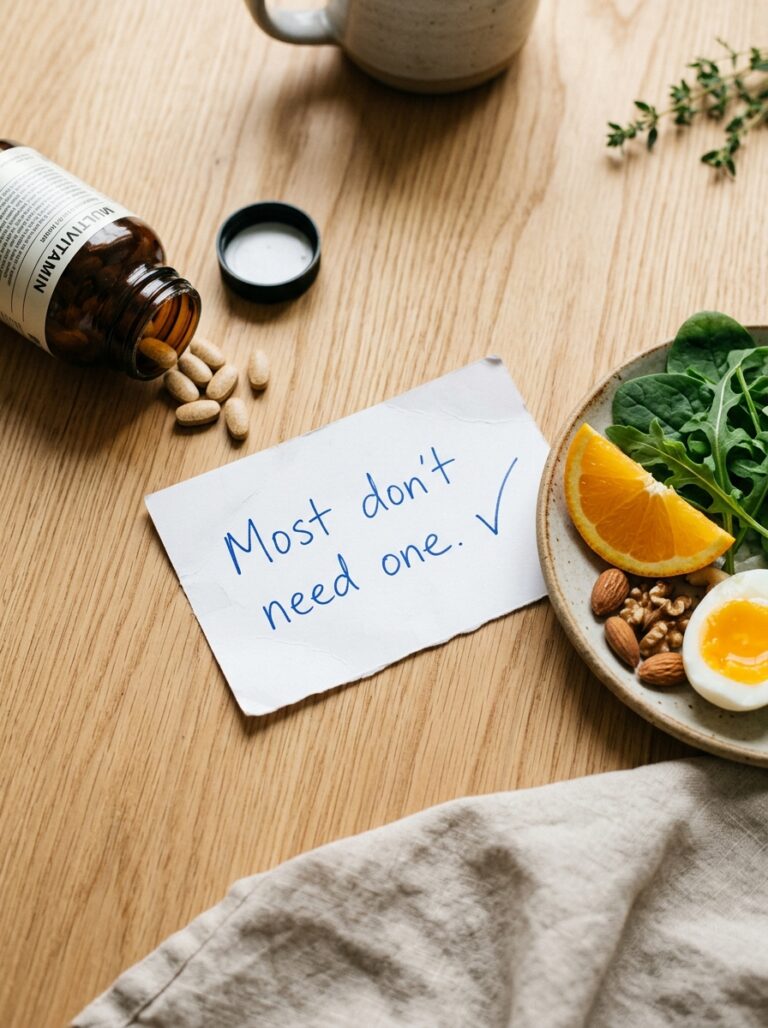
Walk into any pharmacy and the multivitamin shelf reads like an insurance policy you'd be foolish to skip: one tablet, every base covered, peace of mind for a dollar a day. The trials that actually tested that promise tell a quieter story. For most adults who eat a reasonably varied diet, a daily multivitamin doesn't move the outcomes people buy it for.
This guide walks through what the big randomized trials found, who genuinely has a gap worth filling, and why the smartest version of "covering your bases" is usually two or three targeted nutrients, not a 27-ingredient tablet.
Before you decide

A multivitamin is low-risk for most people, but "low-risk" is not the same as "useful." Before you add one, the more honest first question is whether you have a gap at all, and the most reliable way to answer that is your diet and, where relevant, blood work.
If you take prescription medication, a few interactions are worth knowing. Vitamin K in a multi can blunt warfarin, and the iron, calcium, magnesium, and zinc in a tablet can bind certain antibiotics and thyroid medication and reduce their absorption. Separate doses and check with your pharmacist.
People who smoke or have heavy asbestos exposure should specifically avoid high-dose beta-carotene, which raised lung-cancer risk in trials. That's one reason a megadose "high-potency" formula is not automatically the safer choice.
If your goal is a specific symptom, fatigue, low mood, brittle nails, a multivitamin is a scattershot answer to a question that deserves a targeted one. Ask your doctor about a blood test for the usual suspects, ferritin, vitamin D, and B12, before assuming a broad tablet is the fix. You can see how I weigh evidence and conflicts of interest on the how we review supplements page.
What a multivitamin actually is

There's no legal definition of "multivitamin." The NIH Office of Dietary Supplements notes the term covers everything from a simple A-to-zinc tablet to "high-potency" formulas with two dozen-plus ingredients at very different doses. Two products on the same shelf can share a name and almost nothing else.
A typical broad-spectrum multivitamin-mineral (MVM) supplies the fat-soluble vitamins A, D, E, and K; the B-complex; vitamin C; and a set of minerals like zinc, selenium, copper, iodine, and often iron. Most provide somewhere around 100% of the Daily Value for the vitamins, though minerals like calcium and magnesium are usually under-dosed because a full day's worth wouldn't fit in one pill.
The logic of the product is breadth: a little of everything so no single base is uncovered. The catch is that "a little of everything" assumes you're low on everything, which, for someone eating a varied Western diet, is rarely true.
As a dietitian, this is where I anchor. Nutrient needs are best met from food, and a multivitamin earns its place when the diet genuinely can't cover a requirement, not as a default reflex. The fortification already built into the food supply, in cereals, flour, milk, and salt, means many people are quietly closer to their targets than they assume.
What the big trials show
This is the part the marketing skips. Multivitamins have been tested in large, long, randomized trials, the strongest kind of evidence, and on the outcomes that matter most the results are mostly flat.
The landmark trial is the Physicians' Health Study II, which randomized about 14,600 male physicians to a daily multivitamin or placebo for over a decade. For cancer, the multivitamin produced a modest but real 8% reduction in total cancer incidence, the single most-cited "win" for multivitamins. But in the same cohort, the cardiovascular arm found no reduction in heart attacks, strokes, or cardiovascular death.
In 2022 the US Preventive Services Task Force reviewed 84 studies and concluded the evidence is insufficient to recommend multivitamins for preventing cardiovascular disease or cancer, while recommending against beta-carotene and vitamin E outright.
The newest twist is cognition. The COSMOS-Mind trial and its pooled analysis found a daily multivitamin modestly slowed cognitive aging in older adults, an encouraging signal the investigators themselves flagged as needing confirmation.
| Outcome | What the trials found | Strength of signal |
|---|---|---|
| All-cause mortality | No reduction in living longer | Consistently null |
| Cardiovascular disease | No reduction in heart attack or stroke (PHS II) | Null |
| Total cancer | Small 8% drop in men (PHS II) | Modest, real, men only |
| Cognitive aging | Modest slowing in older adults (COSMOS) | Promising, needs confirmation |
The honest read: a daily multi does not help you live longer or protect your heart, gives a small cancer-incidence edge in one male cohort, and may nudge cognition in older age. That is a far thinner case than "covers all your bases."
Who actually benefits (and who's wasting money)

The evidence isn't "multivitamins are useless." It's that the benefit is concentrated in specific groups with real, predictable gaps, and largely absent in everyone else. Match yourself to the list rather than the marketing.
Pregnancy and anyone planning it have the clearest case. The US Preventive Services Task Force recommends 400 to 800 mcg of folic acid daily for all women who could become pregnant, started before conception, because it prevents a large share of neural-tube defects. A prenatal multivitamin is the convenient delivery vehicle, and iron needs climb in pregnancy too.
Vegans and strict vegetarians need a reliable B12 source, because the vitamin is found almost entirely in animal foods. A multivitamin or a standalone B12 both work; the point is that the gap is real and food won't close it.
Older adults are a genuine case for a different reason: absorption. Up to 10 to 30% of people over 50 lose the stomach acid needed to free B12 from food, so the NIH flags supplemental or fortified B12 for this group even when intake looks adequate on paper.
Add restricted or very-low-calorie diets, malabsorption conditions like celiac or Crohn's, and people after bariatric surgery, where multiple deficiencies are expected and supplementation is part of standard care.
Who's likely wasting money: a healthy adult eating a varied, mostly whole-food diet who takes a multi "just in case." That's the population the Annals of Internal Medicine editorial bluntly told to "stop wasting money," and on the hard outcomes the data backs them up.
What to look for IF you take one
If you're in a group that benefits, or you simply want the insurance and accept the modest evidence, a few label habits separate a sensible tablet from a marketing one. More is not the goal; matching real needs without overshooting is.
Favor doses near 100% of the Daily Value, not "high-potency" megadoses. A formula at 1,000% of several vitamins isn't filling a gap, it's stacking water-soluble vitamins you'll excrete and fat-soluble ones that can accumulate. The intake the average diet already provides plus a 100%-DV tablet rarely leaves a meaningful shortfall.
Check the form of the nutrients that matter. Look for B12 as methylcobalamin or cyanocobalamin (both work), folate as folic acid or methylfolate, and vitamin D as D3 (cholecalciferol) rather than the weaker D2.
Decide whether you want iron. Premenopausal women and pregnant people often do; men and postmenopausal women usually don't, and an iron-free "men's" or "50+" formula avoids unnecessary intake.
Buy third-party tested. Supplements aren't pre-approved for content the way drugs are, so a seal from USP, NSF, or ConsumerLab is your independent check that the label matches the bottle.
| Label feature | What it tells you | Worth paying for? |
|---|---|---|
| Doses near 100% Daily Value | Fills gaps without overshooting | Yes, the sensible default |
| Third-party tested seal (USP / NSF) | Independent check on content and purity | Yes, a useful signal |
| Iron-free “men’s” or “50+” formula | Matches the iron need of the group | Yes, if you don’t need iron |
| “High-potency,” 500 to 1,000% DV | A bigger number, not a bigger benefit | No, often counterproductive |
| Beta-carotene at high dose | Raised lung-cancer risk in smokers in trials | No, especially if you smoke |
If you want help narrowing a shortlist by group or budget, I keep separate guides to the best multivitamin for men, the best multivitamin for women, and the best value multivitamins.
Better than a multi for most people
Here's the reframing the multivitamin aisle doesn't want: for most people the smart spend isn't one tablet covering 27 nutrients at trace doses, it's a meaningful dose of the two or three nutrients you're actually short on. A multi often gives you a sliver of the nutrient you need buried in a pile you don't.
Vitamin D is the most common real gap, especially in winter, at higher latitudes, with darker skin, or if you're rarely outdoors. A standalone D3 delivers a useful dose; the smear of D in a multi often doesn't.
Omega-3 (EPA and DHA) is another nutrient diet frequently misses unless you eat oily fish a couple of times a week. A fish-oil or algae-based capsule targets that gap directly, where no multivitamin meaningfully helps.
B12 deserves its own tablet for vegans and older adults, at a dose chosen for the absorption problem rather than the token amount in a broad formula.
The logic is the dietitian's standard one: the supplement that helps is the one that closes a real gap, and a deficiency-sized dose of the right nutrient beats a trace of everything. If you genuinely have several gaps, a multi can be efficient, but for one or two, target them. If the bigger question on your mind is whether the whole category is worth it, I dig into that in are multivitamins a waste of money.
Side effects and over-supplementation
At label doses a multivitamin is generally well tolerated, with the most common complaint being mild nausea or stomach upset, usually solved by taking it with food. Iron-containing formulas can cause constipation or dark stools.
The real risk isn't the multi alone, it's stacking. Layer a "high-potency" multi on top of a separate vitamin D, a fish oil with added vitamins, and a fortified diet, and a few fat-soluble vitamins can quietly add up past the safe upper limit. Vitamin A, D, E, and K accumulate in the body in a way the water-soluble vitamins don't.
The classic example is vitamin A: chronically high intake from supplements is linked to liver problems and, in pregnancy, birth defects, which is why a quality prenatal uses beta-carotene or a capped retinol dose.
A few nutrients carry their own cautions. High supplemental beta-carotene raised lung-cancer risk in smokers, and routine high-dose vitamin E showed no benefit and some signals of harm, the two the USPSTF recommends against. None of this is a cure-or-harm claim about a normal daily tablet; it's the case for not treating "more vitamins" as automatically safer. If you take several supplements, total up the fat-soluble vitamins across all of them.
FAQ
Should a healthy adult take a multivitamin?
For most, there's no strong reason to. If you eat a varied diet and have no diagnosed gap, the trials show a multi doesn't extend life or protect your heart. The exception is small, specific groups with predictable shortfalls.
Are expensive multivitamins better than cheap ones?
Price tracks marketing more than quality. A third-party-tested formula at doses near 100% of the Daily Value is what matters; a premium "high-potency" tablet often just gives you more of nutrients you'll excrete.
Is it true multivitamins just make "expensive urine"?
Partly. Water-soluble vitamins you don't need are excreted, so excess vitamin C and B-complex literally leave in your urine. The phrase oversimplifies, fat-soluble vitamins are stored, not flushed, but it captures why megadoses of the water-soluble ones are wasted.
Do I still need a prenatal if I eat well?
Yes. The folic-acid case for preventing neural-tube defects is strong enough that the USPSTF recommends supplementation for anyone who could become pregnant, diet regardless, ideally starting before conception.
Can a multivitamin replace eating vegetables?
No. A multi supplies isolated vitamins and minerals; whole foods bring fiber, polyphenols, and a food matrix that no tablet reproduces. It's a backstop for gaps, not a substitute for the diet.
The bottom line on multivitamins
The multivitamin is sold as cheap insurance, and "is this multivitamin good?" is the wrong question. The right one is whether you actually have a gap, and if you do, whether a targeted nutrient would close it better than a trace of everything.
The evidence is flat for the outcomes people buy multivitamins for, no longer life, no heart protection, a small cancer-incidence edge in one male cohort, and a promising but unconfirmed cognition signal in older age.
If you're pregnant or planning it, vegan, older with absorption issues, eating a restricted diet, or post-bariatric-surgery, a multi or a targeted supplement is reasonable, choose doses near 100% DV, third-party tested, with the right iron decision. If you're a healthy adult eating broadly, your money is almost always better spent confirming and fixing the one or two nutrients you're truly low in, usually vitamin D, omega-3, or B12.
Reviewed by Sarah Thompson, Registered Dietitian, focused on vitamin and mineral nutrition. See more from Sarah Thompson. This article is educational and is not a substitute for individualized medical advice; talk to your doctor before starting a supplement, especially if you are pregnant, take prescription medication, or are managing a diagnosed condition.
