
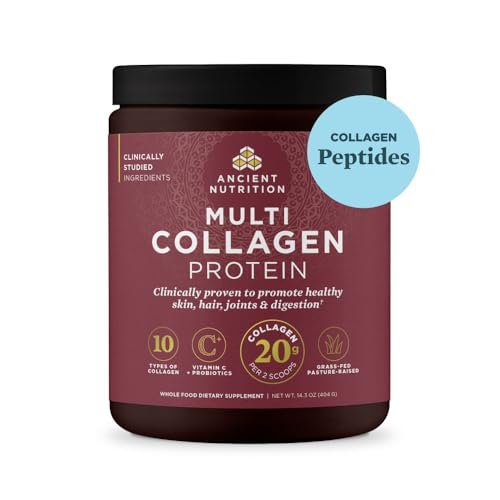
Ancient Nutrition's Multi Collagen Protein is everywhere: pharmacy endcaps, Amazon bestseller lists, and the supplement drawers of people who follow Dr. Josh Axe's content. The pitch is compelling — one powder drawing from bovine, chicken, fish, and eggshell membrane sources to cover five collagen types (I, II, III, V, and X) in a single scoop. It sounds like a complete collagen solution. But does covering five types actually produce better outcomes than a simpler, single-source bovine powder? And is the "bone broth" brand identity connected to anything clinically meaningful, or is it lifestyle packaging? Verdict: Ancient Nutrition Multi Collagen Protein is a real product with legitimate collagen content; its marketing leans heavily on the "5 types" framing, which has no head-to-head clinical support over well-researched type I+III peptides like Verisol; it lacks NSF or Informed Sport certification; and at roughly $0.85 per serving it sits at a price premium that more rigorously tested alternatives like Thorne Collagen Peptides or Pure Encapsulations Collagen do not always justify.
Summary: What You Need to Know
What it is: A dietary supplement collagen powder blending bovine hide, chicken sternum, fish, and eggshell membrane to cover five collagen types.
What the research says: Hydrolyzed collagen peptides have solid trial support for skin hydration, elasticity, and wrinkle reduction. The key mechanism is dipeptide absorption (Pro-Hyp and Hyp-Gly), not the type number on the label.
The "5 types" question: No published RCT has shown a multi-type blend outperforms a high-quality type I+III hydrolysate for skin or a specific type II preparation for joints.
Certifications: B-Corp and Regenerative Organic Certified for farming practices. No NSF Certified for Sport. No Informed Sport. No USP verification on the product itself.
Price: Approximately $0.85 per serving for the unflavored 45-serving tub at standard retail. That is roughly on par with Thorne Collagen Plus and above many single-source bovine options.
Best fit for: Someone who wants a multi-source powder and trusts the Ancient Nutrition brand ecosystem; willing to pay a modest premium for the lifestyle positioning and varied sourcing rather than optimizing for third-party certification or lowest cost per gram.
Brand Context: Drs. Josh Axe and Jordan Rubin
Ancient Nutrition was co-founded in 2016 by Dr. Josh Axe, a functional medicine practitioner and chiropractor with a large online following, and Jordan Rubin, an entrepreneur who had previously built and sold a natural health products company (Garden of Life) to Nestle for approximately $2.3 billion. That background matters: the founders brought genuine knowledge of the supplement industry and real resources to product development.
The brand's origin story is closely tied to bone broth. Rubin was consuming bone broth to support recovery from a knee injury but struggled to travel with frozen broth. The solution — a shelf-stable bone broth protein powder — became one of Ancient Nutrition's first products and shaped the identity the company still carries. Bone broth had cultural traction as a traditional healing food, and Ancient Nutrition was early and aggressive in bringing it to a mainstream supplement audience. The company holds a patent on their bone broth protein powder process.
From Nashville, Tennessee, Ancient Nutrition now employs over 110 people, holds a B-Corp certification, pursues Regenerative Organic Certification for its founders' farms, and participates in Savory Institute programs for regenerative land management. That corporate context is relevant when you see the premium pricing: some of the cost reflects a genuine values infrastructure, not purely marketing.
What the brand does not have, as of this writing, is NSF Certified for Sport or Informed Sport product-level certification on the Multi Collagen Protein. Those programs test individual product batches for label accuracy and banned substances. Axe and Rubin built a wellness lifestyle brand; they did not build it for the athlete-verification market, and that distinction shows in the certification profile.
Product Profile: Five Types, Four Sources
The Multi Collagen Protein formula draws from four animal-derived sources to deliver five collagen types:
-
Type I from bovine hide hydrolysate and fish collagen peptides. Type I is the most abundant structural collagen in human skin, tendons, and bones. This is the type supported by the widest body of skin RCT literature, including the Verisol bioactive peptide trials.
-
Type II from chicken sternum cartilage. Type II is the dominant collagen of joint cartilage. UC-II (undenatured type II collagen) research shows meaningful effects in knee osteoarthritis at 40 mg doses — but importantly, UC-II works through an oral tolerance immune mechanism, and hydrolyzed type II performs differently from undenatured type II. Most multi-collagen powders use hydrolyzed chicken sternum; the product page does not specify whether Ancient Nutrition's type II source is denatured or undenatured.
-
Type III from bovine hide hydrolysate. Type III collagen co-localizes with type I in skin and blood vessels. Type I and III are typically paired in bovine-source peptide products; Verisol, the proprietary peptide used in multiple skin-focused RCTs, is a type I+III blend.
-
Type V from eggshell membrane. Type V is found in hair follicles and the placenta. There is limited human trial data supporting supplemental type V specifically, separate from the broader collagen peptide literature.
-
Type X also attributed to eggshell membrane or chicken sternum. Type X is expressed during cartilage development. Like type V, it appears in multi-collagen marketing with more frequency than in peer-reviewed supplementation literature.
Each scoop delivers approximately 20 grams of protein from this blend. The unflavored version contains collagen peptides from these four sources with no added flavors; flavored versions (vanilla, chocolate, and others) include additional ingredients. The powder mixes into hot or cold liquids and is relatively odor-neutral in the unflavored format, which is consistent with standard hydrolyzed bovine and fish peptide behavior.
Does Covering Five Types Actually Matter?
This is the central question, and the honest answer is: clinically, probably not in the way the marketing implies.
Here is what the evidence actually shows. A 2023 systematic review and meta-analysis published in Nutrients (PMID 37432180) analyzed 26 randomized controlled trials involving 1,721 patients and found that hydrolyzed collagen supplementation significantly improved skin hydration and elasticity. Crucially, the analysis found no significant differences in outcomes based on collagen source — bovine, fish, chicken, or porcine — for skin elasticity (p = 0.21). The driver of outcome was not which animal the collagen came from or how many types were present; it was the concentration of bioactive dipeptides (Pro-Hyp and Hyp-Gly) in the hydrolysate.
The Verisol research program (PMID 24401291) reinforces this. Verisol is a proprietary hydrolysate of type I+III bovine collagen from GELITA. In a randomized, double-blind, placebo-controlled trial, 2.5 grams of Verisol daily for eight weeks produced a statistically significant 20% reduction in periorbital wrinkle volume and a 65% increase in procollagen type I biosynthesis compared to placebo. These are some of the most cited skin-outcome numbers in the entire collagen literature — and they come from a two-type, single-source bovine product, not a five-type blend.
None of this means that multi-type blends are inferior. It means the evidence does not demonstrate superiority. No published RCT has tested a five-collagen-type blend head-to-head against a well-characterized type I+III hydrolysate and shown that the five-type product wins. The "5 types" argument is biologically plausible as a theoretical frame — different tissues do express different collagen types — but the supplementation research has not validated the assumption that ingesting all five types in one serving meaningfully improves on ingesting one or two types at an adequate dose.
The bone broth framing is also worth naming directly. "Bone broth-derived" suggests a traditional whole-food origin story. In nutritional terms, bone broth collagen is hydrolyzed collagen protein — the same category of ingredient as any other collagen hydrolysate. The provenance is real; the clinical relevance of that provenance, compared to non-broth-derived hydrolysate, is not established. It is a brand identity descriptor, not a clinical-grade specification.
Quality and Testing Transparency
Ancient Nutrition's quality language on its website is confident. The company references "clinically proven results," "science-backed formulations," and "non-GMO ingredients." The certifications that exist — B-Corp, Regenerative Organic Certified, CarbonNeutral — are real and substantive for what they measure, which is corporate conduct and farming practices.
What is missing is product-level third-party testing that a consumer can verify independently. NSF Certified for Sport and Informed Sport both test finished product batches for banned substances, label accuracy, and contamination. Neither certification appears on Ancient Nutrition Multi Collagen Protein as of this writing. USP verification — which checks that a supplement contains what it says and no more — is also absent.
This does not mean the product is unsafe or mislabeled. Most collagen supplements in the mass-market tier do not carry NSF or Informed Sport certification; those programs are primarily adopted by brands targeting athletes subject to anti-doping rules. But if third-party verified testing matters to you — and for a YMYL supplement category, it reasonably might — Thorne and Pure Encapsulations have meaningfully stronger certification profiles. Thorne's Collagen Fit carries NSF Certified for Sport. Pure Encapsulations uses NSF Good Manufacturing Practice-verified manufacturing and Informed Sport-eligible supply chain standards.
The allergen picture: fish and chicken are present in this formula. Consumers with seafood or poultry allergies need to read the label carefully. The eggshell membrane source also introduces egg-derived material. The unflavored formula contains no gluten-containing grains per Ancient Nutrition's labeling, but the facility handles multiple ingredients and the label does not carry a certified gluten-free seal.
Pricing: What You Are Paying For
The unflavored 45-serving tub costs approximately $38-$42 depending on retailer and subscription status, placing the per-serving cost at roughly $0.85-$0.93. That figure sits above the budget end of the bovine-only collagen market (where plain hydrolysates run $0.30-$0.60 per serving) and roughly on par with, or slightly above, Thorne and Pure Encapsulations collagen products.
The premium reflects several things: the multi-source formulation is more expensive to manufacture than a single-source bovine powder; the Ancient Nutrition brand commands lifestyle pricing; and the sustainability infrastructure (regenerative farming, B-Corp, carbon neutral operations) has real cost. Whether that premium is worth it is a personal values question as much as a nutritional one.
For most people focused purely on skin and joint outcomes, the clinical evidence does not support paying a premium specifically for five collagen types over a well-sourced type I+III hydrolysate at an effective dose. But Ancient Nutrition is not only competing on clinical outcomes — it is selling a brand identity that includes specific values around how food is produced. If that identity resonates with you, the extra cost has a justification.
Frequently Asked Questions
Does Ancient Nutrition Multi Collagen actually work?
Collagen peptides as a category have solid clinical support for skin hydration, elasticity, and reduced fine lines when taken at doses of 2.5-10 grams daily for at least 8 weeks. Ancient Nutrition delivers 20 grams per serving, which exceeds the effective dose range in most trials. The formula is likely to produce the outcomes associated with hydrolyzed collagen generally. Whether the five-type sourcing adds anything beyond what a high-quality type I+III bovine hydrolysate would produce is not established by current evidence.
Is Ancient Nutrition collagen third-party tested?
The company holds B-Corp, Regenerative Organic Certified, and CarbonNeutral certifications. These cover corporate conduct and farming. The Multi Collagen Protein does not carry NSF Certified for Sport or Informed Sport product-level testing as of this writing.
What is the difference between type I, II, III, V, and X collagen?
These types differ in structure and tissue distribution. Type I and III are the main structural collagens in skin; type II dominates joint cartilage; type V appears in hair follicles; type X is associated with cartilage development. Supplemental research has primarily studied type I+III hydrolysates for skin and type II preparations for joints. Types V and X appear in multi-collagen formulas more often than they appear in peer-reviewed supplementation trials.
Is the "bone broth" connection clinically meaningful?
Bone broth as a traditional food contains gelatin, which yields collagen peptides on digestion — the same category of compound found in modern collagen hydrolysate supplements. The phrase "bone broth" on Ancient Nutrition's products refers to their brand origin and processing approach; it is not a clinical-grade descriptor that would predict different outcomes compared to bovine collagen from a non-broth source.
Can I take this during pregnancy or nursing?
Defer this question to your OB or midwife. Collagen peptides as a dietary supplement are not FDA-approved drugs, and no adequate clinical safety data exists specifically for pregnant or nursing populations.
How does this compare to Thorne or Pure Encapsulations?
All three deliver hydrolyzed collagen peptides at effective doses. Thorne and Pure Encapsulations have stronger third-party testing certification profiles. Ancient Nutrition offers a multi-source formula and a stronger sustainability narrative. The head-to-head clinical outcome differences are not established. See the Thorne and Pure Encapsulations reviews for a fuller comparison.
Conclusion
Ancient Nutrition Multi Collagen Protein is a legitimate collagen supplement from a well-resourced brand with genuine commitments to regenerative farming and corporate responsibility. It delivers 20 grams of hydrolyzed collagen per serving from four sources, covering five collagen types. The formula will produce what hydrolyzed collagen generally produces — modest but real improvements in skin hydration and elasticity with consistent use.
What the product does not have is clinical proof that covering five types outperforms a simpler, well-characterized type I+III hydrolysate. The "5 types" marketing claim is biologically plausible but not supported by head-to-head RCTs. The "bone broth" framing is genuine brand heritage, not a clinically differentiated specification. And the absence of NSF Certified for Sport or Informed Sport product testing is a real gap for consumers who prioritize independently verified label accuracy.
If you already trust the Ancient Nutrition brand and its values, and the multi-source story appeals to you, this is a real product that will do what collagen peptides generally do. If you are optimizing for third-party testing confidence and clinical evidence per dollar, the Thorne and Pure Encapsulations options in this cluster deserve a close look before committing.
As an Amazon Associate, I earn from qualifying purchases. Product recommendations are based on real reviews and independent research.
This article is for informational purposes and not medical advice. Peptides, especially those marketed for therapeutic use, can interact with medications and health conditions. Consult a licensed physician before starting any supplement, particularly if you are pregnant, nursing, taking prescription medications, or managing a chronic condition.
As an Amazon Associate, I earn from qualifying purchases. Product recommendations are based on real reviews and independent research.
