
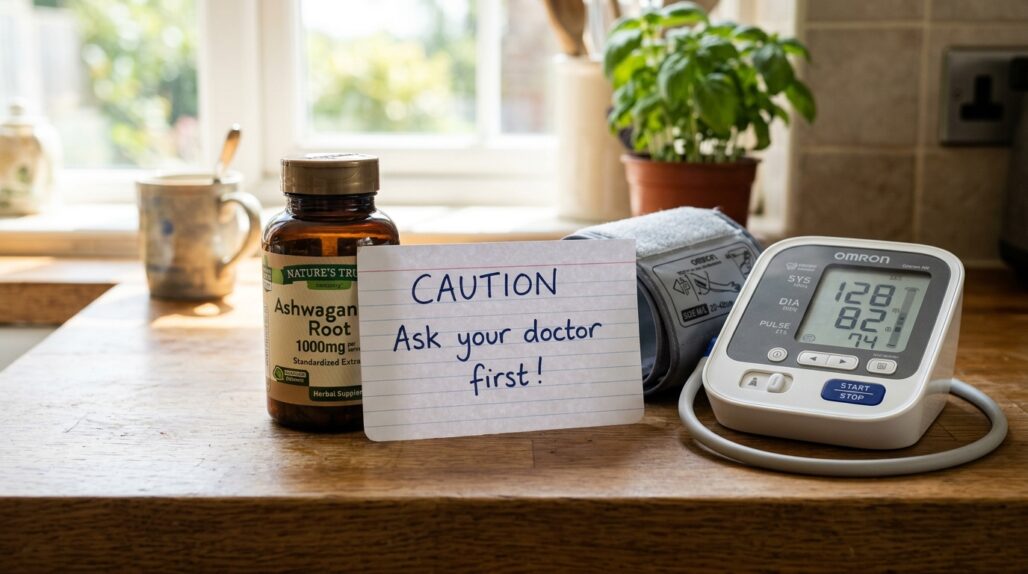
Affiliate disclosure: this article contains affiliate links. As an Amazon Associate, UsefulVitamins.com earns from qualifying purchases at no extra cost to you.
Do ashwagandha and blood pressure pills actually interact?
Yes, in a direction most people do not expect. The worry with a stress and sleep herb is rarely that it will raise your pressure. It is that ashwagandha and your medication push the same way, so the two effects add up.
Blood pressure drugs lower pressure on purpose. Ashwagandha lowers it a little as a side effect. Put them together and you can end up further down than your prescriber dialed in. For most people that means feeling woozy when they stand up. For someone already running low-normal, or on more than one BP drug, it can mean more than that.
So this is not a flat no. Plenty of people take ashwagandha and a blood pressure medication without trouble. But it is not a casual add-on either. The honest answer is the middle one: get your prescriber in the loop, start low, and watch your numbers.
One thing to set straight before the details. We are an education site, not your prescriber. Nothing here tells you to start, stop, skip, or replace a medication, and ashwagandha is never a "natural alternative" to a blood pressure drug. The point is to help you ask the right question of the right person.
Why they interact: the mechanism, graded honestly
The interaction is pharmacodynamic, which is a long word for "two things acting on the same target in the body." Both your medication and ashwagandha lower blood pressure. They are not competing for absorption in your gut, and neither one blocks the other. They simply point the same direction, and the body sees the combined effect.
How ashwagandha lowers pressure is not fully pinned down. The leading explanations are that it dampens the cortisol and stress response, and that it has a mild relaxing effect on blood vessels. Either way the measured result in human trials is a modest drop.
Now the grading, claim by claim.
The BP-lowering effect of ashwagandha on its own is moderately supported. Several small randomized, placebo-controlled trials show real reductions. Standardized-extract trials in stressed or mildly hypertensive adults have shown systolic reductions on the order of 3 to 10 mmHg, with smaller diastolic drops; the effect is modest and varies by study. An older trial using 2 g/day of root powder for 12 weeks also found a significant drop. The effect is not huge, and it is not nothing.
The amount depends on who you are. In healthy adults with normal pressure, a study using 300 mg twice daily for 8 weeks found no significant change in vital signs. The reductions show up mainly in people who are stressed or already mildly hypertensive. Worth noticing: the drop is larger in exactly the population most likely to be on a BP drug.
The interaction with the drug itself is the weaker claim. No clinical trial has taken people on an ACE inhibitor or a calcium channel blocker and added ashwagandha to measure what happens. The additive-with-medication concern is reasonable extrapolation from the two effects pointing the same way, not a trial result. So grade it as theoretical but plausible: solid evidence that ashwagandha lowers pressure, plus basic pharmacology.
The authorities line up with that read. The NIH Office of Dietary Supplements ashwagandha fact sheet explicitly lists antihypertensives among the medications ashwagandha "might interact with." The Drugs.com professional monograph for amlodipine and ashwagandha flags additive hypotensive and orthostatic potential and tells people to use caution and check with a provider. Neither calls it a hard contraindication. Both treat it as a "talk to someone first" situation.
One more thing the fact sheet notes: the blood pressure issue rarely travels alone. Ashwagandha is also sedative, and the same NIH source flags possible interactions with sedatives and anti-anxiety drugs, with antidiabetes medications, and with immunosuppressants. If you take more than your BP pill, the conversation with your prescriber covers more than pressure.
The practical rule: timing, dose, and who is most at risk
Start with the part people get wrong. Spacing the doses hours apart does not fix this. When two things bind each other in the gut, taking them at different times helps. This is not that. The combined effect on your blood vessels is the same whether you take the pills together or twelve hours apart, so timing tricks do nothing here.
What actually cuts the risk is monitoring and a low starting dose, with your prescriber watching.
The rule, step by step:
- Do not start it on your own. Bring the bottle, or its exact name and dose, to your prescriber or pharmacist before the first capsule.
- If you are cleared, start low. Around 300 mg/day of a single standardized extract is a sensible opening dose. Do not jump straight to a high-dose stress formula.
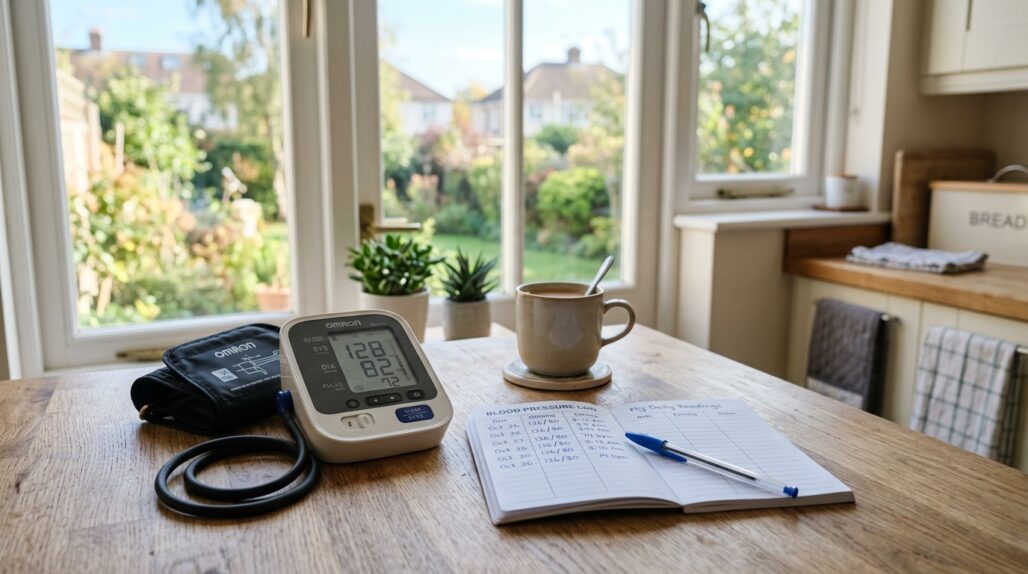
- Check home blood pressure twice a day – morning and evening, seated, after a few minutes of rest – for the first 2-3 weeks. Write the numbers down.
- Take the readings to your appointment. If your pressure is drifting low, your prescriber decides whether the medication dose changes. You do not adjust the drug yourself.
Who is most at risk, and should be most careful:
- Older adults. Pressure regulation is already less forgiving, and a drop on standing causes falls.
- Anyone already running low-normal blood pressure. Less room to go down before symptoms start.
- People on more than one BP medication. Each one is already pulling pressure down; ashwagandha is one more pull.
- Anyone with surgery coming up. Anesthesia lowers pressure too, and ashwagandha is sedative, so the combination on the table is a real concern. The NCCIH ashwagandha overview and standard surgical practice point the same way. Stop herbal supplements about 2 weeks before a scheduled procedure, and tell your surgical team and anesthesiologist you take it.
Plainly: never use ashwagandha as a stand-in for your medication, and never skip or shrink a prescribed dose to "make room" for the supplement.
What to actually do: the safe way to approach this
If your prescriber gives the green light, the safe version of this combination is built around one tool, a home blood pressure monitor, plus a low, consistent dose and a clean routine.
A cuff is the actual safety device here. It turns a vague "I feel a bit off" into a number you and your prescriber can act on. Pick an upper-arm automatic monitor, take readings at the same times each day, and log them. A simple notebook or a notes app is fine.
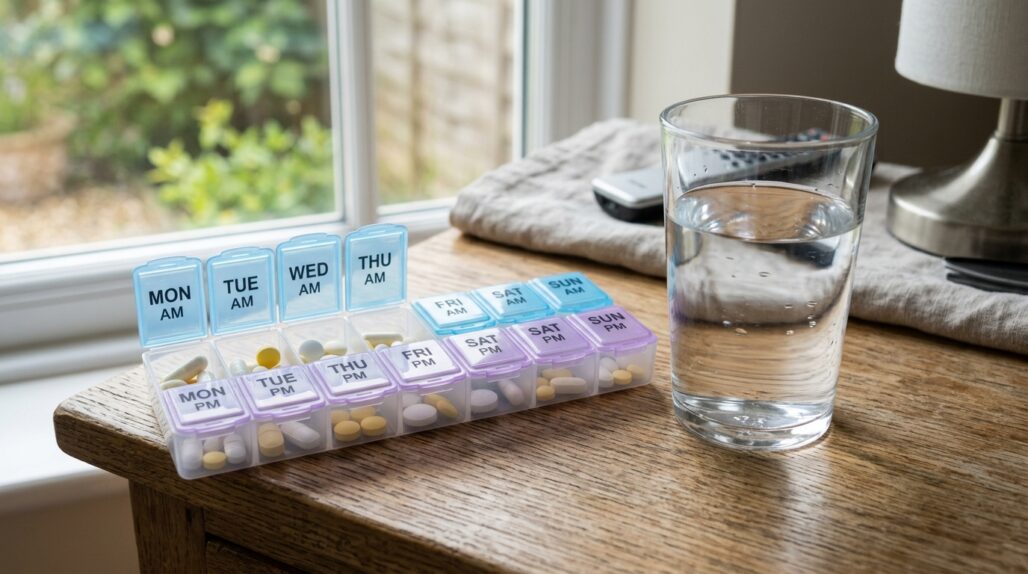
For the supplement itself, a standardized extract at a modest dose is easier to monitor than a kitchen-sink stress blend, because you know what you are adjusting. Keep your medication on its own schedule so nothing gets skipped or doubled. A weekly organizer keeps the medication and the supplement separate and consistent, which matters more than the exact minute you take either one.
The cleanest way to avoid a surprise interaction is to keep everything in one list. Log every prescription and every supplement in one place so an overlap gets flagged before you add the next thing. StackMyMed (our own free app) does this by letting you scan your BP medication and your ashwagandha into a single list and flagging the pairing as something to raise with your pharmacist. It does not diagnose you or tell you what to do; it surfaces the question so a professional answers it. No app required, either: the low-tech version works just as well. Write out your full list, every drug and every supplement with doses, and hand it to your pharmacist. Either way, the decision lands with the person qualified to make it.



As an Amazon Associate, UsefulVitamins.com earns from qualifying purchases at no extra cost to you.
Some links below are affiliate links. If you buy through them we may earn a small commission at no extra cost to you. It does not change what we recommend, and it is never a substitute for your prescriber's advice.
These are safe picks for doing this carefully, not a green light to self-combine. The supplement is here only for the case where a prescriber has already cleared a monitored trial; the real workhorse is the cuff.
Related pairs and the wider class
"Blood pressure medication" covers several drug families, and the additive logic applies across the lot. ACE inhibitors (lisinopril, ramipril), ARBs (losartan, valsartan), calcium channel blockers (amlodipine), beta-blockers (metoprolol), and diuretics (hydrochlorothiazide) all lower pressure, so ashwagandha's modest drop stacks onto any of them. The reasoning does not change with the class.
Ashwagandha's other interactions are worth knowing because most people on a BP drug take something else too. The NIH fact sheet flags sedatives and anti-anxiety drugs (ashwagandha can add to their drowsiness), diabetes medications (it may lower blood sugar a little, another additive effect), and thyroid medication, where it can nudge your own thyroid hormone up. We cover that last one separately in our piece on ashwagandha and sertraline for the sedative and serotonergic angle.
For the mineral side of blood pressure stacking, magnesium raises a similar additive question – see magnesium and blood pressure medication. If you are choosing a product or working out an equivalent dose between root powder and concentrated extract, our ashwagandha buyer's guide and the extract converter will help you land on a sensible amount before you bring it to your prescriber.
What ties all of these together: ashwagandha is generally well tolerated on its own, but the moment a prescription is in the picture, the safe move is to disclose it and monitor, not to guess.
| Question | Answer |
|---|---|
| Do they interact? | Yes, additively. Both lower blood pressure, so the effects add up toward low readings, not a spike. The drug interaction itself is extrapolated; the BP-lowering effect of ashwagandha is moderately evidenced. |
| How do I take them? | Only with prescriber clearance. Start low (around 300 mg/day), keep your medication on its own schedule, and monitor. Spacing them apart does not reduce the risk. |
| Who should be careful? | Older adults, anyone with low-normal baseline pressure, people on more than one BP drug, and anyone with surgery coming up (stop about 2 weeks before). |
| When do I call a doctor? | Persistent dizziness or lightheadedness, fainting or near-fainting, blurred vision, unusual fatigue, or home readings running noticeably low (for example systolic under about 90). |
FAQ
Does ashwagandha raise or lower blood pressure? In the trials that show an effect, it lowers it modestly – on the order of 3 to 10 mmHg systolic depending on the dose and the person, with the bigger drops in stressed or mildly hypertensive adults. In healthy people with normal pressure, several studies found no significant change. It does not reliably raise pressure.
Can I just take my ashwagandha at a different time of day from my BP pill? No, and this is the most common mistake. Timing fixes only matter when two things block each other’s absorption in the gut. This interaction is additive in the bloodstream, so the combined effect is the same whether you take them together or hours apart.
Is this combination ever an outright “avoid”? Not as a blanket rule for the general population – the authorities treat it as caution, not contraindication. But treat it as off-limits without medical sign-off if you already run low pressure, take multiple BP drugs, or have surgery scheduled, where the safer move is to hold off.
How long until I would notice an effect on my pressure? The trials measured changes over 8 to 12 weeks, so any drift tends to build gradually rather than hit on day one. That is exactly why a 2-to-3-week log of twice-daily home readings is useful – it catches a slow downward trend before it turns into symptoms.
What if I feel dizzy after starting it? Persistent dizziness or lightheadedness, especially standing up, is the signal to stop the ashwagandha and call your prescriber. Bring your home readings. Fainting, near-fainting, or blurred vision means seek care promptly rather than waiting for the next appointment.
Should I tell my pharmacist even though ashwagandha is just a supplement? Yes. Pharmacists are the easiest people to ask about drug and supplement overlaps, and “just a supplement” is how many real interactions slip through. Hand over a full list of everything you take, prescription and otherwise, with doses.
The bottom line
Ashwagandha and blood pressure medication can go together for many people, but it is a caution, not a casual yes. Both lower pressure, so the effects add up, and the realistic risk is feeling faint or seeing low readings rather than a dangerous rise. Get your prescriber's say-so first, start at a low dose if cleared, and check your home blood pressure twice a day for the first few weeks. Spacing the doses apart does nothing, because the effect is additive, not an absorption clash. Stop and call your doctor for persistent dizziness, fainting or near-fainting, blurred vision, unusual fatigue, or unusually low readings. And keep the supplement in your medication list so your pharmacist sees the full picture.
This article is for education and is not medical advice. It does not replace your prescriber, and nothing here is a reason to start, stop, or change a prescription on your own. Talk to your doctor or pharmacist about your specific medications before combining anything.
Reviewed by the UsefulVitamins Editorial Team.
