

Affiliate disclosure: this article contains affiliate links. As an Amazon Associate, UsefulVitamins.com earns from qualifying purchases at no extra cost to you.
Two of the most common bottles in a supplement drawer, and one of the most common questions about them: is it fine to swallow them at the same time, or do they fight each other on the way in? The short version is that they get along at the doses most people use. The longer version is worth two minutes, because the answer changes once zinc climbs past a certain point, and that is exactly where people get tripped up.
Do zinc and magnesium actually interact?
A little, but probably not the way you are worried about. Zinc and magnesium are both divalent minerals, meaning they carry the same kind of charge, and they lean on some of the same intestinal transport routes to get absorbed. In theory that sets up a turf war for absorption. In practice, at the amounts in a normal supplement or a multivitamin, the overlap is small enough that it does not change your real-world status.
The clearest human data on the zinc-versus-magnesium question comes from a metabolic balance study by Spencer and colleagues, indexed on PubMed. Healthy men were given 142 mg of supplemental zinc a day, and at that level magnesium absorption and overall magnesium balance dropped significantly. That number matters: 142 mg is more than three times the upper limit for zinc. So yes, the interaction is real, but it shows up at a dose almost nobody takes by accident.
On the safety side, a 12-week randomized trial reported on PubMed Central gave participants 30 mg of elemental zinc plus 250 mg of magnesium together every day. There were no adverse effects from the pairing, and the group saw modest metabolic improvements. That is the dose range most readers are actually in, and it came through clean.
So the honest grade: the safety of combining the two at standard doses is well documented. The specific magnesium-absorption hit is modest and really only kicks in at megadose zinc. The interaction people more often run into at high zinc is not with magnesium at all – it is with copper.
Why high-dose zinc is the part to respect
The mechanism is worth understanding, because it shapes how you take these. The body regulates how much zinc and copper it absorbs using the same gut proteins (metallothioneins). When zinc intake runs high for weeks, it ramps up those proteins, and copper gets trapped in the intestinal cells and shed instead of absorbed. Over time that quietly drains your copper.
The NIH Office of Dietary Supplements set the Tolerable Upper Intake Level for zinc at 40 mg a day for adults, and notes that intakes around 50 mg a day or more, taken over weeks, can blunt copper absorption, weaken immune function, and lower HDL cholesterol. If copper drops far enough, the result can be anemia and low white-cell counts, sometimes alongside nerve symptoms like numbness and weakness in the arms and legs. Mayo Clinic makes the same point about long-term, high-dose zinc and copper deficiency.
The thing that bites people is rarely the magnesium. It is unmonitored high-dose zinc running for a long stretch, often from cold-season megadoses, certain denture creams that contain zinc, or doubling up across a multivitamin plus a standalone zinc pill without noticing. Magnesium is the bystander in that story.
Magnesium has its own dose ceiling, and it is a gentler one. The NIH Office of Dietary Supplements sets the upper limit for magnesium from supplements at 350 mg a day of elemental magnesium. Go past that and the first thing you usually get is loose stools or stomach cramping. That is uncomfortable, not dangerous in healthy kidneys, and it is a magnesium-dose problem, not a sign the two minerals are reacting badly with each other.

The practical rule: how to take them
| Question | Answer |
|---|---|
| Do they interact? | Only at very high zinc doses. Zinc and magnesium compete for the same gut mineral transporters, but at normal supplement amounts the overlap is too small to matter. |
| How do I take them? | Together is fine, ideally with food. Zinc 8 to 40 mg a day and magnesium up to about 350 mg a day from supplements. Food blunts the nausea zinc can cause on an empty stomach. |
| Who should be careful? | Anyone taking high-dose zinc (40 mg or more) for weeks should add a little copper, since long-term high zinc lowers copper. People with reduced kidney function should clear magnesium with a doctor. |
| When should I call a doctor? | Weeks of high-dose zinc plus new fatigue, weakness, numbness or tingling, frequent infections, or easy bruising can signal copper deficiency. Stop and get checked. |
For most people this is simple.
- At normal doses, take them together, with food. Zinc 8 to 40 mg a day and magnesium up to about 350 mg a day from supplements can go down at the same time. Food softens the stomach upset zinc can cause and blunts any minor mineral competition.
- If you use high-dose zinc (above 40 mg), give it room. For short cold-season courses, separate the zinc dose from your magnesium by roughly 2 hours, and do not run high-dose zinc for more than a week or two without either adding a little copper or checking with a pharmacist first.
- Mind the total, not just one bottle. A multivitamin, a ZMA product, and a standalone zinc capsule can stack up fast. Add up everything before you decide you are under 40 mg.
- Do not treat either mineral as a stand-in for a prescription. If you take these for a medical reason, keep your medication and ask your prescriber where the supplements fit.
Who should be most careful? Two groups. First, anyone on long-term high-dose zinc – that is the copper-deficiency risk, and it is the one with real teeth. Second, anyone already pushing the magnesium ceiling for the loose-stool reason, or with reduced kidney function, since impaired kidneys clear magnesium poorly and can let it build up. People with kidney disease should not self-dose magnesium at all without a clinician's say-so.
About those ZMA-style products that pre-combine zinc and magnesium (usually with vitamin B6): they are formulated within these limits, typically around 30 mg zinc and 400-ish mg magnesium, which is why they exist as a single capsule in the first place. The pairing is intentional.
What to actually do (the safe way to take it)
If you are building this from scratch, keep it boring and within the limits above. A sensible zinc dose in a well-absorbed form, a magnesium form that is easy on the stomach, and a way to keep your timing straight covers it.


As an Amazon Associate, UsefulVitamins.com earns from qualifying purchases at no extra cost to you.
UsefulVitamins may earn a commission from purchases made through links on this page, at no extra cost to you. We only suggest products that fit the safe approach described above.
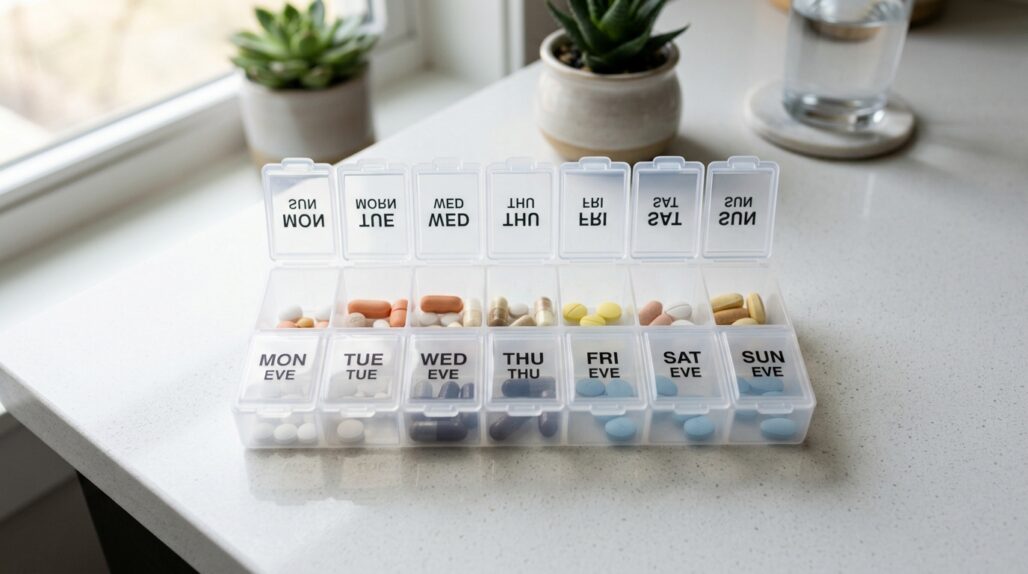
A gentle zinc form like picolinate or citrate around 15 to 30 mg sits comfortably under the ceiling and is kinder to an empty-ish stomach than zinc sulfate. For magnesium, glycinate is the form most people tolerate without the laxative effect, which makes it easy to take daily alongside zinc. And a simple weekly organizer is the low-effort fix for the only timing situation that matters here – keeping a short high-dose zinc course a couple of hours away from your magnesium.
If you want one place to keep track of what you are actually taking, you can log both supplements (and any prescriptions) in StackMyMed (our own free app), which adds up your total daily zinc against that 40 mg ceiling and flags overlaps – say, a multivitamin that already contains zinc or magnesium – as something to ask your pharmacist about. It does not diagnose anything; it just raises the question. The no-app version works just as well: write down every bottle with its dose, and hand that list to your pharmacist at the counter. Either way, see the total before you add more.
This is general education, not a change to anything your prescriber set up. If a doctor told you to take a specific zinc or magnesium dose, follow that.
Related mineral pairings and the wider picture
Minerals interact with each other too. Once you are stacking two, it helps to know how the others behave.
- Calcium competes with both zinc and magnesium for absorption at high doses, which is why a single mega "cal-mag-zinc" pill is less ideal than spreading minerals across the day.
- Copper is the one to actively replace if you run high-dose zinc for a stretch – a common ratio is roughly 1 mg copper per 15 mg of supplemental zinc, but check with a pharmacist rather than guessing.
- Iron in large doses can also blunt zinc absorption, another reason to keep big single-mineral doses apart from meals where you can.
For where these minerals collide with medications, the better-known timing issue is minerals and thyroid medication, since zinc, magnesium, calcium, and iron can all reduce absorption of levothyroxine if taken too close together. If that is your situation, our explainer on getting your magnesium dose right is a good place to start, and you can size your zinc intake with the zinc dose calculator. If you want help choosing a product, see our roundup of the best zinc supplements. And since the real risk on this page is overdoing zinc, the deeper read is how much zinc is too much.
FAQ
Can I take zinc and magnesium at the same time of day? Yes, at normal doses (zinc up to 40 mg, magnesium up to about 350 mg from supplements), taking them together with food is fine. Separating them only matters if your zinc dose is high – above 40 mg – in which case give the two about 2 hours of space.
Does magnesium block zinc absorption? Not meaningfully at supplement doses. The documented absorption interference runs the other way and only at very high zinc – around 142 mg a day in the human balance study, more than three times the upper limit. At everyday doses neither one steals much from the other.
Is a ZMA supplement safe? ZMA products combine zinc and magnesium (usually with B6) at doses kept inside the upper limits, typically around 30 mg zinc and 400 mg magnesium, which is why they come as a single pill. Just count any other zinc or magnesium you take so your daily total stays under the limits.
How do I know if high-dose zinc has caused a copper problem? The warning signs after weeks of high-dose zinc are persistent fatigue, unusual weakness, numbness or tingling, frequent infections, or easy bruising. These can mean copper deficiency or anemia. Stop the high-dose zinc and call your doctor or pharmacist to get checked.
Why do I get diarrhea when I take magnesium with zinc? That is almost always the magnesium dose or form, not the combination. Magnesium oxide and citrate draw water into the gut. If you get loose stools, lower the dose or switch to magnesium glycinate, which most people tolerate better.
Should I take copper if I take zinc and magnesium daily? Only really worth it if your zinc runs high or your course is long. At a modest zinc dose under 40 mg, dietary copper usually keeps up. If you take more, ask a pharmacist about adding a small amount of copper to balance it.

The bottom line
Yes, you can take zinc and magnesium together. At normal supplement doses they are safe side by side, ideally with food, and no spacing is needed. The single caveat is zinc: keep it at or under 40 mg a day, and if you use a higher dose for a short stretch, separate it from magnesium by a couple of hours and watch for the copper-deficiency signs above. None of this replaces anything a prescriber put you on. Add up what is in all your bottles, and run the total past your pharmacist before you add more.
This article is for education and is not medical advice. Supplements do not replace a prescribed medication. Talk to your doctor or pharmacist about your own situation before starting or combining anything.
Reviewed by the UsefulVitamins Editorial Team.
