
Affiliate disclosure: this article contains affiliate links. As an Amazon Associate, UsefulVitamins.com earns from qualifying purchases at no extra cost to you.
Doses in this guide are given in IU. Convert from the mcg figure on your label.
Do vitamin D and blood thinners actually interact?
Here is the honest version, because the popular answer hides a trap.
Vitamin D on its own does not touch the clotting pathway. It works on calcium, bone and the immune system. The standard interaction checkers back this up: Drugs.com returns "no interactions found" between vitamin D3 and warfarin, and the same holds for apixaban (Eliquis) and rivaroxaban (Xarelto). The NIH Office of Dietary Supplements vitamin D fact sheet lists the drugs vitamin D does interact with – orlistat, statins, steroids and thiazide diuretics – and anticoagulants are not on that list.
So if "vitamin D plus blood thinner" were the whole question, the answer would be a plain yes.
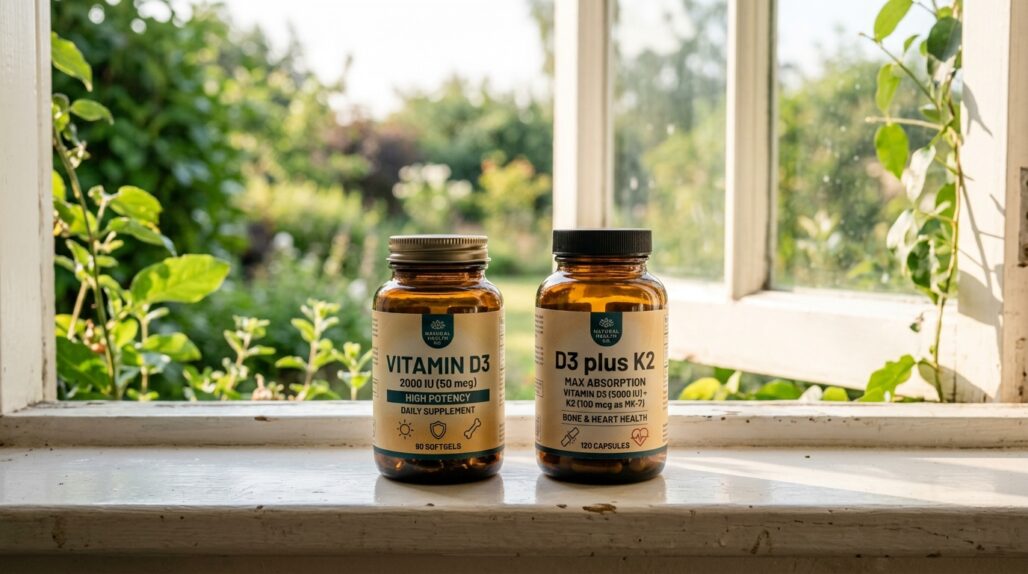
It is not the whole question. This page is a caution and not a clean yes for two reasons: the vitamin K2 baked into a lot of "D3 + K2" softgels, and warfarin's narrow safety margin. Many people grab a combo bottle without reading the second ingredient. On warfarin, that second ingredient is the one that matters.
The verdict, then, is caution. The vitamin D itself is not the problem. The product label and the specific drug you take are.
The mechanism: why the K2 in a combo matters and the D does not
Warfarin (brand name Coumadin) is a vitamin K antagonist. It works by blocking the recycling of vitamin K inside the liver, which throttles production of the vitamin K-dependent clotting factors. The enzyme it blocks is called VKORC1. With less active clotting factor around, blood clots more slowly, and that is the whole therapeutic point. The warfarin clinical reference (StatPearls, NIH) lays this out plainly.
Now add vitamin K2 from a supplement. You are pushing on exactly the pathway warfarin is trying to suppress. Extra vitamin K can partly undo warfarin's effect, raise the amount of working clotting factor, lower the INR and tip a steady patient toward clotting. This is a well-established vitamin K-versus-warfarin mechanism, not a theory. It is the same reason warfarin patients are told to keep their green-vegetable intake steady rather than swinging it week to week.
Evidence grade on the K2 mechanism: strong. It is regulatory-label and textbook level.
The DOACs are different. Eliquis (apixaban) and Xarelto (rivaroxaban) are direct factor Xa inhibitors. As the Cleveland Clinic explains, factor Xa inhibitors bind their target directly and do not rely on the vitamin K pathway. That is why they are called non-vitamin-K-dependent anticoagulants. Vitamin K2 does not reverse a DOAC the way it blunts warfarin. So the K2 worry is mainly a warfarin worry. A DOAC user has more room here, though combo products are still worth reporting.
Two thin signals are worth a mention, and both are low-grade and hypothesis-generating, not practice-changing:
- A small retrospective study of 89 chronic warfarin patients (PMC9381664) found that people with adequate vitamin D needed somewhat lower warfarin doses (the correlation was statistically significant, p = 0.041). It suggests vitamin D status can nudge warfarin sensitivity. It does not tell you to do anything specific.
- A case-control study of 75 bleeders versus 75 controls (PubMed 31415247) linked higher vitamin D levels and vitamin D treatment to more upper-GI bleeding on warfarin (p = 0.019). One small study, first of its kind, not confirmed elsewhere.
In practice the takeaway is modest: do not mega-dose vitamin D while on warfarin, and keep things steady. They are not a reason to avoid vitamin D. They are a reason to dose it to a sensible target rather than guessing high.
The practical rule: how to take vitamin D on a blood thinner
There is no spacing fix here, because nothing useful is competing for absorption. The rule is about which product and how steady, not about hours between pills.
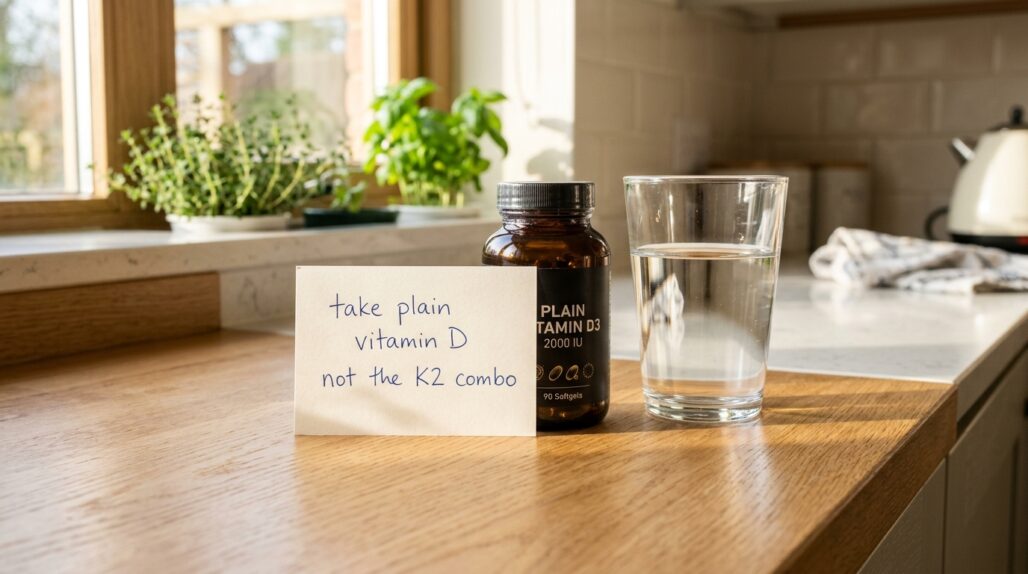
Plain vitamin D, no added K, is fine alongside warfarin or a DOAC. Take it with your largest fatty meal, since vitamin D is fat-soluble and absorbs better with food.
If you take warfarin, the specific instructions are tighter:
- Do not switch onto a "D3 + K2" combo, and do not switch off one, on your own. Adding or removing K2 can move your INR. If you are already on a combo and stable, that is a conversation for your prescriber, not a solo change.
- Keep the dose and the brand consistent day to day. Warfarin tolerates steady vitamin K far better than it tolerates swings.
- Tell your prescriber and pharmacist the exact product and dose before you start anything new, and have your INR checked on the schedule they set if you change products.
If you take a DOAC (Eliquis, Xarelto), you do not need INR checks, and plain vitamin D is straightforward. Still report any combo product so it is on your record.
Whatever the drug, do not mega-dose vitamin D. Dose to your tested level. That respects the weak elevated-D bleeding signal, and it is just sensible.
Who is most at risk: warfarin users on a "D3 + K2" combo, and anyone whose vitamin K intake bounces around. Steady-state DOAC users are far less sensitive. The hard rule that never bends: never adjust or stop your blood thinner to make room for a supplement, and never treat a supplement as a replacement for it.
What to actually do: the safe way to take it
It comes down to one habit: read the second line on the label.

![Vitamin D Test Kit at Home [2 Tests] for Testing Vitamin D Deficiency](https://m.media-amazon.com/images/I/41CFOXSNGbL._SL160_.jpg)
As an Amazon Associate, UsefulVitamins.com earns from qualifying purchases at no extra cost to you.
Some links below are affiliate links. If you buy through them we may earn a small commission, at no extra cost to you. It does not change our picks.
Pick a K-free vitamin D3 if you are on a blood thinner. That clears the only real interaction in one move. Keep your routine consistent with a weekly organizer so you take the same thing at the same time, which is exactly what a steady INR rewards. And test your level so you dose to a number instead of guessing, which keeps you out of mega-dose territory.
The cleanest way to catch a hidden ingredient before it reaches your mouth is to log the prescription and every supplement in one place and let overlaps get flagged. That is what StackMyMed (our own free app) is for: you scan your exact vitamin D product, it can flag a buried K2 against a blood thinner, and you export a clean list to ask your pharmacist about. It does not diagnose anything and it does not replace your pharmacist – it just surfaces the thing to ask about. The low-tech version works just as well: write down your full med-and-supplement list, including brand and dose, and show it to your pharmacist before you start. Either way the decision is theirs to confirm, not the app's.
One more practical note. If a routine blood draw ever flags something odd, mention every supplement you take so the result is read in context.

Related pairs and the wider vitamin K question
This pair sits inside a bigger pattern. Anything that swings vitamin K matters on warfarin, and almost nothing matters for the same reason on a DOAC.
| Question | Answer |
|---|---|
| Do plain vitamin D and blood thinners interact? | No documented direct interaction with warfarin or DOACs. Vitamin D acts on calcium and bone, not clotting. |
| What about a “D3 + K2” combo? | The K2 antagonizes warfarin and can lower the INR. It does not meaningfully affect DOACs like Eliquis or Xarelto. |
| How should I take it? | Choose a K-free vitamin D with a fatty meal, keep the dose and brand steady, and do not mega-dose. No hourly spacing needed. |
| Who should be careful? | Warfarin users on a D3 + K2 combo and anyone whose vitamin K intake fluctuates. DOAC users have more room but should still report combo products. |
| When should I call a doctor? | Any unusual or prolonged bleeding, or for warfarin an out-of-range INR after starting a new product. Stop and seek care. |
If you want to go deeper on the K2 side specifically, our companion explainer on vitamin K2 (MK-7) and warfarin covers why that one is a firmer caution. For the broader picture of what is and is not reasonable to take on an anticoagulant, see our roundup of supplements for blood-thinner and warfarin users.
This is education, not a prescription change. Nothing here is a reason to alter your blood thinner.
FAQ
Does vitamin D thin or thicken your blood? Neither in any meaningful clotting sense. Vitamin D works on calcium and bone, not on the coagulation cascade, which is why interaction checkers list no direct interaction with warfarin or DOACs.
Is a “D3 + K2” supplement safe on warfarin? The K2 is the issue. It opposes warfarin and can lower your INR, so do not start or stop a D3 + K2 combo on your own. Talk to your prescriber, who can monitor your INR if a change is made.
What if I take Eliquis or Xarelto instead of warfarin? DOACs are direct factor Xa inhibitors and do not depend on vitamin K, so K2 does not reverse them the way it blunts warfarin. Plain vitamin D is straightforward, but still tell your pharmacist about any combo product.
Do I need to space vitamin D away from my blood thinner by a few hours? No. There is no absorption competition between them, so separating doses by hours does nothing. The real lever is the product choice and keeping your routine steady.
Can high-dose vitamin D cause bleeding on warfarin? One small study linked higher vitamin D levels to more upper-GI bleeding on warfarin, but it is a single low-grade signal. The sensible takeaway is to dose vitamin D to your tested level rather than mega-dosing, not to fear normal repletion.
How do I check whether my supplement contains hidden vitamin K? Read the supplement facts panel for “K” or “K2” or “MK-7.” If you are unsure, log it in StackMyMed or write the full product name and dose down and show it to your pharmacist before starting.

The bottom line
Plain vitamin D is not a clotting drug, and it has no documented direct interaction with warfarin or with DOACs like Eliquis and Xarelto. The caution is narrow and specific: the vitamin K2 in many "D3 + K2" combos opposes warfarin and can lower your INR, and warfarin's safety margin is thin. So pick a K-free vitamin D, take it with a fatty meal, keep your dose and brand steady, do not mega-dose, and never change your blood thinner to accommodate a supplement. If you want to dose to a number, check your level with a calculator like our vitamin D dose calculator and choose from our best vitamin D supplements guide, then confirm the exact product with the person who manages your anticoagulation.
This article is for general education and is not medical advice. It does not replace your prescription or your prescriber. Always confirm supplements with your doctor or pharmacist before combining them with a blood thinner.
Reviewed by the UsefulVitamins Editorial Team.
