
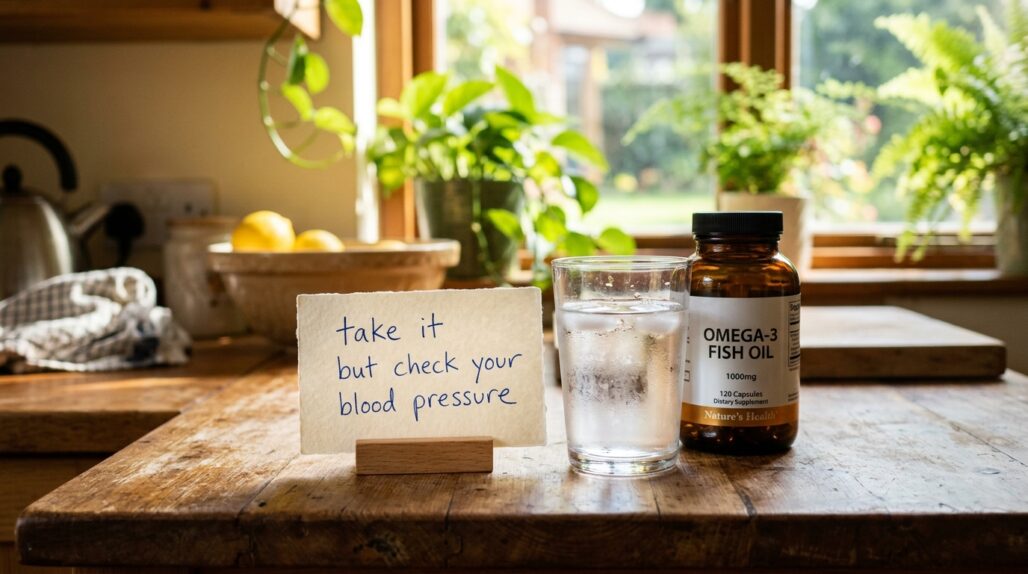
Affiliate disclosure: this article contains affiliate links. As an Amazon Associate, UsefulVitamins.com earns from qualifying purchases at no extra cost to you.
Do fish oil and blood pressure pills actually interact?
Yes, in a quiet way. Fish oil and your blood pressure medication push in the same direction, so their effects stack. That is the whole story in one sentence, but the size of the stack is what decides whether you shrug or pick up the phone.
Omega-3 fatty acids (the EPA and DHA in fish oil) lower blood pressure on their own. Not dramatically. A modest few points. Your antihypertensive also lowers blood pressure, by design. Put them together and you get a little more reduction than the drug alone. For most people on a standard supplement dose, that is harmless and may even nudge a stubborn number in a good way. The question is whether the extra drop ever goes too far, and at high doses it occasionally can.
This is worth saying plainly: fish oil is not a substitute for a blood pressure drug. It does not replace the drug or let you cut the dose on your own, and it is not a "natural alternative." It is a supplement that moves the same dial a small amount. Keep that in mind and the rest of the page makes sense.
One thing this page is not about: the fish-oil-plus-blood-thinner question. Blood pressure medications are not anticoagulants. The theoretical bleeding concern that comes up with warfarin, Eliquis, aspirin, or clopidogrel is a separate pair with a separate answer. If you take a blood thinner too, read that page on its own and clear high-dose fish oil with your prescriber for that reason.
The mechanism: why they add up instead of clash
Omega-3 EPA and DHA lower blood pressure through several gentle, body-wide effects: better endothelial function (the lining of your vessels relaxes a bit more easily), slightly reduced vascular resistance, and small effects on heart rate and arterial stiffness. None of that competes with how an ACE inhibitor, ARB, calcium channel blocker, beta-blocker, or diuretic works. They head the same way, so the effects add up rather than fight each other.
How big is the omega-3 effect by itself? Small and dose-dependent. The strongest recent evidence is the 2022 dose-response meta-analysis in the Journal of the American Heart Association (Zhang and colleagues, 71 randomized trials, 4,973 participants). It found a J-shaped curve: the largest reductions landed around 2 to 3 grams of EPA+DHA a day, with systolic pressure down about 2.6 mm Hg and diastolic down roughly 1.6 mm Hg. The effect was stronger and closer to linear in people who were already hypertensive, who had high cholesterol, or who were older. At 3 g/day, those with established high blood pressure saw an average systolic drop closer to 4.5 mm Hg.
That fits the older work too. The classic 1993 meta-analysis in Circulation (Morris and colleagues, 31 trials) found roughly -3.0/-1.5 mm Hg, dose-dependent, and notably no measurable effect in healthy people with normal blood pressure. The bigger the dose and the higher your starting pressure, the more there is to add.
So how do the interaction databases grade this in practice? Reassuringly. The Drugs.com interaction checker does not flag a problem for fish oil with lisinopril alone or amlodipine alone; the additive-blood-pressure note appears mainly when fish oil meets a diuretic/ACE-inhibitor combination, and it is graded moderate, not severe. The Mayo Clinic puts it the same way: fish oil can lower blood pressure, and taking it with blood-pressure drugs "might increase the effects on blood pressure," so people prone to dizziness or who already run low should be a little careful.
Evidence grade, stated honestly: the blood-pressure-lowering effect of omega-3 is itself moderate-to-high quality (large, consistent randomized data). The risk of a clinically dangerous additive interaction at a typical 1 g/day supplement dose is low. The caution is about dose and about who you are, not about a hidden hazard in the pairing itself.
The practical rule: dose, timing, and who should be careful
Start with what does not work: spacing. People reach for "take them a few hours apart" out of habit, but that only helps when two things compete in the gut for absorption. This is a body-wide effect on your vessels, so separating the pills by hours changes nothing. Skip that idea entirely.
Here is the rule that actually maps to the evidence.
- At about 1 g/day combined EPA+DHA (a common general-health dose), fish oil with blood pressure medication is generally fine. Take it with a meal to cut down on fishy burps and help absorption.
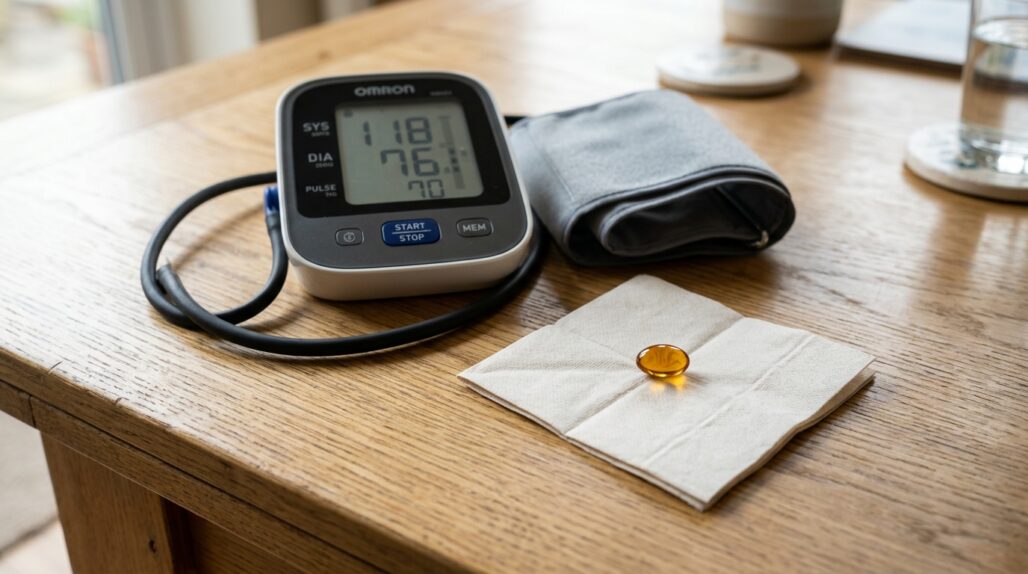
- At a higher dose, roughly 2 to 5 g/day (the kind of intake used for triglycerides or inflammation), tell your prescriber before you start. This is exactly the range where the additive 2 to 4 mm Hg drop is most likely to show up. Check your home blood pressure a few times over the first 2 to 3 weeks so you and your prescriber can see what your real numbers do. Separately, high-dose omega-3 (roughly 4 g/day and up) has been linked to a small, dose-dependent increase in atrial fibrillation in large trials, which is another reason to clear higher doses with your prescriber rather than self-escalating.
- Never adjust or stop a prescribed blood pressure medication on your own because you added fish oil. The job here is to inform your prescriber so they can decide, not to self-titrate.
- Mention the supplement at every medication review. It belongs on your list next to the prescription drugs, not in a separate mental bucket labeled "just a supplement."
Who should be most careful? The people in whom omega-3 lowers pressure the most: those already on blood pressure medication who take a high-dose fish oil, plus hypertensive, high-cholesterol, and older adults, where the effect is strongest and most linear. If you already run on the low side of normal, or you take more than one BP drug, treat any dose increase as a "talk to the prescriber first" moment rather than a quiet experiment.
Working out your real EPA+DHA total is worth doing, because the number on the front of the bottle ("1,000 mg fish oil") is usually not the EPA+DHA you actually get. Two softgels of one brand can deliver very different omega-3 than two of another.
What to actually do: take it the safe way
For most people on blood pressure medication, the safe way to use fish oil is dull, and that is fine.
Pick a standard, well-absorbed form, take it with food, keep the dose modest unless your prescriber has a reason to go higher, and put it on your medication list. Then watch your numbers for a couple of weeks after any change. That is all of it.
If you want the cleanest way to keep a prescription and a new supplement from surprising you, log them in one place and let the overlap get flagged before you swallow anything new. We built StackMyMed (our own free app) for exactly this: you add your blood pressure medication and your fish oil, and it surfaces the additive-blood-pressure note as something to ask your pharmacist about. It does not diagnose you and it does not replace that conversation; it just makes sure the question gets asked. The low-tech version works just as well: write your full list, prescriptions and supplements together, and show it to your pharmacist at the counter. Either way, someone who knows your full picture makes the call.


As an Amazon Associate, UsefulVitamins.com earns from qualifying purchases at no extra cost to you.
Some links below are affiliate links; if you buy through them we may earn a small commission at no extra cost to you. The products are chosen to be safe picks, not a recommendation to change your medication.
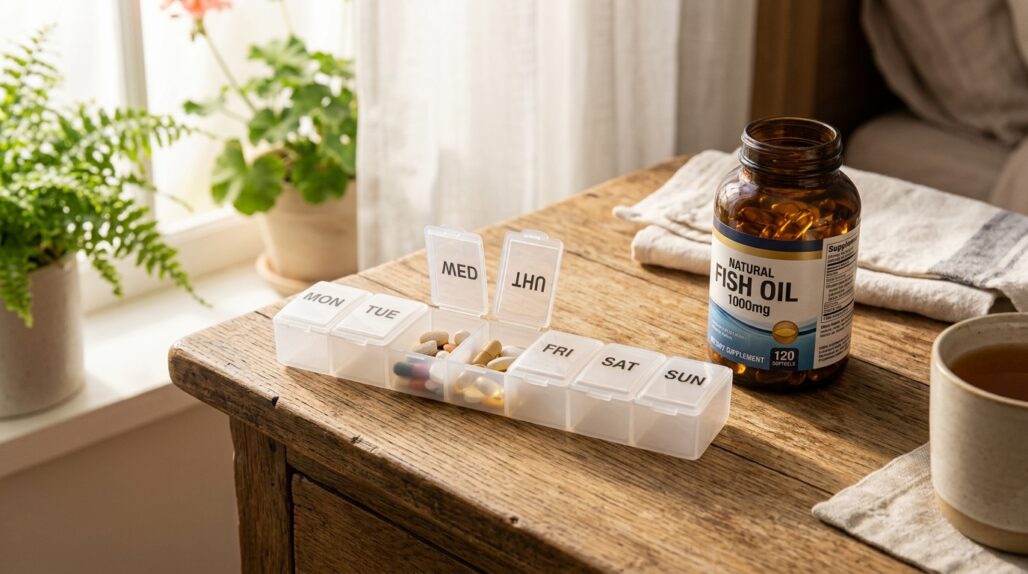
A 7-day AM/PM organizer is not about spacing here (you do not need to space these). It just keeps your fish oil and your BP pill on the same daily routine so nothing gets doubled or skipped, which matters more for the prescription than for the supplement. And if you want a heart-health companion many people on statins or BP drugs ask about, CoQ10 has its own interaction notes worth reading first.
Related pairs: other supplements that move blood pressure
Fish oil is one of several supplements that can nudge blood pressure, and the pattern is the same each time: a supplement with a mild BP effect, stacked on a drug built to lower BP, equals an additive effect to monitor rather than a clash to fear. Magnesium is the close cousin here; it can relax vessels and has its own additive note with blood pressure medication. CoQ10 sits in a similar spot. Knowing how the class behaves beats memorizing one pair, because it tells you what to expect the next time you add something.
If you are choosing a fish oil in the first place, the form and the actual EPA/DHA content matter more than the marketing. Our roundup of the best omega-3 fish oil supplements walks through triglyceride versus ethyl-ester forms, third-party purity testing, and how to read the dose off the label honestly.
| Question | Straight answer |
|---|---|
| Do they interact? | Yes, mildly and additively. Both lower blood pressure, so the effects stack. Graded moderate, not dangerous, at normal doses. |
| How do I take them? | With a meal. No spacing needed. About 1 g/day EPA+DHA is generally fine; at 2-5 g/day clear it with your prescriber first. |
| Who should be careful? | High-dose fish oil users on BP meds, plus hypertensive, high-cholesterol, and older adults, where the BP-lowering effect is strongest. |
| When do I call a doctor? | Persistent dizziness, lightheadedness, fainting or near-fainting (especially standing), blurred vision, or unusually low home BP readings. |
FAQ
Does fish oil lower blood pressure enough to replace my medication? No. The effect is real but small (a few mm Hg), and it is nowhere near a substitute for a prescribed antihypertensive. Treat fish oil as a supplement that adds a little, not a replacement for anything, and never stop or reduce a prescription on your own.
Should I take fish oil and my BP pill at different times of day? There is no benefit to spacing. The blood-pressure effect is body-wide, not an absorption clash in the gut, so taking them hours apart changes nothing. Take the fish oil with whatever meal is easiest, mainly to reduce burping.
I take a high dose for my triglycerides. Is that different? A little. At 2 to 5 g/day, the additive drop in pressure is most likely to show, so tell your prescriber before starting and check your home blood pressure over the first 2 to 3 weeks. Most people are fine; the point is to see your real numbers, not to guess.
Is the bleeding warning about fish oil the same as the blood pressure question? No, and it is worth separating. The bleeding concern comes up with blood thinners (warfarin, Eliquis, aspirin, clopidogrel), which are a different drug class from blood pressure medication. If you take both a BP drug and a blood thinner, the bleeding caution applies for the thinner, not the BP pill.
What is a safe upper amount of fish oil? The FDA has affirmed up to 3 g/day of combined EPA+DHA as generally recognized as safe for the general population, and the American Heart Association uses a similar ceiling for supplement use. Above that, or if you have a health condition, dose under a prescriber’s guidance rather than on your own.
Which blood pressure drugs does this apply to? All the common classes head the same direction as fish oil: ACE inhibitors (lisinopril), ARBs (losartan), calcium channel blockers (amlodipine), beta-blockers, and diuretics. The additive note is broadest when you are on a combination, such as a diuretic plus an ACE inhibitor, where pressure is already being pushed down from two angles.
The bottom line
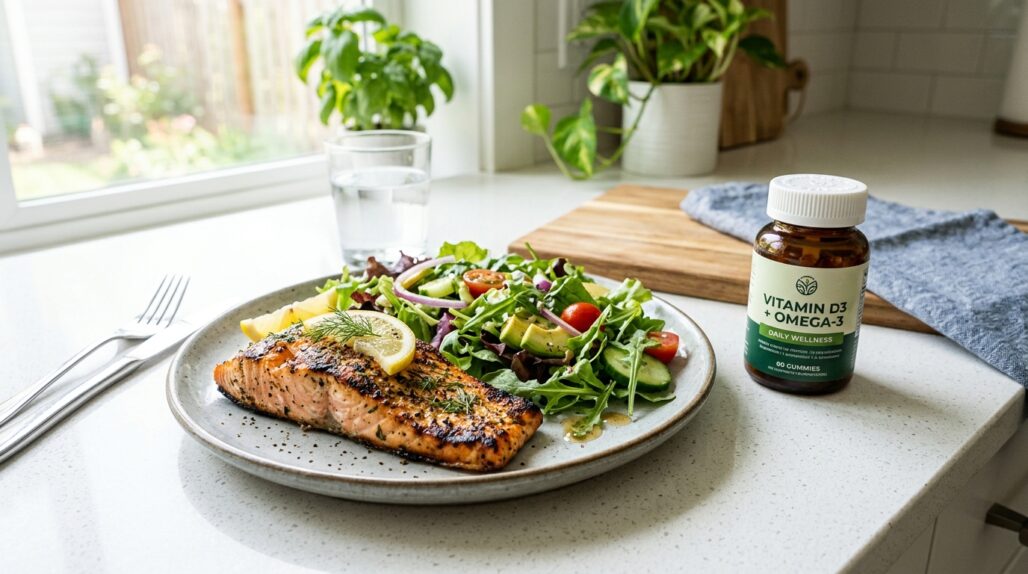
Fish oil and blood pressure medication usually pair fine, and sometimes the combination helps a little, because both lower blood pressure and the effects add up. At a normal 1 g/day dose, take it with food and carry on. At 2 g/day and above, tell your prescriber first and watch your home readings for a couple of weeks, since that is where the extra few points of drop actually show. Spacing the doses does nothing. The symptoms that mean stop and call someone are persistent dizziness, lightheadedness, fainting or near-fainting (especially on standing), blurred vision, or home BP readings running unusually low. Get the exact product and dose in front of your pharmacist or doctor before you combine them.
This article is for education only and is not medical advice or a recommendation to start, stop, or change any medication. Talk to your doctor or pharmacist about your own situation. Prices and product availability change; check current pricing before buying.
Reviewed by the UsefulVitamins Editorial Team.
