
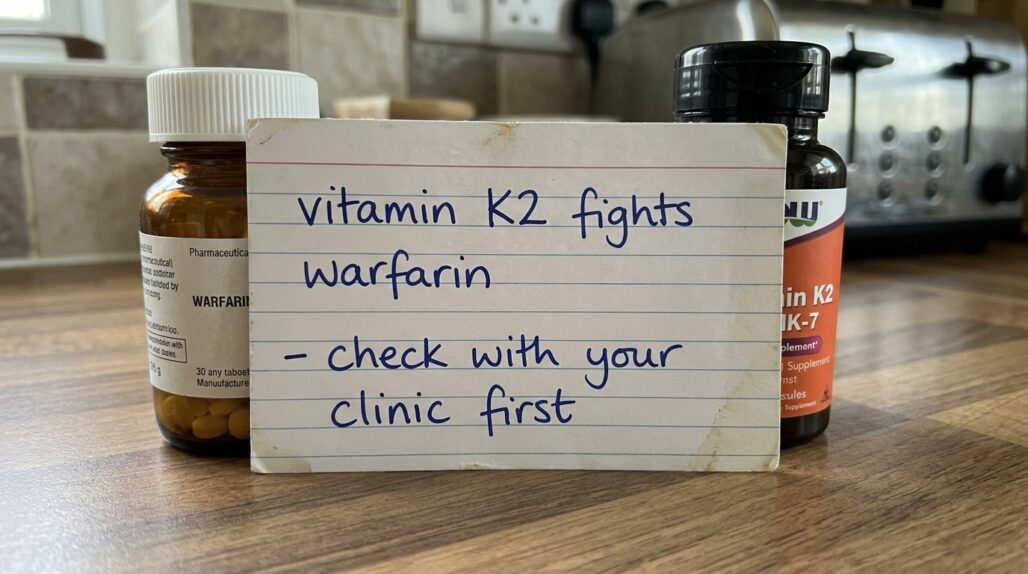
Before you decide
This article is general information, not medical advice, and it cannot replace your prescriber or your anticoagulation clinic. Warfarin is a narrow-margin drug, and the right move depends on your INR target, your history, and your full medication list.
The people at highest risk here are anyone on warfarin (Coumadin, Jantoven) who is shopping for bone, heart, or arterial-calcification support and reaches for a vitamin K2 MK-7 product. Those supplements are marketed for exactly the goals warfarin patients care about, which is how the collision happens.
If you take a direct oral anticoagulant (DOAC) such as apixaban (Eliquis) or rivaroxaban (Xarelto) instead of warfarin, the picture is different, and we cover that below. The warnings here are specifically about vitamin K antagonists like warfarin.
One more framing point. Vitamin K2 is not "dangerous" in a vacuum. It is a normal, useful nutrient. The problem is that it works against the exact drug you are relying on to prevent a clot.
Why warfarin and vitamin K2 fight each other
Your liver needs vitamin K to build several clotting factors – factors II, VII, IX, and X, plus proteins C and S. Each time the body activates one of those factors, it uses up a bit of vitamin K, which then has to be recycled to be used again.
Warfarin blocks that recycling step. It inhibits an enzyme called vitamin K epoxide reductase complex 1 (VKORC1), which is what regenerates usable vitamin K. With the recycling stalled, the liver runs short on active vitamin K and makes fewer working clotting factors, so the blood clots more slowly. The mechanism is laid out in the StatPearls warfarin monograph on the NCBI Bookshelf.
Here is the catch. Adding vitamin K – in any form – hands the liver more raw material and partly overrides the block. That is why a steak dinner or a kale binge can nudge an INR down, and why a concentrated K2 supplement can do it harder and for longer.
Vitamin K2 (menaquinone) counts as vitamin K for this purpose. MK-7 is not a separate, warfarin-safe vitamin. It feeds the same clotting machinery that warfarin is trying to throttle.

Why MK-7 specifically is a bigger problem than people expect
Among the vitamin K forms, MK-7 is the long-acting one. Its long isoprenoid tail keeps it circulating in the blood far longer than vitamin K1 (phylloquinone), with a half-life measured in days rather than hours. That staying power is exactly why supplement brands like it for bone and heart use.
For a warfarin patient, that same property is the hazard. A long-lasting form means the anticoagulant effect can be pushed down steadily, not just for a few hours after a dose.
Researchers have measured how little it takes. In a dose-response study by Theuwissen and colleagues in the Journal of Thrombosis and Haemostasis, supplemental MK-7 at just 10, 20, and 45 micrograms per day influenced anticoagulation, with the higher microgram doses producing a clear, dose-dependent reduction in the anticoagulant effect. These are tiny amounts.
For scale, most retail MK-7 products supply 90 to 180 micrograms per capsule – several times the dose that already moved the needle in that study. So a "standard" K2 capsule is not a small exposure for someone on warfarin.
Earlier work reported to the journal Blood by Schurgers and colleagues found MK-7 was actually more effective than vitamin K1 at carboxylating osteocalcin in healthy volunteers, a marker of stronger vitamin K activity. Translation: gram for gram, MK-7 fights warfarin harder than the K1 in your salad.
How big is the effect, and what does it look like in real life
The risk is not "your INR goes up." It is the reverse. Extra vitamin K2 tends to lower the INR, meaning your blood clots more easily and your protection against stroke or clot weakens.
The NIH Office of Dietary Supplements vitamin K fact sheet states that vitamin K can have a serious interaction with anticoagulants such as warfarin, and that people on warfarin should keep their vitamin K intake about the same from day to day. A supplement that you start, stop, or take inconsistently is the opposite of "about the same."
The FDA prescribing information for warfarin makes the same point from the drug side: dietary and supplemental vitamin K affects warfarin response, and more frequent INR monitoring is advised when starting or stopping any product that can change vitamin K status. A K2 supplement is squarely one of those products.
A practical warning sign worth knowing: if your INR has been steady for months and then drifts below your target range after you change your routine, a new vitamin K source is one of the first things a clinic will ask about.
If you must take K2, the consistency rule
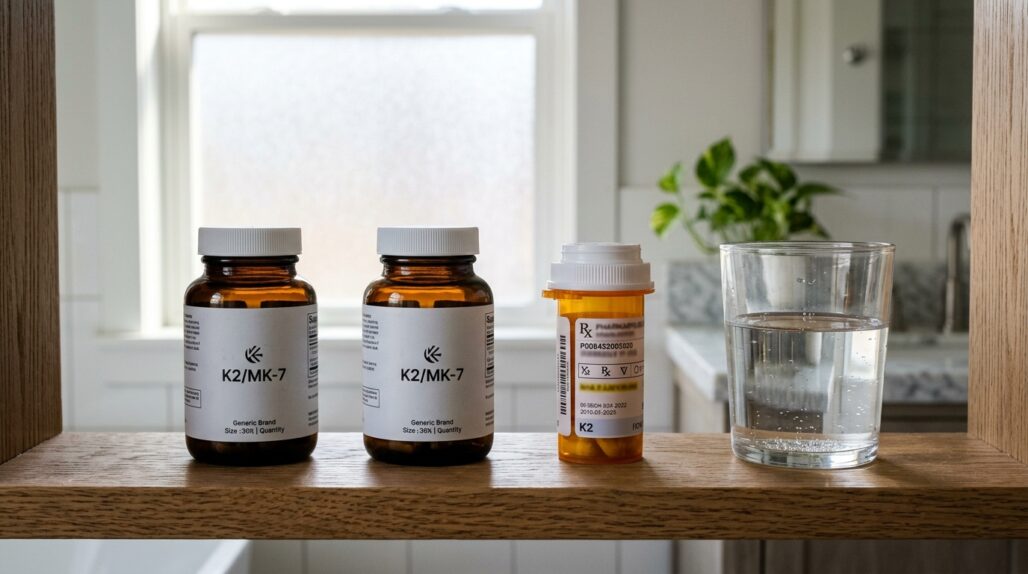
Sometimes a clinician decides the benefit is worth it – for example, in someone with significant bone or vascular concerns – and approves K2 anyway. If that is your situation, the safety hinges on consistency and monitoring, not on the supplement being harmless.
| Situation | What it means for K2 | Practical step |
|---|---|---|
| On warfarin, considering K2 | K2 directly opposes the drug | Do not start without anticoagulation-clinic approval |
| Clinic approves K2 | Effect is manageable only if stable | Same brand, same dose, same time every day |
| Starting or stopping K2 | INR can shift in either direction | Test INR more often during the change |
| On a DOAC (apixaban, etc.) | No vitamin K antagonism | K2 is generally not the same concern |
The core idea: an unstable vitamin K intake is what destabilizes warfarin. A steady microgram dose your clinic has accounted for is safer than an on-and-off habit, because your warfarin dose gets set against that steady background.
What does not work is self-managing it. Skipping K2 on busy days, doubling up when you remember, or switching brands with different potencies all push your INR around in ways your clinic cannot predict.
What about apixaban, rivaroxaban, and other DOACs
If you take a direct oral anticoagulant rather than warfarin, vitamin K2 is generally not the same problem. DOACs like apixaban (Eliquis) and rivaroxaban (Xarelto) block clotting factors directly and do not work through the vitamin K cycle at all, so adding vitamin K does not blunt them the way it blunts warfarin. The Drugs.com interaction summary for Eliquis and vitamin K reflects this lack of a vitamin K antagonism mechanism.
That is one reason DOACs do not require routine INR testing or strict vitamin K consistency. We walk through that in detail in our guide to vitamin K and Eliquis.
This does not mean "anything goes" on a DOAC. Other supplements that affect bleeding still deserve a conversation with your prescriber. But the specific warfarin-versus-K2 conflict does not apply to these drugs.

When to call a clinician
Loop in your anticoagulation clinic or prescriber before you make any change, and reach out promptly if something seems off.
- Before you start, stop, or switch any vitamin K2 product while on warfarin.
- If a recent INR came back below your target range after a routine change.
- New clot signs such as leg swelling or pain, sudden shortness of breath, chest pain, sudden weakness, vision change, or trouble speaking – treat these as urgent and seek emergency care.
- If you are unsure whether a multivitamin, bone formula, or "heart" blend contains hidden K1 or K2, since many do.
Keeping an accurate list of everything you take makes these conversations faster and safer. A free app like StackMyMed lets you log your supplements and prescriptions in one place and flag a possible interaction to raise with your pharmacist. It is a prompt for a professional conversation, not a substitute for clinical judgment.
For the bigger picture on mixing pills and supplements, see our ultimate guide to drug and supplement interactions, run your own combo through the drug-supplement interaction checker, and use the warfarin vitamin K calculator to think about daily consistency.
FAQ
Can I take vitamin K2 MK-7 if I am on warfarin? Not on your own. Vitamin K2 opposes warfarin and can lower your INR, so the decision belongs to your anticoagulation clinic, and any approved use needs a fixed daily dose and closer INR monitoring.
How much MK-7 is enough to affect my INR? Research suggests very little. A dose-response study found supplemental MK-7 influenced anticoagulation at just 10 to 45 micrograms per day, which is below the 90 to 180 micrograms in many retail capsules.
Does vitamin K2 raise or lower the INR? It tends to lower it. More vitamin K means more clotting capacity, which works against warfarin and reduces your protection against clots.
Is K2 safe with Eliquis or other DOACs? Generally yes, regarding this specific mechanism. Apixaban and similar drugs do not act through the vitamin K cycle, so vitamin K2 does not blunt them the way it blunts warfarin. Still tell your prescriber what you take.
I already took an MK-7 supplement – what should I do? Do not panic, but contact your anticoagulation clinic. Tell them the product and dose, and ask whether you need an earlier INR check. Watch for any clot symptoms in the meantime.
What about the small amount of K2 in my multivitamin? Even small amounts matter for warfarin, mainly because of consistency. A steady daily multivitamin your clinic knows about is easier to dose around than one you start and stop.
Conclusion: keep K2 and warfarin apart unless your clinic says otherwise
Vitamin K2 (MK-7) is a useful nutrient and a direct opponent of warfarin at the same time. Because it is long-acting and works against the very enzyme warfarin blocks, even microgram doses can lower your INR and weaken your clot protection.
The safe path is simple. Do not add MK-7 on your own while on warfarin. If your clinic approves it, keep the dose identical every day and test your INR more often during any change. And remember that on a DOAC like apixaban, this particular conflict does not apply.
Your next step: list every supplement and medication you take, then bring that list to your prescriber or pharmacist before changing anything.
This article is for general education and does not replace personalized medical advice. Dosing and supplement decisions for anyone on an anticoagulant should be made with a qualified clinician or anticoagulation clinic.
Reviewed by the UsefulVitamins Editorial Team.
