
Affiliate disclosure: this article contains affiliate links. As an Amazon Associate, UsefulVitamins.com earns from qualifying purchases at no extra cost to you.
Why "1000 mg fish oil" tells you almost nothing
The front of the bottle is the marketing. The back of the bottle is the dose.
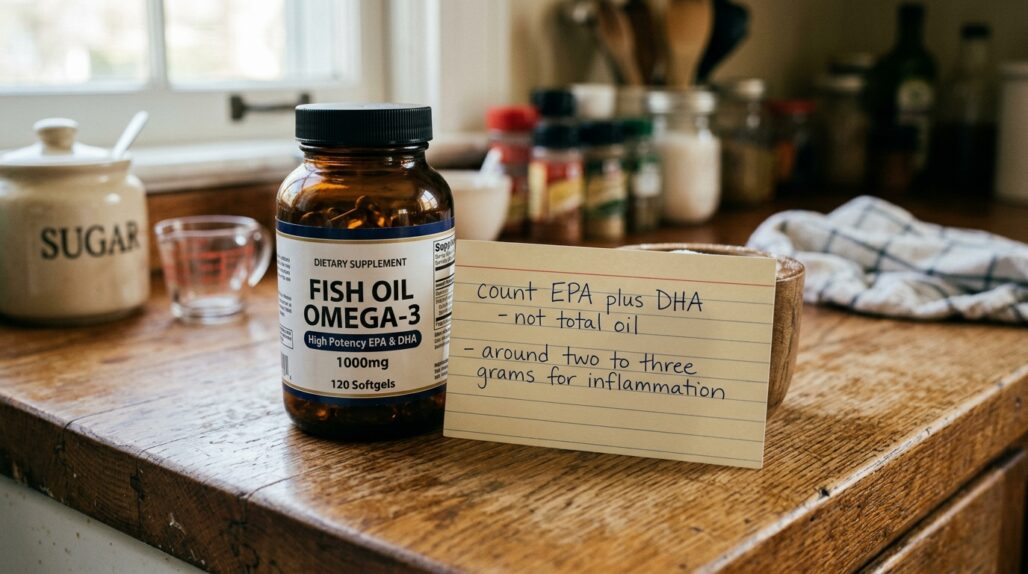
A softgel labeled "fish oil 1000 mg" describes the weight of the oil, not the amount of active omega-3 in it. A typical standard product delivers only about 300 mg of combined EPA + DHA from that gram of oil. The rest is other fats and carrier oils.
For inflammation, the two omega-3s that do the work are EPA (eicosapentaenoic acid) and DHA (docosahexaenoic acid). So the number that matters is the sum of those two on the NIH Office of Dietary Supplements omega-3 fact sheet terms, the EPA + DHA content, not the total oil.
Get that one habit right and most of the confusion about dosing disappears.
The label math, with a worked example
Here is how to read a real panel without getting fooled by the front.
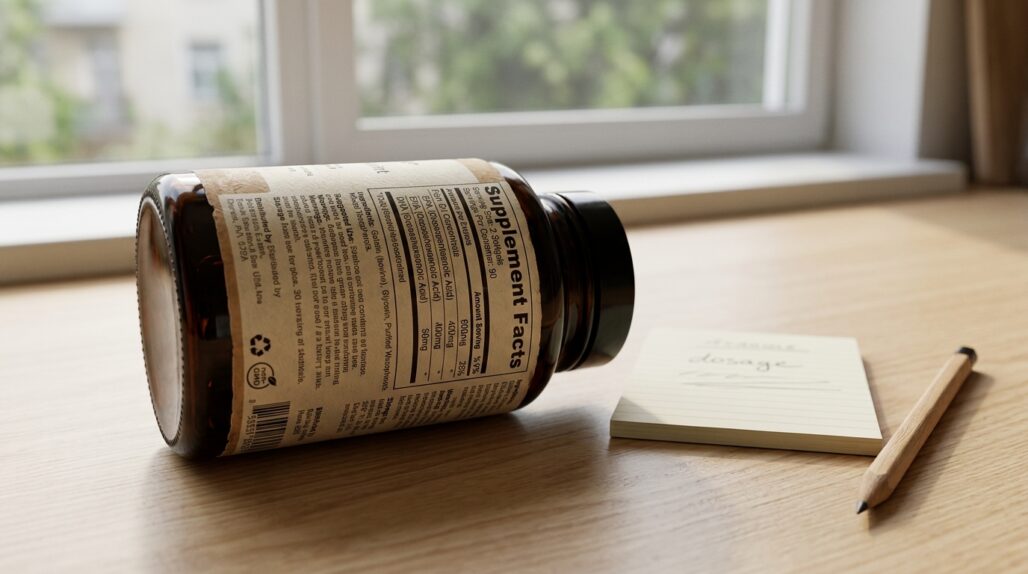
Find the serving size first. Some brands quote their omega-3 numbers per two or three softgels, so a "1200 mg EPA + DHA" claim can secretly require three pills.
Then add the two lines. If a serving lists EPA 400 mg and DHA 200 mg, your combined EPA + DHA is 600 mg per serving, regardless of whether the front says 1000 mg or 1500 mg.
A concentrated product changes the math in your favor. Standard oils are roughly 30 percent EPA + DHA; concentrates run 60 to 90 percent, so you hit a 2 g target in fewer, smaller softgels. To turn your own target into pills per day, run your numbers through our EPA and DHA calculator instead of doing the arithmetic by hand. For the wider context on daily intake, the omega-3 dosage guide walks through baseline needs.
How much for inflammation, by goal
There is no single "anti-inflammatory dose," because the right number depends on what you are doing. General maintenance is a small amount. Calming measured inflammation takes more.
For everyday upkeep, most guidance lands near 250 to 500 mg of combined EPA + DHA per day, which is roughly what a couple of servings of oily fish a week provides.
For an inflammatory goal, the trials that actually moved markers like CRP, TNF-alpha, and IL-6 tended to use 1 to 3 grams of combined EPA + DHA daily. A frequently cited rheumatoid arthritis meta-analysis found reductions in tender joint count and morning stiffness with fish oil over about three months, and later work clusters the joint-symptom benefit around 2.7 g/day of EPA + DHA.
| Goal | Combined EPA + DHA per day | What the evidence is for | Check with a clinician |
|---|---|---|---|
| General maintenance | 250 to 500 mg | Baseline omega-3 status, general wellness | Not usually needed |
| Heart-related (existing CHD) | About 1 g | AHA position for established coronary heart disease | Yes, part of a care plan |
| General inflammation | 1 to 2 g | CRP, TNF-alpha, IL-6 reductions in trials | Sensible above 1 g if on meds |
| Joint / RA symptom support | Around 2.7 g (study range 2 to 3 g) | Tender joints, morning stiffness in RA meta-analyses | Yes, alongside prescribed treatment |
| Above 3 g | 3 g and up | Studied, but the FDA flags this as the supplement ceiling | Required, do not self-direct |
These are education numbers, not a prescription. Fish oil supports a plan; it does not replace one, and it does not treat or cure arthritis or any other condition. If you are weighing your options, it is worth comparing turmeric versus fish oil for inflammation before settling on one.
Why a higher-EPA ratio makes sense for inflammation
Both omega-3s help, but they do slightly different jobs, and for inflammation the bias leans toward EPA.
When you take in more EPA, your cells make signaling molecules called eicosanoids and resolvins that are generally less inflammatory than the ones built from arachidonic acid. The review work by Philip Calder on omega-3s and inflammation describes EPA-derived mediators as lower in inflammatory potency, with EPA and DHA both feeding the resolvin pathways that help inflammation switch off.
That is why a product with a higher EPA-to-DHA ratio is a reasonable pick when inflammation is the target, while a more DHA-weighted oil suits brain and eye goals. A purified high-EPA approach is also what the REDUCE-IT trial used at 4 g/day, though that was a physician-supervised cardiovascular study, not a self-serve dose.
DHA still matters. You do not need to chase EPA-only; you just do not want a token amount of EPA buried in a low-concentration oil.
When you will notice anything
Fish oil is a slow build, not a switch. The fatty acids have to work their way into your cell membranes before the signaling shifts.
Inflammatory blood markers such as CRP generally start to move after 8 to 12 weeks of steady daily intake, and joint-symptom trials usually run at least 12 weeks. If you stop after two weeks because "nothing happened," you stopped before the experiment finished.
| Stage | What is happening | What you might notice |
|---|---|---|
| Weeks 1 to 2 | Blood EPA + DHA rising, membranes not yet saturated | Usually nothing measurable |
| Weeks 4 to 6 | Membrane omega-3 content climbing | Some people report easing stiffness |
| Weeks 8 to 12 | Markers like CRP shift in studies | The realistic window to judge it |
| Beyond 12 weeks | Steady state, benefits maintained by consistency | Stable effect if the dose is right |
Consistency does more than a perfectly timed pill. Take it with a meal that has some fat, which helps absorption, and take it on the same schedule every day.
Which form and product to buy
Once your EPA + DHA target is set, the form is the next decision that changes the outcome.
The two common forms are triglyceride (TG, often "re-esterified TG") and ethyl ester (EE). A widely cited Dyerberg bioavailability study and related work found the TG form absorbs better, roughly 124 percent versus 73 percent for ethyl ester in one head-to-head. EE products are cheaper and still work, especially taken with food; TG is the gentler, better-absorbed upgrade. Our TG vs EE vs krill breakdown compares them in detail.
For an inflammation goal, look for three things: a high EPA + DHA per serving (a concentrate), an EPA-leaning ratio, and a freshness or third-party purity mark. Then match the pill count to your target. The roundup of vetted omega-3 fish oil supplements narrows the field if you want a shortlist.
We may earn a commission from links below, at no extra cost to you. It does not change our picks.


As an Amazon Associate, UsefulVitamins.com earns from qualifying purchases at no extra cost to you.
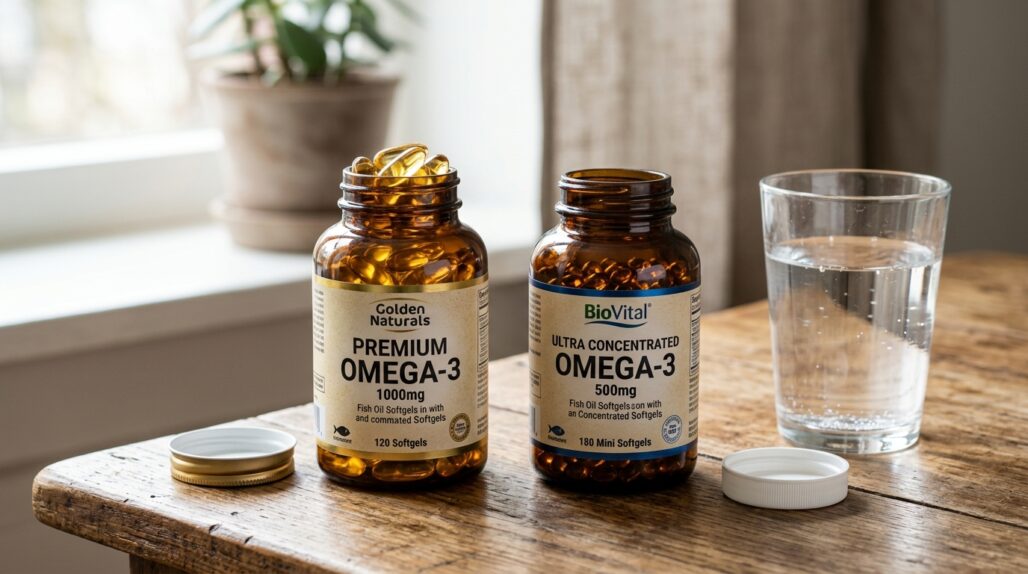
A high-EPA concentrate gets you to 2 g in fewer softgels. A standard TG oil is fine for maintenance. Pick the one whose label math hits your number with the fewest pills you will actually keep taking.

What to watch for, and who should be careful
Fish oil is well tolerated for most people, but the dose ceiling is real and worth respecting.
The NIH Office of Dietary Supplements notes the FDA recommends not exceeding 3 g/day of combined EPA + DHA, with no more than 2 g/day from supplements. European regulators consider intakes up to about 5 g/day safe long term, but that is the outer edge, not a starting target.
The classic caution is bleeding. Doses of 2 to 15 g/day can lengthen bleeding time by reducing platelet aggregation. A 2024 meta-analysis on omega-3s and bleeding risk was largely reassuring, but if you take warfarin, a DOAC, antiplatelet drugs, or have surgery coming up, that is a pharmacist or doctor conversation before you go past about 3 g.
Common minor effects are fishy burps, reflux, or loose stools, which often improve by taking it with food, splitting the dose, or switching to a fresher TG product. Rancid oil tastes worse and is lower quality, so smell-test an old bottle.
FAQ
Is 1000 mg of fish oil the same as 1000 mg of omega-3? No. The “1000 mg” usually refers to total oil, while the active EPA + DHA in that softgel might be only around 300 mg. Always add the EPA and DHA lines on the back panel.
How much EPA and DHA should I take for inflammation? Most inflammation evidence sits at 1 to 3 g of combined EPA + DHA per day, with joint-symptom studies clustering near 2.7 g. Use our calculator to convert that into softgels for your specific product.
Is more fish oil always better? No. Past roughly 3 g/day of EPA + DHA the FDA flags caution, and the bleeding-time effect grows. More is not stronger; it just raises the risk side of the ledger.
EPA or DHA for inflammation? Lean toward a higher-EPA ratio for inflammatory goals, since EPA-derived mediators tend to be less inflammatory. DHA still helps and you do not need an EPA-only product, just avoid a low-concentration oil with a token amount of EPA.
How long before fish oil helps inflammation? Plan on 8 to 12 weeks of steady daily use. Blood markers and joint symptoms in trials shift over that window, not in the first week or two.
Can I take fish oil with a blood thinner? Ask your pharmacist or doctor first. Omega-3s can add to the blood-thinning effect, especially at higher doses, so this is a decision to make with the person managing your medication.
The bottom line
For inflammation, ignore the big front-of-bottle number and add up EPA + DHA on the back. Most evidence lands in the 1 to 3 g/day combined range, with an EPA-leaning, triglyceride-form concentrate being the upgrade that gets you there in fewer pills.
Give it 8 to 12 weeks before you judge it, keep daily intake at or below 3 g from supplements unless a clinician says otherwise, and use the EPA and DHA calculator to turn your target into an exact pill count. Fish oil is not a cure; it is one supported, slow-acting piece of a broader plan.
This article is general education, not medical advice. Supplements can interact with medications and are not a substitute for treatment. Talk to a pharmacist or doctor before starting, stopping, or changing anything, especially if you take blood thinners or have a health condition.
Reviewed by the UsefulVitamins Editorial Team.
