
Affiliate disclosure: this article contains affiliate links. As an Amazon Associate, UsefulVitamins.com earns from qualifying purchases at no extra cost to you.
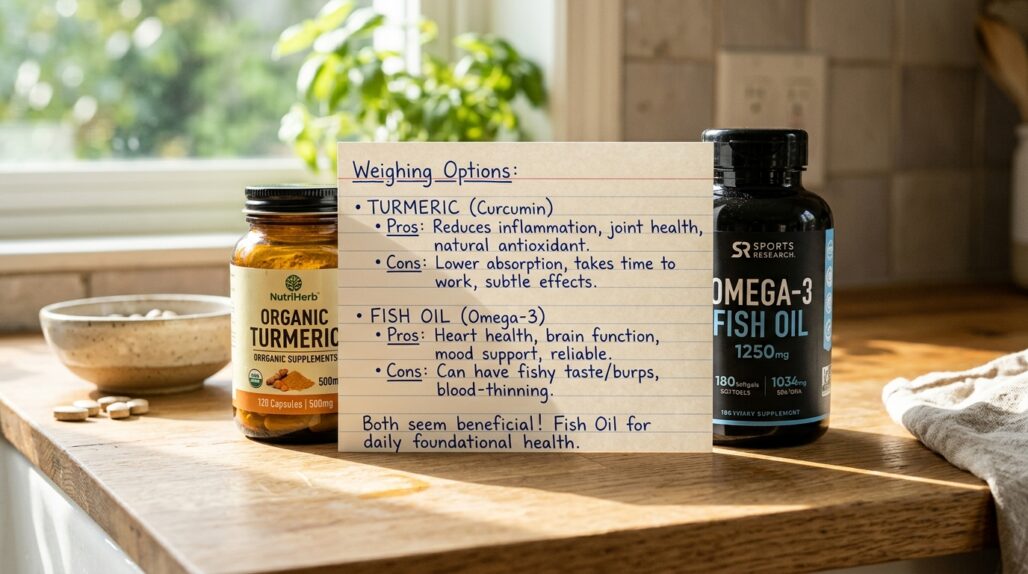
People rarely reach for turmeric and fish oil at the same time by accident. They land here because both are sold as "natural anti-inflammatories," they cost about the same, and it is not obvious which one earns the spot in your cabinet. The short answer is that they are not really competing for the same job. One is best understood as a targeted joint and tissue tool, the other as a baseline you build over months. Below is the honest version of how they compare, graded by what the human trials actually show, not by marketing.
Where the inflammation lives decides the winner
Inflammation is not one thing. A swollen arthritic knee, a flare of gut irritation, a high CRP reading on a routine blood panel, and the soreness 24 hours after a hard workout are all "inflammation," but they sit in different tissues and respond to different inputs. That is why the turmeric-versus-fish-oil question has no clean answer until you say what you are trying to calm.
Turmeric supplements deliver curcumin, the yellow pigment, which acts most visibly on the signaling that switches inflammation on. Fish oil delivers EPA and DHA, omega-3 fats that change the raw materials your body uses and feed the molecules that actively switch inflammation off. Different ends of the same process. Keep that distinction in mind and the rest falls into place.
What curcumin is and how it works
Curcumin is one of several curcuminoids in the turmeric root. Its best-described action is dialing down NF-kB, a master switch that turns on pro-inflammatory genes, along with knock-on effects on COX-2 and inflammatory cytokines like TNF-alpha. That is a believable mechanism for tamping down an active inflammatory signal.
The catch is absorption. Plain curcumin is poorly bioavailable: it is barely water-soluble, unstable, and cleared fast, so a cheap "turmeric 500mg" capsule may put very little into your blood. Formulation is the whole game. The classic human study by Shoba and colleagues found that adding piperine from black pepper raised curcumin bioavailability by roughly 2000 percent (a 20-fold jump), per the 1998 Planta Medica pharmacokinetic study. Phytosome forms that bind curcumin to phospholipids have shown around 29-fold higher plasma curcuminoids in human pharmacokinetic work. The label form matters more than the milligram number on the front.
Evidence grade: moderate, and strongest for joints. A 2025 meta-analysis of 21 randomized controlled trials in 1,705 people with knee osteoarthritis found curcumin significantly lowered CRP (standardized mean difference around -0.91) and, more weakly, TNF-alpha, though IL-6 and ESR did not budge, per the PMC meta-analysis of curcumin and inflammatory biomarkers. Pooled trials also show curcuminoids beat placebo on WOMAC pain and function and were not inferior to NSAIDs for OA pain in a separate RCT meta-analysis. Be honest about the limits: heterogeneity between trials was very high and the authors rated overall certainty as low to very low. Real signal, shaky precision.

What EPA and DHA do and how they work
Fish oil supplies the long-chain omega-3 fats EPA and DHA. Their first effect is structural. As you take more, they partly replace omega-6 arachidonic acid in cell membranes, which shifts the eicosanoid mix away from the more inflammatory products. The more interesting effect is that EPA and DHA are the feedstock for specialized pro-resolving mediators (resolvins, protectins, maresins), the signals that tell an inflammatory episode to wind down and the tissue to repair. So rather than only blocking the "on" switch, omega-3s strengthen the "resolve" phase.
That mechanism shows up in people. In rheumatoid arthritis patients and matched controls, over-the-counter fish oil raised the resolvin precursors 18-HEPE and 17-HDHA in blood, although pro-inflammatory eicosanoids only trended down without reaching significance, per the PMC study on fish oil and lipid mediators. In the large VITAL trial, 1 gram a day of omega-3s (about 460 mg EPA plus 380 mg DHA) was linked to a non-significant roughly 15 percent lower rate of new autoimmune disease overall, reaching significance (about 18 percent) only when probable cases were included; no single disease such as rheumatoid arthritis reached statistical significance on its own. The NIH Office of Dietary Supplements omega-3 fact sheet notes typical supplemental EPA/DHA in the range of about 1 to 3 grams a day for various endpoints and a mild blood-thinning effect at higher intakes.
Evidence grade: moderate, and strongest for whole-body and cardiometabolic inflammation plus joint symptoms in inflammatory arthritis. The mechanistic story is excellent and the RA symptom data are decent; broad CRP-lowering across healthy adults is mixed and dose-dependent. If you want to size a dose to your fish intake, the best omega-3 fish oil roundup spells out EPA/DHA per serving across products.
Head-to-head: what the trials actually show
Both have a coherent mechanism and both have human data. The difference is where that data is most convincing. Curcumin owns the localized joint-pain evidence, with repeated OA trials and NSAID-comparison data. Fish oil owns the build-it-over-time, whole-body evidence, with mechanism-confirming SPM work and cardiometabolic backing. Neither is a fast painkiller, and neither is a treatment for a diagnosed inflammatory disease.
| Factor | Turmeric (curcumin) | Fish oil (EPA/DHA) |
|---|---|---|
| Best for | Knee OA, joint pain, gut, post-exercise soreness | Whole-body and cardiometabolic inflammation, inflammatory arthritis, low omega-3 diet |
| Evidence | 21-RCT meta-analysis lowers CRP and OA pain, but low GRADE certainty and high heterogeneity | Strong mechanism via resolvins, decent RA symptom and prevention data, mixed CRP effect |
| Onset | Weeks for joint pain; not an instant analgesic | Weeks to months as tissue omega-3 levels rise |
| Typical dose | 500 to 1,000 mg curcuminoids in a high-absorption form (piperine or phytosome) | About 1 to 3 g combined EPA/DHA daily, label-quantified |
| Main downside | Cheap forms barely absorb; possible bleeding interaction at high dose | Fishy burps, larger softgels, mild bleeding effect at higher doses |
One practical point that decides more outcomes than people expect: a turmeric capsule that does not absorb is a non-starter, and a fish oil that does not state its EPA/DHA can be mostly filler oil. Read the form on turmeric and the actual omega-3 content on fish oil before you compare prices.
Who should pick which
Pick turmeric if you have a specific, locatable complaint: an arthritic knee, stiff hands, recurring gut irritation, or muscle soreness from training. The strongest curcumin trials are in exactly these joint and tissue contexts, and a good high-absorption form can rival an NSAID for OA pain without the stomach hit. To compare absorption forms head to head, the curcumin bioavailability comparator lines up piperine, phytosome, and the rest.
Pick fish oil if your goal is broader: heart and metabolic support, an eating pattern low in oily fish, or a high CRP you are trying to chip away at over the long run. Fish oil is also the more sensible default if you are not chasing one painful joint but want a steady anti-inflammatory baseline. Browse forms and EPA/DHA strengths in the best turmeric and curcumin roundup for the turmeric side, and start with a higher-EPA fish oil if joints are part of the picture.
Which to buy


As an Amazon Associate, UsefulVitamins.com earns from qualifying purchases at no extra cost to you.
We may earn a commission if you buy through links on this page, at no extra cost to you. It never changes our verdict.
If your problem is a joint you can point to, the turmeric pick in a high-absorption form is the better first buy. If you want a long-term baseline or cardiometabolic cover, the high-EPA/DHA fish oil pick earns it. And if you want both jobs covered, the combo pick saves money over two bottles. For a wider view of what else competes in this space, see the guide to the best supplements for inflammation.
Can you take both together?
Yes, and for many people that is the smartest move. They act on different stages of the same process: curcumin presses down on the inflammatory "on" signal through NF-kB, while EPA and DHA feed the resolvins that switch inflammation off and clean up. That is complementary, not redundant, so a turmeric-plus-fish-oil stack is reasonable.
Here is the safety note, and it is the real one. Both have a mild blood-thinning effect, and that can be additive. On their own and at sensible doses this is minor for healthy people. It stops being minor if you take an anticoagulant or antiplatelet drug (warfarin, apixaban, clopidogrel, daily aspirin), if you have a bleeding disorder, or if you have surgery or a dental procedure coming up. Regulators have flagged that turmeric and curcumin products can interact with warfarin, and high-dose fish oil adds to that. If any of those apply, talk to your clinician before stacking, and never start or stop a prescription on your own. Most surgeons ask you to pause both for about a week before an operation.
Two more honest caveats. Neither supplement is a treatment for a diagnosed inflammatory disease such as rheumatoid arthritis or inflammatory bowel disease; they are support, and persistent or worsening inflammation needs a proper workup. And if you are pregnant, keep curcumin to food amounts unless your clinician says otherwise.
FAQ
Is turmeric or fish oil better for arthritis? For osteoarthritis joint pain specifically, curcumin has the more direct trial evidence and can approach NSAID-level relief in a high-absorption form. For inflammatory arthritis like rheumatoid arthritis, fish oil has good symptom and prevention data. Many people with joint issues end up using both.
How long until I notice anything? Neither works like a painkiller. Plan on a few weeks for curcumin on joint pain and several weeks to a couple of months for fish oil as your tissue omega-3 levels rise. If nothing has shifted by 8 to 12 weeks at a real dose, reassess.
Does the form of turmeric really matter that much? Yes. Plain curcumin is barely absorbed, so a bargain capsule can do almost nothing. Choose a form with piperine or a phytosome/liposomal delivery, which raise blood levels many times over.
What dose of each should I take? Common research-backed ranges are roughly 500 to 1,000 mg of curcuminoids daily in a high-absorption form, and about 1 to 3 grams of combined EPA plus DHA from fish oil. Check the label for the actual EPA/DHA, not just total fish oil.
Can I take both with a blood thinner? Not without medical sign-off. Both have a mild additive blood-thinning effect, so combining them with warfarin, apixaban, clopidogrel, or daily aspirin can raise bleeding risk. Ask your clinician and do not adjust your medication yourself.
Do I still need these if I eat well? If you eat oily fish a few times a week and use turmeric in cooking, your baseline is already decent. Supplements mainly help when intake is low or you are targeting a specific complaint at a dose food cannot reach.
The bottom line
Turmeric versus fish oil is not a knockout, it is a matching exercise. Curcumin is the better-evidenced pick for joint, gut, and soft-tissue inflammation you can point to, provided you buy an absorbable form. Fish oil is the better pick for whole-body and cardiometabolic inflammatory tone and for anyone short on dietary omega-3s. Pick turmeric for the achy knee, pick fish oil for the long game, and feel free to run both since they hit different parts of the same pathway. The only firm rule: if you take a blood thinner or have surgery coming, clear the stack with your clinician first, because the bleeding effects add up.
This article is for general information and is not medical advice. Talk to a qualified clinician before starting supplements, especially if you take medication, are pregnant, or have a health condition.
Reviewed by the UsefulVitamins Editorial Team.
