
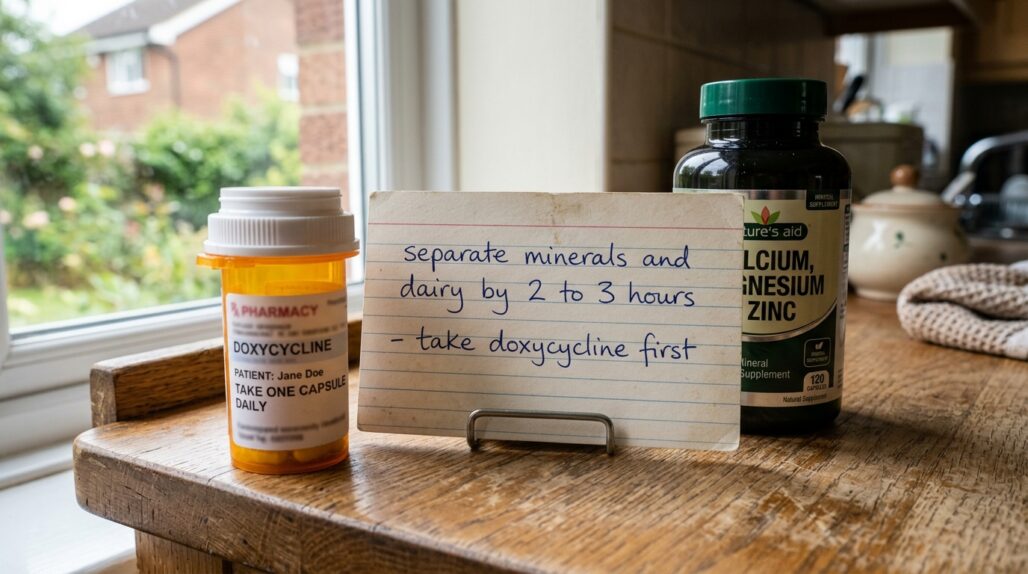
Before you decide
This is general information about a common timing problem, not medical advice for your specific prescription. Doxycycline is used for everything from acne and rosacea to respiratory infections, Lyme disease and malaria prevention, and the right schedule depends on your dose and condition. Your pharmacist can map the spacing onto your real routine in two minutes. For the wider picture across drug classes, our guide to drug-supplement interactions puts this one in context.
The interaction here is not dangerous in the way a bleeding or serotonin interaction is. The risk is a quietly weaker antibiotic. If the minerals knock down absorption, you may be carrying a half-strength dose without knowing it, which matters for clearing an infection.
The people most affected are those who take daily iron, calcium or a multivitamin with minerals, anyone who reaches for antacids or Pepto-Bismol for stomach upset, and people who take their pills with milk or a latte. If that's you, the fix is timing, not stopping your supplements. You can also run your specific products through our drug-supplement interaction checker.
What the interaction actually is
Doxycycline belongs to the tetracycline class, and tetracyclines have a well-documented habit: they grab onto metal ions. In chemistry terms, the drug chelates di- and trivalent cations to form an insoluble complex that the gut wall cannot pull in. The NCBI StatPearls monograph on doxycycline describes exactly this, noting the drug can chelate cations found in many supplements and medications and reduce its own absorption.
The minerals that matter carry a charge of 2+ or 3+. That list includes calcium, iron, magnesium, zinc, aluminum and bismuth. Sodium bicarbonate (baking soda, and some antacids) is flagged too because it shifts stomach pH.
Normally doxycycline is almost fully absorbed, with bioavailability close to 100%. Pair it with the wrong mineral at the same moment and that number can fall hard. A 2023 review of tetracycline-class drugs in dermatology summarized older controlled data showing tetracycline absorption dropped by 81% with iron, 65% with milk and 46% with food. Doxycycline is more food-stable than older tetracyclines, but the mineral effect is the same direction.
So the headline isn't "doxycycline is dangerous with vitamins." It's that a few minerals can rob the dose, and the antibiotic only works at a high enough blood level.
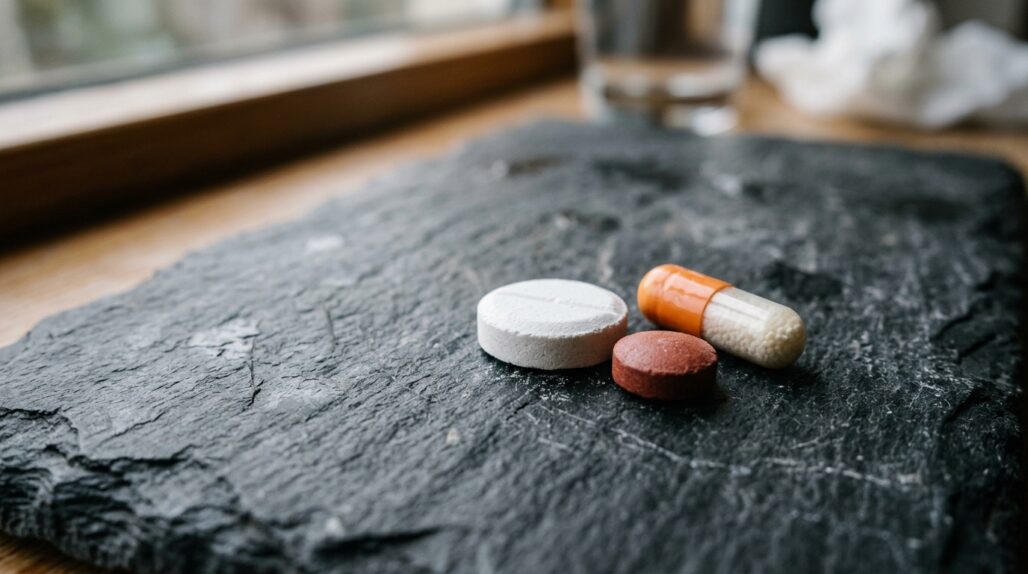
How big the effect is, mineral by mineral
The magnitude depends on which mineral and how much of it lands in your stomach at the same time as the pill.
- Iron is the heaviest hitter. Ferrous sulfate produces the largest drop, which is why iron gets the longest separation window; our complete guide to iron covers forms and dosing.
- Calcium matters whether it comes from a supplement, an antacid, or dairy. Older milk studies cited in the Springer journal Infection found milk lowered doxycycline absorption by roughly a third.
- Magnesium shows up in many "calcium-magnesium-zinc" combos and in magnesium-based laxatives and antacids; see our complete guide to magnesium.
- Zinc is a polyvalent cation too, so high-dose zinc lozenges count. The complete guide to zinc has the form details.
- Aluminum and bismuth appear in antacids and in Pepto-Bismol (bismuth subsalicylate). MedlinePlus lists antidiarrheal agents containing bismuth among the products to separate from doxycycline.
A useful mental model: the more concentrated the mineral and the closer in time, the bigger the loss. A splash of milk in coffee is a smaller hit than a 65 mg iron tablet swallowed together with the antibiotic, but the safe move is to space both.
| Supplement or product | Why it interferes | Practical spacing from doxycycline |
|---|---|---|
| Iron (ferrous sulfate, gluconate) | Strongest chelator; largest absorption drop | Take 3 hours before or 2 hours after the dose |
| Calcium supplements and antacids | Binds the drug; also raises stomach pH | Separate by at least 2 to 3 hours |
| Magnesium and zinc (and combos) | Polyvalent cations form insoluble complex | Separate by at least 2 to 3 hours |
| Dairy and calcium-fortified foods | Calcium in milk, yogurt, fortified juice | Separate by 2 hours; avoid taking the pill with milk |
| Pepto-Bismol (bismuth subsalicylate) | Bismuth is a polyvalent cation | Separate by 2 to 3 hours; ask your pharmacist |
What to do: timing, forms and a simple routine
The good news is the whole problem dissolves with spacing. NCBI guidance recommends taking doxycycline at least 1 hour before or 2 hours after food, and keeping mineral-containing products 2 to 3 hours away from the dose. MedlinePlus is more specific for iron, suggesting you take iron 3 hours before or 2 hours after the antibiotic. For the broader system, our medication and supplement timing guide walks through how to slot a stack around prescriptions.
Here is a routine that works for most once-daily or twice-daily schedules:
- Take doxycycline first, with a full 8-ounce glass of water, ideally on a relatively empty stomach.
- Stay upright for about 30 minutes; doxycycline can irritate the esophagus if it sits.
- Wait 2 to 3 hours before your iron, calcium, magnesium, zinc or multivitamin.
- Keep milk, yogurt, fortified plant milks and calcium-set tofu out of that window too.
- Push antacids and Pepto-Bismol to the same 2-to-3-hour gap.
A practical pattern: antibiotic in the morning with water, breakfast a bit later, and your mineral stack moved to lunch or evening. If you take doxycycline twice daily, anchor minerals to the gap that is farthest from either dose.
One nuance on forms. If doxycycline upsets your stomach, a small low-mineral snack (crackers, not a dairy meal) is usually fine and won't gut the absorption the way a glass of milk or an iron pill would. When stomach comfort matters, ask your pharmacist whether your specific brand can be taken with light food.
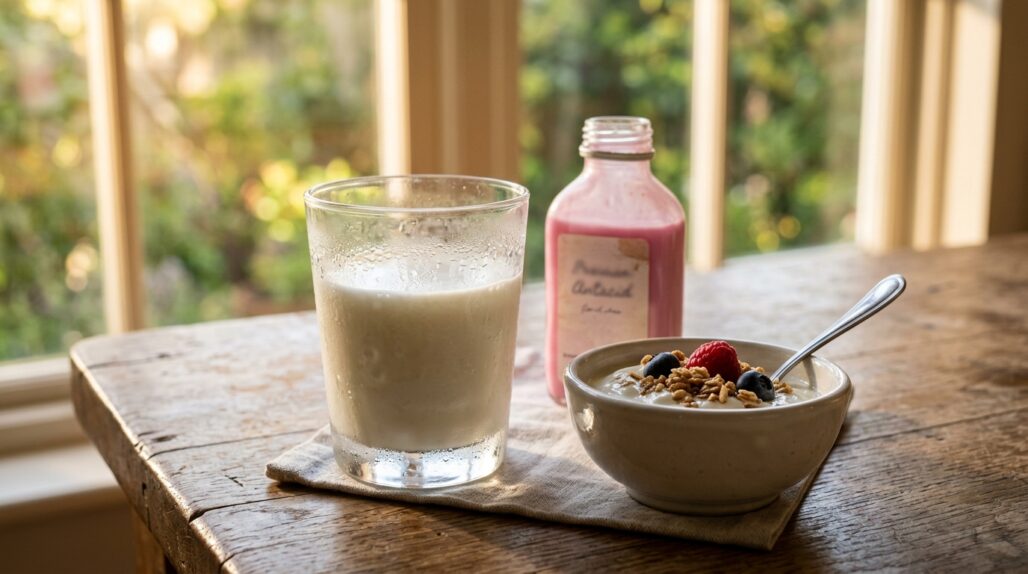
Probiotics during a doxycycline course
Antibiotics can disrupt gut bacteria and trigger antibiotic-associated diarrhea, so many people pair the course with a probiotic. The evidence is reasonable: a 2019 Cochrane review of probiotics for antibiotic-associated diarrhea found a moderate protective effect, strongest with higher-dose products (at least 5 billion CFU per day), and reported low adverse-event rates. That review was in children, and the best-studied strains include Saccharomyces boulardii and Lactobacillus rhamnosus GG.
Timing logic differs from minerals. Probiotics don't chelate doxycycline; the concern is that the antibiotic may kill the live organisms. So the common advice is to separate a probiotic from the antibiotic dose by about 2 hours. Saccharomyces boulardii is a yeast rather than a bacterium, so it isn't killed by antibacterial drugs and is convenient during a course.
Probiotics are not required for everyone, and they don't change the mineral timing rules. If you add one, space it from the dose and run it through your pharmacist, especially if you are immunocompromised, where live-organism products warrant caution.
When to involve a clinician
Most timing questions are pharmacist-level, and a quick call solves them. Reach out sooner rather than later in a few situations.
Ask before you start if you take prescription-strength iron or high-dose calcium, since fitting those around the antibiotic takes a plan. Ask if your infection symptoms are not improving after the expected window, because under-absorption can look like treatment failure. And get medical attention if you develop severe or bloody diarrhea, painful swallowing, or a worsening fever, which need evaluation rather than a supplement tweak.
If keeping track of a full stack feels error-prone, you can log what you take and when in StackMyMed, which helps you flag possible timing clashes to raise with a pharmacist. It organizes the list; it doesn't replace clinical judgment.
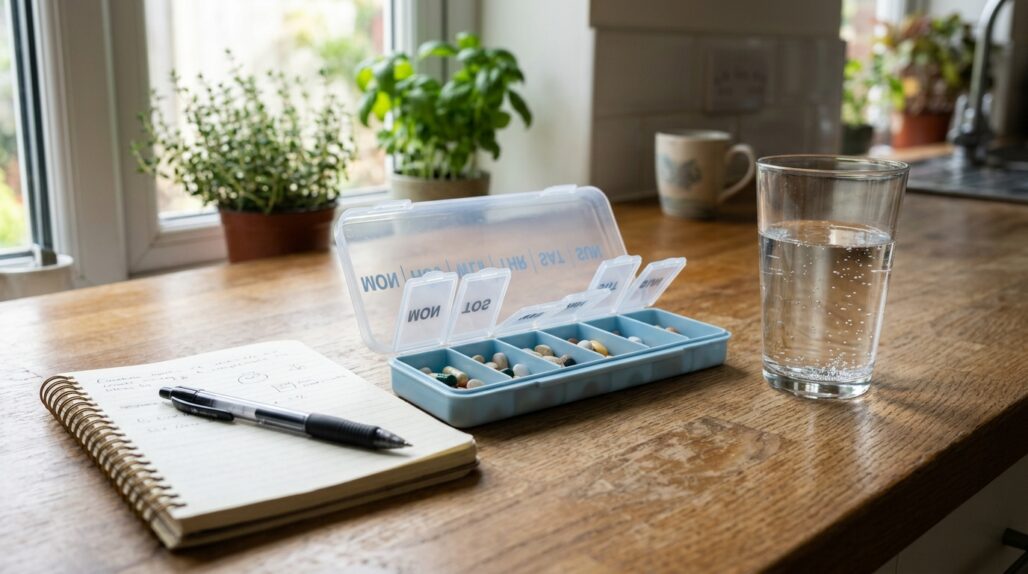
Don't skip a dose to fit a supplement
This is the rule that trips people up. If your supplement window collides with an antibiotic dose, move the supplement, never the antibiotic. Skipping or delaying doses to make room for a vitamin works against the entire point of the course.
The CDC's guidance on using antibiotics correctly is to take them exactly as prescribed and not to skip, save, or share doses. Whether to keep taking them after you feel better is a question for your prescriber. Inconsistent dosing lets the hardier bacteria survive and is one driver of resistance. A missed mineral pill costs you nothing meaningful; a missed antibiotic dose can.
So when in doubt, the priority order is simple: antibiotic on schedule, minerals around it.
FAQ
Can I take my multivitamin with doxycycline? Not at the same time. Most multivitamins contain calcium, iron, magnesium or zinc, which bind the antibiotic. Separate the multivitamin from your dose by 2 to 3 hours.
How long should I wait between doxycycline and dairy? Aim for at least 2 hours, and avoid swallowing the pill with milk. The calcium in dairy can lower absorption by roughly a third when taken together.
Does iron interfere more than calcium? Yes. Iron is the strongest binder, which is why the usual advice is to take iron 3 hours before or 2 hours after the antibiotic, a slightly longer window than for calcium.
Is Pepto-Bismol a problem with doxycycline? It can be. Bismuth subsalicylate is a polyvalent cation that binds the drug, so separate it by 2 to 3 hours and check with your pharmacist before using it during the course.
Should I take a probiotic while on doxycycline? It’s optional and reasonably supported for preventing antibiotic-associated diarrhea. Space it about 2 hours from the dose, and a yeast-based option like Saccharomyces boulardii survives antibiotics well.
What if I accidentally took my calcium with doxycycline? A single overlap is unlikely to ruin treatment. Don’t take an extra antibiotic dose; just resume correct spacing going forward and tell your pharmacist if it keeps happening.
Conclusion: space the minerals, protect the antibiotic
Doxycycline and most supplements coexist fine; the catch is timing. Because calcium, iron, magnesium, zinc, aluminum and bismuth chelate the drug, keep mineral pills, dairy and antacids 2 to 3 hours away from each dose, and give iron the widest gap. Take the antibiotic first with water, move your stack to a later window, and never skip a dose to fit a vitamin. If your routine is complicated or your infection isn't improving, a short conversation with your pharmacist or prescriber settles it.
This article is general educational information and is not a substitute for personalized medical advice. Doses and timing should be confirmed with your prescriber or pharmacist for your specific situation.
Reviewed by the UsefulVitamins Editorial Team.
