
Affiliate disclosure: this article contains affiliate links. As an Amazon Associate, UsefulVitamins.com earns from qualifying purchases at no extra cost to you.
If you're looking for a complete guide to iron supplements that actually tells you whether you need one, the short answer is this: iron is the one mineral you should not supplement without confirmed deficiency, but for the people who genuinely need it, the form and dosing schedule matter as much as the milligram number on the label. This guide walks through what iron actually is, why deficiency is the most common nutritional gap on the planet, who needs to supplement, which form absorbs best, why alternate-day dosing now beats daily dosing in the trial evidence, what the side effects and drug interactions look like, and how to read a ferritin result.
Before you decide
Iron builds hemoglobin in red blood cells, myoglobin in muscle, and the cytochromes that run cellular energy production. Iron-deficiency anemia is the most common nutritional deficiency on the planet, with menstruating women, pregnant women, vegetarians, endurance athletes, frequent blood donors, and people with gut disorders carrying the highest risk. The RDA is 18 mg/day for women aged 19 to 50, 8 mg/day for men and postmenopausal women, and 27 mg/day in pregnancy. Heme iron from animal foods absorbs at 15 to 35%; non-heme iron from plants at 2 to 20%, with vitamin C boosting absorption and tea, coffee, and calcium reducing it. The most tolerable supplemental form is ferrous bisglycinate; the cheapest is ferrous sulfate. New trial evidence supports alternate-day dosing because daily iron triggers a hepcidin spike that blocks the next dose. Never supplement iron without a documented deficiency, keep it out of reach of children (the leading cause of fatal pediatric supplement poisoning), and separate from levothyroxine, certain antibiotics, and antacids by at least four hours.
What Iron Actually Is
Iron is a transition metal the body cannot make and cannot easily excrete. We absorb it from food in two chemical environments and store the rest tightly bound to proteins, because free iron catalyzes oxidative damage.
The two dietary forms behave very differently. Heme iron sits inside the porphyrin ring of hemoglobin and myoglobin in animal foods (red meat, poultry, fish, organ meats, oysters) and crosses the brush border via a dedicated heme transporter. Heme absorbs at roughly 15 to 35%, with little interference from other meal components. Non-heme iron, the form in plants (lentils, beans, tofu, spinach, fortified grains) and in dairy and eggs, exists as ferric (Fe3+) and ferrous (Fe2+) ions that must be reduced to Fe2+ at the brush border and carried by DMT1. Non-heme absorbs at 2 to 20% and is strongly modulated by what else is on the plate.
Once absorbed, iron loads onto transferrin in the blood, travels to the bone marrow for hemoglobin synthesis, and the rest is stored as ferritin in the liver, spleen, and bone marrow. About 70% of body iron sits in hemoglobin, 10% in myoglobin, and the remainder in ferritin and the iron-sulfur clusters that run the mitochondrial electron transport chain.
Supplemental iron comes in two charge states. Ferrous (Fe2+) salts (sulfate, gluconate, fumarate, bisglycinate) cross the brush border directly. Ferric (Fe3+) salts have to be reduced first and absorb less efficiently. The dosing world is built around ferrous salts for a reason.
Actionable takeaway: what matters on the label is the elemental iron in milligrams, not the total iron salt weight. A 325 mg ferrous sulfate tablet provides about 65 mg of elemental iron; a 325 mg ferrous gluconate tablet about 36 mg. Always read the elemental iron value on the supplement facts panel.
Why It Matters
The classic deficiency syndrome is iron-deficiency anemia (IDA), low hemoglobin alongside depleted iron stores. Symptoms build slowly as ferritin drops: fatigue, exercise intolerance, shortness of breath, pale skin and gums, brittle nails, hair shedding, headaches, cold hands and feet, and impaired concentration. Distinctive signs include restless legs syndrome (often improves with repletion when ferritin sits below 75 ng/mL), pica (chewing ice, called pagophagia, or eating clay), and koilonychia (spoon-shaped nails). A 2015 NEJM review by Camaschella is the standard clinical reference.
Iron deficiency without anemia is just as real. Ferritin can be low while hemoglobin still sits in the normal range, and people in that zone often describe fatigue that resolves with repletion before a CBC would have flagged. A complete blood count alone misses many cases of meaningful iron deficiency.
Globally, IDA remains the most common nutritional deficiency. The WHO 2024 anaemia data estimates roughly 30% of non-pregnant women aged 15 to 49 and 37% of pregnant women carry anaemia worldwide. NHANES puts iron deficiency in 10 to 15% of menstruating US women.
The other end of the story is iron overload. Hereditary hemochromatosis (most often homozygous HFE C282Y, carrier frequency around 1 in 200 in Northern European ancestry) causes lifelong iron accumulation in the liver, heart, pancreas, and joints. Untreated, it can lead to cirrhosis, cardiomyopathy, diabetes, and arthritis. Supplementation in undiagnosed hemochromatosis accelerates harm.
Here's the tradeoff. Iron supplementation in a documented deficiency reliably restores energy, exercise capacity, hair density, and quality of life. The same dose in an iron-replete adult adds no benefit and can do measurable harm. Iron is not a wellness supplement. It's a deficiency-correction tool.
Food Sources and RDA
Iron shows up across the food supply, but the form determines the absorption math.
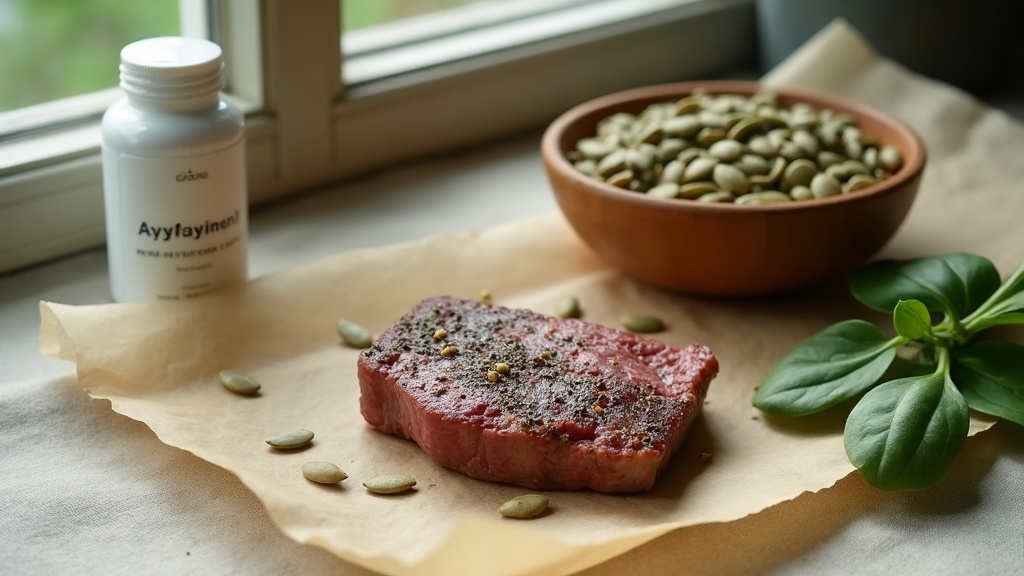
Heme iron sources lead the absorption table. Per 3-ounce cooked serving: beef sirloin about 2.0 mg, chicken liver about 9.9 mg, beef liver about 5.0 mg, dark turkey about 1.5 mg, canned light tuna about 1.0 mg. Six medium raw oysters deliver about 5.6 mg.
Non-heme iron sources are everywhere but absorb less efficiently. A cup of cooked lentils or white beans delivers about 6.6 mg, a cup of cooked spinach about 6.4 mg, an ounce of pumpkin seeds about 2.5 mg, and a serving of iron-fortified breakfast cereal often a full 18 mg.
The current US Food and Nutrition Board RDA is:
| Population | RDA |
|---|---|
| Women 19 to 50, menstruating | 18 mg per day |
| Men, women 51+ (postmenopausal) | 8 mg per day |
| Pregnancy | 27 mg per day |
| Lactation | 9 to 10 mg per day |
| Vegetarians and vegans | 1.8x the standard RDA per IOM adjustment |
| Infants 7 to 12 months | 11 mg per day |
| Children 1 to 3 | 7 mg per day |
The tolerable upper intake level (UL) is 45 mg per day of elemental iron for adults, a ceiling for chronic intake without medical supervision. Repletion doses exceed this under clinician guidance.
Two practical rules govern non-heme iron. Vitamin C at the same meal increases absorption by reducing ferric to ferrous iron at the brush border; 50 to 100 mg (half an orange, a few strawberries, half a red bell pepper) can roughly double non-heme absorption. Calcium, polyphenols, and phytates inhibit absorption: coffee and tea tannins cut non-heme absorption by 50 to 70%, calcium supplements and dairy by 30 to 50%, and phytates in whole grains and legumes have a smaller but real effect.
The average mixed Western diet covers roughly 12 to 18 mg of iron per day, which sits near the male RDA but underdelivers the 18 mg menstruating-woman target before counting absorption losses. That gap is the structural reason iron deficiency clusters in women of reproductive age.
Actionable takeaway: if you menstruate, pair plant iron with a vitamin C source and keep coffee and tea away from the meal by an hour or two. Supplementation enters the picture when blood work confirms a gap, not as a default insurance policy.
Who Needs to Supplement
Iron supplementation earns its place when blood work confirms low ferritin or IDA. The groups most likely to need it:
- Menstruating women, especially with heavy menstrual bleeding (over 80 mL per cycle).
- Pregnant women, whose requirement rises to 27 mg/day. Most prenatals include 27 mg; some women need additional repletion if pre-pregnancy ferritin was low.
- Postpartum women, especially after blood loss above 500 mL or cesarean section. Our guide to the best supplements for postpartum recovery covers the broader nutrient context.
- Vegetarians and vegans, whose iron comes entirely from non-heme sources (IOM applies a 1.8x RDA adjustment).
- Endurance athletes, particularly distance runners (foot-strike hemolysis breaks red cells in the soles).
- People with inflammatory bowel disease, celiac, atrophic gastritis, or post-bariatric surgery (especially Roux-en-Y).
- Frequent blood donors, who lose roughly 200 to 250 mg per donation.
- People with chronic GI blood loss, including chronic NSAID users and anyone over 50 with new IDA (the ACG 2020 guideline flags this as an indication for upper and lower endoscopy to rule out occult malignancy).
- Infants and toddlers on iron-poor diets, where pediatricians recommend fortified formula, fortified cereals, or a drop supplement.
People who should NOT supplement iron without a clinician decision: healthy men with adequate intake, postmenopausal women with normal labs, anyone with hemochromatosis or a family history of it, and anyone without blood work confirming low ferritin.
Actionable takeaway: ask your doctor about a ferritin plus CBC before assuming you're low. Blood work changes the question from "what iron should I take" to "do I actually need iron at all."
Forms and Bioavailability
The supplemental forms in widest use:
- Ferrous sulfate: oldest, cheapest, most widely studied. A 325 mg tablet provides about 65 mg elemental iron. Absorbs well but is the form most associated with GI side effects (nausea, constipation, dark stools, cramping) at full repletion doses.
- Ferrous bisglycinate (iron bisglycinate chelate): iron bound to glycine, carried via a peptide-transport pathway. Comparative trials show it raises ferritin and hemoglobin comparably to sulfate while producing fewer GI side effects, which improves adherence over an 8 to 12 week course.
- Ferrous gluconate: middle on tolerability and cost (about 36 mg elemental per 325 mg tablet).
- Ferrous fumarate: highest elemental iron percentage by weight; common in prenatal formulations.
- Iron polysaccharide complex: ferric-iron complex marketed as easier on the gut; absorption data are mixed.
- Heme iron polypeptide: beef-derived; smaller doses (often 11 mg elemental) can match absorption of higher non-heme doses, though cost is much higher.
- IV iron (Injectafer, Venofer, Feraheme): reserved for severe IDA, oral-iron intolerance, malabsorption, or active inflammation. Clinician-prescribed only.
Actionable takeaway: ferrous bisglycinate is the gentlest practical option, ferrous sulfate the cheapest workable one if you tolerate it. Read the elemental iron value, not the salt weight.
Dosing Protocols
Oral iron dosing looks very different than it did ten years ago because of one mechanism: hepcidin, the master regulatory hormone of iron absorption. A single oral iron dose triggers a hepcidin spike that lasts roughly 24 hours and blunts absorption of the next dose within that window.
Three dose ranges:
Maintenance and mild deficiency: 30 to 60 mg elemental iron per day. Prenatal vitamins, athletes maintaining ferritin, vegetarians with marginal labs, and people stepping down after repletion.
Repletion for documented IDA: 65 to 200 mg elemental iron per day, ideally on an alternate-day schedule. Clinician-supervised territory. The 2017 Lancet Haematology trial by Stoffel and colleagues randomized iron-depleted young women to daily versus alternate-day dosing, and the alternate-day group showed higher fractional absorption and total iron absorbed because each dose started from a lower hepcidin baseline. A 2020 Haematologica follow-up confirmed morning alternate-day dosing maximized absorption versus split daily doses, and Moretti et al. in Blood, 2015 showed daily or twice-daily oral iron progressively raised hepcidin and reduced subsequent absorption.
A 100 to 200 mg elemental dose every other morning often delivers more total absorbed iron over a week than the same per-dose schedule given daily, with less GI burden.
Severe IDA, oral-iron failure, or active malabsorption: IV iron under specialist care. Hematology and gastroenterology decide this pathway.
Take iron in the morning on an empty stomach if you tolerate it, or with a small low-calcium snack if it causes nausea. Pair with 100 mg of vitamin C. Avoid dairy, antacids, calcium supplements, tea, or coffee at the same dose. Repletion course length is typically 8 to 12 weeks, followed by a ferritin and CBC retest; ferritin can take 3 to 6 months to fully refill after hemoglobin normalizes. There's a difference between the dose that fixes a deficiency and the dose that just stacks up in your gut.
Actionable takeaway: if a clinician confirms IDA and oral repletion is the plan, ask whether alternate-day dosing is appropriate. The evidence is now strong enough that many clinicians have moved off daily dosing as the default.
Side Effects and Interactions
Oral iron at repletion doses produces real side effects:
- Nausea, cramping, indigestion, often worse on an empty stomach.
- Constipation, dose-dependent, often improved by hydration, fiber, and bisglycinate.
- Dark stools, harmless and expected. Tarry, melenic-looking stools still warrant a clinician call.
- Metallic taste, usually fades after the first week.
The big-deal safety issue: acute iron poisoning is the leading cause of fatal pediatric supplement poisoning in the United States. A single ingestion of 60 mg per kg of elemental iron can cause severe toxicity in a small child. Always store iron supplements in their original child-resistant container, on a high shelf, out of sight and reach of children, and call Poison Control at 1-800-222-1222 immediately if a child swallows any. Non-negotiable for any household with iron present.
Hereditary hemochromatosis is the other critical safety frame. If you have a family history, unexplained joint pain, liver enzyme elevation, or Northern European ancestry with iron labs trending high, ask your clinician about HFE gene testing and iron-saturation labs before starting iron.
Drug interactions worth knowing, drawn from the NIH ODS iron fact sheet and Drugs.com:
- Levothyroxine (Synthroid, Tirosint, Euthyrox): iron chelates levothyroxine and sharply reduces its absorption. Separate by at least 4 hours. Mandatory, not optional, for anyone on thyroid hormone replacement.
- Fluoroquinolones (ciprofloxacin, levofloxacin) and tetracyclines (doxycycline, minocycline): iron chelates these antibiotics. Separate by 2 to 4 hours, or pause iron during a brief course.
- PPIs (omeprazole, esomeprazole) and H2 blockers raise gastric pH and lower non-heme iron absorption. PPI users often need higher doses or bisglycinate to compensate.
- Calcium supplements, dairy, antacids, and bisphosphonates (alendronate, risedronate) blunt iron absorption. Separate by at least 2 hours.
A supplement that has earned its place still has to fit the rest of the medication list. Don't bolt high-dose iron onto a levothyroxine or fluoroquinolone schedule without a separation plan.
Testing: Ferritin and the Iron Panel
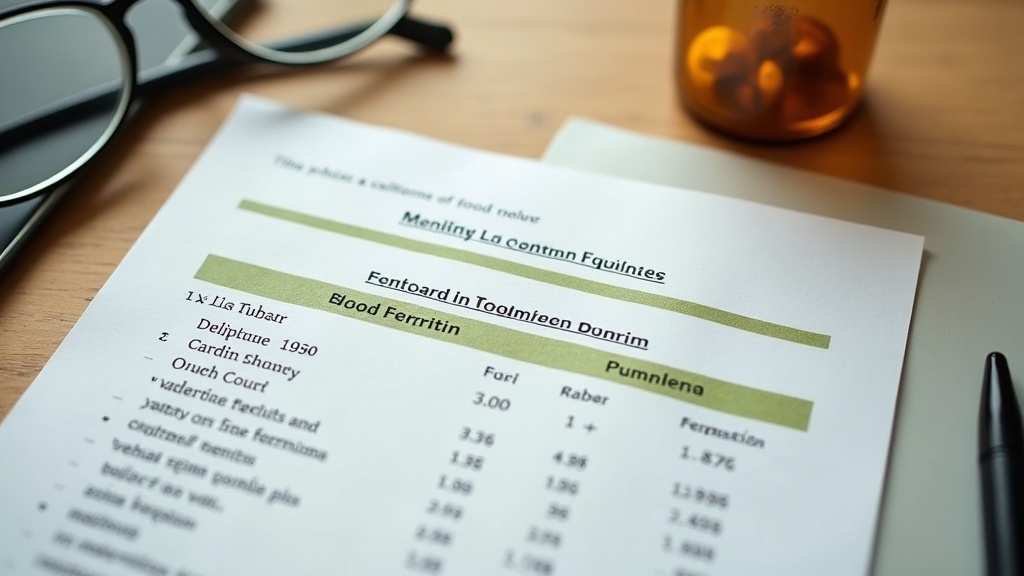
The single most useful blood test for iron status is serum ferritin. It reflects total body iron stores and drops early in deficiency, often before hemoglobin moves. A full workup pairs ferritin with CBC (hemoglobin, hematocrit, MCV, RDW), serum iron (a snapshot), TIBC or transferrin, and transferrin saturation (serum iron divided by TIBC).
Common reference ranges:
| Marker | Iron deficiency pattern |
|---|---|
| Ferritin under 30 ng/mL | Iron deficiency (sensitive cutoff; some labs flag under 12) |
| Ferritin 30 to 100 ng/mL with symptoms | Possible deficiency, especially in athletes or RLS |
| Hemoglobin under 12 g/dL (women) or 13 g/dL (men) | Anemia |
| MCV under 80 fL | Microcytic (consistent with iron deficiency) |
| Transferrin saturation under 20% | Iron-restricted erythropoiesis |
| Ferritin over 300 ng/mL (men) or 200 ng/mL (women) + transferrin saturation over 45% | Iron overload, evaluate for hemochromatosis |
Ferritin is also an acute-phase reactant, so it rises with inflammation, infection, liver disease, and obesity. A "normal" ferritin in an actively inflamed patient may mask true deficiency. Clinicians often pair ferritin with CRP in that scenario.
When to test: unexplained fatigue, restless legs, hair shedding, pica, exercise intolerance, or heavy menstrual bleeding; pregnant women in prenatal labs; athletes; vegetarians and vegans periodically; postpartum women in the first 12 weeks; anyone over 50 with new microcytic anemia (per the ACG 2020 guideline); family history of hemochromatosis (consider HFE gene testing).
Retest at 8 to 12 weeks after starting a repletion course, then again 3 to 6 months out to confirm ferritin has refilled. Once stable on maintenance, annual retest is reasonable.
If you take more than one mineral or supplement, StackMyMed (our companion app) tracks your true daily totals and schedules each dose around its food and spacing rules.
FAQ and Conclusion
How long does it take iron supplements to work? Subjective energy improvement often shows up within 2 to 4 weeks of an effective oral course. Hemoglobin typically rises measurably by 4 weeks. Ferritin takes 3 to 6 months to refill, which is why most clinicians keep patients on iron for at least 3 months after hemoglobin normalizes.
Should I take iron daily or every other day? The trial evidence now favors alternate-day morning dosing for repletion in adults without severe anemia. Stoffel et al. 2017 and 2020 showed alternate-day dosing increases total absorbed iron and reduces hepcidin interference. Daily dosing still has a role in severe anemia or pregnancy.
Why are iron supplements dangerous for kids? Pediatric iron poisoning is the leading cause of fatal supplement overdose in children. Adult iron tablets can look like candy to a toddler, and a few tablets can deliver a lethal dose. Always store iron in its original child-resistant container, out of sight and reach of children, and call Poison Control at 1-800-222-1222 immediately if a child swallows any.
Can I take iron with my multivitamin? Most adult multivitamins contain little or no iron (precisely to avoid over-supplementing men and postmenopausal women). Prenatals usually contain 27 mg, appropriate during pregnancy. Adding a standalone iron supplement on top should be a clinician decision.
Does vitamin C really help iron absorption? Yes, for non-heme iron. 50 to 100 mg at the same meal (half an orange, a few strawberries, half a red bell pepper) can roughly double non-heme absorption. Heme iron from meat is much less affected.
Conclusion: the bottom line on iron supplements
Iron is the one mineral where the population-level evidence reverses the usual supplement logic. Most nutrients are safe to top up speculatively. Iron is not. Supplementing a genuine deficiency reliably restores energy, exercise capacity, and quality of life. The same dose in an iron-replete adult adds nothing measurable and can drive oxidative stress, mask undiagnosed hemochromatosis, and cause real GI side effects with no upside. The benefit lives in the deficiency half, and the diagnostic line runs through a ferritin and CBC, not through a symptom guess.
For the people who do need supplementation, the practical recipe is a clinician-confirmed deficiency, a tolerable form like ferrous bisglycinate at 25 to 60 mg elemental iron, alternate-day morning dosing with a vitamin C source and away from coffee, tea, dairy, calcium, levothyroxine, and certain antibiotics, then a retest at 8 to 12 weeks. For anyone with restless legs, postpartum fatigue, or hair shedding who hasn't checked ferritin, that lab is the first step. Our guide to the best supplements for thinning hair in women covers the ferritin-shedding link, and our guide to the best supplements for postpartum recovery covers the iron context after birth.
Next steps:
- If you suspect iron deficiency, ask your doctor for a ferritin level plus a complete blood count before starting any iron supplement.
- If a clinician confirms deficiency, consider asking about ferrous bisglycinate with alternate-day morning dosing as a starting protocol.
- Review our supplement review methodology and read more from Sarah Thompson, RD on nutrient-status-driven supplementation.
This article is for informational purposes and not medical advice. Iron supplementation should be guided by ferritin and CBC results and discussed with a licensed clinician, especially during pregnancy, lactation, with a family history of hemochromatosis, when taking levothyroxine, fluoroquinolones, tetracyclines, proton pump inhibitors, or other interacting medications. Severe anemia, iron overload, or unexplained iron-deficiency anemia in adults over 50 are clinician territory and may require hematology or gastroenterology evaluation. Keep all iron supplements in their original child-resistant container, out of sight and reach of children. Pediatric iron overdose is a medical emergency: call Poison Control at 1-800-222-1222 immediately.
Reviewed by Sarah Thompson, Registered Dietitian, focused on vitamin and mineral nutrition.
Recommended Products


As an Amazon Associate, UsefulVitamins.com earns from qualifying purchases at no extra cost to you. We only recommend products supported by published research or third-party testing.
