
Affiliate disclosure: this article contains affiliate links. As an Amazon Associate, UsefulVitamins.com earns from qualifying purchases at no extra cost to you.
If you are standing at the counter with a tub of collagen in one hand and a tub of creatine in the other, here is the straight answer: go ahead. These two get stacked together all the time, and the reason is simple. They do different jobs in different places, and neither one gets in the other's way.
The rest of this page explains why that is true, the one lab quirk worth knowing about, and who should still check with a clinician first. None of this changes any prescription you are on. If you take medication, the supplement sits alongside it, not in place of it.
Do collagen and creatine actually interact?
No, not in any way that matters for the average healthy adult. There is no shared absorption route, no shared metabolic pathway, and no documented supplement-supplement clash between hydrolyzed collagen and creatine monohydrate.
Think of them as working on two separate floors of the same building.
Creatine monohydrate gets pulled into your muscle cells, where it sits as a phosphate buffer that helps regenerate ATP, the molecule your muscles burn for short, hard efforts. That is the strength and power side of things.
Collagen is different. Hydrolyzed collagen peptides break down in digestion into amino acids, mostly glycine, proline, and hydroxyproline. Your body uses those as raw material for connective tissue: skin, tendons, ligaments, the structures around the muscle rather than the muscle fiber itself.
Different transporters, different tissues, different end goals. Nothing about taking one blunts the other, and there is no competition for the same door into the body. That is why so many powders and routines pair them.
So the verdict is yes. The interesting part is not whether you can combine them, but the small handful of caveats that come with each one on its own.
The mechanism, and how good the evidence is
Here I will separate what is solidly established from what is softer.
Creatine safety: strong evidence. Creatine is one of the most studied supplements there is. A 2023 narrative review covering doses from 5 to 20 g a day for periods up to five years found no renal harm in healthy adults (see the review indexed at PMC10054094 on long-term creatine safety). The International Society of Sports Nutrition position stand on creatine reaches the same conclusion on dosing and safety. The old fear that creatine "wrecks your kidneys" has not held up in healthy people.
Collagen safety: moderate but consistent. The data here is thinner than for creatine, and I will not pretend otherwise. The Cleveland Clinic overview of collagen supplements describes the side effects as minimal, mostly mild things like headache, lightheadedness, or loose stool, while also being frank that the benefits are not strongly proven. In plain terms: collagen looks safe at sensible doses, but it is not a miracle, and the science behind its claims is still developing.
The one real caveat is a lab artifact, not an interaction. Creatine modestly raises your serum creatinine reading. That sounds alarming because doctors watch creatinine as a kidney marker, but here is the mechanism. Creatine breaks down into creatinine through a normal chemical reaction in the body. Take more creatine, make more creatinine, and the number on the blood panel ticks up. It does not mean your kidneys are failing.
The way to confirm this is a different marker. Cystatin C is made at a steady rate by your cells and is not pushed around by muscle mass, diet, or creatine intake, so a cystatin C based estimate of kidney function gives a cleaner read. The long-term creatine safety review and the ISSN position stand describe exactly this: creatine is degraded to creatinine through normal metabolism, so a physiological surge of creatinine can appear in the blood without any loss of kidney function, while cystatin C stays unchanged. So if your panel flags "elevated creatinine" and you take creatine, that is worth a conversation, not a panic.

The practical rule: how to actually take them
This is the part you came for. The rule is short because there is no spacing puzzle to solve.
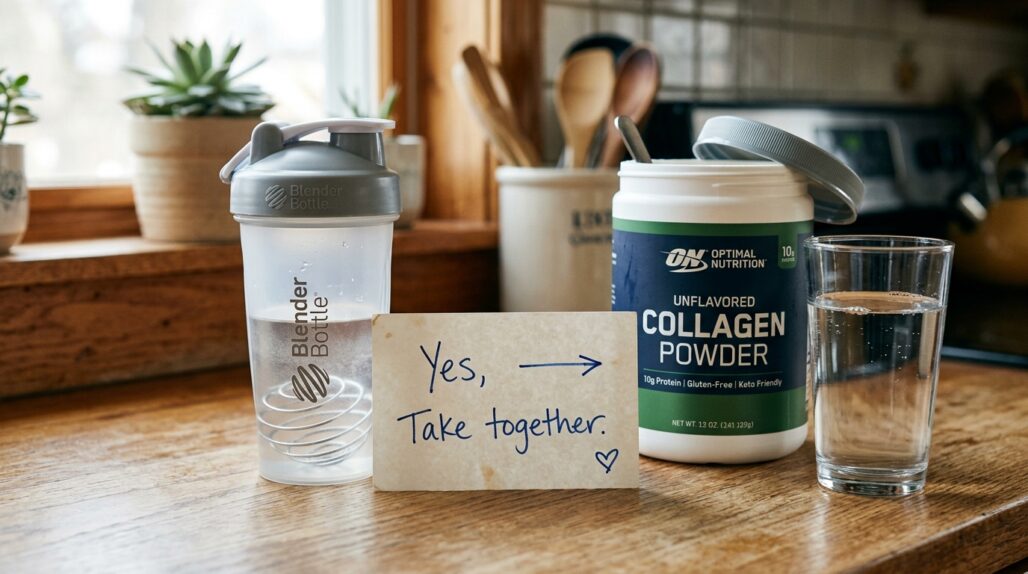
Timing. Take them together. Same time, same drink, same shaker if you like. Neither one needs to be on an empty stomach or away from the other.
Creatine dose. Aim for 3 to 5 g a day of plain creatine monohydrate. You do not need a loading phase. Loading just gets your muscles saturated a week or two faster; a steady 3 to 5 g a day gets you to the same place in about three to four weeks. If you do take a single larger serving and your stomach complains, split it and keep each serving at or under 5 g.
Collagen dose. Trials generally use somewhere between 2.5 and 15 g a day, and 10 to 20 g a day is a common real-world range. Higher is not obviously better; pick a dose you tolerate.
Water. Creatine pulls water into the muscle cell, which is part of how it works. That is not dehydration, but it is a reason to keep your normal fluids up rather than skimp.
The lab note. If you are due for bloodwork, tell whoever draws or reads it that you take creatine. That single sentence lets them interpret a creatinine bump correctly, or order a cystatin C if they want certainty.
Who is most at risk? The combination itself is low risk, but two groups should pause. First, anyone with known kidney disease or reduced kidney function: creatine is studied in healthy kidneys, and a compromised kidney is a different situation, so get cleared before any high-dose creatine. Second, anyone with an animal-protein allergy, because collagen is sourced from bovine, marine, fish, or chicken tissue and could trigger a reaction. The Cleveland Clinic flags that source question as worth taking seriously given how common food allergies are.
One stance to be clear about: this is education, not a prescription change. Nothing here is a reason to start, stop, or adjust any medicine you take. If a supplement ever seems to be doing something to a drug you are on, that is a question for your prescriber, not a DIY fix.
What to actually do, the safe way to stack them


As an Amazon Associate, UsefulVitamins.com earns from qualifying purchases at no extra cost to you.
Some links below are affiliate links. If you buy through them we may earn a small commission at no extra cost to you. We only point to forms we would use ourselves.
The simplest safe routine looks like this. Pick a plain, well-studied creatine monohydrate, unflavored, so you can stir it into anything. Pick a clean hydrolyzed collagen peptide powder, ideally one whose source (bovine, marine, and so on) is clearly labeled so you can dodge an allergy. Put both in your morning or post-workout drink and move on. Prices move around, so treat any figure you see as roughly accurate as of writing and check the current price before you buy.
If you take other supplements or medicines, here is the cleanest habit. Log every prescription and supplement in one place so overlaps get surfaced before you add the next thing. We built StackMyMed (our own free app) to do exactly that: you scan or enter what you take and it flags anything worth raising with a pharmacist, like that creatine-and-creatinine note. It does not diagnose and it does not decide anything for you; it just hands you a clean list and the right questions. The low-tech version works just as well: write your full list on paper and show it to your pharmacist at the counter. Either way, the human with the training makes the call.
For most people the routine really is this boring, and boring is good. No spacing schedule, no loading phase, no clash to manage.

Related pairs and the wider question
A few neighboring questions come up constantly with this pair.
Collagen versus whey for muscle. Collagen is not a complete muscle-building protein the way whey is; it is low in some essential amino acids. If your goal is muscle growth, see how the two compare in our piece on whey versus collagen for muscle and recovery. Collagen does its work on the connective-tissue side, not as a swap for a full protein.
Getting the creatine dose right. If you want a number tailored to your body weight rather than a rule of thumb, run it through our creatine dose calculator. It will also show why a loading phase is optional.
Picking the products. For form and quality, our roundups of the best creatine monohydrate supplements and the best collagen peptides walk through what to look for, including third-party testing and source labeling.
The wider class point: collagen and creatine are both "support" supplements with wide safety margins in healthy people, which is why they pair so easily. The pairings that need real care are not these two; they are supplements that act in the same direction as a drug you take, like something that lowers blood sugar on top of a diabetes medicine. This pair is not one of those.
| Question | Answer |
|---|---|
| Do they interact? | No known interaction. Separate pathways: creatine buffers muscle energy, collagen feeds connective tissue. |
| How do I take them? | Together, no spacing. Creatine 3 to 5 g a day, collagen 10 to 20 g a day, with water. Same shaker is fine. |
| Who should be careful? | Anyone with kidney disease or reduced kidney function (creatine) and anyone with an animal-protein allergy (collagen source). Clear it with a clinician first. |
| When do I call a doctor? | An unexplained flagged creatinine result, signs of an allergic reaction, or GI distress that does not settle when you lower the dose. |
FAQ
Can I mix collagen and creatine in the same drink? Yes. There is no chemical or absorption reason to keep them apart, so the same water bottle, shake, or smoothie is fine. Stir well, since creatine does not fully dissolve and tends to settle.
Will creatine ruin my kidney blood test? It can nudge your serum creatinine up because creatine breaks down into creatinine, but that is a measurement quirk, not damage. Tell the clinician you take creatine; a cystatin C based estimate gives a cleaner read if they want to confirm.
Do I need a creatine loading phase if I take collagen too? No, and loading is optional regardless of collagen. A steady 3 to 5 g a day reaches full muscle saturation in about three to four weeks, which is all loading speeds up.
Is collagen a replacement for protein powder? No. Collagen is missing some essential amino acids, so it is not a complete muscle-building protein. It supports connective tissue, while a complete protein like whey supports muscle repair.
Can I take both if I am on a prescription medication? Usually yes, since neither has a broad drug-interaction profile, but check the specifics of your medicine with a pharmacist. Log both supplements alongside your prescription so any overlap is something you can ask about, not discover later.
Which should I take, marine or bovine collagen, if I have allergies? Choose the source you are not sensitive to, and only from a product that labels its source clearly. If you have a fish or shellfish allergy, avoid marine collagen and discuss the choice with your clinician.

The bottom line
Yes, you can take collagen peptides and creatine monohydrate together. There is no known interaction, no spacing rule, and no need to overthink it: creatine works on muscle energy, collagen feeds connective tissue, and they stay out of each other's lane. Use creatine at 3 to 5 g a day and collagen at 10 to 20 g a day, drink your water, and pick a collagen with a clearly labeled source if allergies are a concern.
The one thing to keep in your back pocket is the creatinine lab quirk. If a kidney panel ever flags "elevated creatinine," mention the creatine before anyone reads too much into it. And if you have known kidney disease or reduced kidney function, get cleared before any high-dose creatine. As always, the safest move is to show your full supplement and medication list to your pharmacist and let them confirm it for your situation.
This article is for general education and is not medical advice, a diagnosis, or a prescription change. Always confirm supplements and medications with your doctor or pharmacist before combining them.
Reviewed by the UsefulVitamins Editorial Team.
