
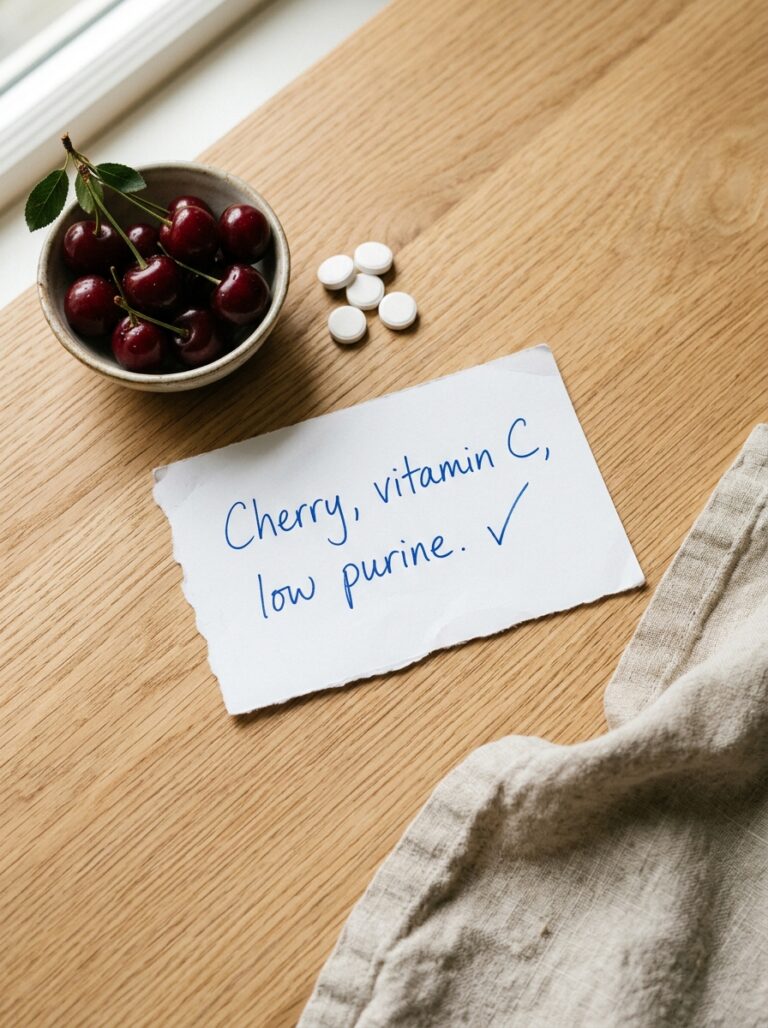
If you're searching for the best supplements for gout, you're probably either nursing a flare that woke you at 3 a.m. or trying to keep the next one away. The honest answer up front: for gout, supplements lower uric acid only modestly, and the heavy lifting comes from diet and, when flares are frequent, prescription urate-lowering therapy. The cherry, vitamin C, and low-purine choices I'd keep in my own family's kitchen are at the bottom, but read the framing first, because a pill is not where the real leverage is.
Affiliate disclosure: this article contains affiliate links. As an Amazon Associate, UsefulVitamins.com earns from qualifying purchases at no extra cost to you.
Before you decide
If you have frequent flares, tophi, kidney stones, or visible joint damage, supplements are not your front line, urate-lowering therapy is. The 2020 American College of Rheumatology guideline strongly recommends allopurinol in exactly those situations, and no supplement on this page replaces it.
The first move before adding anything is to know your number. Ask your clinician for a serum urate level, because the treatment target that defines control is under 6 mg/dL, and you can't manage what you haven't measured.
A few people should be careful. If you have advanced kidney disease, kidney stones, or take a urate-lowering drug, run any new supplement past your doctor or pharmacist first, since some interact with how your kidneys handle urate. You can see how I weigh evidence and conflicts of interest on the how we review supplements page.
What gout actually is
Gout is a form of inflammatory arthritis driven by monosodium urate crystals that deposit in joints when blood uric acid stays high for long enough. The classic flare, a hot, red, agonizingly tender big toe, is your immune system attacking those crystals.
Uric acid is the end product of purine metabolism. Levels climb when your kidneys underexcrete urate, when you overproduce it, or both, and most people with gout are underexcreters rather than overproducers.
The disease runs a spectrum from a single lifetime attack to chronic tophaceous gout with joint destruction. The marker that defines it is serum urate, and the threshold where crystals tend to form is roughly 6.8 mg/dL, which is why guidelines target a number safely below that.
The conventional first line is not a supplement. The 2020 ACR gout guideline names allopurinol as the preferred urate-lowering drug, started low and titrated up to a serum urate target under 6 mg/dL, with anti-inflammatory cover during the first months. Supplements are a layer on top of that strategy, not a substitute for it.
Strongest evidence supplements
Two supplements have actual human trials behind them for gout. Neither is a urate-lowering drug, and it helps to be precise about what each does and does not do.
Tart cherry
Why it helps: Tart cherries are rich in anthocyanins, plant pigments with anti-inflammatory activity, and the popular theory is that they both calm flares and nudge urate down.
What the trials show: The flare signal is the stronger of the two. A case-crossover study of 633 gout patients found cherry intake over a two-day window was associated with a 35% lower risk of a gout attack (odds ratio 0.65), and the effect was larger when combined with allopurinol. But the urate story is weaker, a randomized trial in people with gout tested cherry concentrate up to 30 mL twice daily for 28 days and found no significant effect on serum urate or urine urate excretion. So the most defensible read is "may reduce flares, but not by lowering uric acid."
Dose used: Observational benefit clustered around 2 to 3 servings of cherries (about 10 to 12 each) or the equivalent in concentrate over a couple of days.
Skip if: You're treating it as a urate-lowering drug, that claim isn't supported. It's a reasonable adjunct for someone managing flare frequency, not a reason to skip prescribed therapy. If your main interest is sleep rather than gout, I cover that separately in tart cherry supplements for sleep.
Vitamin C
Why it helps: Vitamin C appears to promote renal excretion of urate, a uricosuric effect, which is a plausible mechanism for lowering blood levels.
What the trials show: This is the one supplement with a pooled urate signal. A meta-analysis of 13 randomized controlled trials (556 participants, median dose 500 mg/day) found vitamin C lowered serum uric acid by 0.35 mg/dL on average (95% CI -0.66 to -0.03). That's a real effect, but it's small, roughly a tenth of what an allopurinol dose titration achieves toward the under-6 target.
Dose used: Most trials used around 500 mg/day, well within the NIH Office of Dietary Supplements tolerable upper intake of 2,000 mg/day for adults.
Skip if: You have a history of calcium-oxalate kidney stones, since high-dose vitamin C can raise urinary oxalate, or you're expecting it to replace a urate-lowering drug. As one input alongside diet it's low-risk; as monotherapy for established gout it's not enough. Vitamin C also overlaps the broader anti-inflammatory picture, which I unpack in supplements for inflammation.
Moderate or mixed evidence

These have a defensible mechanism but thinner or inconsistent human data for gout specifically.
Omega-3 fish oil. Worth considering if you also have cardiovascular risk, with caveats. EPA and DHA dampen the inflammatory cascade, and small studies suggest omega-3 intake may be associated with fewer flares. But the evidence is observational and mixed, and no trial shows it lowers serum urate, so treat it as general anti-inflammatory support, not gout therapy.
Coffee. Mechanism is real, evidence is observational. Long-term coffee intake is associated with lower gout risk in cohort studies, possibly through a mild urate-lowering effect. It's a reasonable habit for a gout-prone person who already drinks it, but starting coffee specifically to treat gout overstates what the data support.
Magnesium and folate. You'll see both promoted for gout. The honest summary is that population correlations exist but controlled evidence that supplementing either changes urate or flares is lacking, so I'd only supplement to correct a documented deficiency, not as a gout strategy.
Popular but evidence-thin
Turmeric and celery seed are widely recommended for gout across social media and supplement-brand marketing. The actual human evidence for either lowering uric acid or preventing gout flares is essentially absent, mostly cell and animal work on inflammation pathways. If you want to try turmeric for general joint comfort, a standardized curcumin extract is low-risk, but I wouldn't expect it to touch your urate number, and I'd keep your eyes on diet and your serum urate target instead.
Diet matters more than pills
Here is the part most supplement roundups bury: for gout, what you drink and eat moves uric acid more reliably than any capsule. Three dietary levers have strong prospective evidence.
Fructose is the big one. A prospective cohort of 46,393 men found that two or more sugar-sweetened soft drinks a day carried an 85% higher gout risk, and risk rose stepwise with total fructose intake. Diet soda showed no association, so the culprit is fructose, not carbonation, which makes cutting sugary drinks one of the highest-yield changes you can make.
Alcohol, especially beer. A 12-year prospective study found alcohol strongly raised gout risk, with beer worse than spirits and moderate wine roughly neutral. Beer's purine load plus alcohol's effect on urate excretion makes it the worst offender, which is a more useful fact than a blanket "avoid alcohol."
Purine load from food. Organ meats, anchovies, sardines, and shellfish are high-purine, and trimming them helps, though their effect is smaller than fructose and beer. Across the diet, the realistic goal is a sustained few-tenths drop in serum urate, meaningful when stacked, not a cure.
When to see a doctor
Stop self-treating and get evaluated promptly if you have frequent flares (roughly two or more a year), visible lumps under the skin (tophi), kidney stones, or a flare with fever that could signal a joint infection rather than gout.
Also see a clinician if your serum urate stays above 6 mg/dL despite diet changes, or you're having attacks while already on a urate-lowering drug, since that usually means the dose needs titrating, not a new supplement.
Tone matters here: gout is highly treatable, and reaching target urate can dissolve existing crystals over time, but that's a managed outcome under medical care, not something a supplement delivers on its own.
FAQ
Does cherry juice actually lower uric acid?
Not reliably. A controlled trial found cherry concentrate did not lower serum urate in people with gout. Observational data link cherries to fewer flares, but the benefit, if real, doesn't appear to work by reducing uric acid.
How much can vitamin C lower uric acid?
On average about 0.35 mg/dL in randomized trials at around 500 mg/day. That's a genuine but small effect, useful as one input alongside diet, not a replacement for prescribed urate-lowering therapy.
Can supplements replace allopurinol?
No. For frequent flares, tophi, or joint damage, the ACR recommends a urate-lowering drug titrated to a target under 6 mg/dL. Supplements may support that plan but don't reach the same urate reduction.
Are there supplements that make gout worse?
Yes, high-dose niacin is the notable one. Drug-induced hyperuricaemia reviews note that gram-level niacin used for cholesterol can raise serum urate and trigger flares in susceptible people. Dietary-amount niacin in a multivitamin is not the concern, gram-level lipid dosing is.
What about losing weight?
Gradual weight loss lowers urate and flare frequency. Crash dieting or fasting can transiently raise uric acid and provoke a flare, so steady loss beats rapid loss for gout.
The bottom line on gout supplements
If you take one thing from this page: gout is driven by uric acid, and the supplements people reach for move that number only a little. Vitamin C at about 500 mg/day shaves roughly 0.35 mg/dL off serum urate, and tart cherry may reduce flare frequency without clearly lowering urate at all.
Both are reasonable, low-risk adjuncts. But the real leverage is cutting fructose and beer, watching purine load, and, when flares are frequent or joints are at risk, using a urate-lowering drug titrated to a target under 6 mg/dL under your clinician's care.
Next steps:
- Get a baseline serum urate and ask whether you meet criteria for urate-lowering therapy
- Cut sugar-sweetened drinks and beer first, the two changes with the strongest data
- Add cherry or vitamin C as a supporting layer, and read the complete guide to vitamin C before dosing
Reviewed by Michael Ward, MD MPH, Preventive Medicine, focused on guideline-based chronic disease management. See more from Michael Ward. This article is educational and is not a substitute for individualized medical advice; talk to your doctor before starting a supplement or changing how you manage gout, especially if you have kidney disease or take a urate-lowering medication.
Recommended Products


As an Amazon Associate, UsefulVitamins.com earns from qualifying purchases at no extra cost to you. We only recommend products supported by published research or third-party testing.
