
Vitamin C is the supplement people reach for first and understand least. The label numbers run from 60 mg in a multivitamin to 1,000 mg in a single chewable, the bottle promises immune support it can't fully deliver, and almost nobody asks the one question that decides whether any of it helps: how much can your body actually use?
This guide answers that, sorts the forms worth paying for from the marketing, and shows where a plate of food quietly beats the pill.
Before you decide

Most people reading this don't have a deficiency, they have a question about whether more vitamin C would help. So start with what you're actually trying to fix. "Boosting immunity" is not a target the evidence can hit cleanly, and it's worth being honest that the cold you're hoping to avoid is unlikely to be prevented by a daily pill.
A specific situation is different: you eat very little fruit or veg, you smoke, you're recovering from surgery, you have a malabsorption condition, or you're a competitive athlete training in extreme conditions. Each of those points to a real answer, and some point away from a supplement entirely.
A few people should check before adding a high dose. If you have a history of calcium-oxalate kidney stones, chronic kidney disease, or the iron-overload condition hemochromatosis, large vitamin C doses can work against you, and those are conversations to have with your physician rather than self-prescribe around.
If you're already low on energy and wondering whether it's a vitamin gap, ask your doctor whether basic blood work makes sense before assuming vitamin C is the missing piece. You can see how I weigh evidence and conflicts of interest on the how we review supplements page.
What vitamin C actually is
Vitamin C is ascorbic acid, a small water-soluble molecule that humans, unlike most animals, cannot make. We lack a working copy of the enzyme L-gulonolactone oxidase, the last step other mammals use to manufacture their own, so for us it's strictly a dietary nutrient, as the StatPearls clinical review on vitamin C deficiency explains. That single quirk of evolution is why scurvy exists and why "essential vitamin" is a literal description, not a marketing word.
Inside the body it does two main jobs. It's a cofactor for a family of enzymes, most famously the proline and lysine hydroxylases that stabilize collagen, the structural protein in your skin, blood vessels, gums, and connective tissue. Without enough ascorbate, collagen can't crosslink properly, which is the mechanism behind every classic scurvy sign.
It's also a water-phase antioxidant that donates electrons to neutralize reactive molecules, and it helps regenerate other antioxidants like vitamin E.
The label distinction people obsess over, "natural" versus "synthetic" vitamin C, mostly isn't one. Ascorbic acid is the same molecule whether it's extracted from acerola cherries or synthesized in a factory, and the NIH notes that natural and synthetic forms are chemically identical with no consistent difference in bioavailability.
What can differ is what rides along with it in a whole food, which is where bioflavonoids enter the picture; I cover whether those add anything measurable in vitamin C and bioflavonoids.
Why vitamin C matters
The clearest case for vitamin C is the one nobody markets: preventing deficiency. The human body holds roughly 1,500 mg of vitamin C when replete, and clinical signs of scurvy appear once stores fall below about 350 mg, which the same StatPearls deficiency review notes takes 4 to 12 weeks of inadequate intake.
Scurvy is not a historical footnote. It still shows up in people with very restricted diets, heavy alcohol use, or eating disorders, and its early signs are vague: fatigue, malaise, then bleeding gums, easy bruising, corkscrew hairs, and wounds that won't close. All of it traces back to failed collagen synthesis.
Beyond preventing deficiency, the most studied claim is the common cold, and the honest answer is nuanced. A Cochrane review of regular supplementation found that for the general population, routine vitamin C did not reduce how often people caught colds, but it did modestly shorten how long colds lasted, by about 8% in adults and 14% in children when taken continuously.
The striking exception was people under extreme physical stress, such as marathon runners, skiers, and soldiers in sub-arctic conditions, where regular vitamin C roughly halved cold incidence. For everyone else, taking it only once a cold has already started showed little benefit.
The other quietly useful role is helping you absorb iron. Vitamin C keeps non-heme iron, the form in plants and most iron supplements, in a soluble, absorbable state, and even 100 to 200 mg taken with an iron-rich meal can meaningfully increase how much you absorb.
For plant-based eaters and anyone managing low iron, that pairing is one of vitamin C's most practical, evidence-backed uses, and it costs nothing extra to do.
Food sources and the RDA

Here is where the dietitian in me wants to slow you down. The Recommended Dietary Allowance for vitamin C is 90 mg/day for adult men and 75 mg/day for adult women, with an extra 35 mg/day advised for smokers because tobacco raises oxidative turnover, according to the NIH Office of Dietary Supplements vitamin C fact sheet.
Those are small numbers, and the everyday surprise is that the average US diet already meets them: national survey intakes run around 105 mg/day for men and 84 mg/day for women from food alone. For most people who eat any fruit and veg, the requirement is covered before a supplement enters the conversation.
That's because vitamin C is abundant and easy to reach. A single medium orange or kiwi clears the daily target on its own, and a few foods do even better.
| Food | Typical serving | Vitamin C | Share of RDA |
|---|---|---|---|
| Red bell pepper | 1/2 cup, raw | about 95 mg | 100%+ |
| Orange juice | 3/4 cup | about 93 mg | 100%+ |
| Kiwifruit | 1 medium | about 64 mg | 70-85% |
| Orange | 1 medium | about 70 mg | 75-95% |
| Broccoli | 1/2 cup, cooked | about 51 mg | 55-70% |
| Strawberries | 1/2 cup, sliced | about 49 mg | 55-65% |
Two practical notes. Vitamin C is heat- and water-sensitive, so prolonged boiling leaches it out; steaming, microwaving, or eating produce raw preserves more. And because it's water-soluble and not stored in large amounts, spreading intake across the day from food keeps your tissues topped up better than one big dose.
If your dietary intake is already at or above the RDA, more isn't better. The supplement that helps is the one that closes a real gap.
Who needs to supplement
Food covers the requirement for most people who eat broadly, so a supplement earns its place when the diet doesn't, or when demand or absorption is unusual. A handful of groups genuinely benefit.
Smokers and people regularly exposed to secondhand smoke have higher turnover and a higher RDA, and often lower blood levels, so a modest supplement is reasonable. People who eat very little fruit and vegetables, whether from limited variety, food insecurity, restrictive eating, or appetite loss, are the group at real risk of frank deficiency.
People with malabsorption conditions or certain cancers can run low despite eating well, and patients on dialysis for end-stage kidney disease may need supplementation under medical supervision because the treatment removes vitamin C. Athletes training under extreme physical stress are the one population where the cold-prevention evidence actually applies.
For everyone else, blood work changes the question. Vitamin C status isn't routinely tested, but if you have symptoms that suggest deficiency or a diet that worries you, it's worth asking your doctor rather than guessing.
Notice who isn't on this list: the healthy adult eating a couple of servings of produce a day, taking 1,000 mg "for immunity." That person is already replete, and the extra is mostly passing through.
Forms of vitamin C compared
Once you've decided a supplement makes sense, the form question is where most of the price differences live, and where most of the marketing does too. The active ingredient is ascorbic acid in every case; what changes is what it's bound to, which affects stomach comfort and, in one case, absorption. Here's how the main options actually compare.
| Form | What it is | Real advantage | Worth the premium? |
|---|---|---|---|
| Ascorbic acid | Plain vitamin C, the reference form | Cheapest, well absorbed, used in most research | Yes, the sensible default |
| Buffered (mineral ascorbates) | Ascorbic acid bound to calcium, magnesium, or sodium | Less acidic, gentler on a sensitive stomach | Only if plain ascorbic acid bothers you |
| Ester-C | Mainly calcium ascorbate plus small amounts of metabolites | Non-acidic, marketed as gentler; absorption similar to ascorbic acid | Modest, mostly a comfort choice |
| Liposomal | Ascorbic acid encapsulated in phospholipid spheres | Measurably higher plasma and white-cell levels in a controlled trial | Sometimes, if you want higher levels without GI upset |
The one form with controlled evidence of an absorption edge is liposomal. A double-blind, placebo-controlled crossover trial found that a 500 mg liposomal dose produced roughly 27% higher peak plasma vitamin C and about 20% higher peak levels inside white blood cells compared with standard ascorbic acid.
That's a real difference, but keep it in proportion: it was a single low dose in healthy adults, the study was funded by a liposomal manufacturer, and the absolute gap is modest. For most people topping up to the RDA, plain ascorbic acid does the job.
I dig into whether liposomal is worth the cost in liposomal vs standard vitamin C, and compare the gentler oral forms head to head in Ester-C vs ascorbic acid vs buffered.
How much to take
This is the section that should change how you shop, because vitamin C has a hard ceiling on usefulness that the dose on the bottle ignores. Absorption is governed by a saturable transport system: at low to moderate intakes of roughly 30 to 180 mg, you absorb 70 to 90% of it efficiently, but as the dose climbs past about 1,000 mg, the fraction you absorb falls below 50%, and your kidneys excrete the rest, as the NIH ODS fact sheet documents.
The classic saturation-kinetics study in healthy volunteers mapped this precisely. Plasma vitamin C rose steeply across the 30 to 100 mg range and then flattened, with tissues effectively saturated around 200 mg/day and almost no further gain in plasma above 400 mg; intakes beyond about 500 mg were quantitatively excreted in the urine.
In plain terms, once you're full, you're full, and extra capsules mostly produce more expensive urine. That study is part of why a target in the low hundreds of milligrams, not the thousands, is the rational supplemental range.
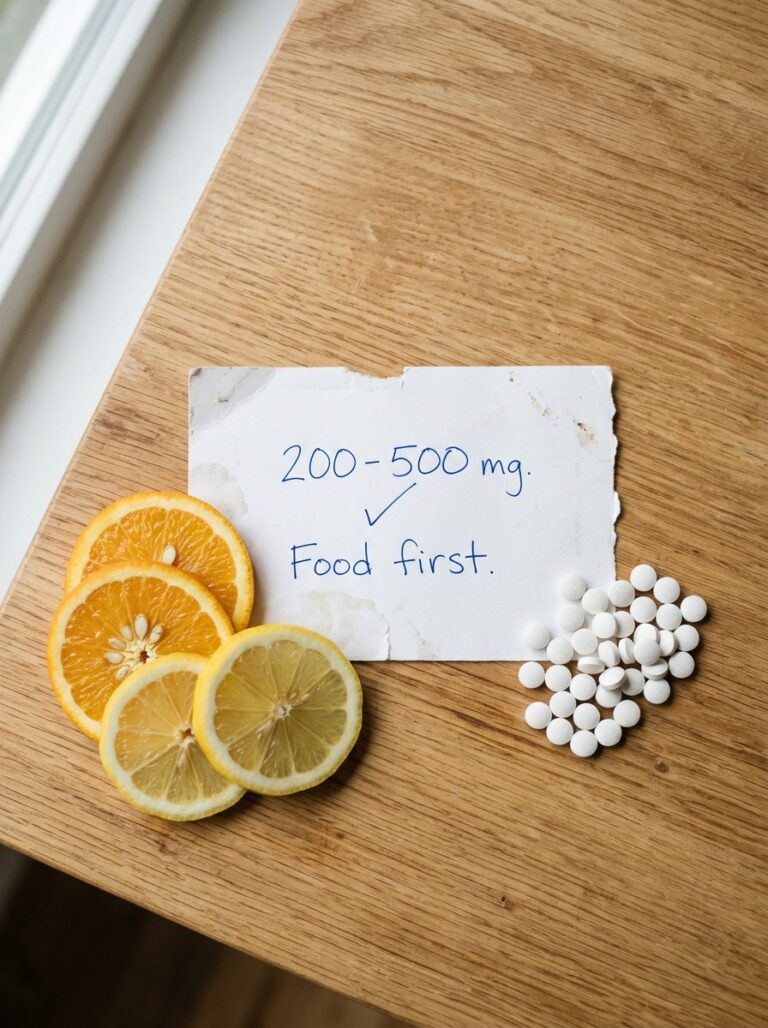
So for practical dosing: if you're closing a dietary gap, 200 to 500 mg/day, ideally split or taken with food, covers it with margin. For iron absorption, 100 to 200 mg alongside the meal or iron supplement is the useful amount.
Timing is otherwise flexible because vitamin C is water-soluble, taking it with food can reduce stomach upset, and splitting a dose absorbs slightly better than one large bolus. There is no evidence-based reason for a healthy person to sit at 1,000 mg or more indefinitely, and there's a difference between the dose that closes a gap and the dose that just stacks up in your kidneys.
Side effects and interactions
For healthy adults at sensible doses, vitamin C is very safe, which is part of why it's so over-taken. The Tolerable Upper Intake Level is 2,000 mg/day for adults, set by the Institute of Medicine mainly to avoid gastrointestinal distress: at high intakes, the unabsorbed vitamin C draws water into the gut and commonly causes diarrhea, cramping, and nausea.
Those symptoms resolve when you lower the dose, but they're a clear signal you've gone past what your body can use.
The interaction that deserves real attention is kidney stones. Excess vitamin C is partly metabolized to oxalate, and a large prospective study following health professionals found that men taking 1,000 mg/day or more of supplemental vitamin C had about a 19% higher risk of developing kidney stones than non-users, while dietary vitamin C carried no such risk and women showed no significant association.
If you've had calcium-oxalate stones, that's a reason to keep supplemental doses low or skip them. High doses can also promote iron absorption to a degree that matters in hemochromatosis, may interfere with certain lab tests, and theoretically could affect some chemotherapy regimens, so anyone in cancer treatment should clear high-dose vitamin C with their oncology team.
None of this is a cure claim and none of it replaces medical care: vitamin C supports normal physiology within a varied diet, it doesn't treat disease on its own, and persistent symptoms warrant a doctor's workup, not a bigger bottle.
FAQ
Does vitamin C prevent colds?
Not in the general population. Regular daily supplementation doesn't reduce how often most people catch colds, though it modestly shortens their duration, and taking it after a cold starts shows little benefit. The clear exception is people under extreme physical stress, like endurance athletes, where the Cochrane review found regular intake roughly halved incidence.
Is 1,000 mg of vitamin C a day too much?
It's within the safe upper limit of 2,000 mg, but it's well past where the benefit plateaus. Above roughly 500 mg/day your body excretes most of the excess, and in men, 1,000 mg+ supplemental doses are linked to a higher kidney-stone risk, so there's little upside and a small downside.
Should I take vitamin C with food?
You can take it either way, but with food often reduces the chance of stomach upset, especially with plain ascorbic acid. Pairing it with iron-rich or plant-based meals is actively useful because it improves non-heme iron absorption.
Is liposomal vitamin C worth it?
For most people, no. A controlled trial showed it raised blood and white-cell levels more than standard vitamin C, but the gap was modest, the dose was small, and the study was industry-funded. Plain ascorbic acid covers the requirement at a fraction of the cost.
Can I just get vitamin C from food?
For the large majority of people, yes. The RDA is under 100 mg, one orange or half a red pepper covers a day, and average diets already meet the target. Supplements make sense for smokers, very low-produce diets, malabsorption, and specific medical situations.
The bottom line on vitamin C
Vitamin C is a textbook food-first nutrient, and the supplement industry has spent decades training people to ignore that. The requirement is small, an ordinary diet with any fruit and vegetables usually meets it, and the body saturates in the low hundreds of milligrams and excretes the rest, which means the 1,000 mg habit mostly enriches your urine.
If you genuinely have a gap, because you smoke, eat little produce, have a malabsorption issue, or train at extremes, a plain ascorbic acid supplement in the 200 to 500 mg range is the rational answer, with buffered or Ester-C if your stomach is sensitive and liposomal only if you want higher levels and don't mind paying for them.
Pair it with iron-rich meals for a free absorption win, keep high doses off the table if you're prone to kidney stones, and remember that the orange in your fruit bowl is doing more honest work than the megadose in your cabinet.
Reviewed by Sarah Thompson, Registered Dietitian, focused on vitamin and mineral nutrition. See more from Sarah Thompson. This article is educational and is not a substitute for individualized medical advice; talk to your doctor before starting a supplement, especially if you have kidney disease, a history of kidney stones, hemochromatosis, or are managing a diagnosed condition.
