
Sermorelin is a strange case. It was once FDA-approved — sold as Geref, studied in multicenter pediatric trials, used in endocrine clinics for more than a decade. The manufacturer voluntarily pulled it from the market in 2008 for commercial reasons, not safety concerns. And now it lives almost entirely as a compounded peptide marketed by anti-aging clinics to adults who never would have qualified for the original approved indication. That regulatory history is real, but it does not mean the compound has an evidence base for the uses it is currently promoted for: there is no FDA-approved sermorelin product in active distribution, no approved adult anti-aging indication, and the compounded versions in circulation today are not subject to the same manufacturing oversight as the original approved drug.
Summary: What Sermorelin Is and What the Evidence Actually Covers
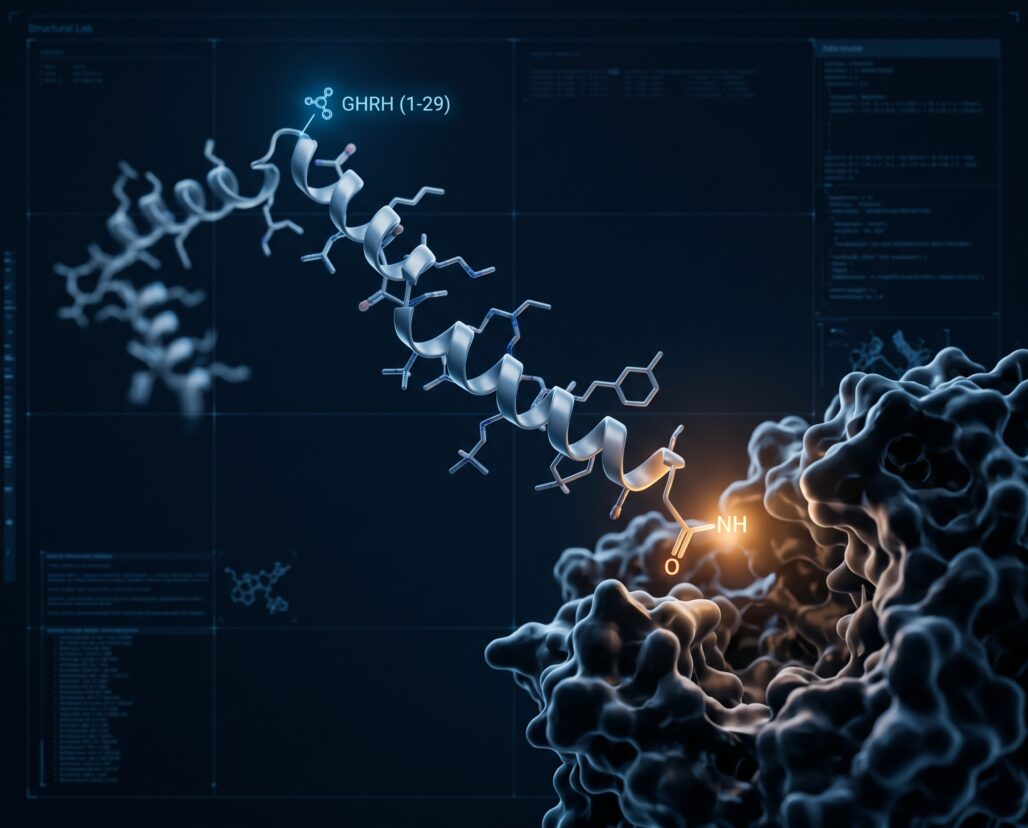
Sermorelin is a synthetic 29-amino-acid amide corresponding to the biologically active N-terminal fragment of human growth hormone-releasing hormone (GHRH). It binds the GHRH receptor on the anterior pituitary, stimulates endogenous GH pulse release, and was FDA-approved as Geref for pediatric growth hormone deficiency diagnosis and treatment from the mid-1990s until its voluntary market withdrawal in 2008. The original approval covered children — not adults, not anti-aging, not body composition.
Best for: Understanding the regulatory history and the gap between the compound's approved indication and its current compounded-market promotion.
Not ideal for: Anyone expecting an evidence base for adult anti-aging, muscle gain, or wellness optimization. That indication has never been FDA-approved and is supported only by small observational studies and mechanistic rationale.
What to look for: If a clinic describes sermorelin as "FDA-approved" without specifying that no FDA-approved sermorelin product is currently in active distribution and that the original approval covered pediatric GH deficiency only, that framing is incomplete.
Decision shortcut: Sermorelin's prior FDA approval does not transfer to its current compounded form or to adult anti-aging indications. The Geref approval covered a manufacturer-produced product under GMP oversight that no longer exists. Compounded sermorelin is a different regulatory and quality situation.
The what-are-peptides overview covers how peptide compounds differ from approved drugs, and are-peptides-safe addresses the quality and safety questions that apply broadly to compounded peptides.
What Sermorelin Actually Is: Synthetic GHRH 1-29
Human GHRH is a 44-amino-acid peptide produced by the arcuate nucleus of the hypothalamus. Its job is to travel a short distance to the anterior pituitary, bind the GHRH receptor on somatotroph cells, and trigger pulses of growth hormone (GH) release into the bloodstream. The challenge for any therapeutic use is that GHRH is rapidly degraded by plasma enzymes — primarily dipeptidyl peptidase IV — within minutes of entering circulation.
Early research in the 1980s established that the biological activity of GHRH is contained almost entirely in its first 29 amino acids. Grossman and colleagues demonstrated in 1984 that GHRH(1-29)NH2 — the N-terminal fragment amidated at its C-terminus — is equipotent to the full 44-amino-acid sequence at stimulating GH release in both normal subjects and GH-deficient children and young adults (Grossman et al., 1984, PMID 6236914). That 29-amino-acid amide became sermorelin: shorter than native GHRH, more stable, and cheaper to synthesize, while retaining the key receptor-binding geometry.
Sermorelin works by binding the GHRH receptor — a G-protein-coupled receptor on pituitary somatotroph cells — triggering cyclic AMP signaling that drives GH granule exocytosis. Crucially, it stimulates endogenous GH secretion: what reaches the bloodstream is the patient's own pituitary GH, in physiological pulses, regulated by the pituitary's feedback loop. That distinction from injecting exogenous GH matters both for the mechanism and for how the diagnostic application worked.
This mechanism is shared with other GHRH analogs, but the structural approach and regulatory history differ sharply across the class. CJC-1295 extends half-life through albumin binding and has only Phase 1 pharmacokinetic data. Tesamorelin uses a lipid tag on the full 44-amino-acid GHRH sequence and is the only GHRH analog with a current FDA approval — for HIV-associated lipodystrophy specifically, not general wellness.
The FDA-Approved Era: 1990s to 2008
Sermorelin reached FDA approval under two distinct roles, both within the pediatric GH deficiency context.
The first was diagnostic. Because sermorelin stimulates endogenous GH release from a pituitary with intact somatotroph function, it could be used as a provocative test: inject sermorelin intravenously and measure peak GH response. A blunted response suggested pituitary or hypothalamic GH deficiency. The FDA approved this diagnostic use, and the Prakash and Goa review from 1999 noted that intravenous sermorelin at 1 microgram per kilogram appeared effective and produced fewer false-positive deficiency diagnoses than some competing provocative agents like arginine or glucagon (Prakash and Goa, 1999, PMID 18031173). The diagnostic application was retired from clinical recommendations around 2009, when guidelines shifted away from GHRH-based provocative testing in favor of other assessments.
The second role was therapeutic: once-daily subcutaneous sermorelin to promote growth in prepubertal children with confirmed GH deficiency. This is where the multicenter trial record sits. The Geref International Study Group published results in 1996 from a 110-patient open-label trial of once-daily subcutaneous GHRH(1-29) at 30 micrograms per kilogram in previously untreated prepubertal GH-deficient children. Mean height velocity rose from 4.1 cm per year at baseline to 8.0 cm per year at 6 months and 7.2 cm per year at 12 months. Seventy-four percent of children demonstrated a good response. Bone age progression tracked proportionally to height-age progression. No adverse changes in biochemistry, glucose metabolism, or IGF-1 generation were noted (Thorner et al., 1996, PMID 8772599). The trial was conducted under the Geref brand and supported the approved indication.
A comparative trial by Chen and colleagues randomized 60 children with hypothalamic-origin GH deficiency to GHRH(1-29)-NH2 at two dose levels or to direct GH therapy. Height velocity at 6 months reached 14.6 cm per year in the GH group, versus 9.2 to 9.3 cm per year with sermorelin at either dose — a clinically meaningful and statistically significant difference favoring direct GH (Chen et al., 1993, PMID 8329830). The study also found that nearly all patients in both sermorelin groups developed GHRH antibodies, and that serum IGF-1 initially rose but then declined during treatment. This finding — antibody development with functional attenuation — is an important nuance that rarely appears in anti-aging clinic marketing.
Sermorelin's approved therapeutic use was in children with confirmed GH deficiency. The approval was never extended to adults, to healthy individuals, or to the body composition and wellness contexts in which it is now primarily marketed.
Why Production Was Discontinued: Commercial Reasons, Not Safety
In 2008, EMD Serono voluntarily discontinued Geref for commercial reasons: the GH deficiency treatment market had shifted toward direct somatropin products, which offered larger height velocity gains in GH-deficient children. Sermorelin could not compete on efficacy, faced increasing somatropin competition, and was exited as a business decision. There was no FDA safety recall, no adverse event withdrawal, and no enforcement action.
That context matters because anti-aging clinic materials sometimes imply sermorelin's market absence is temporary or irrelevant. The accurate framing is simpler: the only product ever approved for human use no longer exists, and what is available today is a compounding-pharmacy preparation under a different regulatory framework than the original approved drug.
Compounded Sermorelin Today: The 503A Reality
With no commercially manufactured FDA-approved sermorelin product in distribution, the compound now circulates almost exclusively through compounding pharmacies operating under the FDA's 503A framework — state-licensed pharmacies that compound medications for individual patients based on a valid prescription from a licensed practitioner.
The FDA's ongoing review of bulk drug substances eligible for 503A compounding has included sermorelin in its Category 1 nominations — meaning it has been nominated for evaluation and a determination on whether it is appropriate for compounding under 503A is pending. Until that final determination is published, compounding use continues in a regulatory grey zone.
The quality gap from the original Geref is real. Approved drugs manufactured commercially must pass standardized testing for identity, potency, purity, sterility, and contaminants before release. Compounded preparations under 503A are not subject to the same pre-release manufacturing controls. Audits of compounded peptide products across the category have documented mislabeling, contamination with bacterial endotoxins, incorrect potency, and degradation from improper storage. A compounding pharmacy label does not carry the same manufacturing verification as an approved drug label.
Sermorelin is not a dietary supplement and cannot be sold as one. It requires a valid prescription from a licensed practitioner.
Anti-Aging Clinic Use: Off-Label, No Approved Indication
The primary market for compounded sermorelin today is adult anti-aging and men's health clinics, where it is offered for purposes including improved body composition, increased energy, better sleep, faster recovery, and general GH-axis optimization. None of these indications are FDA-approved. Currently no FDA-approved indication exists for sermorelin in adults for any purpose.
The mechanistic case is plausible: GH secretion declines with age (somatopause), and stimulating the aging pituitary via a GHRH analog is theoretically more physiological than exogenous GH injection because the pituitary's feedback loop limits excess. A 2006 editorial by Walker (PMID 18046908) made this argument explicitly in the context of adult-onset GH insufficiency. A 2017 observational study by Sigalos and colleagues found that mean IGF-1 rose from 159.5 to 239.0 ng/mL after approximately 134 days of sermorelin combined with GHRP-2 and GHRP-6 in 14 hypogonadal men (Sigalos et al., 2017, PMID 28830317). The study was observational, confounded by concurrent peptide use, and measured IGF-1 — not the body composition or recovery outcomes anti-aging clinic materials lead with. There are no randomized controlled trials measuring body composition endpoints in healthy adults taking compounded sermorelin.
Two populations should treat this as a hard stop. Tested athletes should know that GHRH analogs, including sermorelin, are listed under WADA Section S2.4 and prohibited at all times — in-competition and out-of-competition. Anyone pregnant or planning pregnancy should avoid sermorelin entirely: there are insufficient data from human use to characterize fetal risk, and GH-axis manipulation during pregnancy carries developmental concerns that have not been studied.
Sermorelin vs. CJC-1295 vs. Tesamorelin: Not Interchangeable
Anti-aging clinics frequently group these three GHRH analogs into one category and swap them based on cost and availability. They share a receptor target but are structurally and evidentially distinct.
Sermorelin is the shortest: the 29-amino-acid N-terminal GHRH fragment with no structural modifications beyond the C-terminal amide cap. Its short half-life — close to native GHRH — is why the approved therapeutic use required once-daily bedtime dosing to align stimulation with the body's natural overnight GH pulse.
CJC-1295 (with DAC) extends half-life to approximately six to eight days by covalently binding serum albumin via a maleimide linker. It has two human pharmacokinetic studies but no efficacy trials and no FDA approval. CJC-1295 without DAC — widely sold in grey-market channels — lacks the albumin modification, has a half-life of roughly 30 minutes, and has no published human data at all.
Tesamorelin (Egrifta) uses the full 44-amino-acid GHRH sequence with an N-terminal lipid tag and is the only GHRH analog with a current FDA approval — granted in 2010 for excess visceral fat in HIV-positive adults with lipodystrophy. That approval does not transfer to sermorelin or to the anti-aging population.
Three compounds, one receptor, three completely different evidence records. The shared mechanism does not make them equivalent therapeutic options.

Frequently Asked Questions
Was sermorelin ever FDA-approved? Yes — as Geref, for pediatric GH deficiency diagnosis and treatment from the mid-1990s until EMD Serono voluntarily discontinued production in 2008. Currently no FDA-approved sermorelin product is in active distribution.
Is compounded sermorelin the same as Geref? The active ingredient is the same 29-amino-acid peptide, but compounded versions are manufactured under 503A pharmacy standards that do not require the same pre-release GMP testing as the original approved drug. Quality controls for potency, sterility, and contamination are not equivalent.
Does sermorelin work for anti-aging in adults? The mechanistic rationale is plausible — aging reduces GH secretion and a GHRH analog could support GH axis function. But no randomized controlled trial has measured body composition, energy, or recovery outcomes in healthy adults using compounded sermorelin for anti-aging purposes. Available adult data are observational, small, and confounded by concurrent peptide use.
How does sermorelin differ from direct GH injections? Somatropin introduces exogenous GH regardless of pituitary function. Sermorelin stimulates the pituitary to produce endogenous GH, subject to the pituitary's own feedback limits. Pediatric trials found that direct GH produced larger height velocity gains — in part because the pituitary's ceiling limits how much GH a GHRH stimulus can drive, and in part because most patients developed GHRH antibodies with prolonged sermorelin use.
Is sermorelin prohibited in sport? Yes. GHRH analogs, including sermorelin, are listed under WADA Section S2.4 and are prohibited at all times, regardless of prescription status or compounding source.
Is sermorelin safe during pregnancy? There are insufficient data from human use to characterize fetal risk. Sermorelin should not be used during pregnancy or while nursing.
Conclusion
Sermorelin's history is unusual in the peptide space. Most compounded peptides marketed in anti-aging clinics were never approved for anything. Sermorelin was — for a narrow pediatric indication, with multicenter trial data, under a real pharmaceutical company's oversight. That prior approval is not nothing.
But the prior approval does not validate the current use. Currently no FDA-approved sermorelin product is in active distribution. The compounded versions circulating today are not manufactured under the same standards as the original Geref. The adult anti-aging indication has no FDA approval and no randomized controlled efficacy trial behind it. Some prescribers find the pituitary-dependent, feedback-regulated GH stimulation more physiological than exogenous GH injections — but that is an argument about mechanism, not proof of clinical outcome.
Four honest takeaways: Sermorelin's prior approval covered GH-deficient children, not adults seeking wellness optimization. Compounded sermorelin is not subject to the quality oversight that applied to Geref, and that matters when you are injecting something. Anyone subject to WADA testing should treat GHRH analogs as prohibited at all times. And if a clinic invokes sermorelin's FDA approval history as validation for today's compounded anti-aging protocol, the approval, the product, and the patient population it covered are all different from what is being offered now — which is a distinction worth holding onto.
This article is for informational purposes only and does not constitute medical advice, diagnosis, or treatment recommendation. Sermorelin is a prescription compound available through licensed practitioners and compounding pharmacies. Currently no FDA-approved sermorelin product is in active commercial distribution. Off-label use in adults has not been evaluated in randomized controlled efficacy trials. Do not start, stop, or change any prescription compound or medication without consulting a licensed healthcare provider who is familiar with your complete medical history. Pregnant and nursing individuals should not use sermorelin given insufficient human safety data. The information on this page reflects published clinical literature and regulatory records as of the date of writing and may not capture subsequent regulatory or research developments.
