
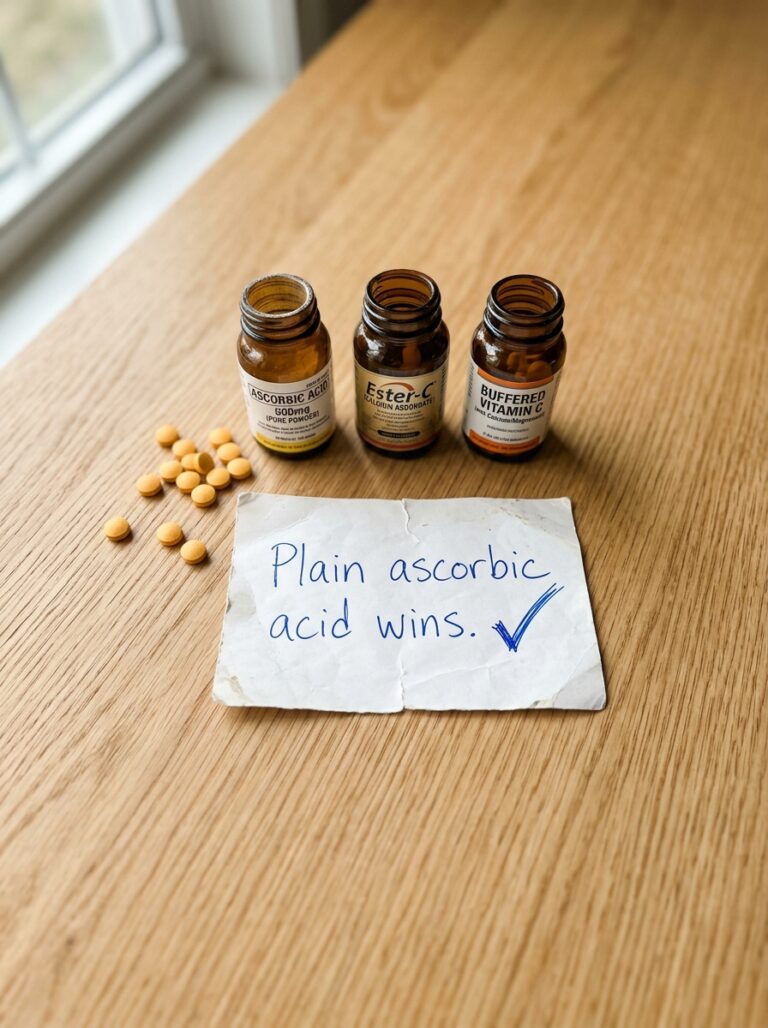
You searched "ester c vs ascorbic acid" because a bottle of plain vitamin C costs a few dollars, the Ester-C and buffered versions cost two or three times more, and you want to know whether the upgrade does anything.
The short answer is that for most healthy adults the premium forms buy a small, mostly theoretical edge, and the cheap form does the job. Here is what the comparative human data actually shows, where the buffered forms genuinely help, and the three vitamin C products at the bottom are the exact ones I'd put in my own family's cabinet.
Affiliate disclosure: this article contains affiliate links. As an Amazon Associate, UsefulVitamins.com earns from qualifying purchases at no extra cost to you.
I pick three specific products at the end, one for each situation, so you can stop comparing labels and just buy.
Before you decide

A quick gut check before you spend on any form. If you have a history of calcium oxalate kidney stones, are on dialysis, have hemochromatosis or another iron-overload condition, or have G6PD deficiency, high-dose vitamin C is not a casual self-prescribe item, so clear the dose with your doctor first.
Vitamin C also raises iron absorption, which is helpful if you are iron-deficient and a problem if you are iron-overloaded. None of the forms here change that calculus; the dose does. And if you are taking vitamin C hoping to fix fatigue, frequent colds, or low energy, ask your doctor about a basic workup before assuming a vitamin is the answer, because true vitamin C deficiency is uncommon in people who eat any fruit and vegetables.
Now the physiology that decides this entire comparison. Vitamin C is absorbed in the small intestine mainly through a specific active transporter (SVCT1), and that transporter is saturable. At low intakes you absorb 70 to 90 percent of a dose; as the dose climbs past a few hundred milligrams, fractional absorption drops and the surplus is excreted in urine, according to the NIH Office of Dietary Supplements.
This is the crux: because a transporter, not the chemical form, sets the ceiling, swapping ascorbic acid for a fancier salt does not meaningfully raise the plateau your blood reaches. The RDA is 90 mg for men and 75 mg for women, with smokers needing 35 mg more, and the average US diet already supplies most adults their requirement, so a supplement is closing a modest gap, not loading a tank.
The relevant outcome metric across these trials is plasma vitamin C concentration, with some studies adding leukocyte (white blood cell) concentration as a tissue-uptake proxy. You can read the full physiology in our complete guide to vitamin C, and you can see how I weigh evidence and conflicts of interest on the how we review supplements page.
The forms compared
Plain ascorbic acid is vitamin C in its simplest, most acidic form, and it is the reference everything else is measured against. Natural and synthetic L-ascorbic acid are chemically identical with no known difference in biological activity, and a steady-state human review found synthetic and food-derived vitamin C equally bioavailable.
It is also the form used in the overwhelming majority of clinical trials, which means when you buy plain ascorbic acid you are buying the exact molecule the evidence was built on. Its one drawback is the acidity, which on an empty stomach can cause mild GI upset in sensitive people.
Buffered vitamin C (mineral ascorbates) is ascorbic acid neutralized with a mineral, most commonly sodium ascorbate or calcium ascorbate. The mineral raises the pH so the powder is closer to neutral rather than acidic, which is the genuine selling point: a gentler feel on the stomach. Both the ascorbic acid and the accompanying mineral appear to be well absorbed, so bioavailability tracks plain ascorbic acid.
The honest caveat, per the Linus Pauling Institute, is that "there appears to be little scientific research to support or refute the claim that mineral ascorbates are less irritating to the gastrointestinal tract." The buffering is real chemistry; the clinical GI benefit is plausible but thinly studied.
Watch the mineral load: 1,000 mg of sodium ascorbate carries about 111 mg of sodium, which matters on a sodium-restricted diet, and calcium ascorbate adds calcium you should count toward your daily total.
Ester-C is a branded calcium ascorbate that also contains small amounts of vitamin C metabolites (dehydroascorbate and calcium threonate). It is marketed on "enhanced bioavailability and retention." The marketing traces partly to a 1987 rat study showing the calcium ascorbate complex was absorbed faster and excreted more slowly than L-ascorbic acid, but that is an animal acute study.
In humans the picture is narrower. A randomized, double-blind, placebo-controlled trial found Ester-C and plain ascorbic acid produced essentially the same plasma vitamin C curve, both peaking around four hours; Ester-C's edge was a higher percent change in leukocyte vitamin C at 8 and 24 hours. So the human advantage is a tissue-uptake signal, not a plasma or clinical one. As a dietitian I'd call that interesting, not decisive.
| Form | Plasma bioavailability | GI tolerance | Relative cost | Best for |
|---|---|---|---|---|
| Plain ascorbic acid | Reference; the form trials are built on | Acidic; can bother an empty stomach | Lowest per mg | Most healthy adults |
| Buffered (sodium/calcium ascorbate) | Equivalent to ascorbic acid | Near-neutral pH; plausibly gentler | Moderate premium | Sensitive stomachs, high daily doses |
| Ester-C (calcium ascorbate + metabolites) | Same plasma as ascorbic acid; higher leukocyte signal | Buffered, generally well tolerated | Highest premium | Those set on a buffered branded form |
A 2025 systematic review of alternative vitamin C forms in healthy adults reached the same balanced conclusion: calcium ascorbate showed better tolerability and fewer epigastric adverse events than plain ascorbic acid in some studies and occasionally higher leukocyte concentrations, while plasma improvements were inconsistent and the authors stressed that more research is needed before claiming functional advantages.
A separate preliminary crossover trial found no difference between calcium ascorbate and ascorbic acid at 250 mg, and only modest, early immune-marker differences at 500 mg that the authors themselves flagged as preliminary. The pattern is consistent: where the alternatives differ at all, it is at the tissue or marker level, not the blood level or a clinical endpoint.
How to choose
The form question is really three smaller questions: does plain acid bother your stomach, how high is your daily dose, and how much do you care about a thin tissue-retention signal? Here is how I map common situations to a form.
If you are a healthy adult closing a modest dietary gap, choose plain ascorbic acid. At 250 to 500 mg a day it raises your plasma vitamin C as well as anything else on the shelf, costs the least, and is the form the evidence is built on.
There is a difference between the dose that maintains adequacy and the dose that just stacks up and gets excreted, and for most people 250 to 500 mg sits comfortably in the first category.
If plain vitamin C reliably upsets your stomach, choose a buffered mineral ascorbate. This is the one situation where paying more is clearly rational. The near-neutral pH is the genuine benefit, even though the GI-comfort claim is better supported by chemistry and user experience than by large trials. Sodium ascorbate or calcium ascorbate both work; pick based on which mineral you'd rather not overload on.
If you take a high daily dose, say above 1,000 mg for a specific reason your clinician supports, a buffered form again earns its premium, because the acid load of large doses of plain ascorbic acid is exactly what tends to trigger loose stools and cramping. Splitting the dose helps as much as switching the form.
If you are sodium-restricted or watching calcium, lean toward plain ascorbic acid or pick your buffered mineral carefully, since sodium ascorbate adds sodium and calcium ascorbate adds calcium you should count toward your daily total.
If you specifically want the Ester-C retention story, it is a reasonable, well-tolerated buffered product, just know you are paying the highest premium for a leukocyte-level signal rather than a proven clinical or plasma edge. If your interest is squeezing more vitamin C into circulation, the more studied lever is the liposomal route, which we compare in detail in liposomal vs standard vitamin C bioavailability.
FAQ

Is Ester-C actually better absorbed than regular vitamin C?
Not in your bloodstream. The human trial showed the same plasma curve as plain ascorbic acid. Its measured advantage was higher vitamin C in white blood cells at 8 and 24 hours, a tissue signal whose clinical meaning is not established.
Is buffered vitamin C easier on the stomach?
Plausibly, because neutralizing the acid lowers the pH irritation. But major reviewers note the GI-comfort claim is not well backed by trials, so treat it as a sensible option to try if plain acid bothers you, not a proven upgrade for everyone.
Why does high-dose vitamin C cause diarrhea?
Once the gut transporter saturates, unabsorbed vitamin C draws water into the bowel. The NIH notes GI effects like diarrhea, nausea, and cramps become common above about 3,000 mg/day, with a tolerable upper limit of 2,000 mg/day for adults. Buffering and dose-splitting can reduce the discomfort.
Do I need vitamin C with bioflavonoids?
For absorption, no. Most studies show no appreciable bioavailability difference from added bioflavonoids, so it is not a reason to pay more on absorption grounds.
Is synthetic vitamin C worse than vitamin C from food?
No. Synthetic and food-derived L-ascorbic acid are chemically identical and equally bioavailable at steady state in humans. Food brings other nutrients, but the vitamin C molecule itself absorbs the same.
The bottom line on vitamin C forms
When you line up the human data, the forms converge on the same plasma vitamin C, because a saturable gut transporter, not the label on the bottle, sets the ceiling. That makes plain ascorbic acid the sensible default for most healthy adults: it is the cheapest per milligram and the exact form nearly every trial used.
The premium forms are not scams, they are answers to a specific problem. Buffered mineral ascorbates are the one genuinely useful upgrade, and only if plain acid actually upsets your stomach or you are taking a high daily dose, where the near-neutral pH earns its cost. Ester-C is a perfectly good buffered product whose marketed "retention" edge rests on leukocyte and animal data rather than a plasma or clinical advantage, so pay its higher premium only if that story matters to you.
Match the form to your stomach and your dose, not to the marketing. If you eat fruit and vegetables most days, a modest 250 to 500 mg of plain ascorbic acid closes the gap without overshooting, and the money you save on the form is better spent on the diet that covers most of the requirement in the first place.
Before adding a daily dose above the RDA, especially if you have kidney-stone history, iron overload, or take other medications, ask your doctor whether you need it and at what dose, rather than letting a label decide for you.
Recommended Products


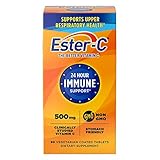
As an Amazon Associate, UsefulVitamins.com earns from qualifying purchases at no extra cost to you. We only recommend products supported by published research or third-party testing.
Reviewed by Sarah Thompson, Registered Dietitian, focused on vitamin and mineral nutrition. See more from Sarah Thompson. This article is educational and is not a substitute for individualized medical advice; talk to your doctor before starting a supplement, especially if you have kidney-stone history, an iron-overload condition, or are managing a diagnosed condition.
