
Affiliate disclosure: this article contains affiliate links. As an Amazon Associate, UsefulVitamins.com earns from qualifying purchases at no extra cost to you.
If you searched for collagen peptides bioavailability, you are probably trying to figure out whether the $40 tub in your cart is actually different from a cup of bone broth or a scoop of whey.
Before you decide
Who should NOT pick form by price alone: anyone on warfarin or other anticoagulants without a once-noted check with their prescriber, anyone with chronic kidney disease where total protein intake is medically restricted, and anyone counting on collagen to fix hair shedding without first ruling out low ferritin or thyroid issues.
Do this first before buying anything: tally your typical week of protein. The adult RDA is about 0.8 g/kg/day, and most active adults do better at 1.0 to 1.2 g/kg/day. If your total protein is already at that range from eggs, dairy, fish, chicken, and legumes, the marginal benefit of adding a collagen scoop for general "skin, hair, nails" support is small, except for the specific patented forms studied below.
What bioavailability means for collagen
Collagen is a protein, and protein digestion is one of the more efficient processes in the gut. Stomach acid and pepsin partially unfold the protein, pancreatic enzymes and brush-border peptidases continue the work in the small intestine, and the end products are free amino acids and small di- and tripeptides absorbed by dedicated transporters like PepT1. For hydrolyzed collagen, the manufacturer has done a lot of the early work by enzymatically pre-cleaving the long fibers into peptides in the 2 to 10 kDa range. That is why hydrolysate dissolves in cold water and whole gelatin does not.
The real bioavailability question for collagen is not whether the amino acids get into your blood. They do, with digestibility around 95 percent for hydrolyzed forms. The interesting question is whether certain small dipeptides specific to collagen, like Pro-Hyp (proline-hydroxyproline) and Hyp-Gly (hydroxyproline-glycine), survive digestion intact and reach circulation. The Iwai et al. 2005 study detected these dipeptides in human serum after an oral hydrolysate dose, peaking around one to two hours after ingestion. The proposed mechanism for the skin and joint claims is that these intact dipeptides signal fibroblasts and chondrocytes directly, beyond just feeding the general amino acid pool.
That is a real but modest mechanism. The proxy metrics in collagen trials are also imperfect: skin elasticity by cutometer, ultrasound dermal density, self-reported joint pain scales, and athletic injury rates. Useful, but each one is several steps removed from the dipeptide concentration that actually drives the effect.
The forms compared

Hydrolyzed collagen peptides (Type I and III bovine, Type II chicken, Type I marine)
The workhorse category. Bovine hide is the most common source for Type I and Type III. Marine collagen from fish skin is mostly Type I and tends to come in smaller average peptide weights, which marketers translate as "faster absorbing." The acute serum dipeptide data does not show a clinically meaningful difference between well-hydrolyzed marine and bovine peptides at equal doses. Type II chicken collagen is the form used in cartilage-focused products. Typical dose for general use is 10 to 20 g/day. Gut tolerance is good, mixability in cold liquid is the practical buying criterion.
Whole collagen protein (unhydrolyzed)
Essentially gelatin in dry form. Poorly soluble in cold liquid, gels in warm liquid, and requires more digestive work. The final amino acid pool is similar to hydrolysate, but the dipeptide yield in serum is lower and the texture limits use. For most readers there is no reason to buy whole collagen powder when hydrolysate exists at the same price.
Bone broth
The food-form of collagen, simmered out of bones, joints, and skin. Collagen content per cup ranges roughly 1 to 10 g depending on simmer time, bone-to-water ratio, and acidulant. To match a 10 g hydrolyzed dose you might need several cups, at a cost-per-gram higher than any powder. Broth is a fine food and a useful source of glycine, but not a reliable way to dose collagen.
Marine collagen (Type I from fish skin)
A subcategory of hydrolysate worth calling out because it is the default choice for readers avoiding bovine sources for dietary or religious reasons. Bioavailability per gram is broadly comparable to bovine at equal doses. Cost per gram tends to run higher. If you are not avoiding bovine for a specific reason, marine is not a meaningful upgrade.
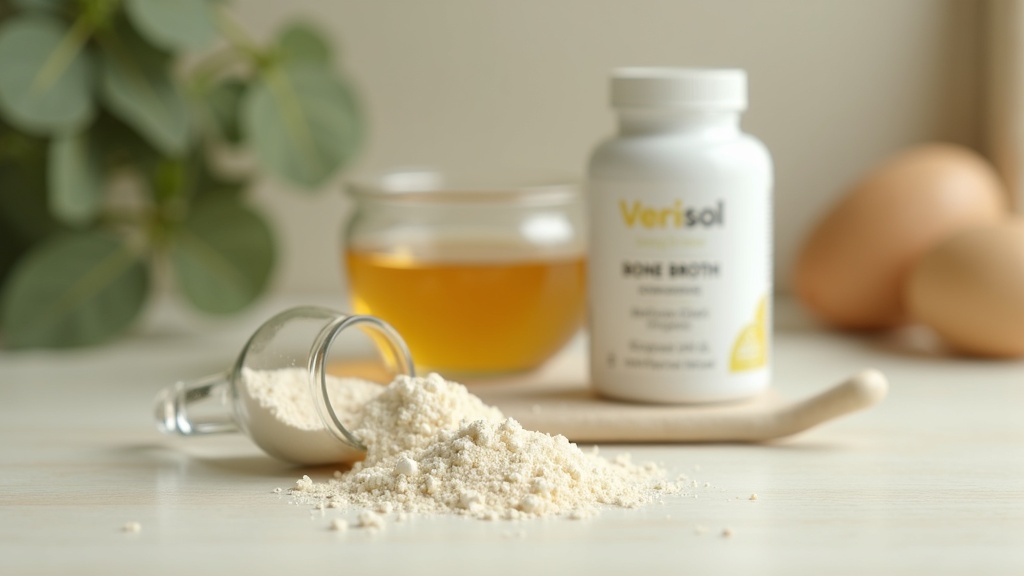
Patented studied forms: Verisol, Fortigel, UC-II
These are the forms with the actual published RCT evidence and are worth naming.
- Verisol is a patented bioactive collagen peptide used in the Proksch et al. 2014 trial at 2.5 g/day, associated with improved skin elasticity in women aged 45 to 65 over eight weeks. The trial dose is much smaller than a typical 10 to 20 g scoop, which is one reason "I take collagen and feel nothing" complaints are common when the form is generic and the goal is specifically skin.
- Fortigel is the joint-focused patented peptide, typically dosed at 5 g/day in cartilage and joint trials.
- UC-II is undenatured Type II collagen, dosed at 40 mg/day in the Lugo et al. 2016 knee osteoarthritis trial. UC-II works through oral tolerance, where small amounts of intact Type II collagen interact with gut immune tissue. It is not a bioavailability story at all.
Vegan collagen builders
"Vegan collagen" products are not collagen. They are amino acid mixes, usually glycine, proline, and lysine with vitamin C, sold on the premise that they support endogenous collagen synthesis. The biochemistry is reasonable. The evidence that the finished mix produces outcomes equivalent to animal-source hydrolysate is weak. For readers avoiding animal sources, a vegan builder with adequate vitamin C is a reasonable option, with a shorter evidence ladder.
Liposomal collagen
Marketed as more bioavailable. The evidence that a liposomal delivery system meaningfully changes serum amino acid or dipeptide kinetics for a protein this large is minimal. Treat as a premium price for an unproven delivery claim.
| Form | Relative bioavailability | Typical dose | Cost per dose (mid-tier US) | Cost per gram of collagen |
|---|---|---|---|---|
| Hydrolyzed bovine peptides (generic) | High, ~95 percent digested | 10 to 20 g | $1.00 to $1.50 | ~$0.08 to $0.10 |
| Hydrolyzed marine peptides | High, ~95 percent digested | 10 to 20 g | $1.50 to $3.00 | ~$0.12 to $0.18 |
| Verisol (patented bovine peptide) | High, dipeptide-bioactive | 2.5 g (skin trial dose) | ~$1.00 to $1.50 | ~$0.40 to $0.60 |
| UC-II (undenatured Type II) | Not a bioavailability story (oral tolerance mechanism) | 40 mg | ~$0.50 to $1.00 | not comparable |
| Whole collagen protein (unhydrolyzed) | Adequate, harder to digest | 10 to 20 g | $0.80 to $1.20 | ~$0.06 to $0.10 |
| Bone broth (homemade or carton) | Variable, food matrix | 1 to 10 g per cup | $0.50 to $3.00 per cup | ~$0.30 to $3.00 |
| Vegan collagen builder | N/A (provides amino acid precursors) | per label | $1.00 to $2.00 | not comparable |
The RCT evidence per form
Cross-form head-to-head bioavailability trials in humans are rare, and the strongest outcome evidence sits on a small number of patented-form trials rather than on the generic category.
The Proksch et al. 2014 trial randomized 114 women aged 45 to 65 to 2.5 g/day of Verisol or placebo for eight weeks. Skin elasticity by cutometer improved in the Verisol group, with the effect persisting four weeks after the intervention stopped. This is the most-cited skin trial in the category. The dose is the part to remember: 2.5 g is roughly one-quarter to one-eighth of a typical "beauty collagen" scoop.
The Lugo et al. 2016 trial compared UC-II 40 mg/day to glucosamine plus chondroitin in 191 adults with knee osteoarthritis over 180 days. UC-II was associated with greater improvement in WOMAC scores. The mechanism is oral immune tolerance, not peptide bioavailability, which is why the dose looks tiny compared with a 10 g hydrolysate scoop.
The Shaw et al. 2017 trial gave 15 g of gelatin plus 48 mg of vitamin C one hour before jump rope training. The protocol was associated with higher serum markers of collagen synthesis and, in an engineered-ligament model, with greater tissue collagen content. The actionable detail is the timing window: take the dose about 60 minutes before the loading activity.
The Clark et al. 2008 trial randomized 147 athletes with activity-related joint pain to 10 g/day of collagen hydrolysate or placebo for 24 weeks, with the active arm reporting less joint discomfort during activity. Modest effect, specific to the activity-related complaint.
For the generic hydrolysate category, the Iwai et al. 2005 data confirms that Pro-Hyp and Hyp-Gly dipeptides reach circulation. What the data does not yet show is a tight dose-response curve that predicts outcomes for a generic 10 g/day scoop in a healthy adult.
Actionable takeaway: if you want the published outcome, buy the form and dose that produced it, which usually means Verisol 2.5 g/day for skin or UC-II 40 mg/day for knee discomfort. Generic hydrolysate is fine as a protein with a useful amino acid pattern, but treat the outcome promise as soft.
Cost-vs-bioavailability decision matrix
Here is the honest math. A 10 g generic bovine hydrolysate dose at $1.00 to $1.50 works out to about $0.10 per gram of collagen. A 2.5 g Verisol dose in a branded product runs about $0.40 to $0.60 per gram, but the studied dose is one-quarter the generic scoop, so the per-day cost lands in the same ballpark. UC-II at 40 mg/day costs less than $1 per day and is the cheapest evidence-backed entry, because the dose is so small.
When does a premium named form pay off? When your goal matches the trial. Skin elasticity in women 45 and over maps to Verisol at 2.5 g/day. Knee osteoarthritis discomfort maps to UC-II 40 mg/day. Tendon and ligament loading maps to 15 g hydrolysate plus 50 mg vitamin C 60 minutes before training. Outside those scenarios you are paying for the brand, not the outcome.
When is generic hydrolysate fine? As a protein top-up with a glycine-and-proline-rich amino acid pattern in an adult already eating enough total protein, or as a tolerable post-workout protein for readers who do not enjoy whey. It is not a substitute for total protein adequacy.
When is bone broth the right call? As a food you enjoy, not as a primary collagen source. The dose per cup is too variable to plan around.
How to choose the right form for your goal
If your goal is skin elasticity, age 45 and over
Verisol-containing product at 2.5 g/day for at least eight weeks. Vital Proteins Beauty Collagen and several other mainstream brands list Verisol on the label. The dose is the part to honor. Doubling it does not double the effect.
If your goal is knee osteoarthritis discomfort
UC-II 40 mg/day. This is a different category from hydrolyzed peptides and works on a different mechanism. Use it alongside what your physician recommends rather than as a replacement.
If your goal is tendon or ligament loading as an athlete
15 g of hydrolyzed collagen or gelatin plus about 50 mg of vitamin C, taken 60 minutes before the training session. This is the Shaw 2017 protocol. The timing window matters more than the brand.
If your goal is general "protein boost for skin, hair, nails"
Any 10 to 20 g hydrolyzed peptide product from a third-party-verified brand. Treat it as a protein with a specific amino acid profile, not as a magic bullet. If hair shedding is the actual complaint, ask your doctor about a blood test for ferritin, iron studies, and thyroid before assuming collagen is the lever.
If you are vegan
A collagen builder with glycine, proline, lysine, and at least 75 mg of vitamin C, alongside total protein intake that comfortably meets 1.0 g/kg/day. The evidence is weaker than for animal-source patented forms. Set expectations accordingly.
If you are pregnant or trying to conceive
Collagen is a protein and is generally compatible with pregnancy from a safety standpoint, but the named patented forms have not been independently studied in pregnancy. Stick with whole-food protein adequacy from eggs, fish, dairy, and legumes during pregnancy, and confirm any supplement use with your OBGYN.
FAQ
Is collagen just expensive protein? Mostly, yes. It is a protein with an unusually high glycine and proline content and a small amount of bioactive dipeptides. The novel signal beyond the amino acid pool is real but modest, and is best documented for the specific patented forms at their specific trial doses.
Why does my generic scoop not do anything visible for my skin? Two common reasons. The form may not match the trial form (generic bovine hydrolysate is not Verisol), and the daily protein floor may already be high enough that adding more glycine and proline does not move the needle. The skin trial signal is also modest, and "I see no change" can simply be honest noise.
Can I take collagen with warfarin or other anticoagulants? Collagen as a dietary protein does not have a recognized interaction with warfarin in the Drugs.com collagen monograph. The caution that sometimes circulates is a confusion with vitamin K, not collagen itself. If your collagen product is bundled with extra vitamin K, that is a separate conversation with your prescriber.
Is bone broth bad? No. It is a food. It is just an unreliable way to dose collagen if you have a specific gram target in mind.
Do I need a blood test before supplementing? Not for short-term collagen use at typical doses in a healthy adult. If your reason for taking it is hair shedding or fatigue, ask your doctor about ferritin, iron studies, vitamin D, and thyroid first. The supplement you actually need may not be collagen.
Conclusion: the bottom line on collagen peptides bioavailability
For the vast majority of readers, collagen is a well-absorbed protein with a glycine-and-proline-rich amino acid profile and a small bioactive dipeptide signal. The strongest published outcomes sit on patented forms at specific trial doses, not the generic scoop. Skin elasticity at age 45 and over maps to a Verisol product at 2.5 g/day. Knee osteoarthritis discomfort maps to UC-II at 40 mg/day. Athletic tendon loading maps to 15 g hydrolysate plus 50 mg vitamin C 60 minutes before training. Outside those windows, generic hydrolyzed peptides at 10 to 20 g/day are a reasonable protein top-up, not a magic bullet.
Before you buy any of this, look at your plate. Eggs, fish skin, slow-cooked chicken thighs, Greek yogurt, and the occasional bowl of bean stew already deliver most of the amino acid raw material your fibroblasts use. The supplement is for matching a specific trial protocol, not for replacing the groceries.
Next steps
- Read how we review supplements to see what testing standards we use to vet brands.
- Read the complete guide to collagen for the broader picture on dose timing, food sources, and what collagen does and does not do.
- See more from Sarah Thompson, RD for the rest of the vitamin and mineral coverage.
This article is for informational purposes and not medical advice. Collagen supplements are foods, but if you take prescription medications, manage chronic kidney disease where total protein intake is restricted, or are pregnant or nursing, consult a licensed physician before starting any supplement.
Reviewed by Sarah Thompson, Registered Dietitian, focused on vitamin and mineral nutrition.
Recommended Products

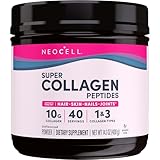

As an Amazon Associate, UsefulVitamins.com earns from qualifying purchases at no extra cost to you. We only recommend products supported by published research or third-party testing.
