
Affiliate disclosure: this article contains affiliate links. As an Amazon Associate, UsefulVitamins.com earns from qualifying purchases at no extra cost to you.
What the studies actually used
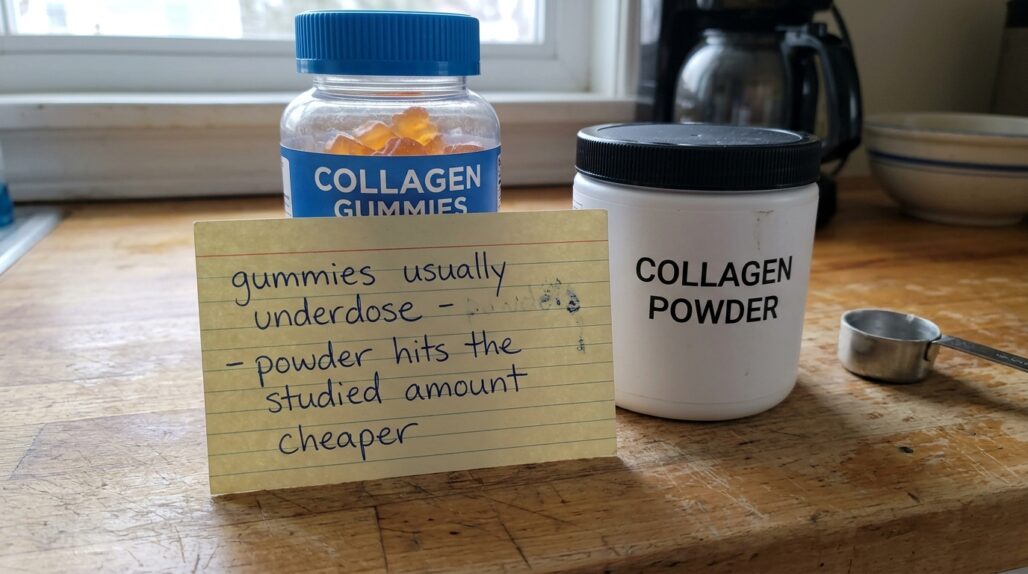
When researchers test collagen for skin, they do not hand people two gummies. They use measured grams of hydrolyzed collagen peptides dissolved in water.
A 2025 systematic review in the American Journal of Medicine pooled randomized trials and found the most common daily dose was 4 g, with a median of about 3.5 g. It is worth noting that this same 2025 review concluded the skin-aging evidence is weak and heavily influenced by industry-funded trials, with higher-quality, independently funded studies showing no clear benefit, so manage expectations regardless of format. A separate meta-analysis of 10 randomized controlled trials and 646 participants reported doses spanning roughly 0.25 g all the way up to 10 g per day, with reported hydration and elasticity gains clustered in the middle and upper end.
There is a low-dose exception worth knowing. A 12-week double-blind trial used just 1,000 mg of a low-molecular-weight peptide once daily and still reported gains in hydration, elasticity and wrinkling. That study used a specific, well-characterized peptide at a clean 1 g dose, which is not the same thing as a candy that happens to contain a smear of collagen.
So the honest target is 2.5 to 10 g a day for most products, with 1 g possible only for a specific tested peptide. Hold a gummy serving up against that and the gap shows itself fast.
The gummy math, gummy by gummy
Here is where the marketing and the milligrams part ways. A gummy serving usually delivers somewhere between 100 mg and 1 g of collagen, and the front of the jar rarely makes that obvious.
Take a popular example. Vital Proteins Collagen Gummies list 2.5 g of collagen across a four-gummy serving. That is actually one of the better ones, and it still only reaches the bottom of the studied range while you chew four pieces.
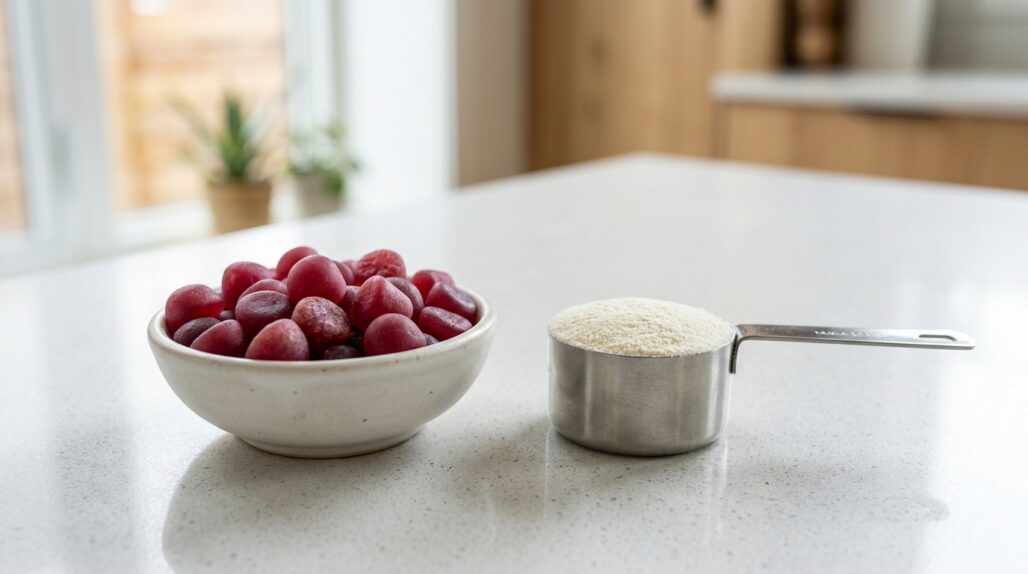
Plenty of others sit far lower. A serving listing 100 mg of collagen gives you one twenty-fifth of a 2.5 g powder scoop. To match that single scoop you would eat 25 of those gummies, and to reach a 10 g study dose you would be working through dozens.
The sugar rides along for the trip. Many gummies carry 1 to 4 g of sugar per serving, so chasing a real collagen dose through gummies can quietly add a tablespoon of sugar to your day. That is the part the cute jar leaves off the front.
| Format | Collagen per serving | Servings to hit ~10 g | Added sugar |
|---|---|---|---|
| Low-dose gummy | ~100 mg | about 100 gummies | High once you scale up |
| Higher-dose gummy | 2.5 g (4 gummies) | about 16 gummies | Moderate, adds up |
| Collagen peptide powder | 10 to 20 g (1 to 2 scoops) | 1 scoop | Usually none |
The table tells the whole story. One scoop of powder does what a fistful of gummies cannot, without the sugar tagging along.
Why powder wins on dose per dollar
Collagen powder is cheaper per gram, and it is not close. A standard tub holds 300 to 500 g of pure peptides, while a gummy jar packs a few grams of actual collagen around a lot of pectin, syrup and flavoring.
Run it out and you are often paying several times more per gram of collagen in gummy form. You are buying candy that happens to carry a trace of the active ingredient, then paying a premium for the texture.
Powder also lets you dial the dose. Want 5 g on a light day and 15 g when you are also using it as part of your protein, you scoop accordingly. If you stack supplements, see whether you can take collagen with creatine in the same routine. Gummies lock you into a fixed, usually small number.
If you want the exact grams for your goal and body weight rather than a generic figure, run it through our collagen dose calculator instead of guessing from a jar. And if you are still deciding whether collagen earns a place in your routine at all, our breakdown of whether collagen is really worth taking is the place to start before you spend anything.
When gummies still make sense
Here is the part the powder evangelists skip. The best collagen is the one you actually take. A study dose of powder sitting unopened in a cupboard does nothing.
If you genuinely will not measure and stir a scoop every morning, but you will happily chew a couple of gummies with your coffee, then a higher-dose gummy beats the powder you keep forgetting. Adherence is a real variable, not a moral failing.
Gummies also travel well. No scoop, no shaker, no clumping, no mess in a hotel room. For a trip or a desk drawer they are simply easier.
Two rules make gummies defensible. First, pick a brand that states a meaningful collagen number, ideally 2.5 g or more per serving, not a token 100 mg. Second, accept the dose for what it is. A gummy at the low end of the range may do less than a 10 g scoop, and the trial evidence sits mostly at higher doses.
A reasonable hybrid
Some people keep a powder tub at home and a small gummy jar for travel and busy mornings. That gets you the studied dose most days and an easy backup the rest of the time. Honest, cheap and realistic.

Which form to actually buy
For dose per dollar, collagen peptide powder is the default pick, and an unflavored one stirs into coffee, water or a smoothie without changing much.
If a known per-gram cost matters most, a plain value powder reaches the studied range for the least money. If you have weighed everything and still know a powder will not get used, a higher-dose gummy you will take beats nothing.
For a deeper look at sourcing and texture, especially for skin goals, see our guide to the best marine collagen powder for skin. And if you want to know when results should show up so you do not quit too early, our timeline on how long collagen takes to work on skin sets honest expectations.
Heads up: the links below may earn UsefulVitamins a commission at no extra cost to you. We only suggest forms we would actually use.


As an Amazon Associate, UsefulVitamins.com earns from qualifying purchases at no extra cost to you.
What quality and testing still cover
This is a low-risk category, so there is no scary safety angle here. The real caveats are about getting what you paid for.
Collagen is not a complete protein. It lacks tryptophan, one of the nine essential amino acids, so it cannot replace whole-protein sources like eggs, fish or poultry in your day. Treat it as a supplement to your protein, not a swap for it. If you are weighing it against a muscle-building shake, our look at whey versus collagen for muscle and recovery covers where each one actually helps.
Quality varies because the FDA does not approve dietary supplements before they go on sale, and the responsibility for safety and accurate labeling sits with the manufacturer. That makes third-party testing your shortcut to trust.
Look for a seal from an independent verifier. The USP Dietary Supplement Verification Program and NSF both check that what is on the label is in the jar and that contaminants stay within limits. A tested powder is a safer bet than an untested gummy with a glossy front.

FAQ
How much collagen do I actually need per day? Most skin studies used about 2.5 to 10 g daily, with 4 g being the most common dose, though one well-designed trial saw benefits at 1 g of a specific low-molecular-weight peptide. Use our calculator for a number matched to your goal.
How many collagen gummies equal a scoop of powder? It depends entirely on the label. A gummy at 100 mg per serving would need about 25 servings to match a 2.5 g scoop, while a 2.5 g four-gummy serving matches that scoop directly but adds sugar.
Are collagen gummies a waste of money? Not always. They cost more per gram of collagen and often underdose, but a higher-dose gummy you take daily beats a powder you keep skipping. Adherence is the deciding factor.
Do collagen gummies have a lot of sugar? Many carry 1 to 4 g of added sugar per serving, which is minor for one serving but adds up if you eat several to chase a real dose. Check the nutrition panel, not the front label.
Is collagen a complete protein? No. It is missing tryptophan, so it does not cover all essential amino acids and should not replace whole-protein foods in your diet. It still counts toward total protein grams.
How long before collagen shows results? Skin trials typically ran 8 to 12 weeks before measuring changes, so give any format at a real dose a couple of months before deciding it works for you.
The bottom line
Most collagen gummies do not hold enough collagen to match the 2.5 to 10 g doses used in research, and matching that range through gummies means chewing a lot of pieces and a fair bit of sugar. Powder reaches the studied amount in one scoop for less money, which is why it is the better pick for almost everyone.
Gummies earn their place only when convenience is the difference between taking it and not. If that is you, choose a higher-dose, third-party-tested option and accept the tradeoff. Either way, sort your target grams first, then pick the form that fits the life you actually live.
This article is general education, not medical advice. Talk to a pharmacist or your doctor before starting any supplement, especially if you are pregnant, nursing, managing a health condition, or taking medication.
Reviewed by the UsefulVitamins Editorial Team.
