
Before you decide
This is general information for people taking low-dose methotrexate for rheumatoid arthritis or a similar autoimmune condition, not personal medical advice. Your rheumatologist set your folate plan for a reason, and the safest version of this article is the one you read alongside their instructions.
Methotrexate works by interfering with folate, the B vitamin your cells need to divide. That is the point of the drug, but it is also why so many people feel queasy, get mouth ulcers, or see their liver numbers climb. Folic acid was added to the regimen precisely to soften those effects.
The people who most need to get this right are anyone newly started on methotrexate, anyone with liver concerns or alcohol use, and anyone managing several medications at once. If you are pregnant or trying to conceive, methotrexate is a separate and serious conversation – the folate question is not the headline there.
What the folic acid actually does
Methotrexate is the anchor disease-modifying drug for rheumatoid arthritis, and it depletes folate as it works. That depletion is what produces the side effects most likely to make someone quit treatment.
Adding folic acid restores enough folate to protect healthy tissue without rescuing the inflammatory cells methotrexate is meant to suppress. The result, on paper, looks almost too good: fewer side effects and no measurable loss of benefit.
The strongest summary comes from the Cochrane systematic review by Shea and colleagues, which pooled six randomized trials covering roughly 624 patients. Supplementation protected against the side effects that matter most.
A plain-language Cochrane editorial walking through those numbers puts figures on it: folate gave about a 26% relative reduction in gastrointestinal side effects, roughly a 77% relative reduction in raised liver enzymes, and around a 61% relative reduction in stopping methotrexate for any reason. Crucially, there was no significant reduction in how well methotrexate controlled the arthritis – joint counts and disease activity held steady.
So the old fear that "folic acid cancels out my methotrexate" does not hold up for low-dose weekly therapy. The vitamin protects the patient, not the disease.

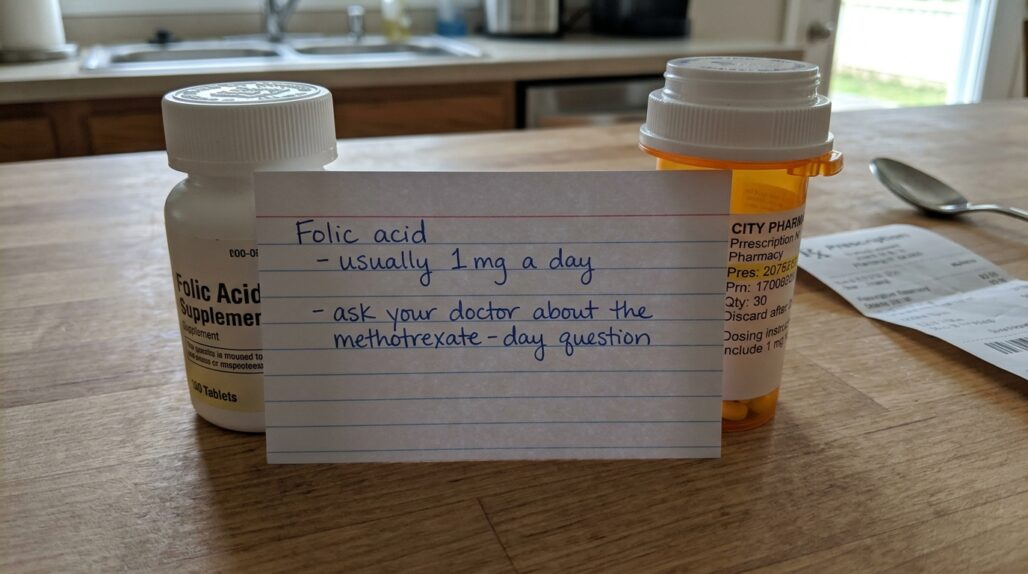
The standard dose: 1 mg a day or 5 mg a week
There is no single universal number, and that is normal. Regimens vary by country and by clinician.
In the United States, the most common pattern is 1 mg of folic acid daily. Routine folate supplementation alongside methotrexate is standard practice, supported by the Cochrane evidence and reinforced by the 2021 American College of Rheumatology rheumatoid arthritis guideline, which recommends increasing folic or folinic acid for patients struggling to tolerate methotrexate. The trial evidence behind this is built on low-dose folic acid – generally 7 mg or less per week, the Cochrane review’s inclusion threshold.
In the UK and much of Europe, the NHS Specialist Pharmacy Service describes 5 mg once a week, on a different day from methotrexate, as the most commonly recommended regimen. If side effects persist, that can sometimes be raised, but there is little evidence for going above 10 mg a week.
A few practical points worth keeping straight:
- Daily and weekly schedules both work – the total weekly folate is what matters, not the exact split.
- The folic acid sold for methotrexate support is ordinary vitamin B9, the same molecule in a standard B-complex or prenatal-style folic acid tablet.
- More is not better. Megadosing folate has not been shown to add protection and can muddy the picture for your care team.
Do not invent your own number from a forum thread. Match the dose your prescriber wrote, and if you cannot remember it, that is a quick call to the pharmacy rather than a guess.
The "skip it on methotrexate day" debate
This is the question that fills patient forums, and the honest answer is that clinicians do not fully agree.
The concern is theoretical. Folic acid is the same nutrient methotrexate antagonizes, so some prescribers worry that taking a folate dose on the same day as methotrexate could slightly blunt the drug or interfere with its absorption. The NHS guidance reflects exactly this caution, recommending folic acid on a separate day and noting that folate is usually avoided on the methotrexate day itself.
Here is the nuance. The Cochrane evidence found benefit even in studies that did not rigidly separate the two, and the loss-of-efficacy worry has not clearly played out in trials. So you will meet rheumatologists who insist on skipping the methotrexate day, and others who are relaxed about a steady daily 1 mg through the week.
What you should not do is change the timing on your own based on something you read. The split your clinic uses is deliberate, and a daily-versus-weekly schedule has different logic than a six-days-on, one-day-off schedule.
If your instructions are vague or you have lost track of them, ask one specific question: "Do you want me to skip folic acid on my methotrexate day, or take it every day?" That single sentence resolves the entire debate for your own case.

Folic acid is not folinic acid – do not swap them
This is the most important safety distinction in the whole topic, and it is the one most often missed.
Folic acid is the cheap, standard synthetic form your body has to convert before it can use it. Folinic acid – sold as leucovorin – is a reduced, already-active folate that skips that conversion step entirely.
Why that matters with methotrexate is mechanical. As the folinic acid drug reference explains, folinic acid can enter cells and become usable folate even while methotrexate is blocking the normal pathway. That is a feature in cancer care, where high-dose methotrexate is deliberately "rescued" with carefully timed leucovorin. It is a hazard if used casually.
A few facts to hold onto:
- Folinic acid is timing-sensitive and prescription-controlled, not an over-the-counter upgrade to folic acid.
- Used at the wrong time or dose, it can work against the methotrexate you are taking on purpose.
- For routine low-dose rheumatoid arthritis therapy, folic acid is the usual supplement; folinic acid is reserved for specific situations a specialist manages.
If a supplement bottle says "folinic acid," "calcium folinate," or "leucovorin," that is not your daily folic acid tablet. Do not substitute one for the other to "get more active folate." That decision belongs entirely to your prescriber.
How the common regimens compare
The table below lays out the patterns you are most likely to be given. None of this replaces your own prescription – it is a map, not a menu you choose from.
| Regimen | Typical schedule | Main rationale | Self-adjust? |
|---|---|---|---|
| Daily folic acid | 1 mg every day, common in the US | Steady folate cover, simple habit | No – confirm with prescriber |
| Weekly folic acid | 5 mg once a week, on a non-methotrexate day | Common UK/EU pattern, easy to separate from the dose | No – confirm with prescriber |
| Skip the methotrexate day | Folic acid on most days, but not the dosing day | Avoids any theoretical same-day interference | No – clinic preference varies |
| Folinic acid (leucovorin) | Specialist-set, timing-controlled | Different molecule for specific cases, not routine | No – prescription only |
If you take several medications and supplements, it helps to keep one current list so nothing slips. You can log your stack in a tool like StackMyMed and bring the flagged items to your pharmacist – it organizes the conversation, it does not replace clinical judgment.

When to call your clinic
Folic acid is a steadying supplement, not an emergency tool. Still, a few situations deserve a prompt call rather than a wait-and-see.
Reach out to your rheumatologist or pharmacist if you notice persistent mouth ulcers, ongoing nausea, unusual fatigue, easy bruising, or signs your liver numbers might be off. These can be folate-related and are exactly what your team adjusts the regimen to prevent.
Seek urgent care for severe symptoms – high fever, breathlessness, a widespread mouth or skin reaction, or signs of infection – since methotrexate suppresses the immune system and those situations are not the moment to self-manage with a vitamin. The NIH Office of Dietary Supplements folate fact sheet is a solid reference for what folate does, but it is not a substitute for the team monitoring your bloodwork.
For broader context on how prescription drugs and supplements interact, our ultimate drug-supplement interactions guide and the drug-supplement interaction checker are useful starting points, and our note on autoimmune disease drug-supplement conflicts covers the wider picture for DMARD users. If you want to look beyond folate, our roundup of the best supplements for methotrexate users walks through the other nutrients worth raising with your team. If you want to understand the form of folate you are taking, see our guide to the best folate supplements, and our methods are explained in how we review supplements.
FAQ
Does folic acid stop methotrexate from working? No. The pooled trial evidence shows folic acid reduces side effects without lowering methotrexate’s control of rheumatoid arthritis, which is why co-prescribing it is standard practice.
How much folic acid should I take with methotrexate? The usual amounts are 1 mg a day or 5 mg once a week, but the exact dose and schedule should come from your prescriber, not a generic recommendation.
Should I skip folic acid on the day I take methotrexate? Some clinicians advise this to avoid any theoretical same-day interference, and others do not. Ask your own rheumatologist which schedule they want you on.
Is folinic acid the same as folic acid? No. Folinic acid (leucovorin) is a different, already-active folate that is prescription-controlled and timing-sensitive with methotrexate. Do not substitute it for your daily folic acid tablet.
Can I take a regular multivitamin instead of separate folic acid? Possibly, but the folate amount and timing still matter, so confirm with your pharmacist that the multivitamin meets what your clinic intended rather than assuming it does.
What if I miss a folic acid dose? A single missed dose is rarely a problem, but do not double up or change your methotrexate to compensate. If you miss doses often, tell your clinic so they can simplify the plan.
Conclusion: a partner, not a problem
Folic acid earns its place beside methotrexate. It quietly lowers the nausea, mouth sores, and liver-enzyme rises that push people off an otherwise effective drug, and it does so without dulling the benefit. The standard 1 mg daily or 5 mg weekly approach is well supported, and the genuine open questions – whether to skip the methotrexate day, and the firm line between folic acid and folinic acid – are exactly the things to settle with your prescriber rather than online.
Your next step is simple: confirm your dose, your schedule, and the methotrexate-day question with your rheumatologist or pharmacist, and keep your full medication list somewhere you can hand it over at each visit.
This article is for general education and does not replace personalized medical advice. Methotrexate and folate dosing should always be set and adjusted by your prescribing clinician.
Reviewed by the UsefulVitamins Editorial Team.
