
Affiliate disclosure: this article contains affiliate links. As an Amazon Associate, UsefulVitamins.com earns from qualifying purchases at no extra cost to you.
What collagen can and cannot do for skin on a calendar
Here is the honest version. Oral collagen is not a topical cream that plumps the surface overnight, and it is not a drug. You swallow hydrolyzed peptides, your gut breaks them into amino acids and small fragments, and over weeks those building blocks plus a signaling effect appear to nudge the skin's own collagen and hydration machinery. That takes time.
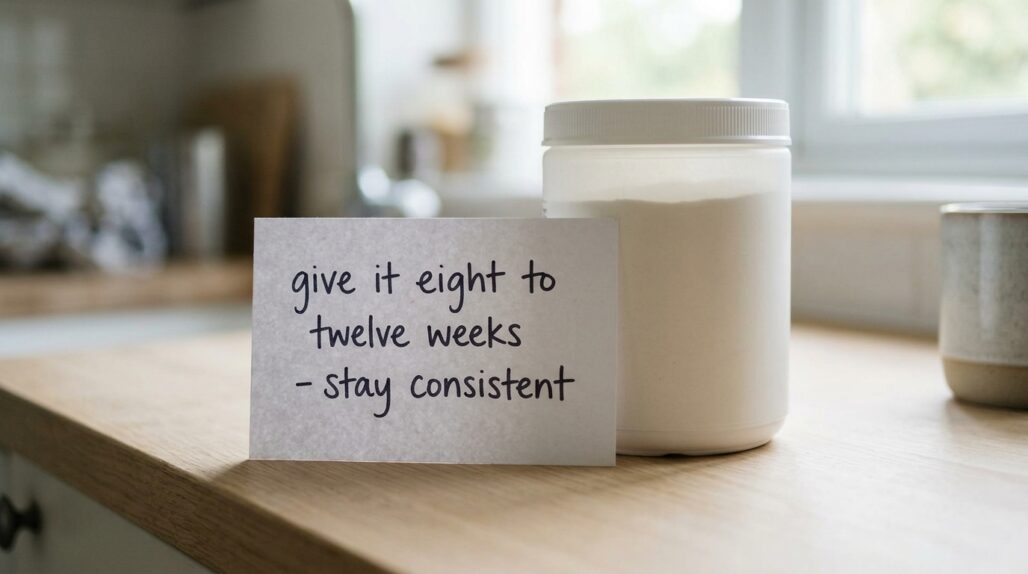
The studies that show a benefit measured it in weeks, not days. Skin hydration and elasticity tend to move first, somewhere around the 4 to 6 week mark, while anything you would actually see in a mirror or a side-by-side photo usually needs 8 to 12 weeks of daily use.
So if you started a tub three days ago and your skin looks the same, nothing is wrong. You are simply early. The realistic question is not "is it working today" but "am I taking the studied dose every day for long enough to find out."
The week-by-week timeline (what the trials actually found)
A few well-run trials give us a rough calendar. In a classic 8-week double-blind study published in Skin Pharmacology and Physiology, women took 2.5 g or 5 g of collagen hydrolysate daily, and skin elasticity was measurably higher by week 4 and still improving at week 8.
A separate 12-week randomized trial of a low-molecular-weight collagen peptide at 1,000 mg per day found skin hydration was significantly above placebo by week 6. And a triple-blind marine collagen trial using 10 g daily saw elasticity peak around week 6 with a wrinkle reduction reaching significance only by week 12.
Pulling those together, here is a reasonable map of what to expect. Treat it as a guide, not a guarantee.
| Stage | What is happening | What you might notice |
|---|---|---|
| Weeks 1 to 3 | Peptides absorbed daily, amino acid pool building, nothing visible yet | Usually nothing. This is the patience window. |
| Weeks 4 to 6 | Hydration and elasticity markers start to shift in trials | Skin can feel a little more supple or less tight; subtle, not dramatic. |
| Weeks 8 to 12 | Elasticity gains hold; some wrinkle and roughness measures reach significance | The first changes that might show in a careful photo comparison. |
| Beyond 12 weeks | Maintenance; benefits depend on continued daily use | Whatever you gained tends to fade if you stop, so it is an ongoing habit. |
One reframe worth keeping. The earliest changes are things you feel and measure, not things you see. Visible change is the slowest part, which is exactly why so many people quit at week three and conclude it did nothing.
How much collagen the studies used
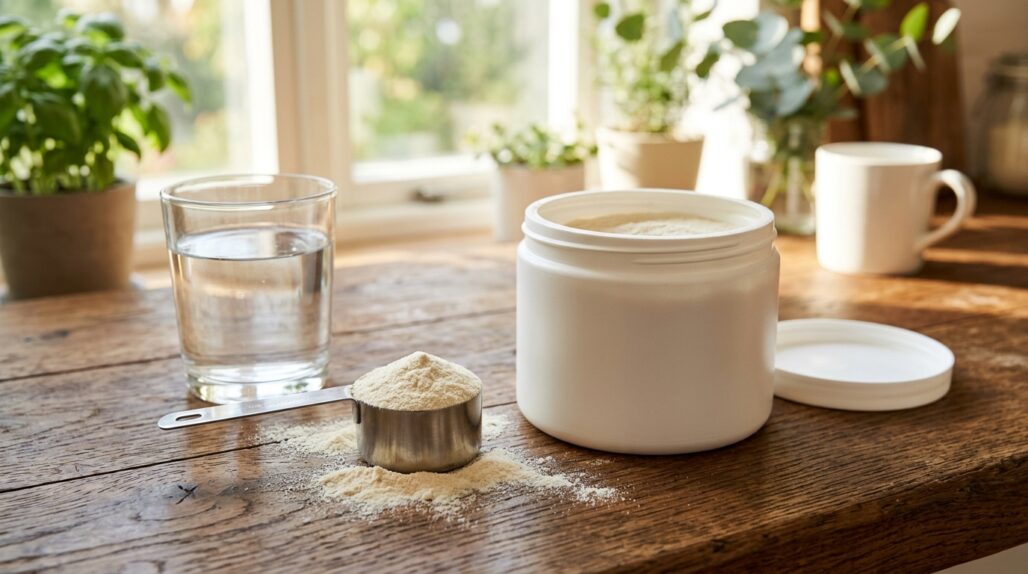
The studied range is wider than most labels suggest, but the meat of the evidence sits low. A systematic review of 26 randomized controlled trials in 1,721 people found significant improvements in skin hydration and elasticity, with most trials using 2.5 to 10 g of hydrolyzed peptides per day and benefits that got more reliable after 8 weeks or more.
Some skin trials go as high as 15 g, but more is not clearly better for skin, and the lower 2.5 to 5 g doses produced results in head-to-head work. A bigger scoop mostly costs you more money.
Two practical traps to avoid:
- Compound weight is not always peptide weight. A scoop is often a round 10 or 11 g, and most of that is the peptides, but flavored or blended tubs pack in cocoa, sweeteners, or other actives that pad the number. Read the supplement facts panel, not the front of the tub.
- Powder versus capsule math. A few capsules rarely hit the studied dose. If a capsule serving is 1 to 1.5 g, you would need a small handful to match a powder scoop, which is why capsules suit convenience more than a research-level dose.
To turn this into a number for your body weight and scoop size, use our collagen dose calculator rather than guessing – it does the grams-per-scoop math so you are not eyeballing it. This article is the timeline and the decision around that number; the calculator is the number itself.
Does timing matter? (Empty stomach vs with food)
Short version: not much. You may have read that collagen needs an empty stomach so your stomach acid can "focus" on it. That logic does not hold up, because hydrolyzed peptides are already pre-digested into small fragments before they reach you.
Your gut absorbs those fragments whether or not other food is present. There is no clinical trial showing that empty-stomach timing produces better skin than taking it with a meal. Some of the strongest trials happened to dose in the morning on an empty stomach, but that was a study protocol, not a proven requirement.
So the verdict is plain: consistency beats timing. Anchor your scoop to something you already do every day – your morning coffee, your post-workout shake, your evening tea – so you never skip. A daily dose you actually remember beats a "perfect" dose you take four days a week.
If you are deciding between a tub and a ready-to-drink shot, the format question is more about adherence and cost than absorption. We break that down in is liquid collagen worth it versus powder so you can pick the one you will actually keep using.

Marine vs bovine: does the source change your timeline?
This is where marketing gets loud and the evidence stays quiet. Marine collagen peptides tend to have a lower molecular weight than bovine, and they are mostly Type I, the dominant collagen type in skin. That sounds like it should win.
But once a peptide is hydrolyzed down to small fragments, both marine and bovine land in the absorption-friendly range, and no trial has shown marine produces better skin outcomes than bovine at the same dose. The hydrolysis quality and the daily gram count matter more than the animal it came from.
A quick way to choose:
- Marine collagen suits you if you avoid beef or pork, want a Type-I-focused option, and do not have a fish or shellfish allergy. It often costs more per gram.
- Bovine collagen peptides give you Type I and III, usually at a lower price, and are the workhorse of many of the trials.
If you want the marine route for skin specifically, our roundup of the best marine collagen powder for skin covers what to look for. Neither source will shorten the timeline much – both run on the same 4-to-12-week clock.
Which collagen to buy (form and what to look for)
The "best" collagen for skin is the one that is hydrolyzed, third-party tested, dosed in the studied range, and cheap enough that you will refill it for three months straight. Beyond that, the differences are smaller than the labels imply.
What earns a spot on your counter:
- Hydrolyzed peptides (also called collagen hydrolysate or collagen peptides), not raw gelatin, for the absorption profile the trials used.
- A scoop in the 5 to 10 g range so hitting the studied dose is one serving, not five.
- A third-party tested mark for heavy metals, which marine sources in particular should carry.
- A vitamin C source nearby, since per StatPearls on vitamin C, vitamin C is a cofactor your body needs to build its own collagen. You do not need a fancy combo product; a vitamin-C-rich diet covers it.
We may earn a commission from purchases made through the links below, at no extra cost to you. We only suggest products that fit the criteria above.
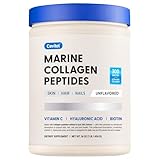


As an Amazon Associate, UsefulVitamins.com earns from qualifying purchases at no extra cost to you.
Before you commit to a tub, it is worth asking the bigger question of whether collagen is the right spend at all for your goals. We lay out the case on both sides in is collagen really worth taking, because for some people the honest answer is that sunscreen and sleep will do more.

The caveat nobody selling collagen will lead with
The evidence is real but not airtight. A 2025 meta-analysis in the American Journal of Medicine found that when you separate the trials by quality, the high-quality studies showed no significant skin effect, while the weaker and more often industry-funded ones showed benefit. Industry groups disputed parts of that analysis, and other reviews still report gains, so the field is genuinely split.
Two things follow from that. First, manage expectations: even in the positive trials, the changes are modest, not a face-lift. Second, collagen sits on top of the basics, it does not replace them.
Three factors cap your results no matter how good your powder is:
- Sun exposure. Daily UV breaks down collagen faster than any supplement rebuilds it. Sunscreen is the single highest-leverage skin habit.
- Age. Older skin tends to respond, sometimes more clearly than younger skin in subgroup data, but the baseline rate of collagen loss climbs with age.
- Diet and protein. If your overall protein and vitamin C intake is low, collagen is patching one corner of a bigger gap.
If after a fair 12-week trial at the studied dose you see nothing, that is useful information. It means collagen is not your lever, and the money is better spent elsewhere. This is supportive care for skin, not treatment for a medical skin condition – take any persistent or worsening skin problem to a clinician.
FAQ
How long until I see collagen working on my skin? Expect subtle hydration and elasticity changes around 4 to 6 weeks and the first potentially visible changes around 8 to 12 weeks, based on randomized trials. Judge it at three months, not three weeks.
What is the right daily dose of collagen for skin? Trials used roughly 2.5 to 15 g of hydrolyzed peptides per day, with most benefit seen in the 2.5 to 10 g range. Run your scoop size through our collagen dose calculator to land on a real number.
Should I take collagen on an empty stomach? It does not appear to matter. Hydrolyzed peptides are pre-digested and absorb with or without food, so taking it consistently every day matters far more than the timing.
Is marine collagen better than bovine for skin? Not in a way trials have proven. Marine is lower molecular weight and Type-I-rich, but at the same dose no study shows it beats bovine for skin outcomes, so choose on diet, allergy, and price.
Will the results last if I stop taking collagen? Probably not. Benefits in the trials depended on continued daily use, so any gains tend to fade over weeks once you stop, which makes collagen an ongoing habit rather than a one-time fix.
Is it safe to take collagen every day? For most healthy adults daily collagen is well tolerated, but if you are pregnant, have a fish or shellfish allergy, or take medication, check with a pharmacist or doctor before starting.
The bottom line
Collagen for skin works on a slow clock: feel-it changes around 4 to 6 weeks, see-it changes around 8 to 12 weeks, at a daily dose most trials put between 2.5 and 10 g of hydrolyzed peptides. Timing and source are minor next to the one thing that actually predicts results, which is taking the studied dose every single day for a full three months.
Set realistic expectations, keep your sunscreen and protein intake solid, and treat collagen as a steady supporting habit rather than a quick fix. Get your exact scoop number from our collagen dose calculator, pick a tub you will refill, and put a reminder on the calendar for the 12-week mark.
This article is general education, not medical advice. It is not a diagnosis or a treatment plan, and it should not replace guidance from your own pharmacist or doctor, especially if you are pregnant, have allergies, or take prescription medication.
Reviewed by the UsefulVitamins Editorial Team.
