
Affiliate disclosure: this article contains affiliate links. As an Amazon Associate, UsefulVitamins.com earns from qualifying purchases at no extra cost to you.
Why hemoglobin and ferritin move on two different clocks
People often quit iron too early because they were watching the wrong number. Your body fixes the urgent shortage first and the savings account last.
When you start iron, the body prioritizes hemoglobin, the protein in red blood cells that carries oxygen. That is the part you notice. Less fatigue, less breathlessness, a bit more color. This is why an increase of about 1 g/dL of hemoglobin after one month is what clinicians use to confirm the treatment is working, per the American Academy of Family Physicians review on iron deficiency anemia.
Ferritin is the other number, and it is the slow one. Ferritin is the protein that holds iron in storage, so a blood ferritin level is the best everyday marker of how full your iron tank is, as the NIH Office of Dietary Supplements iron fact sheet explains. Refilling that tank happens only after the daily demand is covered, which is why it lags weeks behind how you feel.
So the honest framing is this: you can feel better in a month and still be running on empty. Stopping at the "I feel fine" point is the most common reason ferritin never fully recovers.
The realistic week-by-week timeline
Numbers here assume a confirmed iron deficiency, a reasonable dose, and decent absorption. Heavier depletion, ongoing blood loss, or a gut condition will stretch every row out.
| Stage | What is happening | What you might notice |
|---|---|---|
| Days 1 to 7 | Bone marrow ramps up red blood cell production (reticulocytes rise). | Usually nothing yet. Possibly some stomach upset from the pills. |
| Weeks 2 to 4 | Hemoglobin climbs, roughly 1 g/dL over the first month. | Early energy lift, less breathlessness on stairs. |
| Weeks 6 to 8 | Hemoglobin often nears normal; ferritin has only started inching up. | You feel mostly back to normal, but stores are still low. |
| Weeks 8 to 12 | First sensible retest window for ferritin. | A blood test shows whether stores are actually rebuilding. |
| Months 3 to 6 | Ferritin stores refill if dosing and absorption hold. | Steadier energy; ferritin reaches a healthier range on testing. |
The AAFP review puts a clean rule on the back end: in adults, therapy is generally continued for about three months after the anemia itself is corrected, specifically to let stores catch up. That is the difference between treating the symptom and refilling the tank.
When to retest, and why earlier is a waste
The single most useful habit is patience with the blood draw. A ferritin retest at around 8 to 12 weeks tells you something real. A retest at three weeks mostly tells you that ferritin is slow.
There is one extra wrinkle worth knowing. Ferritin is also an inflammation marker, so a cold, an injury, or a flare can push it up temporarily and make stores look better than they are. That is a good reason to let a clinician read the result in context rather than chasing the number yourself.
A few practical markers, drawn from the AAFP review and the NIH ODS fact sheet:
- A ferritin below 15 ng/mL strongly suggests iron deficiency; using a cutoff of 30 ng/mL catches far more true cases.
- A ferritin at or above roughly 100 ng/mL generally rules iron deficiency out.
- If ferritin has not budged after a full retest window, that is your signal to talk to a doctor rather than to simply double the pills.
If you want to translate a target into a daily milligram figure for your situation, our iron dose calculator does that math; this page is the timeline and the protocol around it, not a substitute for that number or for a clinician.
The dose, and the trap of compound weight
Iron labels are confusing on purpose, almost. The big number on the front is often the weight of the whole iron compound, not the elemental iron your body actually counts.
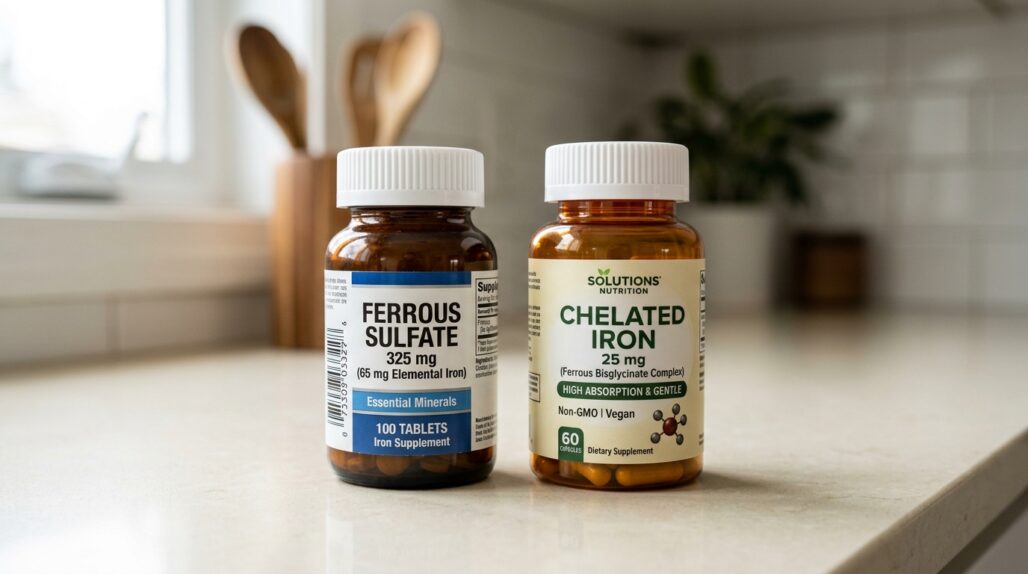
A classic 325 mg ferrous sulfate tablet delivers about 65 mg of elemental iron, per the AAFP figures. The standard treatment target for iron deficiency anemia in adults sits near 120 mg of elemental iron per day, with a common practical range of 100 to 200 mg depending on severity and tolerance.
That gap matters for safety too. The NIH Office of Dietary Supplements sets the tolerable upper intake level for supplemental iron at 45 mg per day for healthy adults, a ceiling meant to avoid gut side effects in people who are not deficient. Treatment doses for a diagnosed deficiency intentionally go above that under medical supervision, which is exactly why you should not be self-prescribing treatment-level iron without a confirmed reason.
Read the elemental number, not the headline number. Use the iron dose calculator to convert a label into the amount that actually lands.
Every-other-day dosing: less is sometimes more
Here is the counterintuitive part that good research now supports. Taking iron every other day can absorb as well as, or better than, daily dosing, with fewer side effects.
The mechanism is a hormone called hepcidin. A dose of iron raises hepcidin for roughly a day, and high hepcidin blocks the next dose from getting absorbed. In the Stoffel randomized trials, splitting iron across alternate days kept hepcidin lower and raised fractional absorption compared with stacking doses day after day.
A later randomized double-blind placebo-controlled trial in iron-depleted women backed up the tolerability angle. At equal total iron, alternate-day dosing produced comparable ferritin at the end but significantly fewer gastrointestinal symptoms along the way, and a lower rate of lingering iron deficiency at six months (about 3% versus 11%).
The takeaway is not "take half as much forever." It is that a gentler schedule can match daily dosing on results while being easier on your stomach, which keeps people actually taking it. Any schedule change for a treated deficiency is worth running past your prescriber first.
How to take it so it actually absorbs
Timing and pairing change how much of each dose lands. None of this is exotic; it is mostly about what you swallow it with.
- Pair it with vitamin C. Ascorbic acid is the strongest known enhancer of nonheme iron and can override several dietary blockers, according to a review of iron-absorption promoters and inhibitors. A glass of orange juice or a small vitamin C dose with the pill is a reasonable habit.
- Keep coffee and tea away from it. Polyphenols and tannins in coffee, black tea, and red wine cut nonheme iron uptake. Give them a gap of an hour or two on either side.
- Separate it from calcium. Calcium blunts iron uptake, so do not take iron alongside a calcium supplement, a big glass of milk, or a dairy-heavy meal.
- On an empty stomach absorbs best, with food is gentler. If empty-stomach dosing upsets you, taking it with a little food is a fair trade; consistency beats a perfect but skipped dose.
For the deeper mechanics of which iron your gut handles best, our guide to heme versus non-heme iron bioavailability walks through why the source changes absorption so much, and the complete guide to iron covers food sources, testing, and who is most at risk.

Which form to buy if your stomach hates iron
If iron has wrecked your gut before, the form is the lever. The cheap default works, but it is also the rough one.
Ferrous sulfate is the standard and the most studied, but it dumps free iron in the stomach and causes side effects in a large share of users. Ferrous bisglycinate (a chelated form) tends to be gentler because the iron is released later in the gut, and studies suggest it can match sulfate on hemoglobin and ferritin gains at a lower elemental dose with fewer complaints. Slow-release iron spreads the dose out, which some people tolerate better, though it can absorb a bit less.
If you tolerate iron fine, the inexpensive sulfate is hard to beat on value. If you do not, a chelated bisglycinate or a slow-release version is the honest upgrade, not a fancier brand of the same harsh compound. Pairing any of these with vitamin C is the cheap optimization.
The links below may earn UsefulVitamins a commission at no extra cost to you. We only point to forms that match the evidence above.


As an Amazon Associate, UsefulVitamins.com earns from qualifying purchases at no extra cost to you.
For a fuller shortlist across forms and price points, see our roundup of the best iron supplements, then match the elemental dose to the figure from the calculator above.
FAQ
Why does ferritin take so long to rise when I already feel better? Your body refills hemoglobin first because oxygen transport is urgent, and only refills storage ferritin once daily needs are met. Feeling better usually reflects hemoglobin recovery in the first month, while ferritin keeps climbing quietly over the following months.
When should I retest my ferritin? Around 8 to 12 weeks is the sensible window. Earlier than that mostly confirms ferritin is slow. Let a clinician interpret the result, since infection or inflammation can push ferritin up temporarily.
Is taking iron every other day really as good as every day? For many people, yes. Trials show alternate-day dosing can absorb as well per dose and cause fewer stomach symptoms, because it keeps the hepcidin block lower. Confirm any schedule change with your prescriber, especially if your deficiency was significant.
Does vitamin C actually help, or is that a myth? It helps with nonheme iron, which is what supplements are. Vitamin C is the strongest dietary enhancer of nonheme iron absorption and can counter blockers like tea and calcium, so a small dose alongside your iron is a fair habit.
How long should I keep taking iron once my levels look normal? Often about three more months after the anemia is corrected, to let stores refill, but the exact length depends on why you were low. This is a call for your doctor, not a fixed rule you set yourself.
Can I just take iron long-term to keep ferritin high? No. Iron deficiency has an underlying cause that needs identifying, and ongoing unsupervised iron can mask that cause or push iron too high. Treat the deficiency with a clinician, then stop or maintain only on their advice.
The bottom line
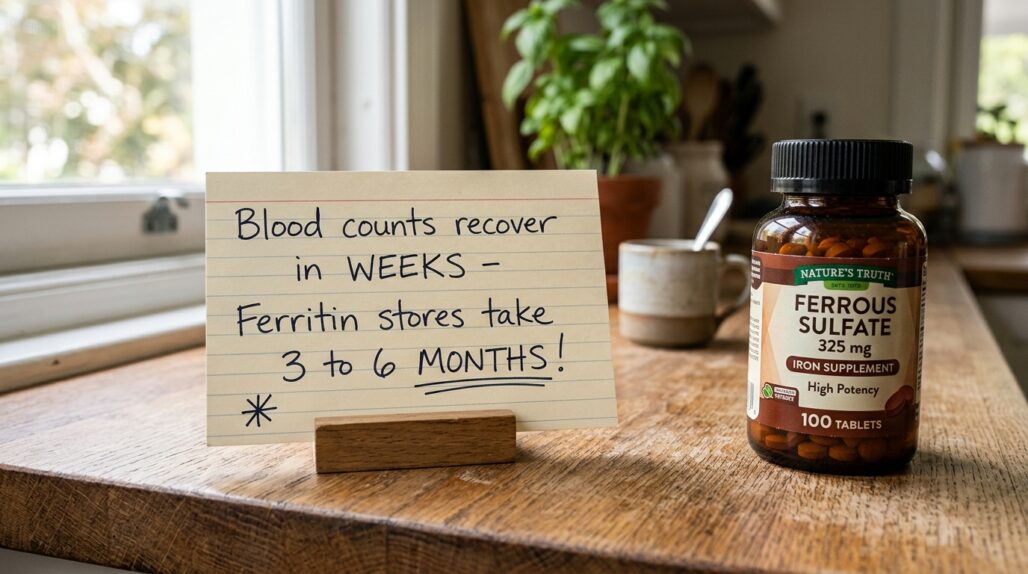
Expect your blood counts to recover in 2 to 4 weeks and your ferritin stores to take 3 to 6 months. Judge progress by a retest at 8 to 12 weeks, not by how you feel, and keep going until stores are full rather than stopping at the first energy lift.
The practical wins are simple: read the elemental iron number, pair doses with vitamin C, keep coffee and calcium away, and consider an every-other-day schedule or a gentler chelated form if your stomach struggles. Use the iron dose calculator for your number, and treat the deficiency with a doctor rather than guessing.
This article is general education, not medical advice. Iron deficiency is a medical issue with an underlying cause; confirm it with a blood test and work with a pharmacist or doctor before starting, changing, or continuing iron, and do not self-treat indefinitely.
Reviewed by the UsefulVitamins Editorial Team.
