
If your doctor has raised the subject of bone-building injections for osteoporosis, you have likely encountered two names: teriparatide (Forteo) and abaloparatide (Tymlos). Both require a daily subcutaneous shot, both are capped at 24 months of lifetime use, and both target the parathyroid hormone receptor. So which one is better — and does the difference even matter? The honest answer: these drugs are more similar than different; abaloparatide shows a modestly lower rate of hypercalcemia and a comparable fracture-reduction record, while teriparatide has a longer safety track record and a lower-cost biosimilar — the right choice hinges on your side-effect tolerance, insurance, and your physician's judgment.
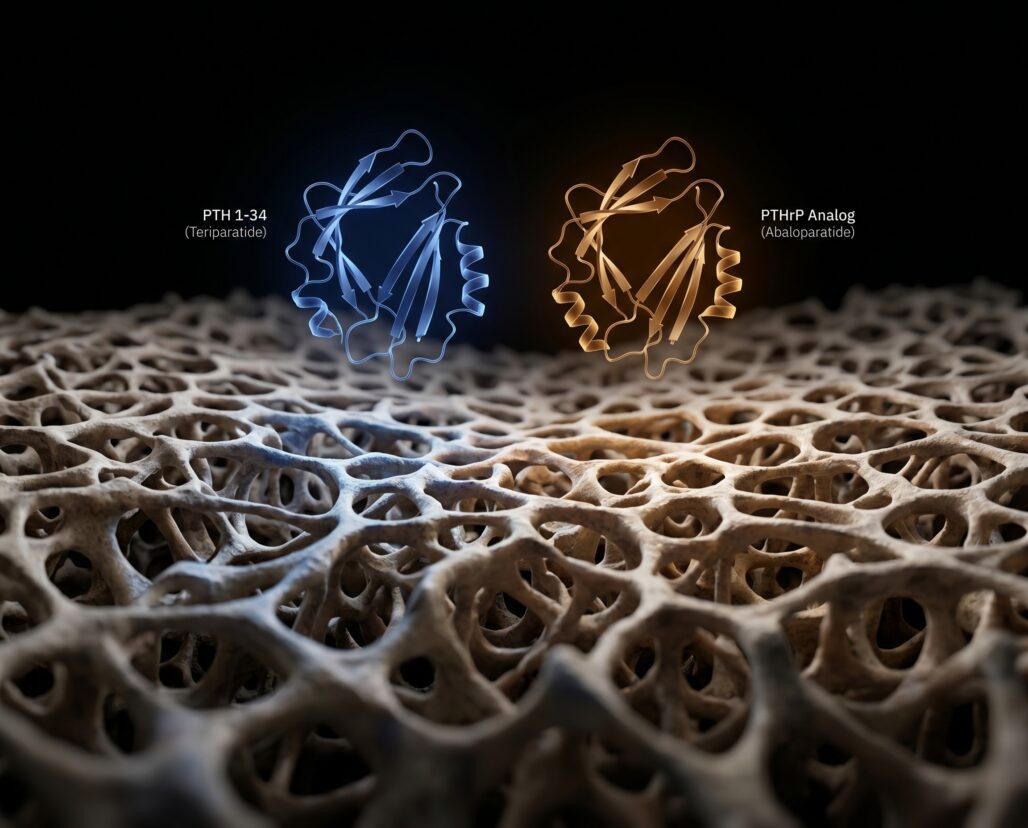
Both Drugs at a Glance
Both medications belong to the class of parathyroid hormone receptor agonists. Both are given as a once-daily subcutaneous injection — 80 micrograms for abaloparatide, 20 micrograms for teriparatide — typically in the abdomen. Neither is a first-line drug; guidelines reserve anabolic bone agents for patients at high or very high fracture risk.
Teriparatide (Forteo, Bonsity): FDA approved in 2002 for postmenopausal women and men with primary or hypogonadal osteoporosis at high fracture risk. A biosimilar, Bonsity, entered the US market in 2020. The original osteosarcoma black box warning — based on rat studies at supraphysiologic doses — was removed from the US label in 2020 after real-world pharmacovigilance studies found no meaningful elevation in human osteosarcoma incidence.
Abaloparatide (Tymlos): FDA approved in 2017 for postmenopausal women and, following a 2022 label expansion, for men with primary or hypogonadal osteoporosis at high fracture risk. It carries a black box warning for osteosarcoma that remains in place as of 2024.
Neither drug is approved for use during pregnancy. Both are contraindicated in patients with Paget's disease of bone, prior skeletal radiation therapy, bone metastases, or a history of skeletal malignancy.
Mechanism: PTH 1-34 Versus a PTHrP Analog
This is where the pharmacology gets genuinely interesting — and where the two drugs diverge in a way that has measurable downstream effects.
Teriparatide is recombinant human parathyroid hormone fragment PTH(1-34). It binds the parathyroid hormone type-1 receptor (PTH1R) in both its RG conformation (G-protein coupled) and its R0 conformation (G-protein uncoupled). Binding to the R0 state produces prolonged cyclic AMP signaling after the drug clears the receptor. Think of it like a key that fits two different locks: one opens immediately, the other keeps the door ajar after the key is removed. The downstream effect is stronger and more sustained RANKL stimulation — meaning teriparatide drives both bone formation and bone resorption more vigorously than its successor.
Abaloparatide is a synthetic analog of parathyroid hormone-related protein (PTHrP), sharing the first 20 amino acids with PTHrP while substituting more than half of the remaining residues. Research published in the Journal of Bone and Mineral Research (PMID 26562265) showed that abaloparatide has comparable RG affinity but roughly fourfold lower R0 affinity compared to teriparatide. The result is a more transient cAMP signal, less RANKL induction from osteoblasts, and — in preclinical and clinical data alike — a measurably lower propensity to stimulate bone resorption alongside bone formation.
In plain terms: abaloparatide was engineered to pull more of the anabolic lever while nudging less of the catabolic lever. Whether that mechanistic difference translates into clinically meaningful superiority is a question the trials partially, but not definitively, answer.
Head-to-Head Trial Data: What ACTIVE and ACTIVExtend Actually Show
The pivotal Phase 3 ACTIVE trial (Miller et al., JAMA, 2016; PMID 27533157) enrolled 2,463 postmenopausal women with osteoporosis across 28 sites in 10 countries. Participants were randomized to 18 months of daily subcutaneous abaloparatide 80 mcg (n = 824), open-label teriparatide 20 mcg (n = 818), or placebo (n = 821). The primary endpoint was incidence of new vertebral fracture in the abaloparatide group versus placebo.
Key findings from ACTIVE:
- New morphometric vertebral fractures occurred significantly less often in both active treatment groups compared to placebo.
- Nonvertebral fracture rates were also reduced with abaloparatide versus placebo.
- Bone mineral density gains favored abaloparatide over placebo at total hip, femoral neck, and lumbar spine (all P less than 0.001).
- Hypercalcemia rates — a marker of excessive calcium release from resorption — were 3.4% with abaloparatide versus 6.4% with teriparatide (risk difference -2.96; 95% CI -5.12 to -0.87; P = 0.006). This was a statistically significant safety advantage for abaloparatide.
Importantly, ACTIVE was not powered for a direct head-to-head comparison of fracture outcomes between the two drugs. Teriparatide was included as an active reference arm under open-label conditions, which means patients and investigators knew who was receiving it. That design choice limits the reliability of any direct fracture-rate comparison between the two drugs.
ACTIVExtend (PMID 29800372) extended the picture. After ACTIVE concluded, participants received 24 months of alendronate 70 mg weekly. Over the full 43-month combined period, the abaloparatide-then-alendronate group achieved an 84% relative risk reduction in vertebral fractures versus placebo-then-alendronate (0.9% versus 5.6%; P less than 0.001), with lumbar spine BMD 17.2% above baseline at month 43. No equivalent sequential-extension trial exists for teriparatide within the same design, though independent studies confirm bisphosphonates preserve teriparatide-driven BMD gains.
Bottom line: Both drugs robustly reduce vertebral and nonvertebral fracture risk versus placebo. Neither has proven fracture superiority over the other in a properly powered head-to-head trial. Abaloparatide's lower hypercalcemia rate is the most consistent comparative safety finding.
Side-Effect Comparison
Both drugs share a common side-effect profile because they act through the same receptor. What differs is the magnitude of certain effects.
Orthostatic hypotension: The FDA label for Tymlos specifies that orthostatic hypotension may occur within four hours of injection, with symptoms including dizziness, palpitations, tachycardia, and nausea. The same warning appears for teriparatide, but ACTIVE trial data suggest it is more clinically prominent with abaloparatide. Patients on antihypertensive medications, with autonomic neuropathy, or prone to dehydration face elevated risk and should discuss timing with their prescriber.
Hypercalcemia: As noted above, abaloparatide produced statistically fewer cases of hypercalcemia in ACTIVE (3.4% versus 6.4%). This mechanistic advantage — less bone resorption stimulation — is one of abaloparatide's genuine clinical differentiation points.
Injection site reactions: Both drugs carry risk of local bruising, redness, and discomfort at the subcutaneous injection site. Neither compound is meaningfully different here.
Nausea, headache, dizziness: Common to both; usually mild and transient.
Osteosarcoma: Teriparatide's boxed warning was removed in 2020 after pharmacovigilance data found no meaningful signal in humans. Abaloparatide's boxed warning remains. Neither drug is appropriate in patients with Paget's disease, prior skeletal radiation, or a history of bone malignancy.
| Side Effect | Teriparatide | Abaloparatide |
|---|---|---|
| Hypercalcemia | ~6.4% (ACTIVE) | ~3.4% (ACTIVE) |
| Orthostatic hypotension | Present; moderate | Present; more prominent |
| Nausea / dizziness | Common | Common |
| Osteosarcoma boxed warning | Removed 2020 | Still present (2024) |
| Injection site reactions | Yes | Yes |
The 24-Month Lifetime Limit and Sequential Therapy
Both drugs share a critical regulatory constraint: neither is recommended for more than 24 months of use during a patient's lifetime. The FDA language for each drug states that safety and efficacy beyond two years have not been established, and the current guidance calls for restricting lifetime use accordingly.
This limit reflects the studied window: extending use beyond 24 months could alter bone architecture in ways that remain uncharacterized. Practically, patients and prescribers should plan the full treatment trajectory before starting.
What happens after you stop? This is not optional to address. BMD gains from both teriparatide and abaloparatide are substantially lost within 12 to 18 months if no follow-on antiresorptive therapy is used. The bone biology here is straightforward: the anabolic peptide stimulated active osteoblasts; when you remove the stimulus, remodeling cycles revert toward resorption. Sequential bisphosphonate therapy — alendronate being the most studied — preserves and often further increases the BMD gains achieved during the anabolic phase. ACTIVExtend demonstrated this for abaloparatide with 24 additional months of alendronate producing continued fracture protection. Multiple trials have confirmed the same principle for teriparatide. Patients should not stop either drug without having a plan for transitioning to an antiresorptive agent.
Cost and Access: Bonsity Changes the Equation
Until 2020, the cost comparison between teriparatide and abaloparatide was essentially a draw at the branded level — both Forteo and Tymlos carried list prices in the range of $7,000 to $9,000 per year. The arrival of Bonsity, a teriparatide biosimilar approved in October 2019 and commercially launched in 2020 by Pfenex and Alvogen, shifted that balance.
Bonsity is pharmacologically equivalent to Forteo — same active ingredient, same strength, same route of administration, demonstrated bioequivalence. List price estimates for Bonsity run approximately $4,000 to $5,000 per year, representing a 30% to 40% reduction versus branded Forteo. No biosimilar exists for abaloparatide as of this writing.
The key point: if cost is a primary concern and both drugs are clinically appropriate, the availability of a teriparatide biosimilar gives teriparatide a real-world cost advantage that abaloparatide cannot currently match. Manufacturer savings cards exist for both branded products; your prescriber's office can help identify them.
Side-by-Side Comparison Table
| Property | Teriparatide (Forteo / Bonsity) | Abaloparatide (Tymlos) |
|---|---|---|
| Molecule | Recombinant human PTH(1-34) | Synthetic PTHrP analog |
| FDA approved | 2002 | 2017 |
| Approved for men | Yes (primary / hypogonadal) | Yes (since 2022) |
| Dose | 20 mcg SC once daily | 80 mcg SC once daily |
| Device | Prefilled pen | Prefilled pen |
| 24-month lifetime limit | Yes | Yes |
| Osteosarcoma boxed warning | Removed 2020 | Present (2024) |
| Vertebral fracture reduction | Robust vs placebo | Robust vs placebo |
| Direct head-to-head fracture comparison | Not powered in ACTIVE | Not powered in ACTIVE |
| Hypercalcemia rate | ~6.4% | ~3.4% |
| Orthostatic hypotension | Warning present | Warning present; more prominent |
| Biosimilar available | Yes (Bonsity) | No |
| Estimated annual cost (list) | $4,000-$9,000 (Bonsity to Forteo) | ~$7,000-$9,000 |
| Sequential antiresorptive needed | Yes | Yes |
| Contraindicated in pregnancy | Yes | Yes |

FAQ
Can I take teriparatide and abaloparatide at the same time?
No. They act through the same receptor and are not intended for combined use. The 24-month lifetime limit applies to each drug individually.
Which drug builds more bone faster?
BMD gains at total hip and femoral neck were numerically similar in ACTIVE. Neither drug has been proven superior in a properly controlled head-to-head fracture trial.
Can men use these drugs?
Yes. Teriparatide has carried a men's indication since 2002. Abaloparatide received the same indication in 2022.
What happens if I cannot take a bisphosphonate after stopping?
Denosumab (Prolia) is a widely used alternative, particularly for patients with chronic kidney disease where bisphosphonates are contraindicated. Discuss sequential options with your prescriber before stopping either anabolic drug.
Is Bonsity exactly the same as Forteo?
Bonsity received 505(b)(2) approval with demonstrated bioequivalence to Forteo. Same active ingredient, same dose, same route, same indications.
Will my insurance cover either drug?
Prior authorization is typical for both. Most plans require documented fracture history or a T-score below -2.5. Have your prescriber's office lead the prior authorization process.
Actionable Takeaways
-
If hypercalcemia is a concern (for example, in patients with a history of kidney stones or mild hypercalcemia), abaloparatide's statistically lower hypercalcemia rate in ACTIVE makes it the more targeted choice — discuss this specifically with your prescriber.
-
If cost is a primary constraint, teriparatide (as Bonsity) currently offers the only biosimilar option in this drug class and may carry meaningfully lower out-of-pocket costs depending on your insurance.
-
No matter which drug you use, plan the transition to a bisphosphonate or alternative antiresorptive before you start, not after you stop. Waiting until month 24 to figure out the next step risks a window of bone loss that defeats the purpose of the anabolic course.
-
Ask about the orthostatic hypotension risk before your first injection. For the first several doses of either drug — but particularly abaloparatide — administer in a setting where you can sit or lie down for 30 minutes. Avoid the first injection on a day when you need to drive immediately afterward.
Conclusion
Teriparatide and abaloparatide are the only two FDA-approved anabolic bone agents currently available in the United States, and they share more features than they diverge on. Both drive meaningful reductions in vertebral and nonvertebral fracture risk. Both come with a 24-month lifetime cap and an equally non-negotiable requirement for sequential antiresorptive therapy. The mechanistic difference — abaloparatide's more transient PTH1R signaling and lower R0 receptor affinity — translates in clinical practice to less hypercalcemia and possibly a marginally different orthostatic hypotension profile. Teriparatide benefits from 20-plus years of real-world use and the now-available Bonsity biosimilar.
Neither drug is universally "better." The decision between them belongs in a conversation with a physician who knows your fracture history, lab values, comorbidities, and insurance situation. What is clear from the evidence is that both are significantly more effective than doing nothing for patients at high fracture risk — and that the sequential therapy afterward matters just as much as the anabolic phase itself.
For a deeper look at each drug individually, see our explainers on teriparatide (Forteo) and abaloparatide (Tymlos). If you are evaluating bone-building options as a woman over 40 or a senior over 60, our guides on peptides for women over 40 and peptides for seniors over 50 cover the broader landscape.
This article is for informational purposes and not medical advice. Peptides, especially those marketed for therapeutic use, can interact with medications and health conditions. Consult a licensed physician before starting any supplement, particularly if you are pregnant, nursing, taking prescription medications, or managing a chronic condition.
