
Before you decide
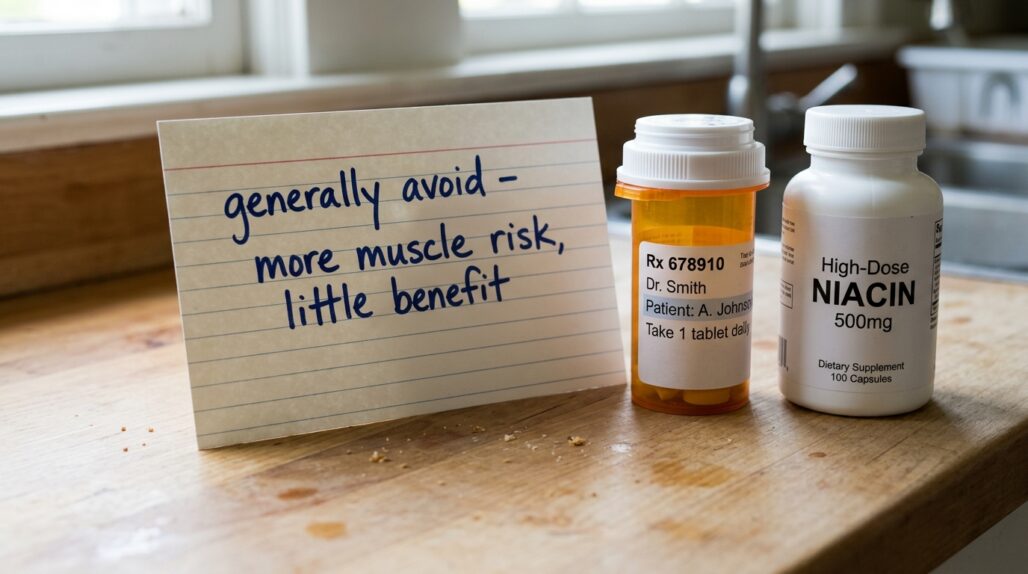
This article is general information, not medical advice. Your cholesterol numbers, your kidney and liver function, and the exact statin you take all change the math, so any decision about niacin belongs with your prescriber or pharmacist.
The people most likely to run into trouble are those taking high-dose niacin (1 gram or more per day) for cholesterol while also on a statin. That is very different from the small amount of vitamin B3 in a multivitamin or a balanced diet, which is not the concern here.
Older adults and anyone with kidney disease, diabetes, low thyroid, or a higher statin dose sit at the top of the risk list. If that is you, this is a conversation to have before you change anything.
What the niacin-statin interaction actually is
Niacin in cholesterol-lowering doses is nicotinic acid, and statins both lower LDL ("bad") cholesterol, but through different routes. The worry when they are combined is overlapping muscle toxicity.
Statins carry a small baseline risk of myopathy – muscle pain or weakness tied to muscle-cell breakdown. In rare cases this escalates to rhabdomyolysis, where damaged muscle releases its contents into the blood and can injure the kidneys.
US statin labeling specifically flags that myopathy risk rises when a statin is combined with lipid-altering doses of niacin (1 g/day or more). The FDA-approved prescribing information for statins lists concurrent niacin among the drugs that increase this risk and advises monitoring for muscle symptoms, a point echoed in the NIH Office of Dietary Supplements niacin fact sheet.
The signal traces back to early case reports of severe myopathy and rhabdomyolysis when niacin was layered onto statin therapy. The absolute risk in controlled studies has been low, but it is real enough to appear on the label, which is why self-stacking is discouraged.
How big is the muscle risk, really?
Be careful not to read this as "niacin will destroy your muscles." For most patients the added risk is modest. The problem is that the upside is largely missing, so even a modest extra risk tips the balance the wrong way.
In the HPS2-THRIVE trial of 25,673 high-risk patients, adding extended-release niacin (with laropiprant) to statin therapy produced more serious adverse events, including excess muscle-related problems, infections, and bleeding, as reported in the European Heart Journal write-up of the trial's muscle and liver outcomes.
So the muscle question is not just "is it dangerous." It is "why accept any extra muscle risk for a drug that did not improve outcomes." That framing matters more than a single percentage.
The trials that changed the advice
Niacin looks good on paper. It raises HDL ("good") cholesterol and lowers triglycerides, and for years that was reason enough to add it to a statin. Then two large randomized trials tested whether those lab improvements translated into fewer heart attacks and strokes.
AIM-HIGH added extended-release niacin to statin therapy in patients with established cardiovascular disease and low HDL. It was stopped early because the niacin arm showed no reduction in cardiovascular events despite the expected lipid improvements, as detailed in the AIM-HIGH analysis in JACC.
HPS2-THRIVE was larger and arrived at the same place. Adding niacin/laropiprant to a statin did not lower the rate of major vascular events, with a hazard ratio of 0.96 (95% CI 0.90 to 1.03) reported in the New England Journal of Medicine results paper. Worse, it added side effects.
The takeaway from both trials is consistent: better lipid numbers did not mean fewer events when niacin was the lever. That is why current practice moved away from niacin as a routine statin add-on.

Where guidelines landed
The shift is now baked into the major recommendations. The 2018 AHA/ACC multisociety cholesterol guideline does not endorse niacin as an add-on to statin therapy, citing the lack of outcome benefit in randomized trials.
When a statin alone is not enough, the same guideline points toward ezetimibe as a reasonable next step, with PCSK9 inhibitors reserved for higher-risk cases. Niacin is not on that ladder for most people.
That is the practical bottom line: the question is not really "is niacin safe with my statin" but "is there a better, proven option" – and usually there is.
The niacin form confusion (flush vs no-flush)
If you are shopping the supplement aisle, the labels are genuinely confusing, and the confusion can lead people to the wrong product entirely.
- Nicotinic acid is the cholesterol-active form. It is the one that causes the classic warm, itchy "niacin flush" and the one studied in the trials above.
- Nicotinamide (niacinamide) does not flush and does not lower cholesterol in a meaningful way. It is a different tool for different jobs.
- "No-flush" niacin (inositol hexanicotinate) releases very little active nicotinic acid, so it largely avoids the flush but also largely avoids the cholesterol effect.
This matters because someone trying to "support cholesterol" might grab a no-flush bottle expecting a benefit it does not deliver. The forms are summarized in the NIH Office of Dietary Supplements niacin fact sheet.
The honest framing: the only niacin form that does much for cholesterol is the one that flushes and carries the muscle and liver cautions discussed here.

Liver risk, and why "sustained-release" is the wrong shortcut
People often reach for sustained-release or "timed-release" niacin to dodge the flush. That trade is a problem for the liver.
Sustained-release niacin is more strongly tied to liver injury than the immediate-release or prescription extended-release forms. The processing pathway that smooths out the flush also shifts metabolism in a way that can stress the liver, as explained in the NIH LiverTox review of niacin.
Liver-enzyme elevations are usually mild and reversible, but they climb with dose, and reports cluster at intakes above 3 grams per day. Layering that on a statin, which has its own liver-monitoring story, is exactly the kind of self-experiment to avoid.
If a niacin product is ever appropriate for you, the form, the dose, and the monitoring schedule are clinical decisions, not a guess at the pharmacy shelf.
What to do instead
Start by not changing your statin or adding niacin on your own. Then bring the real goal – lower cardiovascular risk, not a prettier lab printout – to the person managing your prescriptions.
| Lever | What it targets | Why it is preferred over niacin |
|---|---|---|
| Statin optimization | LDL cholesterol | Dose or drug adjustment has the strongest outcome evidence; first thing to revisit. |
| Ezetimibe add-on | LDL cholesterol | Guideline-endorsed next step when a statin alone falls short; no flush, no niacin liver concern. |
| Diet and activity | Overall lipid profile and risk | Foundational, low-risk, and compounds the effect of any medication. |
| High-dose niacin | HDL and triglycerides | Not preferred – trials showed no event benefit and added muscle and liver risk. |
If you want to keep your supplement and prescription list straight so you can hand it to your pharmacist, a tracking app like StackMyMed can help you log and flag a stack for review. It is a prompt for a professional conversation, not a substitute for clinical judgment.
For the bigger picture, our guide to supplements people consider for high cholesterol covers what the evidence does and does not support, and our ultimate drug and supplement interactions hub maps the common medication conflicts.
When to call a clinician now
Some symptoms should not wait for your next routine visit. Stop and call your prescriber or seek urgent care if you develop unexplained muscle pain, tenderness, or weakness, especially if it spreads or comes with fever or dark, cola-colored urine.
Also flag yellowing of the skin or eyes, severe fatigue, or persistent nausea and right-upper-abdomen pain, which can signal a liver problem. These are reasons to act, not to tough it out.
If you take a statin and are even considering niacin, run it past your pharmacist first. Checking related conflicts in our drug and supplement interaction checker is a reasonable starting point before that conversation.
FAQ
Can I take a multivitamin with niacin while on a statin? The small amount of B3 in a standard multivitamin is not the concern. The interaction is about high-dose cholesterol-level niacin, typically 1 gram a day or more.
Does no-flush niacin avoid the statin interaction? No-flush niacin (inositol hexanicotinate) releases very little active nicotinic acid, so it is unlikely to lower cholesterol much in the first place – and any niacin you add still belongs in a conversation with your prescriber.
Why did doctors used to recommend niacin with statins? Niacin improves HDL and triglyceride numbers, which looked promising. The AIM-HIGH and HPS2-THRIVE trials later showed those lab gains did not translate into fewer heart attacks or strokes.
What should I take instead to lower cholesterol further? That is a prescriber decision, but guidelines generally favor optimizing the statin first and adding ezetimibe before considering older options like niacin. Read more in our guide to supplements for high cholesterol.
Is the muscle risk the same for everyone? No. Older adults and people with kidney disease, diabetes, low thyroid, or higher statin doses appear to be at greater risk, which is why individual review matters.
What about red yeast rice instead of niacin? Red yeast rice contains a statin-like compound and brings its own overlap concerns, so it is not a free pass for someone already taking a statin.
Conclusion: skip the self-stack, ask about better levers
The case against routinely adding niacin to a statin is not dramatic toxicity – it is a poor trade. You take on extra muscle and liver risk for a combination that two large trials showed did not reduce cardiovascular events.
If your cholesterol is not where it needs to be, the productive move is a conversation with your prescriber about optimizing the statin or adding a proven agent like ezetimibe, not a high-dose niacin bottle from the supplement aisle. Keep your full list handy and bring it to that visit.
This article is for general education and does not replace personalized advice from your doctor or pharmacist. Do not start, stop, or change any medication or supplement based on what you read here.
Reviewed by the UsefulVitamins Editorial Team.
