
If you're on semaglutide or tirzepatide and your energy has been cratering despite the weight loss going as planned, iron deficiency is worth moving higher on your checklist. The short answer: GLP-1 medications create a real but under-discussed anemia risk, particularly in pre-menopausal women, and the right supplement depends entirely on what your labs show and how sensitive your gut already is. This article breaks down why appetite suppression becomes an iron supply problem, which form suits GLP-1 users (and which one piles additional constipation onto the side effects you're already managing), and how to read a label so the "200 mg" on the bottle doesn't mislead you. You'll also get a comparison table, five picks with honest trade-offs, and one category to skip outright.
Affiliate disclosure: this article contains affiliate links. As an Amazon Associate, UsefulVitamins.com earns from qualifying purchases at no extra cost to you.
Iron supplementation without lab confirmation is a bad idea — too much iron causes constipation, oxidative stress, and worsens the GI issues GLP-1 users are already managing. Get serum ferritin and transferrin saturation tested first.
Quick answer: best iron supplement for GLP-1 users
Top Pick: Thorne Iron Bisglycinate. NSF-certified, 25 mg elemental per capsule, gentle enough for a GI system already under GLP-1 pressure.
Best for: Adults with documented iron deficiency (serum ferritin below 30 ng/mL or TSAT below 20%) who want the gentlest effective form at a clinical dose.
Not ideal for: Anyone without lab-confirmed deficiency. Also not appropriate for hemochromatosis, iron overload, or CKD without prescriber guidance.
Decision shortcut: GLP-1 GI sensitivity + documented deficiency = bisglycinate. Budget = Solgar Gentle Iron (same form, lower price). Severe deficiency needing fast repletion = ask your prescriber about ferric maltol (Accrufer) before reaching for any OTC option.
Table of contents
- Why GLP-1 medications raise anemia risk
- Iron forms compared: what belongs in a GLP-1 user's stack
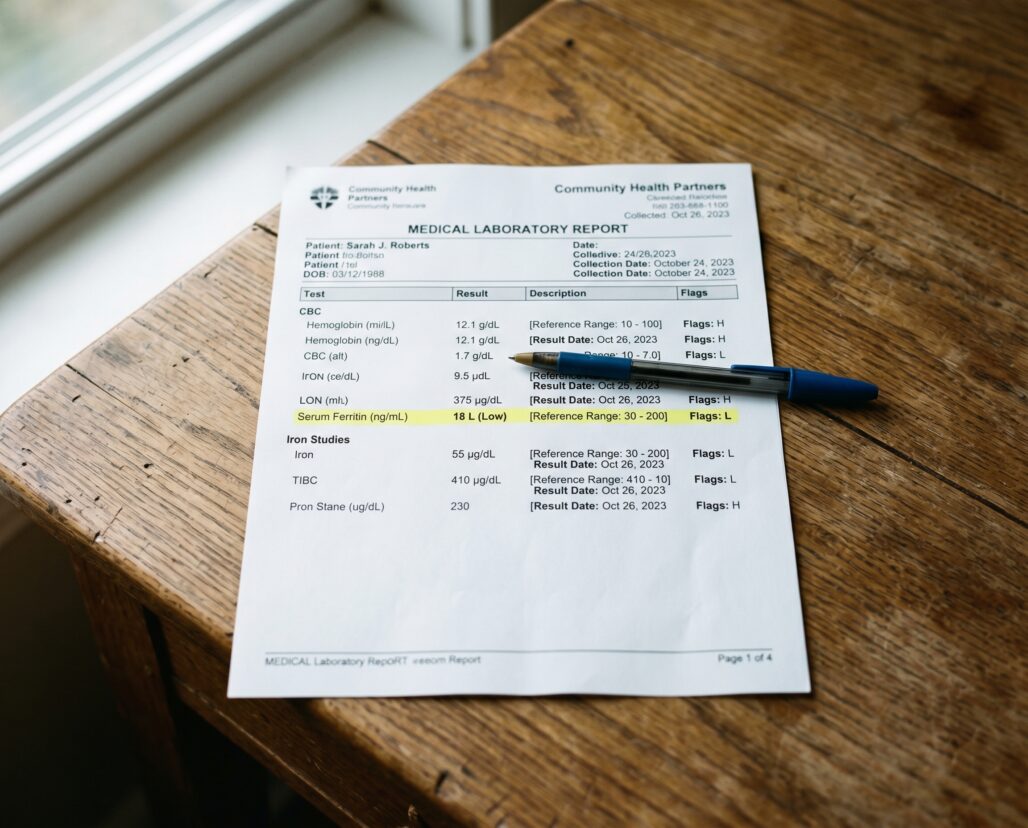
- Get tested first: the two numbers that matter
- How we picked
- Comparison table
- Product picks
- Products to skip
- How to use iron supplements on a GLP-1
- Side effects and interactions
- FAQ
- Related reading
Why GLP-1 medications raise anemia risk
GLP-1 receptor agonists work by suppressing appetite. That mechanism also cuts iron intake: red meat, fortified grains, and leafy greens all shrink when total food volume drops 20-35%. For pre-menopausal women — already running a monthly iron deficit from menstruation — a 6-12 month GLP-1 course can push ferritin below functional thresholds before symptoms appear. A 2023 analysis of semaglutide trial data also raised the possibility that rapid weight loss affects hepcidin signaling independently of dietary intake.
GLP-1 prescribers are increasingly running iron panels at 6-month intervals. If yours has not, it is worth asking. For a broader guide to what labs to track, see peptides and blood tests.
Iron forms compared: what belongs in a GLP-1 user's stack
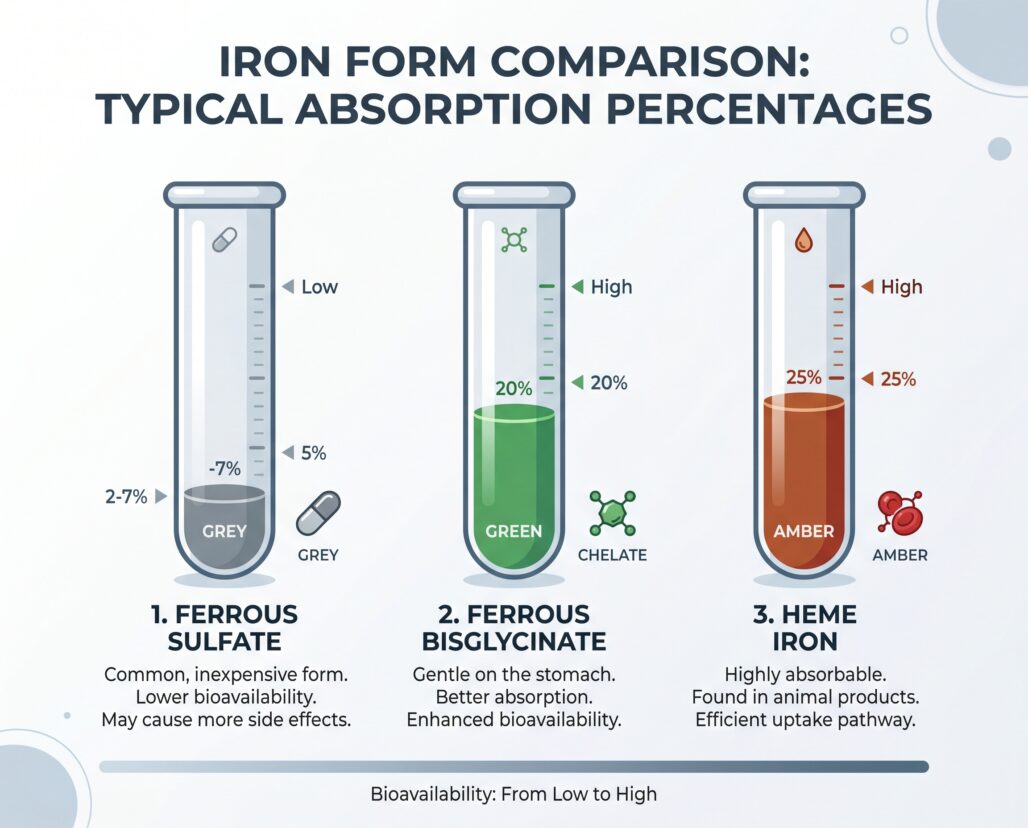
Think of the different iron forms like delivery trucks for the same cargo. They all eventually get elemental iron to your bloodstream, but the route and the GI toll along the way differ considerably.
Ferrous sulfate is the cheapest and most common generic form. It works, but causes constipation, nausea, and cramping in 20-40% of users. For GLP-1 users whose gut is already under pressure from slowed gastric emptying, that trade-off is rarely worth it.
Iron bisglycinate is the appropriate form for most GLP-1 users. Chelation reduces free iron in the intestinal lumen and improves mucosal uptake. A 2014 study in the European Journal of Clinical Nutrition found bisglycinate produced significantly fewer GI side effects than ferrous sulfate at equivalent elemental doses.
Heme iron (bovine or porcine sourced) has the highest bioavailability at 15-35%, and the highest price. Bisglycinate covers moderate deficiency at lower cost.
Ferric maltol (Accrufer, prescription) has strong tolerability data. Worth discussing with your prescriber if bisglycinate at standard doses is not moving ferritin after 8-12 weeks.
The label math problem
A bottle labeled "Ferrous Sulfate 325 mg" contains about 65 mg elemental iron — only 20% is the mineral you want. A bottle labeled "Iron Bisglycinate 27 mg" often already states the elemental dose. Check the Supplement Facts panel for "Iron (as ferrous bisglycinate)" and use that figure, not the compound weight on the front label.
Get tested first: the two numbers that matter
Iron supplementation without lab confirmation is a bad idea. Too much iron causes constipation, oxidative stress, and — in people with undetected hemochromatosis — serious organ damage over time. Ask your prescriber for:
- Serum ferritin — below 30 ng/mL signals deficiency; below 12 ng/mL is overt deficiency.
- Transferrin saturation (TSAT) — below 20% confirms functional deficiency even when ferritin looks borderline.
Ferritin is an acute-phase reactant: inflammation can elevate it and hide a real deficit. TSAT adds the context ferritin misses.
Actionable takeaway: Get the labs. Then buy the supplement.
How we picked
We reviewed 20+ products listed under "iron supplement" on Amazon with at least 500 reviews. Criteria: elemental iron stated explicitly on the Supplement Facts panel; form clearly named; third-party testing (NSF, USP, ConsumerLab, or practitioner-platform listing as quality proxy); cost per mg elemental iron; and GI tolerability based on form pharmacology. We did not conduct independent lab testing.
Comparison table
| Brand | Form | Elemental iron per dose | Vitamin C included | Cost/dose | GI tolerability | Best for |
|---|---|---|---|---|---|---|
| Thorne Iron Bisglycinate | Ferrous bisglycinate chelate | 25 mg | No | ~$0.40 | Excellent | Top Pick: GLP-1 GI sensitivity |
| Pure Encapsulations Iron C | Ferrous bisglycinate + 50 mg vit C | 25 mg | Yes | ~$0.55 | Excellent | Convenience: iron + C combined |
| MegaFood Blood Builder | Heme + food-based blend | ~26 mg | Yes (whole food) | ~$0.90 | Very good | Whole-food sourcing preference |
| Solgar Gentle Iron | Ferrous bisglycinate | 25 mg | No | ~$0.25 | Excellent | Budget bisglycinate pick |
| Floradix Iron + Herbs (liquid) | Ferrous gluconate | 10 mg | Yes (fruit-based) | ~$0.60 | Good | Swallowing difficulty; low-level repletion |
| Nature Made Iron 65 mg | Ferrous sulfate | 65 mg | No | ~$0.06 | Poor (constipation risk) | Skip for GLP-1 users |
Product picks
Top Pick: Thorne Iron Bisglycinate
Form: Ferrous bisglycinate chelate (25 mg elemental iron per capsule)
Best for: Most GLP-1 users with documented deficiency who want a clean bisglycinate at a standard repletion dose
Why we picked it: Thorne holds NSF Certified for Sport status, uses Ferrochel chelated bisglycinate (the chelation supplier cited in comparative tolerability literature), and states elemental iron on the label without conversion math. At 25 mg elemental per capsule, it lands within the 18-65 mg daily range appropriate for mild-to-moderate deficiency.
The trade-off: At roughly $0.40 per capsule it costs about 60% more than the Solgar option below. Both deliver the same bisglycinate molecule. You are paying for NSF batch-testing documentation, not a chemically superior compound.
Skip if: Budget is the primary constraint; Solgar Gentle Iron covers the same form for less. Also skip if deficiency is severe (ferritin under 12 ng/mL) — 25 mg elemental daily will be slow to replete at that level and a higher prescription dose may be warranted.
Actionable takeaway: Our default recommendation for GLP-1 users who want third-party assurance and the gentlest effective form.
Best convenience pick: Pure Encapsulations Iron C
Form: Ferrous bisglycinate chelate + 50 mg ascorbic acid (25 mg elemental iron per capsule)
Best for: GLP-1 users who want iron and vitamin C in one capsule
Why we picked it: Adding 50-100 mg ascorbic acid to iron increases non-heme absorption by roughly 67%, per a Nutrients (2020) meta-analysis. Pure Encapsulations bundles both in one NSF-certified capsule. "#1 best-seller on Amazon" should never be the only reason to buy — this earns its place for the formulation logic.
The trade-off: At $0.55 per dose it is the priciest capsule on this list.
Skip if: Your multivitamin already includes 50+ mg vitamin C. No point paying for a cofactor you already have covered.
Actionable takeaway: Best single-capsule option for GLP-1 users not already supplementing vitamin C.
Premium pick: MegaFood Blood Builder
Form: Ferrous bisglycinate + whole-food matrix (beet root, organic orange) (~26 mg elemental iron per 2-tablet serving)
Best for: GLP-1 users who prefer food-matrix sourcing; people with previous GI sensitivity to isolated iron forms
Why we picked it: MegaFood's food-state approach binds iron to a whole-food matrix (beet root, orange, broccoli), which some users tolerate even better than isolated bisglycinate. ConsumerLab testing confirmed the product met its label claims. Widely available on practitioner platforms.
The honest valuation: MegaFood Blood Builder costs roughly $0.90 per serving versus Solgar Gentle Iron at $0.25 — three-and-a-half times the price for the food matrix, without published head-to-head data showing faster repletion at that premium. If food-state genuinely improves your tolerability, the cost is defensible. If you just want effective bisglycinate, Solgar or Thorne deliver it for less.
Skip if: You want transparent isolated-form dosing; the food matrix complicates dose comparisons. Verify the current label if vegan.
Actionable takeaway: Best for people who want food-sourced iron and are willing to pay for it.
Budget pick: Solgar Gentle Iron
Form: Ferrous bisglycinate chelate (25 mg elemental iron per capsule)
Best for: Cost-sensitive buyers; people testing bisglycinate tolerability before committing to a premium brand
Why we picked it: Same 25 mg elemental bisglycinate as Thorne at roughly $0.25 per capsule — about 60% less. Solgar sources to USP ingredient standards and has a long retail track record. GI tolerability is equivalent to the top pick in practice.
The trade-off: No product-specific NSF or USP finished-product certification on this SKU. GMP manufacturing is a quality floor, not the same as batch-by-batch finished-capsule testing.
Skip if: The audit trail matters for a long-term daily supplement. Step up to Thorne if NSF verification is a requirement.
Actionable takeaway: The strongest value play in this roundup. Same molecule as the Top Pick, lower cost. Start here if budget is the primary constraint.
Best liquid pick: Floradix Iron + Herbs
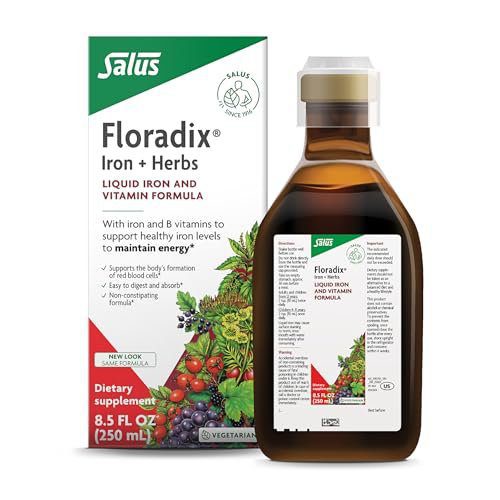
Form: Ferrous gluconate (liquid, 10 mg elemental iron per 10 ml serving)
Best for: GLP-1 users with swallowing difficulty during nausea phases; mild insufficiency maintenance
Why we picked it: Floradix combines ferrous gluconate with plant-based cofactors and vitamin C. The liquid format is genuinely useful when GLP-1-related nausea makes swallowing capsules difficult. At 10 mg elemental per serving, GI distress is uncommon even in sensitive users.
The constraint: Ten milligrams elemental is underpowered for correcting documented deficiency. Standard repletion protocols use 18-65 mg daily. Floradix is appropriate for mild insufficiency maintenance or as a bridge while waiting for labs — not for active repletion of confirmed deficiency.
Skip if: Ferritin is below 30 ng/mL and your prescriber wants repletion. This dose will not move the needle in that scenario.
Actionable takeaway: Sensible for people with swallowing difficulty or very mild insufficiency. Not a substitute for bisglycinate capsules when labs confirm deficiency.
Products to skip
Skip: High-dose ferrous sulfate for GLP-1 users (Nature Made Iron 65 mg)
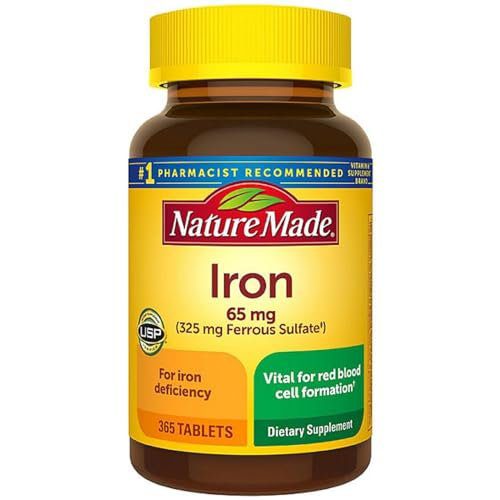
Nature Made is a credible brand with USP verification. The problem is the form and dose combination for this population. Ferrous sulfate causes constipation, nausea, and cramping in 20-40% of users. GLP-1 medications already slow gastric emptying and predispose users to constipation. Stacking ferrous sulfate on top is a poor call for almost every GLP-1 user, and 65 mg elemental without lab confirmation also carries unnecessary oxidative stress risk.
The honest move: Solgar Gentle Iron delivers 25 mg bisglycinate at $0.25 per capsule. The GI improvement for a few extra cents is not a hard call.
Skip: Any iron product that omits the form from the label
If a label says "Iron 18 mg" without naming the salt (sulfate, bisglycinate, gluconate, or fumarate), you cannot predict GI tolerability or compare bioavailability. There is no legitimate reason to hide the form. Skip it.
How to use iron supplements on a GLP-1
Timing: Empty stomach when possible — absorption is higher. If GLP-1-related nausea makes fasted iron difficult, take with a small meal excluding dairy, coffee, and tea, which suppress non-heme absorption.
Vitamin C pairing: If your supplement does not include vitamin C, pair it with 50-100 mg ascorbic acid simultaneously. Vitamin C converts ferric to ferrous iron in the stomach, significantly improving uptake.
Separation from other supplements: Two hours minimum between iron and calcium, antacids, magnesium, or zinc — all compete for the same intestinal transporters. Check whether your multivitamin contains more than 200 mg calcium per serving. See best multivitamins for GLP-1 users for formulations built to avoid this conflict.
Duration: Most repletion protocols run 3-6 months. Recheck ferritin and TSAT at 8-12 weeks. Once ferritin normalizes, stop or reduce to dietary maintenance.
Side effects and interactions
GI effects: Constipation, nausea, cramping, and dark stools are all possible. Dark stools are expected and not a concern. Bisglycinate substantially reduces the first three compared to ferrous sulfate.
Iron overload: Hemochromatosis affects roughly 1 in 200-300 people of Northern European descent. In undetected carriers, self-supplementing without testing can accumulate to organ-damaging levels.
Key drug interactions:
- Levothyroxine: iron reduces absorption significantly; separate by at least four hours
- Quinolone and tetracycline antibiotics: iron chelates these in the gut; separate by two to three hours
- PPIs: reduce gastric acid and impair non-heme absorption; bisglycinate is less affected than ferrous sulfate
For a broader picture of monitoring and stacking on GLP-1 therapy, see supplements for GLP-1 muscle loss.
FAQ
Do I need to get tested before taking iron?
Yes. Without labs, you don't know the right dose or duration if deficient, and if you're not deficient you risk constipation, oxidative stress, and iron overload. Serum ferritin and TSAT are a straightforward add to any blood panel.
How much elemental iron should I take per day?
The adult RDA is 8 mg (men) to 18 mg (pre-menopausal women). Deficiency repletion protocols use 18-65 mg elemental daily. Most OTC bisglycinate products deliver 25 mg per capsule — one daily at the lower repletion range, two if your prescriber recommends higher.
How long before ferritin improves?
At 25-50 mg elemental bisglycinate daily, ferritin typically rises measurably within 8-12 weeks. Fatigue often improves before labs fully normalize.
Can I take iron alongside my GLP-1 multivitamin?
Check for calcium. If the multivitamin contains more than 200 mg per serving, separate the two by at least two hours. For another micronutrient worth testing at the same time, see best B complex for GLP-1 users.
Is bisglycinate as effective as ferrous sulfate at correcting deficiency?
At equivalent elemental doses, repletion speed is comparable. The meaningful difference is the GI side-effect burden, which is substantially lower for bisglycinate. Ferrous sulfate dominates pharmacy shelves because of cost, not clinical superiority.
As an Amazon Associate, I earn from qualifying purchases. Product recommendations are based on real reviews and independent research.
Related reading
- Peptides and blood tests: what to track on Wegovy or Zepbound — parent guide for lab monitoring on GLP-1 therapy
- Best multivitamins for GLP-1 users — covering multiple micronutrient gaps in one daily pill
- Best B complex for GLP-1 users — B12 and folate are often low alongside iron in GLP-1 users
- Supplements for GLP-1 muscle loss — the broader micronutrient and protein picture
Conclusion: the bottom line on iron supplements for GLP-1 users
GLP-1 medications create a real iron deficiency risk through reduced food intake. Pre-menopausal women are most exposed. Iron supplementation without lab confirmation is still a bad idea — too much iron is as problematic as too little. Get serum ferritin and transferrin saturation before buying.
If labs confirm deficiency: bisglycinate is the right form for most GLP-1 users. It sidesteps the GI distress that makes ferrous sulfate a poor fit for anyone whose gut is already under pressure. Thorne Iron Bisglycinate for NSF-verified quality; Solgar Gentle Iron for the same molecule at lower cost; Pure Encapsulations Iron C if you want the vitamin C pairing in one capsule. More forms in one capsule does not automatically mean better repletion.
Next steps:
- Request serum ferritin and transferrin saturation before starting iron
- Flag interacting medications (levothyroxine, antibiotics, PPIs) with your pharmacist
- Start at 25 mg elemental bisglycinate daily with vitamin C, separated from calcium and dairy
- Recheck ferritin at 8-12 weeks; stop or reduce to maintenance once it normalizes
This article is for informational purposes and not medical advice. Peptides — especially those marketed for therapeutic use — can interact with medications and health conditions. Consult a licensed physician before starting any supplement, particularly if you are pregnant, nursing, taking prescription medications, or managing a chronic condition.
As an Amazon Associate, I earn from qualifying purchases. Product recommendations are based on real reviews and independent research.
