
If you're on semaglutide, tirzepatide, or another GLP-1 agonist and wondering whether your regular multivitamin still covers you, the honest answer is: probably not, if your appetite is significantly suppressed. A standard multivitamin is calibrated for someone eating 2,000+ calories a day. Eat 1,200 calories and skip breakfast, and that same pill covers partial micronutrient ground at best. This article breaks down which multivitamins are formulated for reduced-appetite conditions, why active B-vitamin forms matter for roughly 30% of users (MTHFR variants), and when iron-free vs. iron-included deserves more thought than most people give it. You'll also get a straight answer on AG1 and the $99/month question.
Affiliate disclosure: this article contains affiliate links. As an Amazon Associate, UsefulVitamins.com earns from qualifying purchases at no extra cost to you.
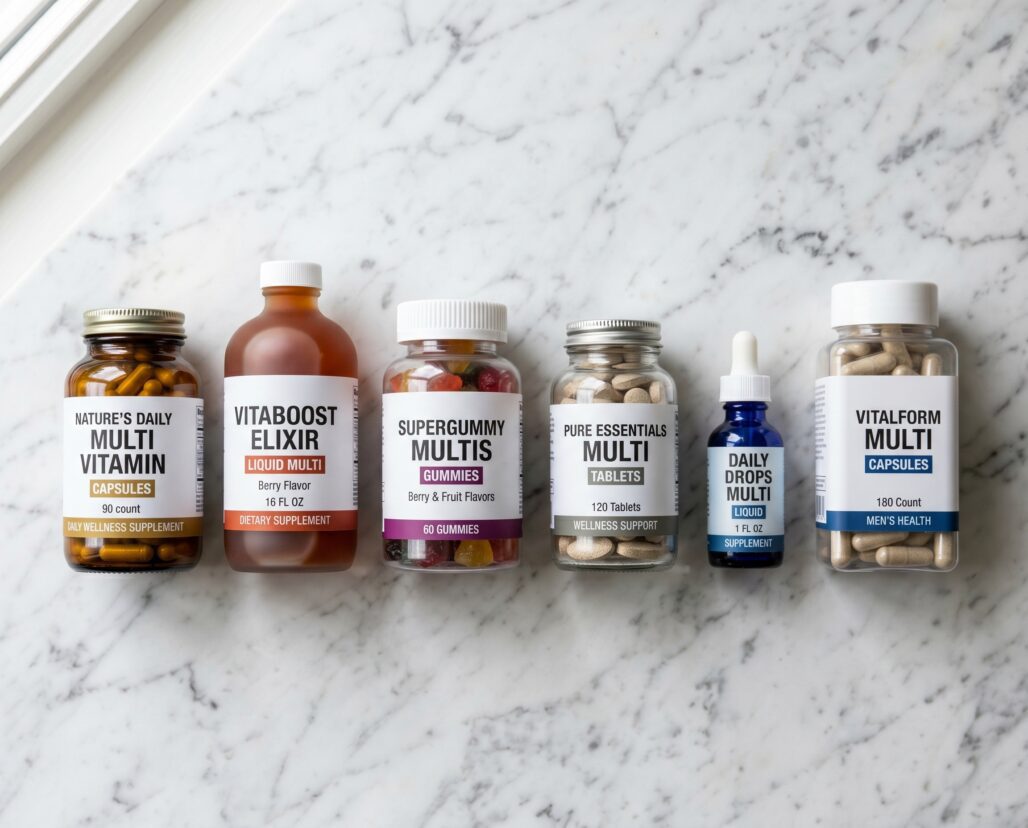
Quick answer: best multivitamin for GLP-1 users
Top Pick: Bariatric Advantage Ultra Solo — formulated for reduced-absorption, reduced-appetite conditions, iron-free and iron-included SKUs available.
Best for: Adults eating under 1,400 calories/day on GLP-1, post-bariatric surgery patients on GLP-1, documented B12 or folate gaps.
Not ideal for: Mild appetite suppression where diet is still varied; budget-only buyers (better value exists at half the price).
Decision shortcut: Mild suppression with a decent diet = Pure Encapsulations O.N.E. or Garden of Life Vitamin Code. Significant appetite reduction or more than 10% body weight lost = bariatric-adapted picks.
Table of contents
- Who this is for
- How we picked
- Comparison table
- The picks
- Brands to skip
- Why reduced appetite changes your micronutrient math
- Active vs. inactive B-vitamin forms
- Iron included or iron-free: how to choose
- FAQ
Who this is for {#who-this-is-for}
GLP-1 medications reduce appetite significantly — in clinical trials, weekly semaglutide reduced energy intake by 35% on average (Blundell et al., 2017, n=30). Most standard multivitamins assume a full-calorie diet. They're designed to fill gaps, not carry the full load.
Strong fit:
- Adults on GLP-1 therapy with noticeably reduced appetite for more than 4 weeks
- People who lost more than 8-10% body weight in six months on GLP-1 (micronutrient depletion risk — see how GLP-1 drugs affect muscle loss)
- Post-bariatric surgery patients who are also on GLP-1 (double-reduced absorption)
- People with confirmed or suspected MTHFR variants (~30% of US adults)
Skip this article if: Your appetite suppression is mild and you're still eating 1,600+ calories of varied whole foods. Or if you want the cheapest option on Amazon without further thought — scroll directly to the budget pick.
How we picked {#how-we-picked}
We filtered multivitamins on five criteria: active B-vitamin forms (methylfolate and methylcobalamin over folic acid and cyanocobalamin); dose-per-capsule density for reduced-stomach-tolerance; third-party testing or NSF/USP certification; iron-free and iron-included SKU availability; and cost-per-day relative to actual value. Cross-referenced with Fullscript practitioner formulary notes where available. We did not run lab tests ourselves.
Comparison table {#comparison-table}
| Brand | Form | Active B forms | Iron included | Cost/day | Bariatric-adapted | Best for |
|---|---|---|---|---|---|---|
| Bariatric Advantage Ultra Solo | Capsule | Yes | Both SKUs | ~$1.10 | Yes | Significant appetite suppression |
| Pure Encapsulations O.N.E. | Capsule (1/day) | Yes | No | ~$0.85 | Partial | Quality-conscious, moderate suppression |
| Thorne Basic Nutrients 2/Day | Capsule (2/day) | Yes | No | ~$0.80 | Partial | Stacking athletes, high quality floor |
| Garden of Life Vitamin Code | Capsule (4/day) | Yes | Both SKUs | ~$0.55 | No | Budget-conscious, food-based forms |
| Ritual Essential Women 18+ | Capsule (2/day) | Yes (folate only) | No | ~$1.00 | No | Women wanting clean-label minimalism |
| Bariatric Advantage Chewable | Chewable tablet | Yes | Both SKUs | ~$0.90 | Yes | Nausea, pill fatigue, GI sensitivity |
| Athletic Greens AG1 | Powder | Partial | No | ~$3.30 | No | Skip for this use case |
The picks {#the-picks}
Top Pick: Bariatric Advantage Ultra Solo Multi Capsule {#top-pick-bariatric-advantage-ultra-solo}
Form: Capsule, 1/day
Active B forms: Yes — methylfolate (5-MTHF), methylcobalamin, riboflavin-5-phosphate
Iron SKUs: Iron-free and iron-included versions sold separately
Cost/day: ~$1.10
Why we picked it: Built for post-bariatric patients whose absorption and appetite are both compromised — the closest parallel to GLP-1-driven calorie restriction. The formula packs 500 mcg methylcobalamin, 1,000 mcg 5-MTHF, and elevated zinc into one capsule because the intended user can't compensate with food volume. Iron decision handled by separate SKUs, so you pick the right version rather than guessing.
The trade-off: At ~$1.10/day it's not cheap. The packaging leans clinical. But the nutrient engineering is the point, not the aesthetics.
Who should skip: Users with only mild appetite suppression who still eat nutrient-dense meals. A standard multivitamin at half the price covers them adequately.
Actionable takeaway: If your GLP-1 dosage has meaningfully cut your appetite and you're eating fewer than three full meals a day consistently, this is the pick most directly calibrated to your situation.
Premium choice: Pure Encapsulations O.N.E. Multivitamin {#premium-choice-pure-encapsulations-one}
Form: Capsule, 1/day
Active B forms: Yes — methylfolate, methylcobalamin
Iron: Iron-free
Cost/day: ~$0.85
Why we picked it: Pure Encapsulations tests every production batch for identity, potency, and heavy metals through third-party labs and publishes results. The O.N.E. formula delivers one capsule per day with methylfolate and methylcobalamin, and it's widely stocked on Fullscript — the practitioner dispensary that carries only brands meeting clinical quality standards.
The trade-off: Iron-free only. Right for men and post-menopausal women, but not ideal for pre-menopausal women with heavy periods whose iron risk rises when food variety shrinks on GLP-1.
Who should skip: Pre-menopausal women needing iron coverage. Cost-sensitive buyers — Garden of Life gets you active B forms for ~35% less per day.
Actionable takeaway: The cleanest default for GLP-1 users who want practitioner-grade quality without bariatric-line clinical packaging.
Runner-up premium: Thorne Basic Nutrients 2/Day {#runner-up-premium-thorne-basic-nutrients-2day}
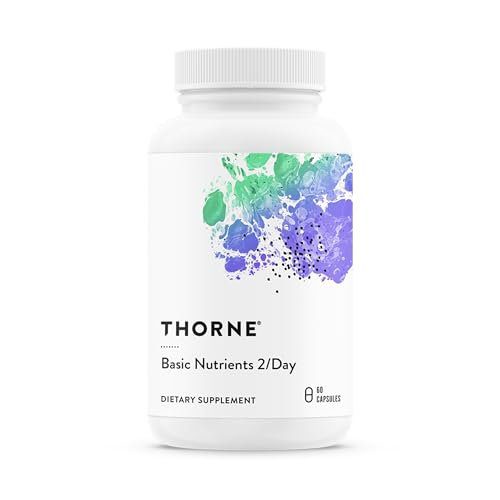
Form: Capsule, 2/day
Active B forms: Yes — 5-MTHF, methylcobalamin
Iron: Iron-free
Cost/day: ~$0.80
Why we picked it: Thorne has strong CGMP credentials and Basic Nutrients 2/Day covers a wide spectrum with 5-MTHF and methylcobalamin. The two-capsule split is slightly less per-capsule density than O.N.E. — gentler on the stomach on high-nausea days.
The trade-off: Second capsule gets skipped on bad nausea days. Iron-free only (same caveat as O.N.E.).
Who should skip: Significant pill fatigue or persistent nausea — use the chewable pick instead.
Actionable takeaway: Strong alternative if O.N.E. is unavailable or you're already in the Thorne ecosystem for other supplements.
Budget pick: Garden of Life Vitamin Code Men / Women {#budget-pick-garden-of-life-vitamin-code}
Form: Capsule, 4/day (can be split to 2/day)
Active B forms: Yes — folate from food sources and 5-MTHF blend
Iron: Women's formula includes iron; Men's is iron-free
Cost/day: ~$0.55 at 4/day, ~$0.28 at 2/day
Why we picked it: Pure Encapsulations O.N.E. costs ~$0.85/day. Garden of Life Vitamin Code delivers active B forms, food-cultured cofactors, and gender-specific formulations for ~$0.55/day at full dose. The active molecule chemistry is the same tier — you're not buying a worse vitamin, you're buying less brand assurance. Think of it like house-brand ibuprofen vs. Advil: same active ingredient, different marketing budget. NSF Certified for Sport on select SKUs.
The trade-off: Four capsules a day for full coverage; B12 dose (60 mcg) is lower than bariatric-adapted picks — documented B12 deficiency needs a separate supplement.
Who should skip: Anyone who can't reliably take 4 capsules daily — at 2/day you're underdosing. A 1/day option is better in that scenario.
Best for women (pre-menopausal): Ritual Essential for Women 18+ {#best-for-women-ritual-essential}
Form: Capsule, 2/day
Active B forms: Folate as 5-MTHF (yes); B12 as methylcobalamin (yes)
Iron: Not included
Cost/day: ~$1.00
Why we picked it: Ritual discloses every ingredient's supplier and country of origin — uncommon in this category. The 9-nutrient minimal formula suits GLP-1 users already stacking omega-3s or magnesium who want a B12 and folate foundation without redundant doses. The delayed-release capsule reduces the gastric hit on a near-empty stomach.
The trade-off: Minimal coverage means no selenium, iodine, or iron. Pre-menopausal women eating less on GLP-1 need iron from a separate source.
Who should skip: Anyone needing broad-spectrum coverage in one pill. Post-menopausal women and men get better density per dollar from the other options here.
Best for active GLP-1 nausea: Bariatric Advantage Chewable Multi {#best-for-nausea-bariatric-advantage-chewable}
Form: Chewable tablet, 2/day
Active B forms: Yes — methylfolate, methylcobalamin
Iron: Both iron-free and iron-included SKUs
Cost/day: ~$0.90
Why we picked it: During dose-escalation phases (typically weeks 4-12), GLP-1 nausea can make swallowing capsules genuinely difficult. Chewable tablets dissolve before hitting the stomach. Bariatric Advantage's chewable carries the same methylcobalamin and 5-MTHF chemistry as the capsule version with the same iron-free/iron-included SKU split.
The trade-off: Two tablets a day plus a small amount of sugar alcohol in the coating. Some people find the texture unpleasant long-term.
Who should skip: Users with no nausea or pill-tolerance issues. The Ultra Solo capsule version delivers slightly better per-capsule nutrition for people who can swallow without difficulty.
Actionable takeaway: The default choice during escalation phases or for anyone who consistently struggles with capsules on a near-empty stomach.
Brands and products to skip {#skip-these}
Skip: Athletic Greens AG1 {#skip-athletic-greens-ag1}
AG1 is $99/month for what's essentially a multivitamin bundled with a greens powder you could replicate at Costco for under $15. The quality floor isn't the problem — it includes methylcobalamin and some decent cofactors. The problem is the structure: AG1 is a greens-plus-multi blend, not a reduced-appetite-adapted multivitamin. Doses for key micronutrients are modest because they're diluted across 75 ingredients. For GLP-1 users needing concentrated coverage in a small serving, that design works against you. Use it for greens convenience if you already like it, but don't count it as your multivitamin strategy when your appetite is suppressed.
Skip: any gummy multivitamin
Gummy multivitamins are almost universally under-dosed. The matrix can't hold the same ingredient volume as capsules, so manufacturers cut doses to fit. ConsumerLab's gummy vitamin testing consistently finds gummy multis delivering 50-80% of label-claimed amounts. For GLP-1 users compressing their food intake, starting from an already-diluted format compounds the gap. Fine for people eating full diets; the wrong tool for this context.
Why reduced appetite changes your micronutrient math {#why-reduced-appetite-matters}
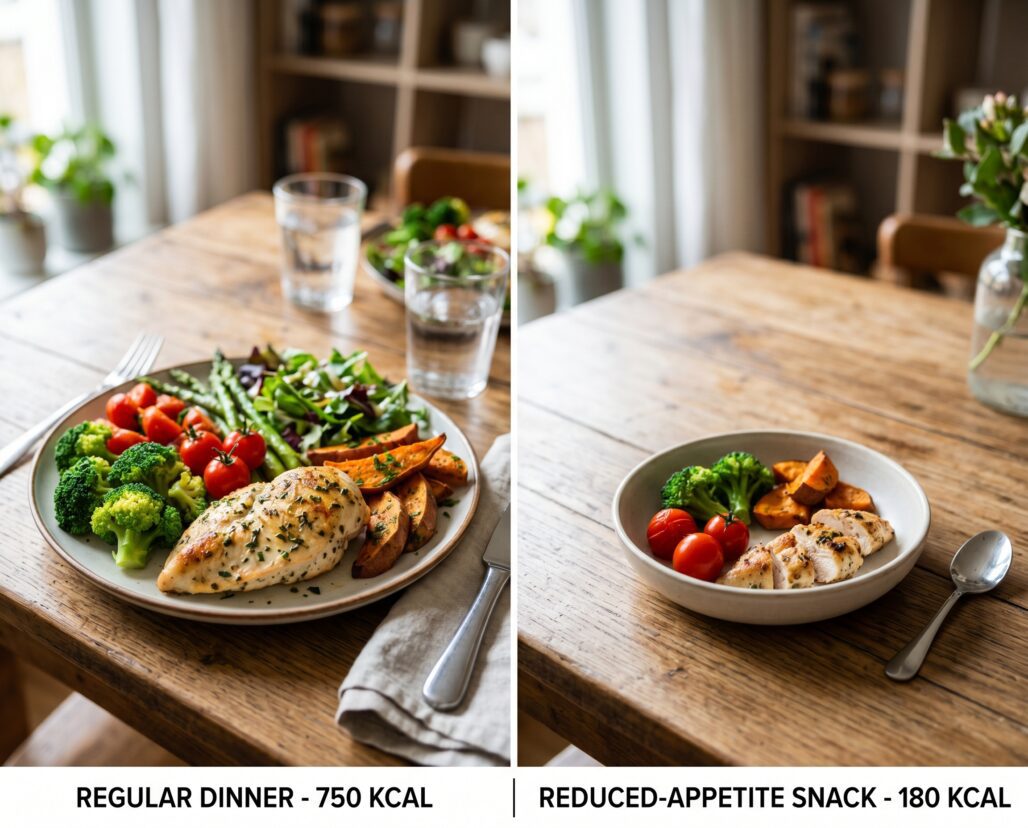
Think of micronutrient intake like filling a tank. Most people fill the tank 80% from food and use supplements to top off the remaining 20%. On GLP-1 therapy, food might cover only 50-55%. A supplement calibrated to add 20% now leaves you consistently short of where deficiency symptoms develop quietly.
The nutrients most likely to fall short are B12, folate, vitamin D, iron (in menstruating women), and zinc (Sherf-Dagan et al., 2021, Obesity Surgery). B12 is particularly vulnerable: GLP-1 drugs slow gastric emptying, which impairs intrinsic factor function and reduces cyanocobalamin absorption — the form in most standard multivitamins. Post-bariatric protocols, the closest evidence proxy, recommend 500 mcg methylcobalamin, 800-1,000 mcg 5-MTHF folate, and iron monitoring (Mechanick et al., 2020, Obesity).
Actionable takeaway: After three or more months on GLP-1, ask your provider for a micronutrient panel (B12, folate, vitamin D, ferritin, zinc). That data tells you where to focus. Without it, you're guessing.
Active vs. inactive B-vitamin forms {#active-b-forms}
Standard multivitamins use folic acid and cyanocobalamin — cheaper precursor forms sufficient for most people. For the ~30% of US adults with MTHFR variants (C677T or A1298C), however, the conversion from folic acid to active methylfolate is impaired (Wilcken et al., 2003, American Journal of Human Genetics). They absorb folic acid but can't fully activate it.
Methylfolate (5-MTHF) and methylcobalamin skip the conversion step. On GLP-1 with reduced food intake, you have less dietary folate and B12 to buffer any conversion inefficiency. Since methylfolate multivitamins at this quality tier cost the same as folic acid versions, there's no meaningful trade-off to accepting the less-active form.
Iron included or iron-free: how to choose {#iron-decision}
| User type | Iron recommendation |
|---|---|
| Men of any age | Iron-free |
| Post-menopausal women | Iron-free |
| Pre-menopausal women, normal periods | Iron-included |
| Pre-menopausal women on GLP-1, eating less | Iron-included + get ferritin checked |
| Hemochromatosis or elevated ferritin | Iron-free, non-negotiable |
The "multivitamin with iron for everyone" default is wrong for most men and post-menopausal women — excess iron causes oxidative stress and, in hemochromatosis, organ damage. For pre-menopausal women on GLP-1, reduced dietary iron from eating less meat and leafy greens can accelerate deficiency. The bariatric-adapted picks in this list offer both SKUs on the same formula — pick before you order.
FAQ {#faq}
How much B12 and folate do GLP-1 users need?
There's no GLP-1-specific RDA. The bariatric surgery guidelines recommend 500 mcg/day methylcobalamin, 800-1,000 mcg 5-MTHF, 3,000 IU vitamin D minimum, and iron monitoring in menstruating women (Mechanick et al., 2020). GLP-1 users eating 1,200-1,400 calories daily are in a comparable nutritional position.
When should I take my multivitamin on GLP-1 therapy?
With food, even a small snack. Fat-soluble vitamins (A, D, E, K) absorb better with dietary fat. On high-nausea days, the chewable format or taking the capsule alongside a few bites handles the near-empty-stomach problem better than nothing.
Is a premium brand worth the extra cost vs. a generic?
The molecule is the molecule — if the form and dose match, clinical outcomes don't differ. The premium buys third-party batch testing and supply-chain transparency. Worth it if you're managing a chronic condition. Less critical for otherwise healthy adults eating reasonably.
Do GLP-1 users need a separate B12 supplement?
Possibly. Bariatric Advantage picks provide 400-500 mcg methylcobalamin — likely sufficient. Standard premium multivitamins typically contain 100-150 mcg. If food intake has dropped significantly and gastric emptying is slowed, sublingual methylcobalamin (1,000 mcg, under $10/month) bypasses the intrinsic factor issue entirely.
As an Amazon Associate, I earn from qualifying purchases. Product recommendations are based on real reviews and independent research.
Conclusion: the bottom line on multivitamins for GLP-1 users
Standard multivitamins assume a full-calorie diet. If your appetite has dropped meaningfully on GLP-1 therapy, the bariatric-adapted picks (Bariatric Advantage Ultra Solo, Bariatric Advantage Chewable) are formulated for exactly this gap. For moderate suppression, Pure Encapsulations O.N.E. or Garden of Life Vitamin Code cover active B forms at different price points. Choose iron-free if you're male or post-menopausal; iron-included if pre-menopausal and eating less. AG1 at $99/month is a greens blend, not a reduced-appetite multivitamin strategy.
Next steps:
- Get a micronutrient panel (B12, vitamin D, ferritin, folate) if you've been on GLP-1 therapy more than 3 months
- Choose your iron SKU before purchasing — most brands don't default to the right version
- Read how GLP-1 drugs affect muscle mass — protein and creatine matter as much as micronutrient coverage for body composition on GLP-1 therapy
- If you're targeting individual nutrients, see best vitamin D for Wegovy and Zepbound users and best B-complex for GLP-1 users for standalone picks
This article is for informational purposes and not medical advice. Supplements — especially those taken alongside prescription medications like GLP-1 receptor agonists — can interact with medications and health conditions. Consult a licensed physician before starting any supplement, particularly if you are pregnant, nursing, taking prescription medications, or managing a chronic condition.
As an Amazon Associate, I earn from qualifying purchases. Product recommendations are based on real reviews and independent research.
