
If you're on semaglutide or tirzepatide and wondering whether your B-complex is still doing its job, the short answer is: for roughly one in three adults it probably isn't, and GLP-1 therapy adds two specific reasons the gap gets worse. This article names the six B-complex products worth your attention, explains why methylated forms matter more on a GLP-1 protocol than a standard multivitamin label suggests, and gives you the value math so you can decide whether a $0.45-per-dose methylated formula is worth it or whether NOW B-50 at $0.10 per dose closes the same gap. You'll also get a comparison table with B12 form, folate form, and cost-per-dose for every pick, plus one category to skip entirely.
Affiliate disclosure: this article contains affiliate links. As an Amazon Associate, UsefulVitamins.com earns from qualifying purchases at no extra cost to you.

TL;DR
Top Pick: Thorne B-Complex #6 earns the nod for most GLP-1 users. All active forms, modest doses without mega-dose B3, and a credible third-party testing record. Designs for Health B-Supreme is the premium step up if you want the most complete methylated stack available. NOW B-50 at roughly $0.10 per dose covers the basics if cost is the constraint, but its cyanocobalamin and folic acid forms are a real trade-off for the ~30% of adults with MTHFR variants. Skip any B-complex with mega-dose niacin (250 mg or more) while on GLP-1 therapy.
Table of contents
- Who this is for / who should skip it
- Why GLP-1 therapy raises B12 and folate risk
- Why the form of B12 and folate matters
- How we picked
- Comparison table
- Top Pick: Thorne B-Complex #6
- Premium choice: Designs for Health B-Supreme
- Budget pick: NOW Foods B-50
- Best for MTHFR variants: Pure Encapsulations B-Complex Plus
- Best food-source option: Garden of Life Vitamin Code Raw B-Complex
- Runner-up: Jarrow Formulas B-Right
- Skip these
- Dosing and how to use
- Side effects and interactions
- FAQ
Who this is for / who should skip it {#who-its-for}
Strong fit:
- Adults on semaglutide (Wegovy, Ozempic used off-label) or tirzepatide (Zepbound, Mounjaro) who are eating significantly less than before and haven't revisited their micronutrient intake since starting.
- Anyone who has tested low or borderline on serum B12, or whose physician has flagged homocysteine creeping upward.
- People who know or suspect they carry an MTHFR variant (common enough that roughly 30% of the U.S. adult population has at least one copy) and want insurance against folic acid conversion inefficiency.
- Vegans and vegetarians on GLP-1 therapy, who face a combined dietary and drug-mechanism pressure on B12.
Skip supplementing if:
- Your recent bloodwork shows B12 comfortably above 400 pg/mL and your diet includes regular animal protein. You may be fine, though retesting in six to twelve months during active weight loss is reasonable.
- You're already taking a high-quality multivitamin with methylated B forms at adequate doses. Adding a separate B-complex on top risks overshooting B6 (peripheral neuropathy risk at sustained high doses above 100 mg/day) without added benefit.
- You have an active B12-related diagnosis being managed by your physician. Supplement dosing for clinical deficiency needs medical supervision.
For the broader picture of which nutrients need monitoring during GLP-1-assisted weight loss, see peptides and blood tests: what to track on semaglutide and tirzepatide.
Why GLP-1 therapy raises B12 and folate risk {#why-glp1}
GLP-1 receptor agonists reduce appetite substantially. That is the mechanism you are paying for. The side effect nobody talks about in the first prescription visit is that sharply reduced calorie intake also reduces B-vitamin intake, and B12 in particular has an absorption route that GLP-1 therapy quietly disrupts on a second front.
B12 from food is bound to proteins. In the stomach, hydrochloric acid and an enzyme called pepsin release B12 from those proteins so it can bind to intrinsic factor and get absorbed in the small intestine. GLP-1 medications slow gastric emptying, which reduces the time food spends in the acid environment that performs this release step. Less time in acid means less B12 cleaved from food protein, which means less available for absorption downstream, even if you're still eating meat and eggs.
Think of gastric acid as the tool that cracks open a nut to get at the kernel. GLP-1 therapy doesn't take away the tool, but it shortens the time the nut spends in the cracker. You get less kernel per meal than you would otherwise.
Folate faces a different problem. Reduced appetite limits green vegetable intake, which is the dietary shortfall side. But for the roughly 30% of adults carrying MTHFR variants, there is an additional conversion failure: the folic acid form found in most standard supplements requires enzymatic conversion to L-5-methyltetrahydrofolate (5-MTHF) to become biologically active. People with common MTHFR variants cannot make this conversion efficiently. They can take folic acid consistently and still run low on active folate.
The practical upshot: on a GLP-1 protocol, a B-complex with active, pre-converted forms (methylcobalamin for B12, 5-MTHF for folate, pyridoxal-5-phosphate for B6) removes the conversion bottleneck that affects a meaningful slice of the population.
For a parallel look at why muscle and energy nutrients need attention during rapid weight loss, see supplements for GLP-1 muscle loss.
Why the form of B12 and folate matters {#why-form-matters}
Most B-complexes in the drugstore tier use cyanocobalamin for B12 and folic acid for folate. Both forms require conversion steps in the body to become the active metabolites that actually function in methylation, DNA synthesis, and homocysteine clearance.
For the majority of people with normal genetics, this conversion works fine. But it is an extra step that costs cellular resources. For the roughly 30% of adults with at least one MTHFR C677T or A1298C variant, the conversion of folic acid to 5-MTHF is specifically impaired. Taking folic acid supplementation does not reliably raise active folate levels in this population. A methylated formula bypasses that enzyme step entirely, delivering the pre-converted form the body can use directly.
The same logic applies, to a lesser degree, to B12. Cyanocobalamin is a synthetic form that the body converts to methylcobalamin and adenosylcobalamin. The conversion is adequate in most people but slower than supplementing with methylcobalamin directly. For GLP-1 users who may already be starting from a depleted baseline, the argument for the pre-converted form is reasonable rather than speculative.
The real question is not whether methylated forms are biologically superior in a controlled trial against a matched dose. They are, modestly. The question is whether the premium is worth it for you specifically. If you don't carry an MTHFR variant and your B12 is mid-range or above, the cyanocobalamin forms work. If you have documented suboptimal B12 or known MTHFR, the methylated forms are the correct choice and the price difference is small enough to be a non-issue.

How we picked {#how-we-picked}
We started with the most commonly recommended B-complexes across practitioner dispensaries (Fullscript, Wellevate), Amazon's top sellers with 500+ reviews, and brands that appear in clinical dietitian recommendations for GLP-1 patients. We filtered for: explicit statement of B12 form (methylcobalamin vs cyanocobalamin), explicit statement of folate form (5-MTHF vs folic acid), B12 dose in the 500-2500 mcg range suitable for repletion rather than cosmetic supplementation, B6 as pyridoxal-5-phosphate (P5P) where available, no mega-dose niacin (250 mg or above as flush niacin) given the blood pressure overlap, and third-party testing documentation. We cross-checked label claims against available certificates of analysis where accessible and excluded brands with vague sourcing on active vitamin forms.
Comparison table {#comparison-table}
| Brand | B12 form | Folate form | B6 form | Cost/dose | All methylated | Best for |
|---|---|---|---|---|---|---|
| Thorne B-Complex #6 | Methylcobalamin | 5-MTHF | P5P | $0.33 | Yes | Most GLP-1 users; clean default |
| Designs for Health B-Supreme | Methylcobalamin | 5-MTHF | P5P | $0.45 | Yes | Maximum methylation; MTHFR confirmed |
| Pure Encapsulations B-Complex Plus | Methylcobalamin | 5-MTHF | P5P | $0.45 | Yes | MTHFR; sensitive buyers; third-party verified |
| Garden of Life Vitamin Code Raw B | Methylcobalamin | Folate from food sources | Mixed | $0.50 | Mostly | Food-source preference; added probiotics |
| Jarrow Formulas B-Right | Methylcobalamin | 5-MTHF | P5P | $0.23 | Yes | Budget methylated; value compromise |
| NOW Foods B-50 | Cyanocobalamin | Folic acid | Pyridoxine HCl | $0.10 | No | Cost-sensitive; no MTHFR concern |
Cost per dose approximate based on standard retail pricing Q2 2026. Prices vary by retailer and purchase size.
Top Pick: Thorne B-Complex #6 {#top-pick}
B12 form: methylcobalamin (1 mg per capsule)
Folate form: L-5-methyltetrahydrofolate (5-MTHF), 400 mcg DFE
B6 form: pyridoxal-5-phosphate (P5P)
Best for: most GLP-1 users wanting a fully active formula at a reasonable price
Why we picked it: Thorne has one of the more credible third-party testing programs in the supplement industry. B-Complex #6 uses methylcobalamin rather than cyanocobalamin, 5-MTHF rather than folic acid, and keeps the niacin dose at 100 mg as niacinamide (the non-flush form), which matters for GLP-1 users who already run lower blood pressure on the medication. The dose is conservative enough to stay well under the B6 threshold at which peripheral neuropathy becomes a concern with long-term use (the tolerable upper limit for B6 is 100 mg/day; Thorne delivers 20 mg as P5P, leaving substantial headroom).
The trade-off: At $0.33 per dose it is not the cheapest option. It is also not as comprehensive as Designs for Health B-Supreme on some of the lesser-discussed B vitamins. But for the majority of GLP-1 users who want a defensible methylated formula without overthinking the stack, it hits the right combination of form, dose, and testing credibility.
Skip if: You need mega-dose B12 for active clinical deficiency (this product delivers 1 mg/capsule, which is appropriate for maintenance; clinical repletion sometimes requires higher doses under physician supervision). Also skip if you are extremely cost-sensitive, Jarrow B-Right is a viable methylated alternative at lower cost.
Actionable takeaway: The default pick. Start here unless you have a specific reason to step up to Designs for Health or step down to Jarrow.
Premium choice: Designs for Health B-Supreme {#premium}
B12 form: methylcobalamin (1 mg per capsule)
Folate form: 5-MTHF (Quatrefolic)
B6 form: pyridoxal-5-phosphate (P5P), plus additional B6 forms
Best for: people with confirmed MTHFR variants; practitioners' first recommendation; buyers who want the most complete active-form stack
Why we picked it: Designs for Health B-Supreme uses Quatrefolic, the most bioavailable patented form of 5-MTHF, and includes both methylcobalamin and adenosylcobalamin (the mitochondrial form of B12 that standard methylcobalamin formulas often omit). If you have confirmed MTHFR status or your homocysteine has been elevated on labs, this is the product most clinical practitioners reach for first.
The value comparison in plain math: NOW B-50 at $0.10 per dose vs Pure Encapsulations B-Complex Plus at $0.45 per dose and Designs for Health B-Supreme also at $0.45 per dose. That is a $10.50-per-month difference on a daily dose. What does the premium buy? Active pre-converted forms that bypass the MTHFR bottleneck, a Quatrefolic patented folate source with a published absorption record, and the adenosylcobalamin form of B12 that the budget options simply don't include. If you carry MTHFR variants, that premium is paying for a genuinely different biological outcome. If you don't, it is paying for thoroughness rather than a meaningfully different result.
Skip if: You don't have documented MTHFR or elevated homocysteine and your budget is a real constraint. Thorne B-Complex #6 at $0.33 per dose is the more practical choice for most people.
Actionable takeaway: The right call when your genetics or labs give you a specific reason. Otherwise, Thorne handles the job for less.
Budget pick: NOW Foods B-50 {#budget-pick}
B12 form: cyanocobalamin (100 mcg per tablet)
Folate form: folic acid (400 mcg)
B6 form: pyridoxine HCl
Best for: cost-sensitive buyers without MTHFR concern; short-term use while determining whether B-complex fits your protocol
Why we picked it: NOW Foods B-50 is third-party verified by Informed Sport and delivers all eight B vitamins in doses close to the RDA. At roughly $0.10 per dose, it is the most accessible entry point in the category. For the 70% of adults without MTHFR variants who are also eating reasonably and just want a reliable safety net for reduced B-vitamin intake on GLP-1 therapy, the cyanocobalamin and folic acid forms convert adequately.
The honest trade-off: NOW B-50 at $0.10 per dose vs Pure Encapsulations B-Complex Plus at $0.45 per dose. What does the premium buy? The premium buys methylated, pre-converted forms that require no enzymatic processing. If you carry an MTHFR variant, that conversion step is not happening reliably, and the folic acid in NOW B-50 may stack in unconverted form in the bloodstream rather than raising active folate levels. Unmetabolized folic acid has been flagged in research as a potential concern at high intakes, though the dose in a standard B-50 formula is far below the levels implicated in that literature.
Skip if: You know you carry an MTHFR variant, or you have had borderline B12 on labs. The cyanocobalamin-folic acid combination in this product requires conversion steps that may underperform in your specific biochemistry. A methylated formula costs $8-12 more per month and removes that uncertainty.
Actionable takeaway: Start here if you're not sure whether you'll take a B-complex consistently, or if your budget is tight. But regard it as a trial rather than a long-term GLP-1 protocol default, and consider upgrading once you've confirmed adherence.
Best for MTHFR variants: Pure Encapsulations B-Complex Plus {#mthfr}
B12 form: methylcobalamin (800 mcg per capsule)
Folate form: 5-MTHF (Metafolin), 400 mcg DFE
B6 form: pyridoxal-5-phosphate (P5P)
Best for: anyone with confirmed MTHFR; buyers who prioritize Pure Encapsulations' allergen-free, hypoallergenic manufacturing
Why we picked it: Pure Encapsulations is one of the most scrutinized brands in the practitioner channel. Every batch is tested for heavy metals, potency, and identity. B-Complex Plus uses Metafolin, a well-documented form of 5-MTHF with published absorption data in MTHFR-variant populations, and methylcobalamin at 800 mcg per capsule, which is a meaningful dose for someone who may have been running low for an extended period before testing.
A note on "recommended by physicians" as a buying signal: Pure Encapsulations is heavily marketed on its physician-recommendation rate, and it earns that reputation on quality. But "practitioner channel" should not be the only reason you choose a brand. The molecule you're buying, 5-MTHF and methylcobalamin, is the same as what Thorne and Designs for Health deliver. You are paying for Pure Encapsulations' allergen-free formulation, hypoallergenic capsule materials, and batch-by-batch third-party documentation. If those factors matter to your situation, the $0.45 per dose is justified. If they don't, Thorne at $0.33 per dose delivers the same active forms.
Skip if: You tolerate standard capsule fillers without issue and don't specifically need the allergen-free formulation. Thorne handles the same biochemistry at a lower price.
Actionable takeaway: The go-to for GLP-1 users who have documented MTHFR variants, multiple food sensitivities, or a prescriber who specifically recommends Pure Encapsulations products.
Best food-source option: Garden of Life Vitamin Code Raw B-Complex {#food-source}
B12 form: methylcobalamin (from cultured S. cerevisiae)
Folate form: food-source folate (from organic spinach and other greens, not synthetic folic acid)
B6 form: mixed food-source forms
Best for: buyers who prefer whole-food-based supplementation; vegans who want added probiotics and enzymes
Why we picked it: Garden of Life Vitamin Code Raw B-Complex is the only food-source B-complex in this roundup. The vitamins come from a Saccharomyces cerevisiae culture that concentrates them from raw food ingredients, which means the folate arrives as naturally occurring food-matrix folate rather than synthetic folic acid. For buyers who philosophically prefer food-sourced supplements over isolated synthetic forms, this is the credible option in the category.
The trade-off: "Food-source" sounds like an unconditional upgrade but requires a clearer-eyed look. The folate form is not a standardized 5-MTHF dose; the actual folate delivered varies with the food-culture matrix. For someone with confirmed MTHFR who needs reliable 5-MTHF dosing, a standardized methylated formula (Thorne, Pure Encapsulations, Designs for Health) gives you more certainty on the active form per capsule. Garden of Life is a reasonable choice for people who prefer whole-food complexity and don't have a documented conversion problem.
Skip if: You need a guaranteed, standardized 5-MTHF dose for MTHFR management. The food-source form is not the same as a calibrated synthetic 5-MTHF at a stated dose.
Actionable takeaway: A sound pick for vegans and whole-food supplement preferences with added probiotics and digestive enzymes. Not the first choice when precise folate dosing matters.
Runner-up: Jarrow Formulas B-Right {#jarrow}
B12 form: methylcobalamin (1 mg per capsule)
Folate form: 5-MTHF (Quatrefolic)
B6 form: pyridoxal-5-phosphate (P5P)
Best for: cost-sensitive buyers who still want a methylated formula; good middle-ground option
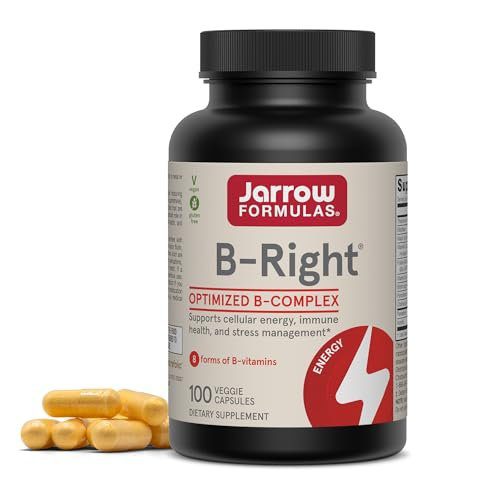
Why we picked it: Jarrow B-Right is the least expensive fully methylated B-complex we reviewed at roughly $0.23 per dose. It uses Quatrefolic 5-MTHF (the same patented form as Designs for Health B-Supreme), methylcobalamin at 1 mg, and P5P for B6. For a GLP-1 user who wants pre-converted forms without paying Pure Encapsulations or Thorne prices, this is the practical compromise.
The trade-off: Jarrow's third-party testing record is less publicly documented than Thorne or Pure Encapsulations. ConsumerLab has tested Jarrow products in adjacent categories and found them generally accurate to label, but batch-by-batch transparency is not at the same level as the premium brands. If you want the active forms and can accept a slightly lower degree of external QA verification, B-Right delivers. If third-party documentation matters as much as form, Thorne at $0.33 per dose is the step up worth taking.
Skip if: You prioritize maximum third-party verification over cost savings. Thorne is only $0.10 more per day for a more documented testing program.
Actionable takeaway: The methylated pick for price-constrained buyers. Adequate for most GLP-1 users who want active forms without the premium brand markup.
Brands and products to skip {#skip-these}
Skip: any B-complex with flush niacin above 100 mg
GLP-1 receptor agonists lower blood pressure as a secondary effect in many users, particularly at higher doses. Niacin (nicotinic acid, the flush form of B3) dilates blood vessels and can cause a pronounced flushing response alongside an acute drop in blood pressure. In a GLP-1 user who is already running lower blood pressure or experiencing lightheadedness during dose escalation, high-dose niacin can compound that effect uncomfortably. Several B-complex products on the market include 250-500 mg of niacin per dose, framed as cardiovascular support. That framing may be legitimate in other contexts, but on a GLP-1 protocol with active appetite suppression and possible reduced caloric intake, it is an unnecessary variable. Stick to niacinamide or inositol hexanicotinate forms, or niacin doses below 100 mg.
Skip: B12-only sublingual sprays marketed as complete B-complex alternatives
Sublingual B12 is a legitimate delivery route for B12 specifically, and it sidesteps the gastric acid absorption issue entirely. But several brands market high-dose sublingual B12 sprays as a complete B-complex solution for GLP-1 users, which they are not. B12 deficiency is one risk; folate, B6, and B1 (thiamine) are independent concerns on a reduced-calorie protocol. A sublingual B12 product addresses one part of the gap. If your physician has specifically flagged isolated B12 deficiency confirmed by labs, sublingual B12 is a reasonable targeted intervention. If you're supplementing as a precaution against the broad micronutrient risk of GLP-1-assisted caloric restriction, a complete B-complex is the more appropriate tool.
Dosing and how to use {#dosing}
Daily target ranges for GLP-1 users
For most adults using a B-complex as a precautionary measure during GLP-1-assisted weight loss, standard-dose formulas are appropriate:
- B12: 500-1000 mcg daily for maintenance. If labs show serum B12 below 300 pg/mL, discuss higher doses (1000-2500 mcg) with your prescriber; clinical repletion often requires higher doses and possibly monitoring.
- Folate: 400-800 mcg DFE (dietary folate equivalents) per day. Women of childbearing age should be at the higher end regardless of GLP-1 status.
- B6: 10-25 mg as P5P is the relevant range for active supplementation. Do not exceed 100 mg per day from all sources combined for extended periods; the tolerable upper limit for B6 is set at 100 mg/day in adults due to peripheral neuropathy risk at sustained higher doses.
- B1 (thiamine): 1.1-1.2 mg is the RDA; most B-50 type formulas deliver 50 mg, which is well above need but not harmful.
Timing and food interactions
Take your B-complex with food. B vitamins are water-soluble, and taking them on an empty stomach can cause nausea in GLP-1 users who are already sensitive. Morning with breakfast, or whenever your largest meal falls, is the most practical anchor.
B12 and folate have no clinically meaningful food interactions at supplement doses. B6 can reduce the effectiveness of certain seizure medications (levodopa, phenobarbital); if you're on any neurological medications, flag the B-complex with your prescriber before starting.
When to expect results
B-vitamin levels normalize gradually. If you start from a mild deficiency, most practitioners expect serum B12 to climb toward normal range within six to twelve weeks of consistent supplementation. Symptomatic improvement (fatigue, brain fog associated with B12 low-normal range) tends to appear on a similar timeline. Testing B12 at your next routine lab draw is the most straightforward way to confirm.
Side effects and interactions {#side-effects}
GI side effects
Water-soluble B vitamins are generally well tolerated. The most common complaint is mild nausea when taken without food, which the with-food timing guidance above addresses. Riboflavin (B2) will turn urine bright yellow regardless of dose; this is expected and harmless.
Drug interactions for GLP-1 users
Two interactions are worth flagging explicitly:
Metformin and B12: Many GLP-1 users also take metformin. Metformin reduces B12 absorption through a separate mechanism, by competing with calcium-dependent transport in the ileum. This means GLP-1 users on metformin face a dual mechanism for B12 depletion: reduced gastric acid availability from slowed gastric emptying plus metformin-mediated absorption competition. If you are on both medications, a B-complex with methylcobalamin is a reasonable precaution, but discussing B12 monitoring with your prescribing physician is the more important step. More details on which labs to track on GLP-1 therapy are at peptides and blood tests: what to monitor on semaglutide and tirzepatide.
Proton pump inhibitors (PPIs): If you are also taking omeprazole or another PPI for GLP-1-related acid reflux (not uncommon during dose escalation), the combination of PPI plus GLP-1-slowed gastric emptying creates a more pronounced B12 absorption bottleneck from food. A sublingual methylcobalamin form or a high-dose oral methylcobalamin bypasses this route and is the more logical approach for this specific combination.
Pregnancy and B vitamins
Folate is critical for neural tube development, and the recommendation for women of childbearing age to maintain at least 400 mcg DFE daily applies regardless of GLP-1 use. GLP-1 medications are generally not recommended during pregnancy; discuss the full picture with your OB or prescribing physician.
FAQ {#faq}
How much B12 do I need per day on Wegovy or Zepbound?
For maintenance supplementation while on GLP-1 therapy, 500-1000 mcg of methylcobalamin daily is a reasonable target. This is higher than the RDA (2.4 mcg) because supplemental B12 has low absorption rates; oral doses in the hundreds of micrograms range are the standard approach to raising serum levels. If a blood test shows deficiency (serum B12 below 200 pg/mL), your prescriber may recommend higher doses.
What's the difference between methylcobalamin and cyanocobalamin?
Cyanocobalamin is a synthetic form of B12 that requires conversion to methylcobalamin or adenosylcobalamin in the body. The conversion works adequately in most people. Methylcobalamin is the pre-converted, biologically active form. For GLP-1 users who may already be depleting B12 through two mechanisms (reduced intake and impaired gastric cleavage), choosing methylcobalamin removes an unnecessary conversion step.
Do I need a separate methylated formula or can my multivitamin handle it?
It depends on what's in your multivitamin. Many standard multivitamins still use cyanocobalamin and folic acid. If your multivitamin already contains methylcobalamin and 5-MTHF at meaningful doses, adding a separate B-complex is likely redundant and increases your B6 load unnecessarily. Check the label before doubling up.
Is the "MTHFR variant" concern relevant to me?
Approximately 30% of U.S. adults carry at least one copy of a common MTHFR polymorphism. The most practical approach if you haven't tested: choose a methylated formula regardless, since the cost premium over non-methylated is small (roughly $8-12/month at the Thorne price point) and it covers both outcomes. Genetic testing for MTHFR is available through most major lab panels and many direct-to-consumer genomic services.
Can I take a B-complex with other GLP-1 adjunct supplements?
B vitamins have no known interactions with magnesium, electrolytes, protein supplements, or iron at standard doses. The one practical note is on iron: B12 and folate deficiency can both cause macrocytic anemia, while iron deficiency causes microcytic anemia. If you're taking iron alongside your B-complex, your iron supplementation is targeting a different mechanism. For more on iron supplementation during GLP-1 weight loss, see best iron supplement for GLP-1 users.
How long should I stay on a B-complex while on GLP-1 therapy?
There is no standard protocol. The most practical approach is to continue for as long as you are on GLP-1 therapy and eating significantly less than your pre-medication baseline. Retesting serum B12 at six-month intervals while on GLP-1 is a reasonable monitoring cadence. If B12 normalizes and stays stable while you're eating more normally, revisiting whether a complete B-complex is still warranted is a reasonable conversation with your physician.
Why avoid high-dose flush niacin on GLP-1 therapy?
Flush niacin (nicotinic acid) causes vascular dilation and can drop blood pressure acutely. GLP-1 users often run somewhat lower blood pressure on the medication, particularly during dose escalation. The combination creates an unnecessary lightheadedness risk. Niacinamide (the non-flush form) in B-complex formulas does not carry this effect and is the appropriate form for background supplementation.
Can I take B-complex and multivitamin together?
Not without checking the overlap. B6 toxicity risk is the specific concern; peripheral neuropathy has been documented at sustained intakes above 100 mg/day, and adding a B-complex to a multivitamin can easily push the daily B6 total above that level in a high-potency B-50 formula. If your multivitamin already contains methylated B vitamins at reasonable doses, skip the separate B-complex and avoid the redundancy.
As an Amazon Associate, I earn from qualifying purchases. Product recommendations are based on real reviews and independent research.
Related reading:
- Peptides and blood tests: what to monitor on semaglutide and tirzepatide
- Supplements for GLP-1 muscle loss: what the evidence actually supports
- Best multivitamin for GLP-1 users
- Best iron supplement for GLP-1 users
Conclusion: the bottom line on B-complex supplements for GLP-1 users
GLP-1 therapy creates a specific and underappreciated risk for B12 and folate status through two converging mechanisms: reduced food intake and impaired gastric acid B12 cleavage. A methylated B-complex removes the conversion bottleneck that affects roughly 30% of the population and is the defensible default for anyone on a long-term GLP-1 protocol. For most users, Thorne B-Complex #6 at $0.33 per dose is the practical answer. If MTHFR is confirmed or homocysteine is elevated, step up to Designs for Health B-Supreme or Pure Encapsulations B-Complex Plus. If budget is the real constraint and no MTHFR flag exists, Jarrow B-Right delivers active forms at $0.23 per dose. NOW B-50 at $0.10 per dose works for a trial period but is not the right long-term choice for anyone with documented conversion limitations.
Next steps:
- Check your most recent B12 lab result. If it's below 400 pg/mL and you're on GLP-1 therapy, prioritize a methylated formula.
- If you're also on metformin, flag the B12 depletion risk with your prescriber and request serum B12 monitoring at your next visit.
- If you don't know your MTHFR status and are planning long-term GLP-1 use, the $0.10-per-day premium for a methylated formula over a standard B-50 is a low-cost insurance policy.
- Review best multivitamin for GLP-1 users to check whether your existing multivitamin already covers this ground.
This article is for informational purposes and not medical advice. B-vitamin supplementation and the dosing strategies discussed here may interact with individual health conditions or medications. Consult a licensed physician or registered dietitian before making significant changes to your supplement regimen, particularly if you are pregnant, nursing, taking prescription medications including GLP-1 receptor agonists or metformin, or managing a chronic condition such as kidney disease or a B12-related diagnosis.
As an Amazon Associate, I earn from qualifying purchases. Product recommendations are based on real reviews and independent research.
