
If you are starting a peptide, the honest baseline is this: get a lab panel before your first dose, repeat it at three months, and re-run anything that goes out of range. Skipping labs to save $80 is the kind of false economy that ends in an avoidable adverse event. Pancreatitis, IGF-1-driven insulin resistance, and blood pressure spikes have all appeared in real patients — some on FDA-approved peptides, some on grey-market compounds — who assumed monitoring was optional. It is not. It is how you catch a problem while it is still a lab value rather than an emergency-room visit.
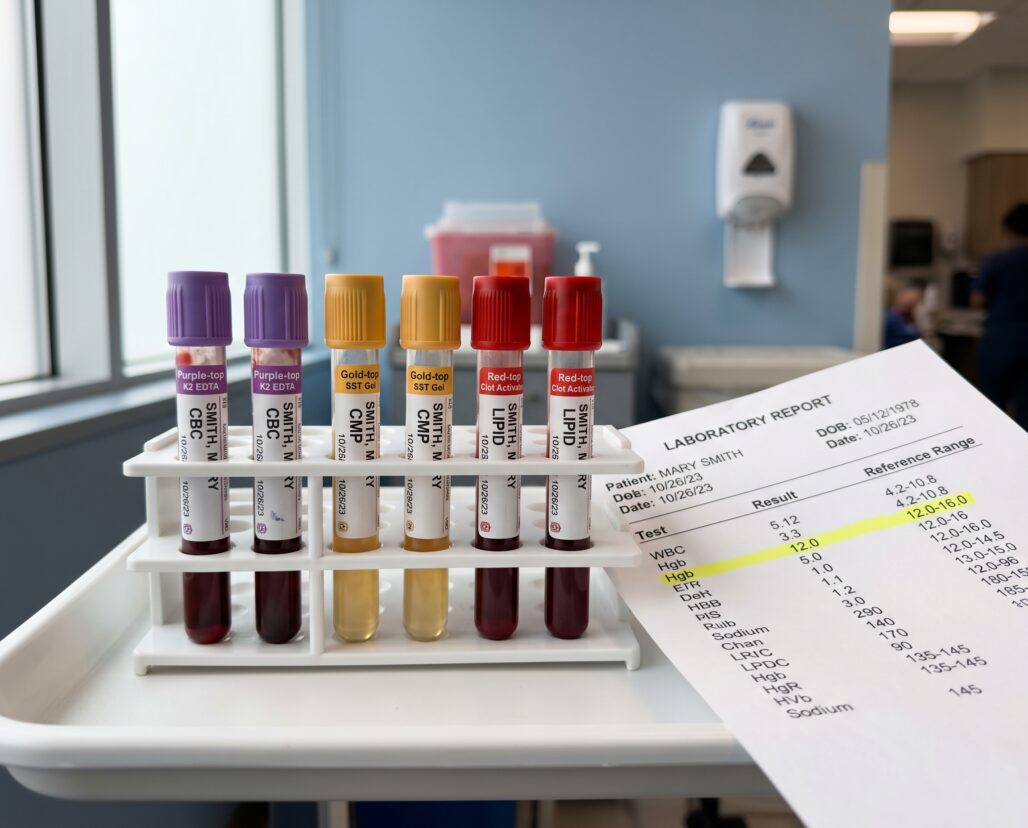
This guide covers what to test before you start, how often to recheck, and which values should stop a protocol until you have spoken with a physician.
Summary / Quick Answer
Baseline for any protocol: CBC, CMP, lipid panel, thyroid panel. For GH-axis peptides, add fasting glucose, HbA1c, and IGF-1. For GLP-1 agonists, add HbA1c and eGFR. For bremelanotide, check resting blood pressure before each use.
Recheck timing: Every three months for the first year. Anything flagged at baseline needs a recheck at six to eight weeks, not three months.
Stop signals: Severe persistent abdominal pain (pancreatitis concern), serum lipase greater than three times the upper limit of normal, eGFR below 30, IGF-1 more than 50% above the age-adjusted upper limit, or any blood pressure reading above 180/110 mmHg — call a physician before the next dose.
Why Blood-Test Monitoring Matters With Any Peptide
Peptides work by hitting receptors throughout the body. A GLP-1 agonist slows gastric motility and shifts pancreatic enzyme secretion. A GH secretagogue like sermorelin or ipamorelin drives IGF-1 upward, reshaping how muscle and fat respond to insulin. Bremelanotide activates melanocortin receptors that constrict blood vessels. None of these effects announce themselves before a lab value moves.
Most early-stage adverse effects from peptides produce measurable changes in standard markers before they produce obvious symptoms. Catching a lipase elevation at 2.5x the upper limit is a workup. Catching it after three days of vomiting and epigastric pain is a hospitalization. Labs close that gap.
One point worth stating directly: monitoring does not make grey-market peptides safer. If you are using a peptide from an unverified vendor — no certificate of analysis, no sterility data, no pharmaceutical oversight — a baseline CBC and CMP will tell you something went wrong, but will not prevent it. Baseline panels are valuable in any protocol, but the underlying drug is still unverified. That distinction matters.
Baseline Panel Before Starting Any Peptide Protocol
Think of this as your starting photograph: a snapshot of where your key biomarkers sit before any intervention. These four panels apply regardless of which peptide you are using.
CBC (complete blood count). Catches pre-existing anemia, immune abnormalities, or platelet issues that would color your interpretation of later results.
CMP (comprehensive metabolic panel). Creatinine and BUN give you a calculated eGFR — your kidney filtration rate — which matters because impaired renal function changes how several peptides are eliminated. Liver enzymes (ALT, AST) give you a baseline before any protocol that loads hepatic metabolism.
Lipid panel. GLP-1 agonists tend to modestly improve lipid profiles; GH-axis peptides can move them in either direction. You need a starting number to judge whether a three-month change is meaningful or noise.
Thyroid panel (TSH at minimum; free T4 if you are on levothyroxine). A depressed or elevated TSH at baseline explains downstream results that would otherwise look confusing. If you are already on levothyroxine, this is not optional — GLP-1 agonists slow gastric transit and can alter levothyroxine absorption, which may require a dose adjustment.
GLP-1 Receptor Agonist Monitoring: What the FDA Label Requires
GLP-1 receptor agonists (semaglutide, liraglutide, tirzepatide and others) are the most widely prescribed peptide-class drugs in clinical use. The monitoring requirements below come directly from FDA prescribing information — they are labeled recommendations tied to documented risks, not optional additions.
HbA1c. Periodic hemoglobin A1c measurement is required to assess glycemic control, per StatPearls GLP-1 agonist clinical guidance. Standard interval: every three months until stable, then every six months.
Lipase and pancreatitis monitoring. This is the highest-stakes lab concern for GLP-1 users. Acute pancreatitis — including hemorrhagic and necrotizing cases — has been reported with every approved GLP-1 agonist. A serum lipase greater than three times the upper limit of normal in a patient with new-onset abdominal pain is a signal to stop the peptide immediately and call a physician. GLP-1 agonists are absolutely contraindicated in patients with a prior history of pancreatitis.
Renal function (eGFR). GLP-1 agonists are primarily renally eliminated. An eGFR below 30 mL/min/1.73m2 contraindicates most agents in this class. Anyone with borderline kidney function at baseline should recheck creatinine and eGFR every three months.
Thyroid / calcitonin. Animal studies showed calcitonin release and C-cell proliferation with some GLP-1 agonists; human causation is not established. The FDA does not recommend routine calcitonin screening for all users. What it does say clearly: a personal or family history of medullary thyroid carcinoma (MTC) or multiple endocrine neoplasia type 2A or 2B is a contraindication. If you have a first-degree relative with MTC, disclose this before starting any GLP-1 agonist.
INR (if on warfarin). Slower gastric transit can shift warfarin absorption timing. INR monitoring may need to increase during the first 60 days of a new GLP-1 protocol.
GH-Axis Peptide Monitoring: IGF-1, Glucose, and Blood Pressure
Growth hormone secretagogues — sermorelin, ipamorelin, CJC-1295, GHRP-6 — stimulate the pituitary to release endogenous GH, which then drives IGF-1 production in the liver. Most of these compounds are either compounded (sermorelin) or exist in a regulatory grey zone. Monitoring protocols are therefore extrapolated from the established rhGH framework, which is the closest regulatory analogue.
IGF-1. The primary efficacy and safety marker for GH-axis protocols. Check at baseline, at six to eight weeks, and every three months thereafter. Target the age-adjusted normal reference range — not the ceiling of it. Chronically supraphysiologic IGF-1 (more than 50% above the upper limit) is associated with insulin resistance and epidemiological links to colorectal and prostate cancer risk. Monitor and dose to keep the result within the normal range.
Fasting glucose and HbA1c. Growth hormone counter-regulates insulin, pushing fasting glucose upward. Anyone starting a GH secretagogue with prediabetic glucose (100-125 mg/dL) or HbA1c in the 5.7-6.4% range should recheck every six to eight weeks. Fasting glucose above 126 mg/dL on two readings, or HbA1c crossing 6.5%, is a signal to pause and get a physician evaluation.
Blood pressure. GH modestly increases fluid retention in the first weeks of a new protocol. Check BP at baseline and at one month. Consistently above 140/90 mmHg with a previously normal baseline warrants evaluation before continuing.
Lipid panel. Repeat at three months. GH-axis peptides generally improve lipid profiles in GH-deficient patients. An unexpected worsening suggests another factor is in play.
Bremelanotide Blood Pressure Monitoring
Bremelanotide (Vyleesi) is the FDA-approved melanocortin receptor agonist for hypoactive sexual desire disorder in premenopausal women. Its standout monitoring requirement: it causes an acute, transient blood pressure rise after each dose.
Per the FDA prescribing information, blood pressure typically increases 6-9 mmHg systolic and 4-7 mmHg diastolic within the first two hours of injection, resolving within 12 hours. Bremelanotide is contraindicated in patients with cardiovascular disease, uncontrolled hypertension, or a history of major cardiovascular events.
Practical implication: check resting blood pressure before each use. Do not use bremelanotide if resting BP is at or above 165/100 mmHg. If a single dose produces a reading above 185/110 mmHg, call a physician before using it again.
A clarification worth making: bremelanotide is a synthetic peptide, not a steroid. Testosterone — often discussed alongside peptide protocols in men's health contexts — is a steroid hormone derived from cholesterol, not a peptide. TRT carries its own distinct monitoring requirements (hemoglobin, hematocrit, PSA) that should not be conflated with peptide monitoring.
Quick-Reference Monitoring Table
| Peptide class | Baseline labs | Recheck schedule | Stop signals |
|---|---|---|---|
| GLP-1 agonists (semaglutide, liraglutide) | CBC, CMP, HbA1c, lipid panel, TSH | HbA1c every 3 months; eGFR every 3 months; lipase if symptoms develop | Lipase > 3x ULN + abdominal pain; eGFR < 30; confirmed pancreatitis; MTC family history identified |
| GH-axis secretagogues (sermorelin, ipamorelin, CJC-1295) | CBC, CMP, fasting glucose, HbA1c, lipid panel, IGF-1, BP | IGF-1 at 6-8 weeks, then every 3 months; fasting glucose every 3 months | IGF-1 > 50% above age-adjusted ULN; fasting glucose > 126 mg/dL x2; HbA1c > 6.5%; BP consistently > 140/90 |
| Bremelanotide (Vyleesi) | CBC, CMP, resting BP | BP before each dose | Resting BP > 165/100 pre-dose; any reading > 185/110 post-dose |
| Grey-market / unverified peptides | CBC, CMP, lipid panel, thyroid panel, HbA1c, IGF-1 if GH-axis | Every 6-8 weeks minimum | Any significant out-of-range value; any new symptom cluster |
ULN = upper limit of normal. This table is a practical reference, not a substitute for individualized medical guidance.
When to Pause, Stop, or Call a Physician
These are the values that should stop a protocol and trigger a physician call before the next dose — not at the next scheduled check.
Call the same day if: Severe abdominal pain, especially radiating to the back, develops during a GLP-1 protocol. This is the classic pancreatitis presentation and requires imaging. It does not get a "wait and see" response.
Pause and call within 24-48 hours if: Serum lipase comes back greater than three times the upper limit of normal, even without symptoms. IGF-1 is more than 50% above the age-adjusted upper limit. Fasting glucose exceeds 126 mg/dL on a recheck. Two consecutive bremelanotide post-dose blood pressure readings exceed 160/100 mmHg.
Flag at next appointment (not emergency) if: LDL or triglycerides shift 10-15% over three months. HbA1c moves from 5.5% to 5.9% in a GH secretagogue user. TSH rises above 4.5 mIU/L at the three-month mark without prior thyroid history.
One important caveat for grey-market users: an out-of-range value in a person using an unverified peptide should prompt more urgency than the same value in someone on an FDA-approved drug. You cannot tell from a blood result whether you are looking at a pharmacodynamic effect or contamination. A contaminated vial and an on-target drug effect are indistinguishable in the lab.
If you are pregnant or planning to become pregnant, see our article on peptides during pregnancy for the specific contraindication list that applies to that context.
Frequently Asked Questions
How much does a baseline panel cost? Out-of-pocket through a direct-to-consumer lab service: CBC, CMP, lipid panel, and TSH typically runs $80-140 combined. Adding HbA1c and IGF-1 adds roughly $40-80. The full baseline is usually under $250 — less than an ER copay for pancreatitis.
Can I skip the baseline if I feel fine? No. The point of a baseline is to know where your markers were before the intervention, so a change at month three can be attributed to the peptide rather than a pre-existing trend. You cannot run that analysis without a starting number.
Do I need a physician to order these labs? In most US states, CBC, CMP, lipid panel, HbA1c, TSH, and IGF-1 are available direct-to-consumer without a physician order. Bremelanotide is prescription-only — your prescriber should be handling the monitoring.
What if my peptide is not on the list above? Use the grey-market row from the monitoring table as your framework — CBC, CMP, lipid panel, thyroid panel, HbA1c, plus IGF-1 if there is any GH-axis mechanism involved. Recheck every six to eight weeks. This does not make an unverified peptide safe. It gives you the earliest possible signal that something is going wrong.
Is testosterone a peptide? No. Testosterone is a steroid hormone derived from cholesterol, not a peptide. TRT monitoring — hemoglobin, hematocrit, PSA, estradiol — is specific to testosterone's pharmacology and should not be substituted for peptide monitoring protocols or conflated with them.
If you are managing a protocol like this, StackMyMed (our companion app) keeps your doses, timing, and interaction checks in one place. It does not replace medical advice — bring the log to your clinician.
Conclusion
Lab monitoring is not a bureaucratic formality. It is the mechanism by which a physiologic signal — a lab value moving outside range — reaches you before a clinical symptom does. The baseline panel gives you a starting photograph. The three-month recheck tells you whether the peptide is doing what it is supposed to do.
The side effects of individual peptides vary by class, dose, and individual biology. The monitoring principle does not vary: know your numbers before you start, track them through the protocol, and treat out-of-range values as information that requires a physician's interpretation — not a signal to increase the dose.
For the full safety context — including what FDA approval actually covers — see our overview on peptide safety. If you are taking other medications alongside a peptide, our guide on peptides and drug interactions covers the GLP-1 and co-prescription overlap in detail.
This article is for informational purposes only and does not constitute medical advice, diagnosis, or treatment. Lab reference ranges and monitoring intervals vary by individual, laboratory, and clinical context. Always consult a licensed healthcare provider before starting, modifying, or stopping any peptide protocol. If you experience severe abdominal pain, significant blood pressure changes, or any other acute symptom during a peptide protocol, contact a healthcare provider or emergency services promptly.
