
If you're on semaglutide (Wegovy) or tirzepatide (Zepbound) and wondering whether you need a vitamin D supplement, the short answer is: yes, almost certainly — but the dose and form matter more than most GLP-1 guides admit. This article covers the bone-loss risk tied to rapid weight loss, what a target 25(OH)D level means, and which products are worth your money. You'll find a value comparison showing where a budget pick delivers the same protection for a fraction of the premium, and at least one product to skip outright.
Affiliate disclosure: this article contains affiliate links. As an Amazon Associate, UsefulVitamins.com earns from qualifying purchases at no extra cost to you.
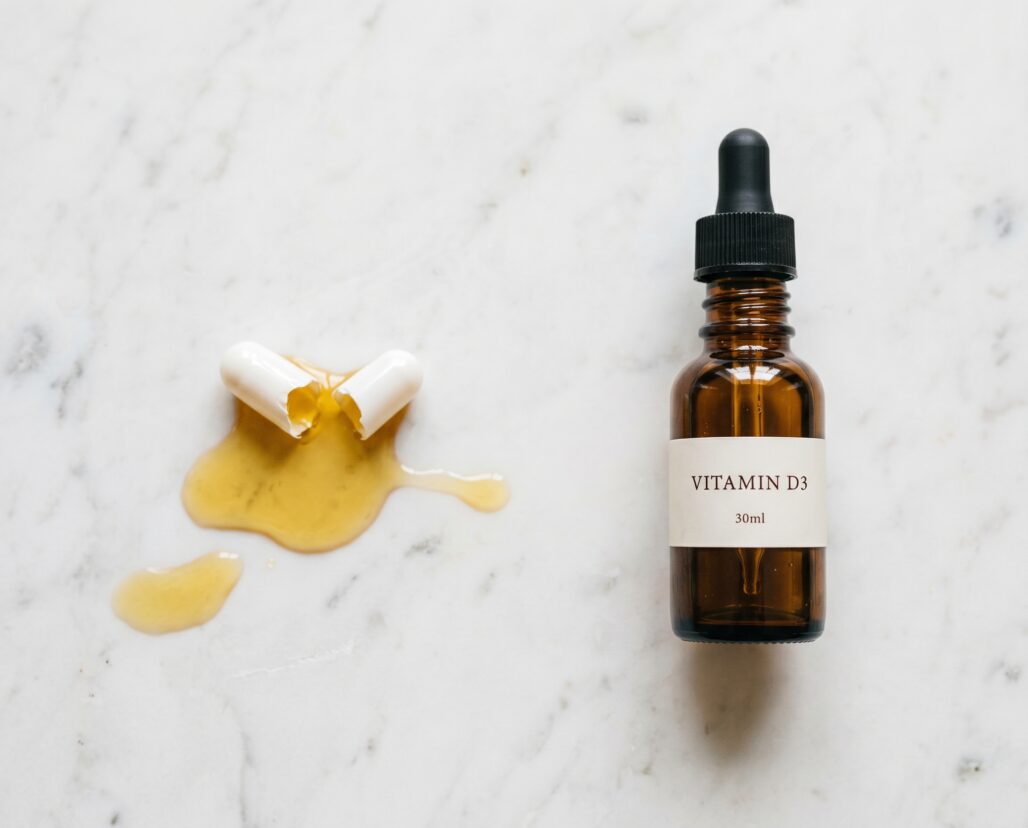
Quick Answer: Best Vitamin D for GLP-1 Users
Top Pick: NOW Foods Vitamin D3 5,000 IU — reliable, verified, and $0.05/serving.
Best for D+K2 stacking: Thorne Vitamin D/K2 Liquid.
- Best for most GLP-1 users: A D3 softgel at 2,000-5,000 IU with a fat-containing meal, third-party batch-tested.
- Not ideal for: Anyone who hasn't confirmed their baseline 25(OH)D level — dosing blind is guesswork.
- What to look at before buying: Third-party verification (USP, NSF, Informed Sport), D3 (not D2), cost per 1,000 IU.
- Decision shortcut: At 40-60 ng/mL already, 2,000 IU/day is a reasonable maintenance dose. Below 30 ng/mL, talk to your clinician before self-dosing.
Table of Contents
- Why GLP-1 users face extra bone-loss risk
- Who needs this (and who can skip)
- How we picked
- Comparison table
- Our picks
- Brands to skip
- How to use vitamin D on a GLP-1
- Side effects and interactions
- FAQ
Why GLP-1 Users Face Extra Bone-Loss Risk {#why-glp1-users-face-extra-bone-loss-risk}
Rapid weight loss accelerates bone resorption. The SUSTAIN and SCALE trial extensions reported a 2-3% reduction in lumbar spine bone mineral density over 12 months at therapeutic semaglutide doses. Tirzepatide trials show similar trends.
Think of the bone remodeling cycle like a renovation crew: demolition (osteoclasts) and rebuilding (osteoblasts) normally stay in balance. During rapid fat-loss phases, demolition outruns the rebuilding crew. Vitamin D is the project manager that keeps calcium supply to the job site consistent.
A 2020 analysis in the Journal of Bone and Mineral Research confirmed that adults with 25(OH)D below 30 ng/mL show significantly impaired calcium absorption and elevated parathyroid hormone — the exact hormonal environment that accelerates cortical bone loss during caloric restriction.
The target for GLP-1 patients is 40-60 ng/mL of 25-hydroxyvitamin D. Getting a baseline blood test is the only honest way to know whether you need 2,000 IU or 5,000 IU. Use the vitamin D unit converter if your lab reports in nmol/L. Vitamin D also pairs with K2-MK7 in the calcium trafficking pathway — one product in this guide covers both.
For the broader bone-support picture, see supplements for GLP-1 muscle loss and the tirzepatide complete guide.
Actionable takeaway: Get a 25(OH)D blood test before picking a dose. That number determines which product in this guide is relevant to you.
Who Needs This (and Who Can Skip) {#who-needs-this-and-who-can-skip}
Strong fit: Adults on Wegovy or Zepbound losing weight quickly, anyone working indoors or living above 35 degrees north latitude, people with a DEXA flag for low bone density, and anyone on GLP-1-reduced calories who may not be hitting daily fat targets (fat is required for D3 absorption).
Skip if: Your 25(OH)D is confirmed above 60 ng/mL with regular outdoor sun exposure, or you have granulomatous disease or primary hyperparathyroidism — both conditions can cause D3 hypersensitivity.
How We Picked {#how-we-picked}
We filtered the top vitamin D3 products on Amazon to a shortlist using four criteria: (1) D3 form (cholecalciferol), not D2 — per Heaney et al. 2011, D3 is 87% more potent at raising serum 25(OH)D; (2) third-party batch testing with a disclosed verification body; (3) dose labeling showing both IU and mcg (1 mcg = 40 IU); (4) cost per 1,000 IU. Cross-referenced against FullScript's practitioner catalogue and ConsumerLab's vitamin D batch-test database.
Comparison Table {#comparison-table}
| Brand | Dose per serving | mcg equivalent | K2 included | Form | Cost per 1,000 IU | Third-party verified | Best for |
|---|---|---|---|---|---|---|---|
| NOW Foods Vitamin D3 5,000 IU | 5,000 IU | 125 mcg | No | Softgel | ~$0.05 | Yes (NPA GMP) | Budget maintenance |
| Thorne Vitamin D/K2 Liquid | 1,000 IU/drop | 25 mcg/drop | Yes (MK-4) | Liquid | ~$0.30 | Yes (NSF) | D+K2 stacking |
| Pure Encapsulations Vitamin D3 | 5,000 IU | 125 mcg | No | Capsule | ~$0.18 | Yes (UL/NPA) | Quality-conscious |
| Sports Research Vitamin D3 | 5,000 IU | 125 mcg | No | Softgel (coconut oil) | ~$0.06 | Yes (Informed Sport) | Bioavailability focus |
| Carlson Solar D Gems | 2,000 IU | 50 mcg | No | Softgel (fish oil) | ~$0.07 | Yes (NPA GMP) | Low-dose maintenance |
| Nordic Naturals Vitamin D3 | 1,000 IU | 25 mcg | No | Softgel (olive oil) | ~$0.13 | Yes (NSF) | Vegan D3 |
Our Picks {#our-picks}
Top Pick: NOW Foods Vitamin D3 5,000 IU
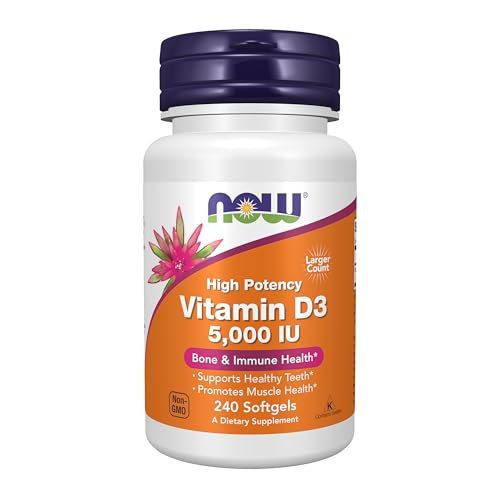
Form: cholecalciferol (D3), 125 mcg per softgel
Best for: most GLP-1 users with confirmed 25(OH)D below 40 ng/mL who need a reliable maintenance dose
Why we picked it: NOW Foods holds NPA Good Manufacturing Practice certification and tests every batch for identity and purity. The 5,000 IU dose aligns with the range most commonly used in GLP-1 bone-support protocols, and the soy oil carrier gives D3 the fat vehicle it needs for absorption. The label states both IU and mcg, which many competitors don't bother to include.
The trade-off: No K2, so if arterial calcium redirection is part of your goal you'd need to stack separately.
Who should skip it: Anyone wanting a single-product D+K2 solution, or anyone whose clinician has recommended liquid format for precise titration.
Actionable takeaway: At roughly $0.05 per serving, this is the value baseline for most GLP-1 users. The Thorne D/K2 Liquid costs six times more per equivalent D3 dose. That premium buys K2 co-delivery — but if your only concern is maintaining 25(OH)D levels, you're paying for a molecule you may not need.
Premium Pick: Thorne Vitamin D/K2 Liquid
Form: cholecalciferol (D3) + menaquinone-4 (K2-MK4), 1,000 IU D3 per drop, 200 mcg K2-MK4 per drop
Best for: GLP-1 users with cardiovascular risk factors or family history of arterial calcification who want both bone and arterial-calcium support in one product
Why we picked it: Thorne carries NSF certification and pharmaceutical-grade GMP across their full facility. The liquid format allows precise titration — useful when a clinician is dialing up from a deficient baseline. The MK-4 K2 form has a shorter half-life than MK-7 but is the form most studied in clinical bone-density trials.
The trade-off: At ~$0.30 per 1,000 IU D3, this is six times the NOW Foods cost. A standalone K2 softgel runs ~$0.04/day — buying both separately would be cheaper. The case for Thorne is liquid titration flexibility plus NSF trust, not the K2 molecule itself.
Who should skip it: Anyone wanting a fixed 5,000 IU daily dose with no K2 goal. Less travel-friendly.
Quality Pick: Pure Encapsulations Vitamin D3 5,000 IU
Form: cholecalciferol (D3), 125 mcg per capsule, non-GMO cellulose carrier
Best for: readers who want the brand most stocked in clinical and practitioner settings
Why we picked it: Pure Encapsulations holds UL certification alongside NSF/NPA GMP production, avoids common fillers, and is available via FullScript — a signal it clears the quality bar for clinical dispensing.
The trade-off: At ~$0.18 per 1,000 IU, it costs 3.6x the NOW Foods equivalent for the same molecule. You're paying for audit-trail manufacturing assurance, not clinical superiority.
Who should skip it: Cost-sensitive buyers. NOW Foods or Sports Research deliver tested D3 for a fraction of the price.
Budget Pick: Sports Research Vitamin D3 5,000 IU
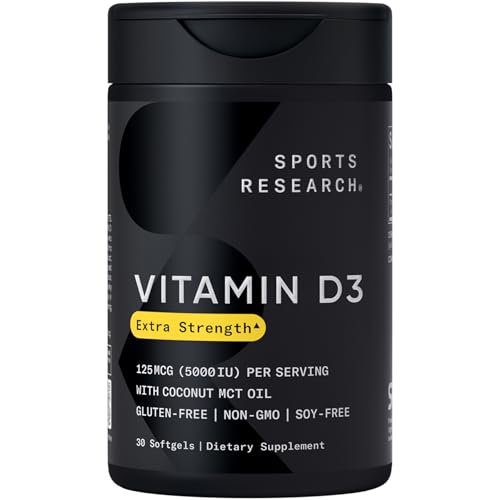
Form: cholecalciferol (D3), 125 mcg per softgel, organic coconut oil carrier
Best for: cost-sensitive buyers who want Informed Sport verification
Why we picked it: Sports Research holds Informed Sport certification (WADA prohibited substance testing) — a stricter standard than basic GMP. The coconut oil carrier helps absorption on low-appetite GLP-1 days without requiring a full meal. At ~$0.06 per softgel, nearly identical cost to NOW Foods with a different testing body.
The trade-off: Brand transparency beyond Informed Sport is thinner than Thorne or Pure Encapsulations. '#1 best-seller on Amazon' should never be the only reason to buy — and Sports Research leans into that.
Who should skip it: Anyone wanting USP or NSF certification specifically. Informed Sport focuses on doping, not broad contaminant purity.
Best for Vegans: Nordic Naturals Vitamin D3
Form: cholecalciferol (D3) from lichen (not lanolin), 25 mcg per softgel, olive oil carrier, certified vegan
Best for: vegans on GLP-1 therapy who need a true D3 product with an animal-free source
Why we picked it: Most D3 supplements use lanolin-derived cholecalciferol. Nordic Naturals uses lichen, making this one of the few certified-vegan D3 options with NSF verification behind it.
The trade-off: At 1,000 IU per softgel you'll take 2-5 caps daily to reach 2,000-5,000 IU, pushing cost to ~$0.13 per 1,000 IU — 2.5x the NOW Foods equivalent. Lichen-sourced D3 is not more effective than lanolin-derived D3 for raising 25(OH)D. You're paying for the sourcing ethics, not better bone protection.
Skip if: You're not vegan.
Low-Dose Maintenance Pick: Carlson Solar D Gems 2,000 IU
Form: cholecalciferol (D3), 50 mcg per softgel, safflower oil carrier
Best for: GLP-1 users already near the 40-60 ng/mL target who want a conservative maintenance dose rather than a repletion dose
Why we picked it: Carlson Labs carries NPA GMP certification and a 50-year manufacturing track record. The 2,000 IU dose is appropriate for people who have already corrected a deficiency — not a repletion dose rebranded as "daily support."
The trade-off: At confirmed deficiency (below 30 ng/mL), 2,000 IU/day corrects it slowly. Use the vitamin D dose calculator to estimate your timeline.
Who should skip it: Anyone deficient. NOW Foods or Sports Research 5,000 IU are more appropriate.
Brands to Skip {#brands-to-skip}
Skip: Any Vitamin D2 (Ergocalciferol) Product
D2 is substantially less efficient at raising 25(OH)D. In a 2011 RCT (Heaney et al., AJCN, n=33), D3 was 87% more potent at raising serum levels. D2 at 50,000 IU weekly works for clinical repletion because quantity overcomes the potency gap — but OTC D2 products at 400-2,000 IU are simply underperforming. If the label says "ergocalciferol" or "vitamin D2," skip it.
Skip: GLP-1-Branded Vitamin D Blends
Brands now market vitamin D co-branded with GLP-1 drug names or labeled "for Ozempic users." These are almost always D2 or D3 with fillers at a 2-5x premium. The "GLP-1 optimized" claim has no regulatory definition. You're paying for the brand, not the molecule. Every product in this guide was selected on testing, form, and dose.
How to Use Vitamin D on a GLP-1 {#how-to-use-vitamin-d-on-a-glp-1}
Dose by 25(OH)D level
| Your 25(OH)D level | Recommended approach |
|---|---|
| Below 20 ng/mL (deficiency) | Clinician supervision; often 4,000-10,000 IU/day short-term, retest at 8 weeks |
| 20-30 ng/mL (insufficiency) | 3,000-5,000 IU/day typical; retest at 8-12 weeks |
| 30-40 ng/mL (low-normal) | 2,000-3,000 IU/day for maintenance |
| 40-60 ng/mL (target range) | 1,000-2,000 IU/day for maintenance |
| Above 60 ng/mL | Reassess need; supplementation may not be necessary |
Always take with fat; retest at 8-12 weeks
Vitamin D is fat-soluble — take it with a fat-containing meal. On GLP-1 low-appetite days, even nut butter or olive oil is enough. Daily consistency matters more than timing. If supplementing calcium too, take both with the same meal (best calcium + K2 for GLP-1 bone loss). Check your multivitamin D3 content before adding a standalone (best multivitamin for GLP-1 users). Recheck 25(OH)D at 8-12 weeks.
Side Effects and Interactions {#side-effects-and-interactions}
Vitamin D3 up to 4,000 IU/day falls within the NIH tolerable upper intake level. Toxicity requires sustained doses above 10,000 IU/day without monitoring (nausea, weakness, kidney stones from hypercalcemia).
Key drug interactions: thiazide diuretics increase calcium retention (hypercalcemia risk with high-dose D3); orlistat reduces fat and D3 absorption (separate by 2+ hours); corticosteroids reduce calcium absorption; cholestyramine/colestipol impair fat-soluble vitamin absorption.
There is no known direct pharmacokinetic interaction between semaglutide or tirzepatide and vitamin D3. The concern on GLP-1s is indirect: lower fat intake and reduced meal frequency may reduce per-dose absorption. Take D3 with your largest fat-containing meal.
FAQ {#faq}
How much vitamin D3 should I take per day on Wegovy or Zepbound?
It depends on your baseline 25(OH)D. Most adults on GLP-1s with confirmed insufficiency (20-30 ng/mL) use 3,000-5,000 IU/day. Without a test, 2,000 IU/day with a fat-containing meal is a reasonable starting point.
Do I need K2 with vitamin D3?
Not necessarily. K2 helps route calcium toward bone rather than arterial walls. If bone density is your only concern and cardiovascular risk is low, standalone D3 is sufficient.
Can I take too much vitamin D3?
Yes. Doses above 10,000 IU/day without monitoring carry genuine toxicity risk. More is not better past the 40-60 ng/mL target range.
Is NOW Foods as good as a $30 specialty brand?
For the active molecule, yes — cholecalciferol is cholecalciferol. The premium buys third-party batch testing and manufacturing accountability, not a different molecule. NOW Foods delivers tested D3 at $0.05/serving.
As an Amazon Associate, I earn from qualifying purchases. Product recommendations are based on real reviews and independent research.
Related Reading
- Supplements for GLP-1 Muscle Loss: What the Evidence Says
- Best Calcium + K2 for GLP-1 Bone Loss
- Best Multivitamin for GLP-1 Users
- Tirzepatide Complete Guide
- Vitamin D Unit Converter
Conclusion: the bottom line on vitamin D for GLP-1 users
Vitamin D is the supplement most GLP-1 users should address first in the bone-support category. Rapid weight loss accelerates resorption; low D status removes the calcium supply line. The target is 40-60 ng/mL of 25(OH)D — the only way to know if you're there is a baseline blood test.
NOW Foods Vitamin D3 5,000 IU is the right pick for most people. Thorne D/K2 Liquid earns its premium only when K2 co-delivery matters. The biggest mistake isn't buying the wrong brand — it's dosing blind and never retesting.
Next steps:
- Get a 25(OH)D blood test (direct-to-consumer or through your GLP-1 prescriber)
- Use the vitamin D dose calculator to estimate your repletion timeline
- See best calcium + K2 for GLP-1 bone loss for the full bone-support stack
This article is for informational purposes and not medical advice. Supplements — especially those taken alongside prescription medications — can interact with conditions and drugs. Consult a licensed physician before starting any supplement, particularly if you are pregnant, nursing, taking prescription medications, or managing a chronic condition.
As an Amazon Associate, I earn from qualifying purchases. Product recommendations are based on real reviews and independent research.
