
If you're on semaglutide or tirzepatide and researching bone health, you've probably landed on a wall of calcium supplements that all look the same and none of them mention K2. The short answer: calcium alone is not enough, calcium carbonate is cheap but barely absorbs, and most calcium supplements ignore K2 entirely — which is a serious problem when rapid weight loss is already pulling calcium out of your skeleton. This article covers which calcium forms actually work, why K2 (MK-7) is not optional for GLP-1 users, a comparison table across five picks, and one category to skip entirely.
Affiliate disclosure: this article contains affiliate links. As an Amazon Associate, UsefulVitamins.com earns from qualifying purchases at no extra cost to you.
Quick answer: best calcium and K2 for GLP-1 bone loss
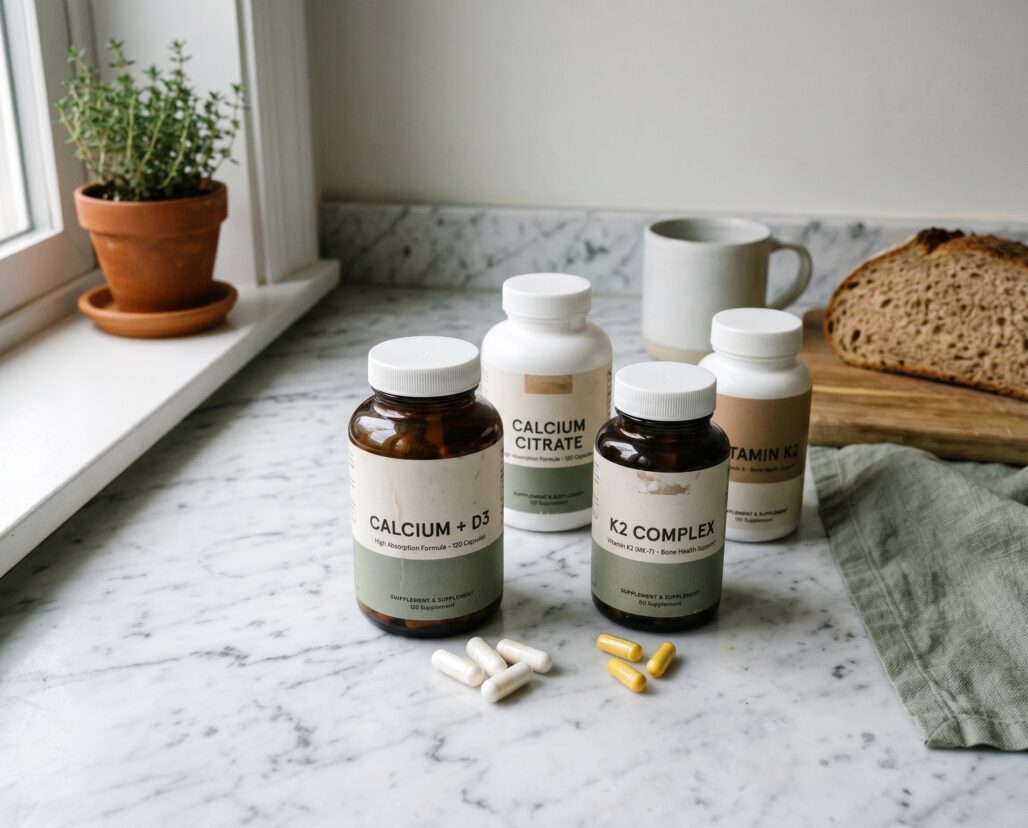
Top Pick for most users: Life Extension Bone Restore with K2. Full bone-matrix formula with calcium citrate-malate, magnesium, D3, and MK-7 K2 in one product.
Best for: GLP-1 users with existing bone density concerns; post-menopausal women and men over 50 losing weight rapidly on Wegovy or Zepbound; anyone with a prior fracture history.
Not ideal for: People on PPIs needing a pure citrate formula; cost-sensitive buyers comfortable stacking components separately (budget approach outlined below).
What to check before buying: Does the label list elemental calcium (not compound mass)? Is K2 present as MK-7 (not MK-4)? Is D3 included? Is the form citrate, hydroxyapatite, or plant-based — not carbonate?
Decision shortcut: For a complete one-product protocol, Life Extension Bone Restore with K2 is the starting point. For the plant-calcium premium with clinical trial data, AlgaeCal Plus. For a budget approach, NOW Foods Calcium Magnesium D3 plus a standalone MK-7 capsule at $0.10-0.15/day.
Table of contents
- How GLP-1 medications affect bone density
- Calcium forms compared
- Why K2 is not optional
- Who we picked for
- How we picked
- Comparison table
- Product picks
- Brands to skip
- How to use calcium and K2 on a GLP-1
- Side effects and interactions
- FAQ
- Related reading
How GLP-1 medications affect bone density
GLP-1 medications produce rapid, significant weight loss — in trials, 15-20% of body weight over 68 weeks. Clinical data found lumbar spine bone mineral density declined approximately 2-3% annually in semaglutide arms, matching untreated post-menopausal bone loss rates.
Adipose tissue produces estrogen, contributes mechanical load to the skeleton, and buffers calcium homeostasis. When fat disappears quickly, the skeleton loses structural demand and hormonal input at once. Reduced appetite further cuts dietary calcium and vitamin D — both required by the bone remodeling cycle.
Calcium supplementation does not reverse GLP-1 bone loss. It slows the rate by ensuring raw material is available. The constraint: calcium does not build bone alone. D3 facilitates intestinal absorption, K2 directs deposited calcium into bone rather than arterial walls, and magnesium supports the enzymes driving mineralization. The supplement has to cover the whole stack, not just the mineral.
For GLP-1 use in older women broadly, see peptides for women over 40.
Calcium forms compared
Think of calcium forms like keys that fit different locks. Carbonate needs stomach acid. Citrate does not.
Calcium carbonate is the cheapest form and what you'll find in most mass-market supplements. Looks strong on paper at 40% elemental calcium by mass. The problem: it requires stomach acid for absorption. GLP-1 users on proton pump inhibitors (PPIs) — a common co-prescription for nausea or reflux — produce less stomach acid and absorb carbonate poorly. Calcium carbonate is cheap but barely absorbs in anyone with compromised acid production.
Calcium citrate absorbs without stomach acid, with or without food. Elemental percentage is lower (21%), but the usable fraction is what matters. Citrate is the recommended form for people on acid-suppressing medications and adults over 60.
Microcrystalline hydroxyapatite concentrate (MCHC) comes from whole bone matrix: calcium, phosphorus, collagen, and bone-specific growth factors in natural ratios. RCT data show bone density maintenance advantages versus carbonate, including Dent and Hawthorn, 1995.
Plant-based calcium (AlgaeCal) comes from red marine algae with calcium, magnesium, and trace minerals. Two company-sponsored trials (Kaats 2011, Brand 2010) showed bone density increases in the AlgaeCal Plus formulation with strontium. Small, industry-funded — but actual human RCT data on a named product.
Why K2 is not optional
Vitamin K2 activates osteocalcin (binds calcium into bone matrix) and Matrix Gla Protein (prevents calcium from depositing in arterial walls). Without K2, supplemental calcium increases the circulating pool without directing it to bone. GLP-1 users mobilizing calcium from their skeleton during rapid weight loss should not take calcium without K2.
MK-4 (synthetic) has a 1-2 hour half-life and requires pharmacological doses (45 mg, three times daily) for documented skeletal effects. MK-7 (fermented, from natto) has a 72-hour half-life and is effective at 100-180 mcg once daily. MK-7 is the only practical option for daily supplementation.
For D3 — which enables calcium absorption to happen at all — see best vitamin D for Wegovy and Zepbound users.
Who we picked for
Higher risk: Post-menopausal women on GLP-1; men over 50 with fracture history or low bone density; people with sarcopenic obesity; anyone already low in D or calcium before starting a GLP-1.
Lower risk: Younger adults on shorter GLP-1 courses (under 6 months); people maintaining consistent resistance training (the most potent non-pharmacological bone stimulus); people reliably eating calcium-rich foods despite appetite suppression.
For older adults where GLP-1 bone loss intersects with frailty, see peptides for seniors over 50.
How we picked
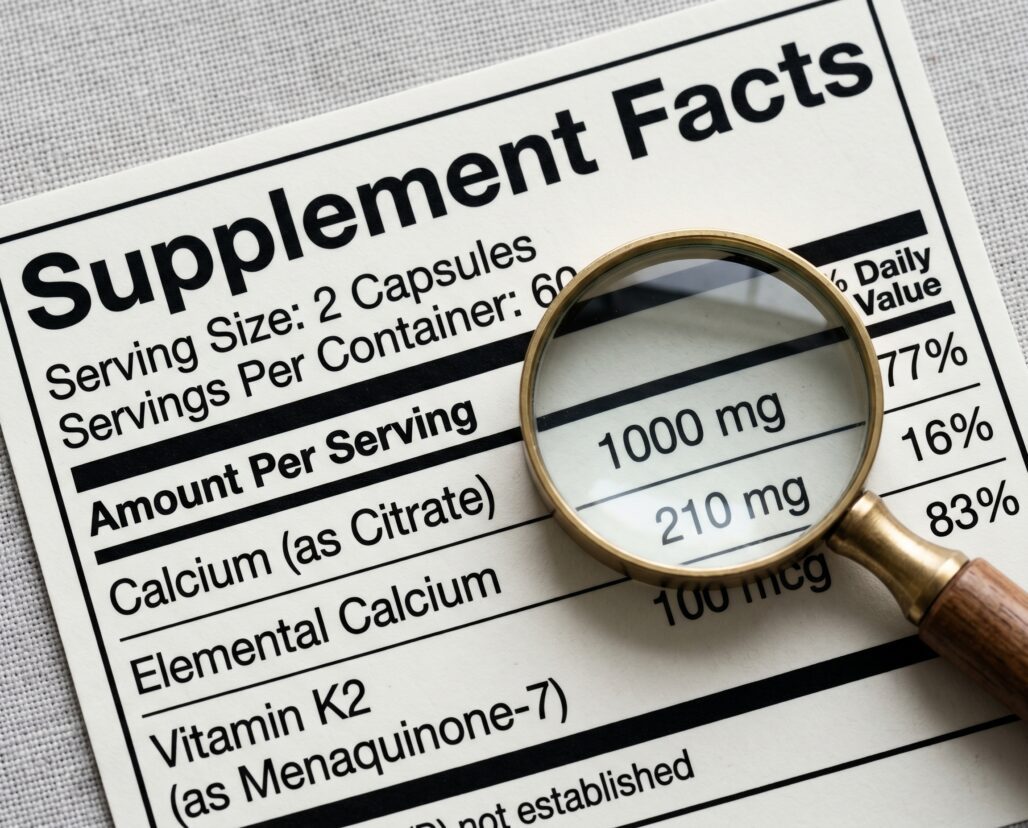
We reviewed 30+ calcium and bone combination supplements on Amazon with at least 300 reviews. Criteria: calcium form clearly stated on label (citrate, MCHC, or plant-based — never "calcium blend"); elemental calcium dose explicit on Supplement Facts; K2 present as MK-7; D3 included or easy to pair; magnesium as a cofactor; cost per 500 mg elemental calcium as the price anchor. We did not conduct lab testing ourselves.
Comparison table
| Brand | Calcium form | Elemental Ca per dose | K2 included (mcg) | D3 included | Cost/dose | Bone matrix complete | Best for |
|---|---|---|---|---|---|---|---|
| Life Extension Bone Restore K2 | Citrate-malate + hydroxyapatite | 700 mg | 45 mcg MK-7 | Yes (1,000 IU) | ~$0.45 | Yes | Top Pick: full-matrix daily |
| AlgaeCal Plus | Plant calcium (algae) | 720 mg | 100 mcg MK-7 | Yes (1,600 IU) | ~$2.20 | Yes (+ strontium) | Premium: RCT-backed plant calcium |
| New Chapter Bone Strength Take Care | Plant calcium (algae) | 385 mg | 80 mcg MK-7 | Yes (400 IU) | ~$0.90 | Partial (lower dose) | Best for older women: whole-food form |
| Jarrow Formulas Bone-Up | MCHC (bone-derived) | 1,000 mg | 0 — add separately | Yes (400 IU) | ~$0.55 | Partial (no K2) | Best food-source: add K2 separately |
| NOW Foods Calcium Magnesium D3 | Carbonate + citrate blend | 500 mg | 0 — add separately | Yes (200 IU) | ~$0.13 | No (no K2, low D3) | Budget pick: add MK-7 separately |
Product picks
Top Pick: Life Extension Bone Restore with K2
Form: Calcium citrate-malate and calcium hydroxyapatite blend (700 mg elemental per 2-capsule serving)
K2: 45 mcg MK-7 per serving
D3: 1,000 IU per serving
Why we picked it: Life Extension Bone Restore with K2 pairs citrate-malate (acid-independent absorption) with hydroxyapatite (bone-matrix context), MK-7 K2, and D3 in a single formula. Citrate-malate absorbs without stomach acid, which matters for GLP-1 users on PPIs. Life Extension publishes Certificates of Analysis, and this formula has a consistent track record on practitioner-facing supplement platforms.
The trade-off: At 45 mcg MK-7, the K2 dose is below the 100-180 mcg range most K2 research used. Post-menopausal women or anyone with documented bone density loss should add a standalone 100 mcg MK-7 daily (about $0.10-0.15 additional).
Skip if: You're on a comprehensive multivitamin with K2 and D3 and only need standalone calcium.
Actionable takeaway: Default recommendation for GLP-1 users who want a bone-matrix protocol without managing five separate supplements. Add standalone MK-7 if post-menopausal or fracture history applies.
Premium choice: AlgaeCal Plus
Form: Plant calcium from red marine algae (Lithothamnion spp.), 720 mg elemental per 4-capsule serving
K2: 100 mcg MK-7 per serving
D3: 1,600 IU D3 per serving
Why we picked it: AlgaeCal Plus is the only over-the-counter calcium supplement with published human RCT data showing bone density increase, not just maintenance (Kaats GR et al., 2011; Brand C et al., 2010). K2 is present at the full 100 mcg MK-7 dose, D3 at a meaningful level. The algae matrix co-delivers magnesium and 73 trace minerals. For post-menopausal GLP-1 users with confirmed bone density loss, this is the case where clinical data on the specific product justifies the premium.
The honest valuation: AlgaeCal Plus costs roughly $88 for 30 days, about $2.20 per dose. Life Extension Bone Restore runs about $0.45 per dose and delivers the same daily calcium target. The 5x premium buys plant-source mineral matrix and product-specific clinical trial data. There are no head-to-head trials comparing the two.
Skip if: Budget is the primary driver.
Actionable takeaway: Our pick for post-menopausal GLP-1 users with confirmed bone density loss who want product-specific efficacy data, not generic calcium supplementation.
Best for older women: New Chapter Bone Strength Take Care
Form: Plant calcium from red marine algae, 385 mg elemental per 3-tablet serving
K2: 80 mcg MK-7 per serving (fermented from natto)
D3: 400 IU per serving
Why we picked it: New Chapter uses fermented vitamins and whole-food-sourced minerals, and the MK-7 K2 is fermented from natto — the form used in most MK-7 research. For older women who prefer food-matrix supplements and are pairing a standalone D3, this fits cleanly.
The honest caveat on dose: At 385 mg elemental per serving, this covers one-third of the daily calcium target. Splitting doses improves absorption, but the gap requires deliberate dietary management. At 400 IU D3, additional D3 is almost certainly needed.
Skip if: You're not tracking dietary calcium and aren't planning a separate D3 supplement.
Actionable takeaway: Clean food-form option for post-menopausal women comfortable building a multi-product protocol. Pair with 2,000-4,000 IU D3 and account for the dietary calcium gap.
Best food-source calcium: Jarrow Formulas Bone-Up
Form: Microcrystalline hydroxyapatite concentrate (MCHC) from bovine bone, 1,000 mg elemental calcium per 6-capsule serving
K2: 0 mcg — not included
D3: 400 IU per serving
Why we picked it: Jarrow Bone-Up is the practitioner category reference for MCHC. The whole-bone-matrix form provides calcium alongside collagen peptides, hydroxyapatite crystals, and bone-specific growth factors in naturally co-occurring ratios. For GLP-1 users who want food-matrix calcium specifically, this is the pick.
The critical gap: Bone-Up does not include K2. Add standalone MK-7 at 100-180 mcg daily ($0.10-0.20 per dose), keeping the total stack competitive with the top pick.
Skip if: You want a complete one-product solution. Life Extension Bone Restore already includes K2.
Actionable takeaway: Best MCHC option for GLP-1 users willing to add K2 separately.
Budget pick: NOW Foods Calcium Magnesium with D3
Form: Calcium carbonate and calcium citrate blend, 500 mg elemental per 2-softgel serving
K2: 0 mcg — not included
D3: 200 IU per serving
Why we picked it: NOW Foods Calcium Magnesium with D3 includes magnesium (250 mg per serving) — absent from most standalone calcium supplements — and a carbonate-citrate blend. At roughly $0.13 per dose it is the lowest-cost option evaluated here.
The honest value comparison: NOW Foods Calcium Magnesium with D3 delivers 500 mg elemental calcium at $0.13/dose. Life Extension Bone Restore with K2 delivers 700 mg plus MK-7 K2 and 1,000 IU D3 at $0.45/dose. Add standalone MK-7 ($0.12/day) and top-up D3 ($0.05/day) to the NOW Foods stack and the total runs about $0.30/day — somewhat less than the top pick, but with two extra products to manage.
Skip if: You're on a PPI or have low stomach acid. The carbonate fraction absorbs poorly without acid.
Actionable takeaway: Legitimate budget option only if you add standalone MK-7 at 100 mcg daily. Without K2, this leaves the most important piece of GLP-1 bone protection off the table.
Brands to skip
Skip: standalone calcium carbonate tablets without K2
This covers Caltrate, many generic store brands, and most 600 mg carbonate-only tablets. The objection is not safety — it is utility. Calcium carbonate without K2 increases the circulating calcium pool without directing it to bone. For GLP-1 users already mobilizing calcium from the skeleton during rapid weight loss, providing the raw material without the routing signal is the most common missed opportunity in the entire category.
If cost is the issue, NOW Foods Calcium Magnesium with D3 delivers a carbonate-citrate blend plus magnesium for $0.13/dose — then add K2 separately. The carbonate-only cost advantage disappears when you account for absorption limits and the K2 gap.
Skip: any label listing only "calcium 1,000 mg" without the salt form
Almost certainly carbonate. Carbonate at 40% elemental means 1,000 mg compound delivers 400 mg elemental calcium. A brand that does not disclose the salt form is hiding a cheap ingredient or doesn't consider the distinction worth communicating. Either way, move on.
How to use calcium and K2 on a GLP-1
Daily target: 1,000-1,200 mg from combined food and supplement sources. Most GLP-1 users with reduced appetite get 300-500 mg from food. The supplement gap is typically 500-700 mg elemental.
Dose splitting: Split into two servings of 500 mg or less (AM and PM). The intestine actively transports roughly 500 mg per window; larger doses rely on a less efficient passive route.
Timing: Citrate and MCHC absorb fasted. Carbonate needs food and stomach acid. K2 and D3 are fat-soluble — take with a fat-containing meal.
Duration: Bone density changes take 6-12 months to appear on DEXA. This is a long-game protocol.
Side effects and interactions
Calcium at 500-1,200 mg elemental daily is generally safe in adults with normal kidney function. Carbonate causes constipation and bloating more than citrate or MCHC — a poor fit for GLP-1 users. People with calcium oxalate kidney stones or CKD stage 3b+ need physician guidance.
Drug interactions to flag:
- Levothyroxine: 4-hour separation required
- Bisphosphonates: take 30-60 min before any food or supplement
- Antibiotics (quinolones, tetracyclines): 2-hour separation
- Thiazide diuretics: increase renal calcium reabsorption; flag with prescriber
- Warfarin/vitamin K antagonists: K2 may affect INR; requires monitoring

FAQ
How much calcium should GLP-1 users take daily?
1,000-1,200 mg from combined food and supplement sources. Most GLP-1 users on reduced appetite get under 500 mg from food. A supplemental 500-700 mg elemental, split AM/PM, covers the typical gap.
What K2 dose is needed?
100-180 mcg MK-7 daily. Research has used 90-200 mcg. MK-7 (fermented, once daily) rather than MK-4 (synthetic, requires three doses at 45 mg each).
Is calcium citrate or MCHC better?
Citrate is the standard for acid-independent absorption. MCHC delivers calcium with collagen and bone-matrix growth factors co-present. Both are better than carbonate for GLP-1 users, especially anyone on a PPI.
Is AlgaeCal Plus worth the premium?
Citrate is the evidence-based standard. AlgaeCal Plus has RCT data on the specific formulation showing bone density increases. Trials are industry-funded and small. At 5x the cost, the upgrade is most justified for post-menopausal women with confirmed bone density loss.
As an Amazon Associate, I earn from qualifying purchases. Product recommendations are based on real reviews and independent research.
Related reading
- Peptides for women over 40 — bone health context in the broader GLP-1 and peptide landscape for this demographic
- Peptides for seniors over 50 — frailty, muscle retention, and bone density considerations for older GLP-1 users
- Best vitamin D for Wegovy and Zepbound users — the D3 side of the bone support protocol
- Best multivitamin for GLP-1 users — evaluating whether a comprehensive multi already covers your calcium and K2 baseline
Conclusion: the bottom line on calcium and K2 for GLP-1 users
GLP-1-driven bone loss is documented, meaningful, and largely unmentioned in most prescriber conversations. Calcium supplementation is one piece of addressing it — but calcium doesn't build bone alone. D3, K2, and magnesium are required cofactors, and the form determines how much actually absorbs.
For most readers: Life Extension Bone Restore with K2 covers the core protocol at a reasonable cost. For post-menopausal women with confirmed bone density loss, AlgaeCal Plus has product-specific clinical trial data behind it. For budget-conscious buyers, NOW Foods Calcium Magnesium D3 is legitimate only if you add standalone MK-7 at 100 mcg daily.
And skip the basic calcium carbonate tablets. Calcium carbonate is cheap but barely absorbs in anyone with compromised acid production, and it ignores K2 entirely.
Next steps:
- Audit your current stack for D3 and K2 — most people supplementing calcium are still missing both
- Review best vitamin D for Wegovy and Zepbound users to confirm D3 dose
- Ask your physician about a baseline DEXA before starting GLP-1 therapy if you have fracture history or known osteopenia
This article is for informational purposes and not medical advice. Supplements, especially those used alongside prescription medications, can interact with conditions and drug protocols. Consult a licensed physician before starting any supplement, particularly if you are pregnant, nursing, taking prescription medications including anticoagulants or thyroid hormone, or managing a chronic condition such as kidney disease.
As an Amazon Associate, I earn from qualifying purchases. Product recommendations are based on real reviews and independent research.
