
Before you decide
This article is general information, not medical advice. Berberine and statins is a real pharmacology question with real safety stakes, so the specifics for your body, your statin, and your dose belong to your prescriber.
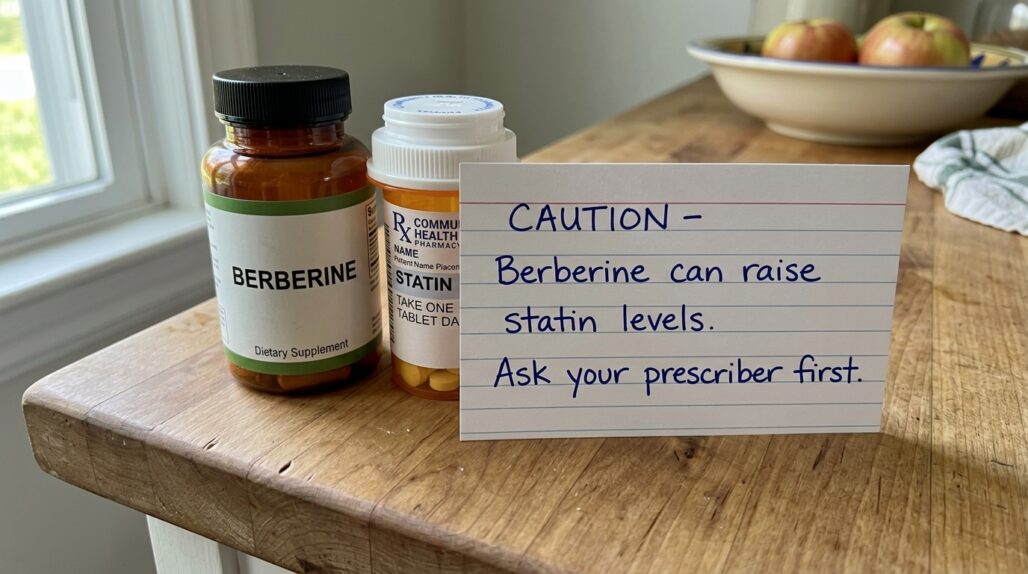
The people most affected are those already on a statin who see berberine marketed as a "natural" cholesterol or weight-loss aid and add it quietly. The risk is not berberine itself – it is the overlap. Both touch the same metabolic machinery, and that is where statin blood levels can climb.
Higher-risk groups include anyone on simvastatin or lovastatin (the statins most dependent on CYP3A4), people taking higher statin doses, older adults, and anyone on other drugs that already strain the same pathway. If that is you, the safe move is a conversation, not a self-experiment.
What berberine actually does to statin metabolism
Berberine is a plant alkaloid pulled from goldenseal, barberry, and related plants. Beyond its blood-sugar and lipid effects, it acts on the body's drug-clearing systems – and that is the heart of the interaction.
Berberine inhibits CYP3A4, the liver enzyme that breaks down a large share of prescription drugs, including several statins. It also blocks P-glycoprotein, a transporter that normally pumps drugs back out of cells. Slow both pathways at once and a statin can build up to higher blood levels than the prescribed dose was meant to produce.
That matters because statin side effects are dose-dependent. The FDA capped the highest simvastatin dose specifically because the muscle-injury signal rose with exposure, and the agency's simvastatin safety communication flagged that the risk often traces back to interactions with drugs that raise statin levels in the body.
Not every statin runs through CYP3A4 to the same degree. Simvastatin and lovastatin lean hardest on it, atorvastatin partly, while pravastatin, rosuvastatin, and pitavastatin mostly bypass it. A berberine interaction is more plausible with the first group and less so with the last.
How big is the effect?
Honest answer: the human data on berberine specifically raising statin levels is thinner than the mechanism suggests. We have strong pharmacology and limited head-to-head dosing studies, so the right posture is caution, not panic.
The clearest concern comes from a 2018 laboratory study showing that berberine combined with statins increased cardiotoxicity by inhibiting both CYP3A4 and the hERG cardiac ion channel, reported in Chemical and Biological Interactions. That is a cell and animal model, not a clinical trial in people, but it points the same direction as the enzyme data.
On the prescribing side, the FDA's ZOCOR labeling treats strong CYP3A4 inhibitors as a contraindication with simvastatin precisely because raising simvastatin levels raises the odds of myopathy and rhabdomyolysis. Berberine is not on that named list, but it works through the same mechanism, which is why "treat it as a real interaction" is the conservative read.
So the effect size is uncertain. Assume the potential to raise statin exposure is real, and let monitoring – not guesswork – manage it.
The combination some studies used (under supervision)
Here is the twist that fuels the trend: a few clinical studies deliberately combined berberine with a statin, and the pairing lowered cholesterol more than either alone. That is true, and it is also where people draw the wrong conclusion.
In a 2008 study published in Metabolism, researchers gave a berberine-plus-simvastatin combination to patients with high cholesterol. The combination cut LDL cholesterol by about 31.8%, beating simvastatin alone and berberine alone, with similar added benefit for total cholesterol and triglycerides. Because berberine lowers LDL by stabilizing the LDL-receptor pathway rather than blocking cholesterol synthesis the way statins do, the two mechanisms can add up.
The detail the headlines drop: that was a supervised clinical study, with researchers choosing the statin, the dose, and the monitoring. A trial that controls every variable is not a green light to combine the two at home with an over-the-counter capsule and no oversight.
If your doctor decides a berberine-statin combination makes sense for you, that is a clinical call backed by follow-up labs. Doing it yourself skips the monitoring that made the study safe.
Berberine, blood sugar, and the diabetes-drug overlap
Plenty of people reach for berberine for blood sugar, not cholesterol – and many of them are already on diabetes medication. That adds a second interaction worth naming.
Berberine can lower blood glucose, and stacking it on top of medications like metformin, sulfonylureas, or insulin can push blood sugar lower than intended. Some early data also suggests berberine may raise metformin levels by slowing its clearance. The practical result is a real, if usually modest, risk of hypoglycemia that calls for closer glucose monitoring.
The NCCIH is direct on the broader point: berberine has been shown to interact with prescription medicines, and anyone taking medication should talk with a health care provider before starting it. That guidance applies whether your statin, your diabetes drug, or both are in the picture. We cover the glucose side in more depth in our guide to low blood sugar with berberine and diabetes drugs.
Berberine also commonly causes gastrointestinal upset – cramping, diarrhea, constipation – which can muddy your read on whether a new symptom is the supplement, the statin, or the interaction.
What 'nature's Ozempic' and 'natural statin' get wrong
Berberine's recent fame rides on two labels: "nature's Ozempic" for weight loss and a "natural statin" for cholesterol. Both oversell what the evidence supports.
On weight loss, the DoD's Operation Supplement Safety is blunt – the "nature's Ozempic" framing is exaggerated and not supported by the evidence. One review found roughly 0.84 kg of weight reduction over 18 weeks, and when low-quality studies were excluded, even that small effect disappeared. That is not in the same universe as a GLP-1 medication.
The "natural statin" label is closer to reality but still misleading. Berberine can lower LDL, yet it is not a regulated, dose-standardized drug. Supplement potency and purity vary by brand, and these products are not reviewed by the FDA for effectiveness before sale. A capsule that lowers cholesterol is not automatically safe to combine with a prescription that works on the same enzymes.
The framing that actually keeps you safe: berberine behaves like a pharmacologically active drug, so treat it like one. If you are comparing options, our overview of supplements studied for high cholesterol lays out where the evidence is stronger and weaker.

What to do if you take a statin
The goal is not to scare you off berberine – it is to route the decision through someone who can see your full medication list. A few practical steps:
- Tell your prescriber and pharmacist before you start. Bring the actual product, since berberine content varies and some blends hide extra ingredients.
- Know your statin. A pravastatin or rosuvastatin user is on safer ground than a simvastatin user, but confirm rather than assume.
- Watch for muscle symptoms. New or worsening muscle pain, tenderness, or weakness is the signal that matters most with statins.
- Do not change your statin dose on your own to "make room" for a supplement. Dose decisions belong to your prescriber.
- Keep timing and brand consistent if you are cleared to use both, so any monitoring reflects a steady picture.
The same overlap logic applies to grapefruit, another CYP3A4 inhibitor that interacts with these drugs – see our piece on grapefruit and statins for the parallel.
The table below sorts the moving parts so you can see where your own situation lands.
| Factor | Lower concern | Higher concern |
|---|---|---|
| Your statin | Pravastatin, rosuvastatin, pitavastatin | Simvastatin, lovastatin |
| Statin dose | Low to moderate | High dose |
| Other interacting drugs | None on CYP3A4 | Other CYP3A4 inhibitors stacked |
| Diabetes medication | None | Metformin, sulfonylurea, insulin |
| Monitoring | Supervised, with labs | Self-stacking, no follow-up |
When to call a clinician
Some symptoms are worth a same-day call rather than a wait-and-see. If you are on a statin and notice unexplained muscle pain, tenderness, or weakness – especially if it spreads or comes with fatigue – flag it.
Dark or cola-colored urine alongside muscle pain can signal rhabdomyolysis, a rare but serious muscle breakdown, and warrants urgent care. The same goes for signs of liver strain like yellowing skin, severe fatigue, or right-upper-abdomen pain.
For blood sugar, if you take diabetes medication and feel shaky, sweaty, confused, or unusually hungry after starting berberine, check your glucose and treat a low promptly. Then loop in your prescriber about whether the combination still fits.
If you want a simple way to keep your full list straight before that conversation, you can log everything in our drug and supplement interaction checker or browse the broader ultimate guide to drug-supplement interactions.
FAQ
Can I take berberine and a statin at the same time? Not without checking first. Both work on cholesterol and berberine can slow how your body clears certain statins, so the safe step is to clear it with your prescriber or pharmacist before combining them.
Which statins interact most with berberine? The statins that depend most on the CYP3A4 enzyme – simvastatin and lovastatin, and to a lesser extent atorvastatin – are the ones where a berberine interaction is most plausible. Pravastatin, rosuvastatin, and pitavastatin mostly bypass that pathway.
Didn’t a study show berberine plus a statin lowers cholesterol better? Yes, a supervised clinical study found the combination cut LDL more than either alone. The key word is supervised – researchers controlled the dose and monitored patients, which is very different from self-stacking an over-the-counter capsule.
Is berberine really “nature’s Ozempic”? No. Independent safety reviewers, including the Department of Defense supplement safety program, call that framing exaggerated and unsupported. Any weight effect seen in studies has been small and faded once low-quality studies were excluded.
What symptoms mean I should stop and call a doctor? New or worsening muscle pain, tenderness, or weakness while on a statin, especially with dark urine, deserves prompt medical attention because it can signal muscle injury. Signs of low blood sugar after starting berberine on diabetes medication also warrant a call.
Does berberine interact with diabetes drugs too? It can. Berberine lowers blood glucose, so adding it to metformin, a sulfonylurea, or insulin may push blood sugar too low, and some data suggests it can raise metformin levels. Closer glucose monitoring and a clinician’s input are the right response.
Conclusion: route the combo through your prescriber
Berberine and statins are not automatically dangerous together, but they are not a casual stack either. They share the CYP3A4 and P-glycoprotein pathways, which means berberine can nudge certain statins to higher levels and raise the odds of muscle problems. The studies that paired them safely did so under medical supervision, with the dose and monitoring controlled – not as a social-media trend.
If you take a statin and want berberine for cholesterol or blood sugar, the next step is a short conversation with your doctor or pharmacist, ideally with the actual product in hand. That is the difference between borrowing a study's benefit and inheriting its risk.
To keep your full stack in one place before that visit, StackMyMed lets you log your medications and supplements and flag possible overlaps to raise with a pharmacist. It is a prompt for a better conversation, not a substitute for clinical judgment.
This article is for general educational purposes and is not a substitute for personalized medical advice. Talk with your doctor or pharmacist before starting, stopping, or combining any supplement and prescription medication.
Reviewed by the UsefulVitamins Editorial Team.
