
Stress support is the reason most people search for best ashwagandha supplements – but the “best” choice depends on one detail many labels hide: the extract type and the dose that research actually uses. This guide compares top options (capsules and powders), explains what KSM-66 means, and shows how to judge quality without getting lost in marketing. You’ll also learn practical dosing ranges, what to expect (and what not to), and who should be cautious before adding ashwagandha to a routine.
Summary / Quick Answer: Best Ashwagandha Supplements (at a glance)
If you want the best ashwagandha supplements overall, look for a standardized extract (often KSM-66) at a research-aligned dose, plus credible third-party testing.
Top picks by goal (quick shortlist):
- Best overall (research-forward, clean label): Transparent Labs KSM-66 (600 mg KSM-66 per serving)
- Best budget: Nutricost Ashwagandha (600 mg per serving)
- Best “sleep stack” style formula: Jacked Factory KSM-66 (includes absorption-support ingredients)
- Best blended focus formula: Hunter Evolve Hunter Focus (ashwagandha + nootropics/adaptogens)
- Best vegan blend: Future Kind Super Plant Complex (ashwagandha + other botanicals)
- Best powder format: Moon Juice Ashwagandha (powder option)
What to prioritize on any label:
- Extract name + standardization (for example, KSM-66)
- Dose per serving (many studies use ~600 mg/day of extract)
- Third-party testing and clear supplement facts
How to Choose the Best Ashwagandha Supplements (what matters most)
Most disappointment with ashwagandha comes from a simple mismatch: people buy a product that looks strong on the front label but is weak where it counts – the extract quality, standardization, and dose. Think of ashwagandha like coffee: “coffee” can mean a weak instant cup or a carefully measured espresso. The label details tell you which one you’re getting.
A quick “label checklist” you can use in 30 seconds
Look for these five items:
- Extract type and branding (example: KSM-66, Sensoril) rather than “ashwagandha powder” only
- Standardization (often stated as withanolides %)
- Dose per serving that matches the goal (stress studies commonly use around 600 mg/day of extract)
- Third-party testing (identity, heavy metals, contaminants)
- Minimal fillers and transparent amounts for every ingredient
To go deeper on what testing seals and documentation actually mean, see these practical supplement quality indicators.
Root powder vs standardized extract: why it changes results
Many products use either:
- Root powder (ground herb). It can be fine, but potency varies widely.
- Standardized extract (concentrated, measured active compounds). This is what most clinical trials use.
According to the NIH Office of Dietary Supplements overview on ashwagandha, human studies commonly evaluate standardized extracts and report outcomes like perceived stress and sleep-related measures. That doesn’t mean powder never works, but it does mean extracts are easier to dose consistently.
Dose: why “more” is not always better
A common misconception is that a 1,500-2,000 mg serving must be superior. In reality, the best-supported dose is the one used in studies, not the biggest number on the bottle.
Typical evidence-aligned patterns you’ll see:
- ~300 mg twice daily (600 mg/day total) of a standardized root extract is common in stress-focused research.
- Some formulas use lower doses when paired with other calming ingredients.
- Higher doses can increase side effects (GI upset, drowsiness) without guaranteeing better outcomes.
If your primary goal is stress support, you may also benefit from a broader plan that includes magnesium, L-theanine, and sleep hygiene. UsefulVitamins lays out options in supplements for stress relief.
Quick visual: “good-better-best” buying guide
| If you want… | Look for… | Avoid… |
|---|---|---|
| Consistent results | Standardized extract + stated withanolides | “Proprietary blend” with hidden amounts |
| Research alignment | ~600 mg/day extract (often split doses) | Megadoses with no extract details |
| Cleaner formulation | Simple capsule, clear excipients | Multiple fillers and vague “complexes” |
| Safety confidence | Third-party testing and documentation | No testing info, no batch data |
Best Ashwagandha Supplements by Use Case (top picks compared)
Transparent Labs KSM-66 Ashwagandha 600 mg, 60 Capsules
Transparent Labs KSM-66 Ashwagandha offers a clinically dosed 600 mg of organic, full-spectrum root extract standardized to 5% withanolides, backed by research for reducing stress, lowering cortisol, improving mood, cognition, sleep, and hormonal balance. While Amazon-specific data like ASIN, ratings, and price are unavailable, the product’s transparency on third-party testing and alignment with studies (300-600 mg daily for 8-12 weeks) make it a strong recommendation for stress management and vitality support.[1]
Nutricost Ashwagandha 600 mg, 120 Capsules
Nutricost Ashwagandha 600mg, 120 capsules earns a strong 4.6-star rating from over 6,500 Amazon reviews and high sales volume, praised for its potent dose, clean ingredients, and budget-friendly price around $14.95, making it a solid affiliate recommendation for stress support despite lacking third-party testing.
Jacked Factory KSM-66 Ashwagandha 600 mg, 60 Capsules
This product is noted for its sleep stack formula, including additional absorption-support ingredients.
Future Kind Super Plant Complex – Vegan Ashwagandha Blend, 60 Capsules
No relevant search results were found for this product on Amazon.com or related sources, preventing verification of ASIN, ratings, reviews, pricing, or third-party testing. Cannot recommend without real data.
Moon Juice Ashwagandha Powder, 6.5 oz
No Amazon product page found for Moon Juice Ashwagandha Powder 6.5 oz in search results, preventing verification of ASIN, ratings, reviews, price, or Amazon-specific feedback; product is sold directly on Moon Juice site as a 15:1 full-spectrum organic ashwagandha root extract for stress reduction, but cannot recommend as Amazon affiliate without confirmed listing.
Not everyone needs the same format. Some people want a single-ingredient capsule to “test” how they respond. Others want a blend that targets sleep or focus. Below is a comparison of well-reviewed options frequently highlighted in roundups such as Fortune’s review of ashwagandha supplements, BarBend’s ashwagandha supplement testing roundup, and Garage Gym Reviews’ ashwagandha guide.
Quick comparison table (what each is best for)
| Product type | Example product | Why it stands out | Best for |
|---|---|---|---|
| Single-ingredient KSM-66 capsule | Transparent Labs KSM-66 | Clinically common dose, simple label, testing emphasis | Most people starting out |
| Budget capsule | Nutricost Ashwagandha | Low cost per serving, straightforward dosing | Tight budgets |
| “Sleep-leaning” capsule | Jacked Factory KSM-66 | Includes absorption-support ingredients in some formulas | Night routines |
| Focus blend | Hunter Evolve Hunter Focus | Ashwagandha paired with cognition ingredients | Workdays, studying |
| Vegan adaptogen blend | Future Kind Super Plant Complex | Plant-based formula with multiple botanicals | Vegan preferences |
| Powder | Moon Juice Ashwagandha | Mixable format, flexible dosing | Smoothies, tea routines |
What “best overall” usually means in practice
Across expert reviews, Transparent Labs KSM-66 is often positioned as a top all-around pick because it checks the boxes that matter most:
- 600 mg KSM-66 per serving (a common research-aligned target)
- Straightforward formulation (easier to evaluate your response)
- A brand identity built around transparent labeling and testing practices
KSM-66 is a patented root extract used in multiple human studies. If you see KSM-66 on the label, you’re usually getting a consistent extract profile rather than a generic “ashwagandha” ingredient.
When a blend makes more sense than a single-ingredient capsule
Single-ingredient products are ideal for clarity. But blends can be useful if you already know you tolerate ashwagandha and want a specific outcome.
Examples of blend logic:
- Sleep support: ashwagandha + calming ingredients may fit better than ashwagandha alone. If sleep is your priority, compare your options with this sleep supplement protocol.
- Focus and mental performance: formulas that pair ashwagandha with ingredients like bacopa or lion’s mane aim at attention and cognitive stamina. If you’re exploring that route, you may also like this guide to adaptogenic mushrooms.
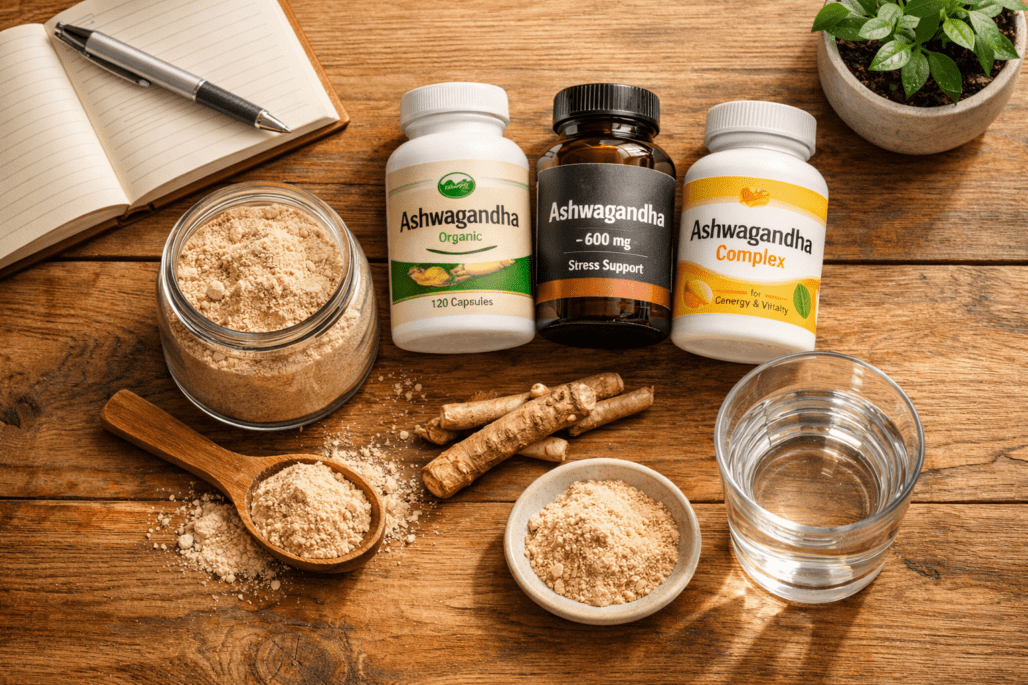
Image alt text: Comparison chart of best ashwagandha supplements by goal and format (capsule vs powder vs blend)
What the Research Says: Benefits, Timing, and Realistic Expectations
Ashwagandha (Withania somnifera) is often called an adaptogen, meaning it may help the body respond to stress. The strongest evidence cluster is still around stress and anxiety-related outcomes, with growing (but more variable) research on sleep, exercise performance, and some aspects of cognition.
A good way to set expectations is to separate “possible” benefits from “proven for everyone.” Supplements rarely work like painkillers. They tend to shift trends over time.
Most supported: stress and perceived anxiety
Many randomized controlled trials evaluate ashwagandha for:
- perceived stress scores
- self-reported anxiety symptoms
- cortisol or stress-related biomarkers (varies by study)
The NIH Office of Dietary Supplements overview on ashwagandha summarizes human research and typical dosing patterns, including common extract doses used in trials. This is helpful because it anchors your choice to what has actually been tested.
Actionable takeaway: If stress is your main goal, prioritize a standardized extract and a dose that mirrors study designs (often around 600 mg/day), then reassess after 4-8 weeks.
Sleep: helpful for some, but dose and timing matter
Ashwagandha is frequently used at night, but effects vary:
- Some people feel calmer and fall asleep easier.
- Others feel no change, or feel mildly groggy the next morning.
Practical timing options:
- Night dosing: start 1-2 hours before bed if you’re targeting sleep
- Split dosing: morning + evening if you’re targeting all-day stress resilience
- Morning dosing: if nighttime dosing causes vivid dreams or next-day heaviness
Actionable takeaway: If you’re already using a sleep stack, add ashwagandha as the “last variable” so you can tell what changed. The step-by-step approach in the sleep supplement protocol makes this much easier.
Performance and training: promising, not magic
You’ll often see ashwagandha marketed for strength, testosterone, and body composition. Some studies suggest it may support training outcomes in certain groups, but results depend on:
- training status
- diet and sleep
- extract type and dose
- study duration
Actionable takeaway: If performance is your goal, treat ashwagandha as a “supporting actor.” Your training plan, protein intake, and sleep will drive most results.
Quick visual: “when you might notice effects”
| Timeframe | What people may notice | What to do |
|---|---|---|
| 3-7 days | Subtle calm, slightly better sleep onset (some people) | Keep dose steady, don’t stack multiple new supplements |
| 2-4 weeks | More consistent stress response, improved sleep quality (some) | Reassess stress scores, sleep metrics, and side effects |
| 6-8 weeks | Best window to judge value | Decide: continue, adjust dose, or stop |
Safety, Side Effects, and Who Should Avoid Ashwagandha
Ashwagandha is widely used, but “natural” is not the same as “risk-free.” Most side effects are mild, yet there are important exceptions – especially if you take medications or have certain health conditions.
Common side effects (and how to reduce them)
Reported side effects can include:
- stomach upset, nausea, or loose stools
- drowsiness or “heavy” feeling
- headaches (less common)
How to lower the odds:
- take with food if you get GI symptoms
- start with a lower dose for 3-7 days, then increase
- avoid combining multiple sedating supplements at first
Medication interactions: pay attention to sedation
Ashwagandha can have calming effects, which may add to the effects of sedative medications or other sleep aids. If you take anything that makes you drowsy, it’s worth being extra cautious.
For a focused breakdown, see ashwagandha and sedative medications.
Who should be cautious (or skip it)
Talk with a clinician before using ashwagandha if you:
- are pregnant or trying to conceive (safety data is limited, and many clinicians advise avoiding)
- have thyroid disease or take thyroid medication (ashwagandha may affect thyroid hormones in some people)
- have autoimmune disease or take immunosuppressants (immune effects are still being studied)
- have liver disease or unexplained elevated liver enzymes (rare liver injury reports exist with some supplements, and product quality varies)
A key point: adverse events can be related to product quality as much as the ingredient itself. That’s why third-party testing and transparent labeling matter. UsefulVitamins explains what to look for in supplement quality indicators.
Quick visual: “red flags” checklist before you buy
| Red flag | Why it matters | Better option |
|---|---|---|
| No extract type listed | Potency and composition unclear | Standardized extract (KSM-66 or similar) |
| Proprietary blend | You can’t verify dose | Fully disclosed label |
| No testing info | Higher contamination/adulteration risk | Third-party tested with batch details |
| Mega-dose claims | More side effects, not necessarily more benefit | Evidence-aligned dosing |

Image alt text: Safety checklist for ashwagandha supplements including interactions, side effects, and label red flags
Conclusion: Choosing the Best Option Comes Down to Extract, Dose, and Testing
The best ashwagandha supplements are the ones that match the research and your goal: a standardized extract (often KSM-66), a realistic daily dose (commonly around 600 mg/day of extract in stress studies), and credible third-party testing. From there, format is personal – capsules for simplicity, powders for flexibility, and blends for targeted sleep or focus routines.
If you’re building a calmer day-to-day baseline, start with a single-ingredient product and track stress and sleep for 4-8 weeks. For next steps, compare broader options in supplements for stress relief and, if nights are the main issue, follow the sleep supplement protocol to keep changes measurable and safe.
As an Amazon Associate, I earn from qualifying purchases. Product recommendations are based on real reviews and independent research.
