
Choosing turmeric curcumin supplements comes down to one thing most labels don’t make obvious: how much curcumin your body can actually absorb. Turmeric root naturally contains only about 2-5% curcumin by weight, so “high turmeric mg” often sounds impressive but delivers less than you’d think. This guide explains what to look for (standardization, absorption tech, and testing), what doses research commonly uses, and how to pick a product that matches your goal – joint comfort, inflammation support, or digestion.
Summary / Quick Answer: What are the best turmeric curcumin supplements?
The best turmeric curcumin supplements are standardized (often to ~95% curcuminoids) and use an absorption booster such as phytosome (phospholipid-bound), piperine (black pepper extract), fenugreek fiber, or liposomal delivery.
Quick checklist (most important first):
- Choose an “enhanced absorption” form (phytosome, piperine, fenugreek, liposomal).
- Look for a clear curcuminoid amount (not just “turmeric powder”).
- Aim for 500-1,000 mg/day to start (enhanced forms), split doses if you go higher.
- Take with a meal that contains fat for better uptake.
- Prefer third-party tested brands and clear manufacturing standards.
If you’re unsure about interactions, use the site’s Drug-Supplement Interaction Checker before starting.
Turmeric vs curcumin: what you’re really buying (and why absorption matters)
Here’s the uncomfortable truth: most people buy turmeric for curcumin’s benefits, but curcumin is a small slice of turmeric. Turmeric root typically contains only about 2-5% curcumin by weight, which is why many supplements use extracts standardized to high curcuminoid percentages rather than plain powder.
Even then, curcumin has a second problem: it’s poorly absorbed on its own. Many formulations exist because “standard curcumin” can have very low bioavailability. Some technologies can dramatically increase blood levels compared with unformulated curcumin, which is why two products with the same milligrams can perform very differently in real life. Consumer and clinician-facing summaries, like Healthline’s overview of supplement forms, repeatedly highlight absorption as the deciding factor when comparing products.
A simple way to think about it
Curcumin is like a nutrient locked in a tough container. The “key” is the delivery system. Without that key, higher doses may not translate into stronger effects.
What label terms actually mean (mini glossary)
- Standardized extract (often 95% curcuminoids): Concentrated curcumin compounds, not whole turmeric.
- Phytosome (phospholipid complex): Curcumin bound to phospholipids to improve uptake.
- Piperine / BioPerine: Black pepper extract that can increase absorption by slowing breakdown.
- Fenugreek fiber complexes: Use plant fibers to increase curcumin availability.
- Liposomal curcumin: Encapsulated in fat-like particles for delivery.
Visual: “Powder vs extract vs enhanced extract”
| Type | What it usually contains | Best for | Main drawback |
|---|---|---|---|
| Turmeric powder | Low % curcumin | Cooking, mild daily use | Low curcumin and low absorption |
| Standardized curcumin extract | Higher % curcuminoids | Targeted supplementation | Still limited absorption if unformulated |
| Enhanced curcumin (phytosome, piperine, etc.) | Curcumin + delivery tech | Most evidence-aligned use | Often costs more |
For a deeper framework on choosing trustworthy products, see Supplement Quality Indicators.
Evidence-based benefits: what curcumin may help with (and what it won’t)
Garden of Life mykind Organics Turmeric Curcumin, 60 Vegan Capsules
This product is a high-quality turmeric curcumin supplement that includes enhanced absorption technology, making it relevant to the article’s focus on effective curcumin absorption.
People often start curcumin for one of three reasons: joint comfort, inflammation support, or digestive support. Research suggests curcumin can influence inflammatory pathways and oxidative stress, but outcomes vary widely based on dose, formulation, and the person taking it.
The most consistent real-world takeaway is this: studies that show clearer effects often use enhanced-bioavailability forms, not plain turmeric powder. Summaries like Mayo Clinic’s community guidance also note that supplements can provide higher curcuminoid concentrations than culinary turmeric, which helps explain why capsules may outperform “golden milk” for targeted goals.
Joint comfort and mobility
Curcumin is commonly used for joint stiffness and day-to-day comfort, especially in active adults. Some trials suggest improvements in pain scores and function, but results differ depending on the formulation and comparison group (placebo vs NSAIDs, for example). If joint support is your priority, it’s reasonable to prioritize phytosome or other enhanced forms and assess your response over 4-8 weeks.
Inflammation markers and recovery
Curcumin is often described as anti-inflammatory, but it’s better to think in terms of supporting a healthy inflammatory response. Some research suggests it may help reduce markers like CRP in certain populations, but it’s not a substitute for medical care. If your goal is recovery support, consistency and formulation quality matter more than chasing the highest milligram number.
Digestion and gut comfort (often with ginger)
Some products pair curcumin with ginger, which may be helpful for people who want digestive comfort alongside inflammation support. Individual tolerance varies – for some, high-dose curcumin can cause GI upset.
Visual: “Benefit-to-formulation match”
| Goal | What to look for | Helpful add-ins |
|---|---|---|
| Joint comfort | Phytosome or other enhanced form | Vitamin D, ginger |
| Inflammation support | Standardized curcuminoids + absorption booster | Black pepper extract |
| Digestive comfort | Moderate dose, take with food | Ginger, probiotics (product-dependent) |
If you’re exploring curcumin alongside medical treatment, read Turmeric Chemotherapy Efficacy to understand why timing and oversight matter.
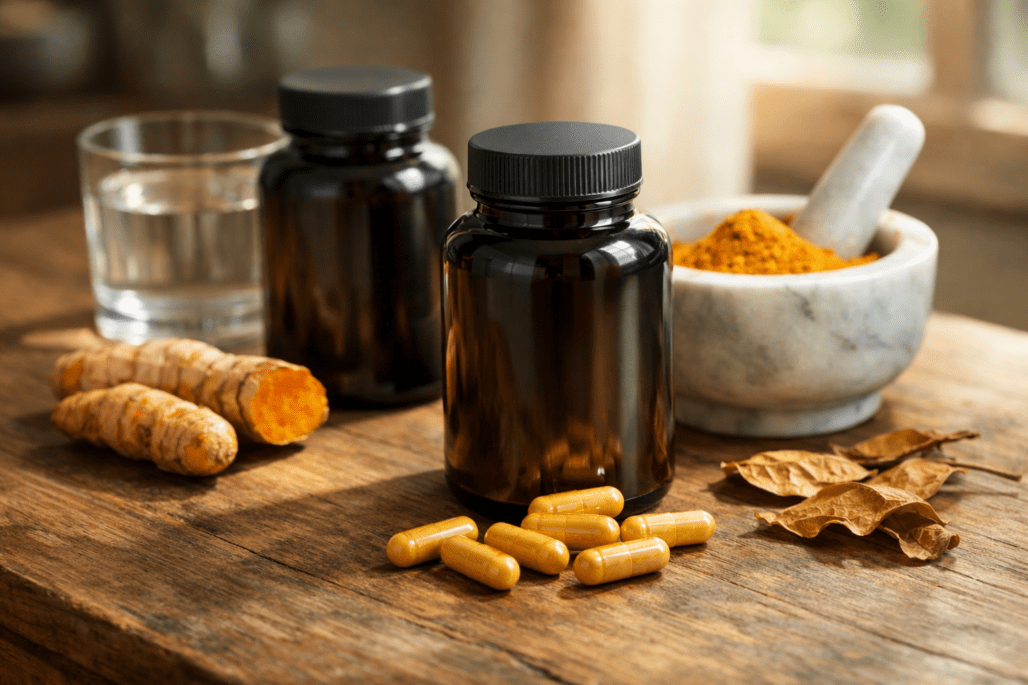
How to choose: a quality checklist for turmeric curcumin supplements
Turmeric Curcumin with BioPerine, 1500mg, 120 Capsules
NutraBlast Turmeric Curcumin with BioPerine offers a solid 1500mg dose per serving with black pepper extract for enhanced bioavailability, earning 4.5 stars from over 2,500 Amazon reviews praising joint relief and value. While not third-party tested, it’s a cost-effective choice at ~$20 for 120 capsules (2-month supply) for those seeking an affordable turmeric supplement, though consider established brands if purity is a top priority.
Most shoppers compare brands by price or “total turmeric mg.” That’s the fastest way to get misled. A better approach is to compare the few label details that actually predict results: standardization, absorption method, testing, and dose clarity.
Health and consumer reviews that compare top products (including roundups from reputable health publishers) tend to converge on the same short list of quality signals: standardized extracts, enhanced absorption, and credible testing.
1) Prioritize standardized curcuminoids (not just turmeric powder)
If the label only lists “turmeric root powder,” you may be getting a small amount of curcumin. Look for:
- “Standardized to X% curcuminoids” (often 95%)
- A clear milligram amount of curcuminoids per serving
2) Choose an absorption strategy you can tolerate
Different boosters work in different ways:
- Piperine (black pepper extract): Effective, but may interact with medications for some people.
- Phytosome: Often well tolerated and widely used in research-backed products.
- Fenugreek fiber complexes: Promising bioavailability data in some formulations.
- Liposomal: Useful for people who dislike pepper-based products.
A Life Extension review discussing high-quality curcumin formulations highlights how delivery systems can change measurable curcuminoid levels substantially compared with standard forms.
3) Look for third-party testing and good manufacturing practices
Curcumin compounds can degrade, and contamination is a real concern across supplements. Prefer brands that clearly state:
- Third-party testing (USP, NSF, or equivalent independent verification)
- cGMP manufacturing
- Full label transparency (no proprietary blends hiding doses)
Use Supplement Quality Indicators as a quick reference when you’re comparing labels.
4) Match the product form to your routine
Capsules are the most common, but not the only option:
- Capsules: simplest dosing, best for consistent daily use
- Gummies: convenient, but often lower potency and added sugars
- Liquids/sprays: useful if you can’t swallow pills, but check actual curcuminoid content
Visual: “Shopping checklist” (save this)
- Standardized curcuminoids listed: Yes/No
- Absorption booster listed: Yes/No
- Third-party tested: Yes/No
- Clear per-serving curcuminoid dose: Yes/No
- Fits your schedule (capsule/gummy/liquid): Yes/No
For planning combinations safely (for example, curcumin plus omega-3s or magnesium), consult the Supplement Stacking Guide.
Curcumin dosage, timing, and safety: how to take it correctly
Nature’s Nutrition Turmeric Curcumin with Ginger, 180 Capsules
This product combines turmeric curcumin with ginger for additional health benefits and uses an absorption enhancer, making it a suitable option for readers looking for effective supplements.
Most people don’t fail with curcumin because they chose the “wrong” brand. They fail because they take an ineffective dose, take it inconsistently, or take it in a way that reduces absorption.
In many studies and clinical-use discussions, effective daily intakes often land in the 500-2,000 mg/day range for enhanced formulations, depending on the specific product design and the goal. Starting lower helps you assess tolerance.
A practical dosing plan (for most healthy adults)
- Start: 500 mg/day of an enhanced-absorption curcumin
- Adjust: after 1-2 weeks, consider 1,000 mg/day if needed
- Higher intakes: if going above 1,000 mg/day, split into 2 doses
Timing: take it with food (and ideally fat)
Curcumin is fat-soluble. Taking it with a meal that includes fat can improve uptake. Many people do best with breakfast and/or dinner.
If you want a routine that’s easy to follow, use the Supplement Timing Optimizer to build a schedule around meals, workouts, and other supplements.
Safety and interactions (don’t skip this)
Curcumin is generally well tolerated, but higher doses can cause:
- stomach upset
- nausea
- loose stools
Be cautious and talk to a clinician if you:
- take blood thinners or antiplatelet medications
- have gallbladder disease or bile duct obstruction
- are pregnant or breastfeeding
- have surgery scheduled (many clinicians advise stopping certain supplements pre-op)
If you’re taking medications, run a quick check with the Drug-Supplement Interaction Checker.
Visual: “Dose and tolerance guide”
| If you feel… | Try this adjustment |
|---|---|
| No changes after 4-8 weeks | Confirm it’s enhanced absorption; consider dose increase |
| Mild GI upset | Take with a larger meal; reduce dose; split dosing |
| Heartburn | Avoid taking on an empty stomach; consider non-piperine form |
| You’re on multiple meds | Check interactions before changing dose |

Conclusion: the smart way to pick a curcumin supplement
Turmeric curcumin supplements work best when you choose for absorption, clarity, and consistency, not just the biggest number on the bottle. Look for standardized curcuminoids, an evidence-aligned delivery method (phytosome, piperine, fenugreek, or liposomal), and credible quality testing. Start with a moderate dose, take it with food, and give it several weeks to judge results.
Next steps:
- Use Supplement Quality Indicators to compare labels quickly.
- Build a sustainable routine with the Supplement Timing Optimizer, especially if you take multiple supplements.
As an Amazon Associate, I earn from qualifying purchases. Product recommendations are based on real reviews and independent research.
