
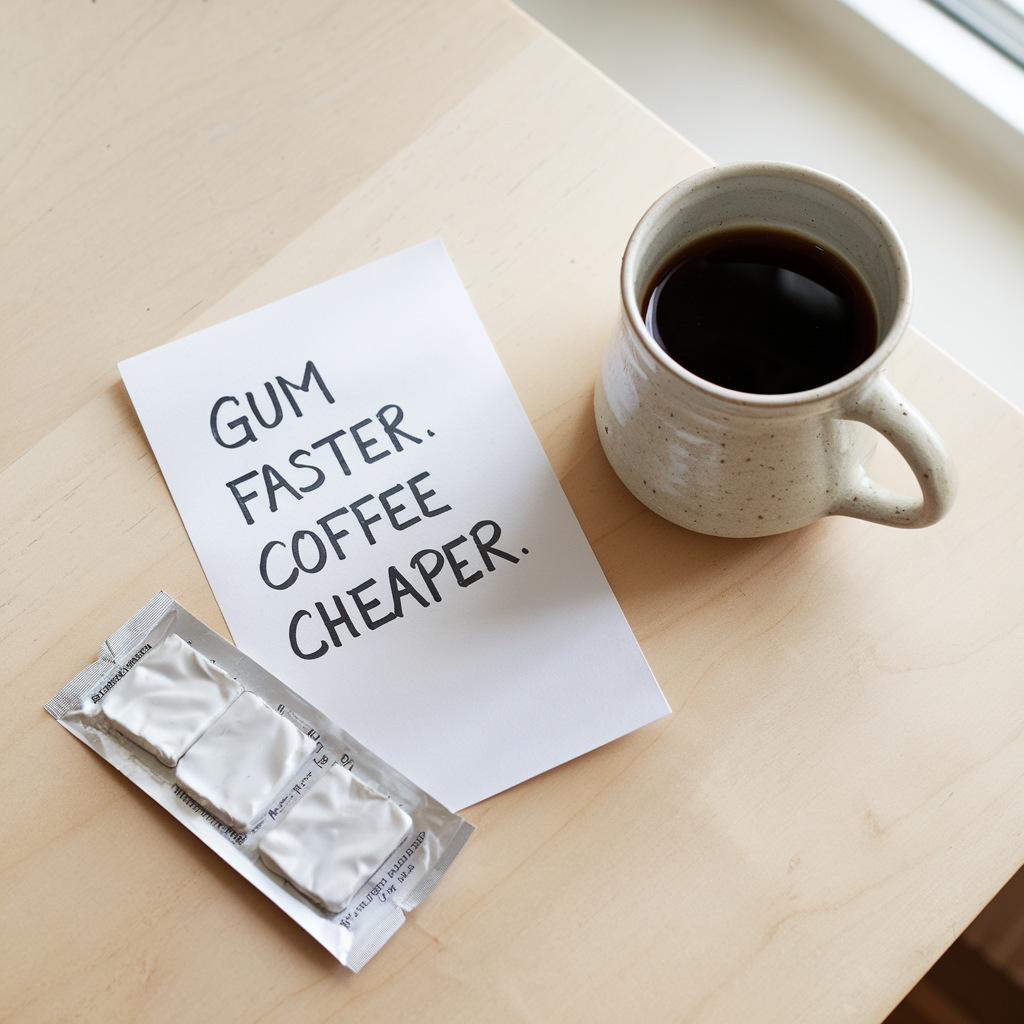
Caffeine gum is chewing gum with 40 to 100 mg of caffeine pressed into each piece, absorbed partly through the lining of the mouth, while coffee delivers a variable 95 to 250 mg per cup through the stomach. We opened the pharmacokinetic trials, pulled the labels from the NIH label database and ran the price math at September 2026 prices. The speed difference is real and measured; the cost difference depends entirely on where your coffee comes from. We have no relationship with any brand named on this page.
Before you decide
Both products deliver the same drug, so the same limits apply. The FDA's caffeine guidance cites 400 mg a day as an amount not generally associated with negative effects for most healthy adults, and puts a 12-ounce cup of regular brewed coffee at 113 to 247 mg. Two large cafe coffees or four 100 mg gum pieces can put you at that ceiling before lunch.
Some readers should not choose between these at all without a doctor. If you are pregnant, the European Food Safety Authority sets the line at 200 mg a day from all sources. If you are under 18, have a heart rhythm problem, take blood pressure medication, or have an anxiety disorder that caffeine worsens, the format question can wait until your prescriber has weighed in. This is general information, not medical advice; your doctor or pharmacist outranks any website, including this one.
This page is for adults who already use caffeine and want to know whether gum earns a place next to, or instead of, their coffee. Gum is a tool for timing; coffee is a beverage that happens to carry caffeine. That distinction settles most of the comparison.
What you are actually comparing
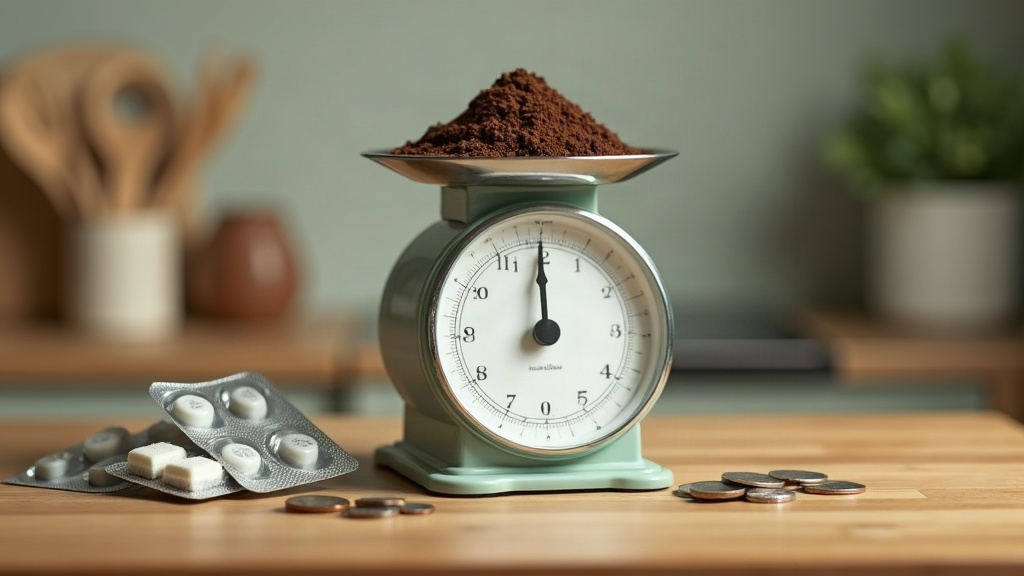
A piece of caffeine gum is a fixed dose. Neuro's Energy and Focus product page states 40 mg of natural caffeine and 60 mg of L-theanine per piece, matching the 80 mg and 120 mg per two-piece serving on its NIH label database record. The Run Gum label record lists 50 mg caffeine, 20 mg taurine and small amounts of B6 and B12 per piece, two pieces to a packet. Military Energy Gum, the brand built on the army research below, lists 100 mg per piece on its FAQ page. You know the dose to the milligram before you chew.
Coffee is not a fixed dose. The USDA FoodData Central entry for brewed coffee gives 40 mg of caffeine per 100 g, about 95 mg in an 8-ounce cup, with the analytical samples ranging from 30 to 44 mg per 100 g. The USDA entry for restaurant espresso gives 212 mg per 100 g, about 63 mg in a 1-ounce shot. Bean, roast, grind and pour size move those numbers by a factor of two, which is why the FDA range for a 12-ounce cup is so wide.
The other difference is what rides along. Gum brings sugar alcohols (sorbitol, xylitol), sweeteners such as sucralose or monk fruit, and in Neuro's case a real dose of L-theanine, covered in our L-theanine dose calculator. For the wider format question, our functional gum vs gummies vs pills guide covers which ingredients suit which format.
Speed: which hits first
The clearest data come from a 2002 pharmacokinetic study in the International Journal of Pharmaceutics, run at an army research institute with 84 healthy non-smoking men, 12 per group. Volunteers received 50, 100 or 200 mg of caffeine as gum or as a capsule, with blood drawn from 5 minutes out to 29 hours. Mean time to peak was 44.2 to 80.4 minutes for gum against 84.0 to 120.0 minutes for capsules, and the absorption rate constant was higher for gum (3.21 to 3.96 per hour against 1.29 to 2.36).
Speed did not cost total exposure. Relative bioavailability of the gum was 64, 74 and 77 percent at 50, 100 and 200 mg, or 75, 87 and 90 percent once corrected for the 15 percent of caffeine left in the chewed gum, and peak concentration did not differ significantly at any dose. The comparison arm was a capsule, not a cup of coffee, so treat 84 to 120 minutes as a swallowed-caffeine benchmark rather than a coffee measurement.
Why is gum faster? A 2019 study in Food and Function chewed caffeinated gum for 2, 5 or 10 minutes and found release rose with chewing time. It also saw two separate plasma caffeine peaks: one from absorption through the mouth lining, one later from the gut once the swallowed saliva reached the stomach. Chew for less than five minutes and you are leaving part of the dose in the gum.
The timing trials agree. A 2013 cycling study in the Journal of Strength and Conditioning Research gave eight male cyclists 300 mg of caffeine gum at 120, 60 or 5 minutes before a time trial. Performance improved only when the gum was chewed 5 minutes before the effort; the 60 and 120 minute doses did not improve performance significantly against placebo. That is one trial of eight people, but it matches the pharmacokinetics.
A 2025 randomized trial in the Journal of the International Society of Sports Nutrition ran the format question directly: 16 resistance-trained men took 4 mg/kg of caffeine as a capsule 60 minutes before lifting or as gum 5 minutes before. Both raised one-rep max by 2.1 to 5.0 percent and power by 6.1 to 20.0 percent, with no difference between formats. The gum group reported gastrointestinal discomfort less often (12.5 percent against 37.5 percent) and palpitations at 24 hours not at all (0 percent against 25 percent). The authors reported no conflict of interest.
The practical rule is short. Chew gum 5 to 10 minutes before the thing you need it for, keep chewing for at least five minutes, and expect the effect to build over the first hour. Drink coffee 30 to 60 minutes ahead if timing matters. Our caffeine dose calculator converts your body weight into the 3 to 4 mg/kg figures these trials used.
The numbers side by side
All figures below come from the trials and labels linked above, the USDA database and the brands' own product pages, checked in September 2026. Coffee caffeine is the USDA average for an 8-ounce cup; the FDA range for 12 ounces is 113 to 247 mg.
| Measure | Caffeine gum | Brewed coffee |
|---|---|---|
| Caffeine per unit | 40, 50 or 100 mg per piece, fixed | about 95 mg per 8 oz, 113 to 247 mg per 12 oz |
| Time to peak blood level | 44 to 80 minutes | 84 to 120 minutes (capsule benchmark) |
| First noticeable effect | reported within minutes in field use; one trial saw a benefit with gum chewed 5 minutes before effort; peak at 44 to 80 minutes | not measured in these trials |
| Absorption route | mouth lining first, gut second (two peaks) | gut only |
| Relative bioavailability | 64 to 77 percent of capsule (75 to 90 corrected for release) | reference |
| Dose control | exact, per piece | varies about 2x by bean, brew and size |
| GI discomfort (4 mg/kg trial) | 12.5 percent | 37.5 percent (capsule arm) |
| Sweeteners and additives | sorbitol, xylitol, sucralose or monk fruit; theanine or taurine by brand | none unless you add them |
| Cost per 100 mg, home | about $0.41 to $1.87 by brand | about $0.22 to $0.32 |
| Cost per 100 mg, bought out | same as above, no premium | not published; chain menus do not list a national price |
| Fits in a pocket | yes | no |
Read the table as two different questions. On speed and dose precision, gum wins every row; on price and simplicity, coffee brewed at home wins every row. The rest of this article is about which of those questions is yours.
Cost per 100 mg: the honest math
Start with coffee, because its price has a public source. The Bureau of Labor Statistics average price series puts 100 percent ground roast coffee at $9.299 per pound for August 2026, the latest month published. The National Coffee Association brewing guide recommends 1 to 2 tablespoons of ground coffee per 6 ounces of water, roughly 7 to 13 g of grounds for an 8-ounce cup. We used 10 g as a middle figure and 15 g for a strong pour.
At 10 g a cup, a 454 g pound brews about 45 cups at $0.21 each. With the USDA average of 95 mg per cup, that is about $0.22 per 100 mg of caffeine brewed at home, rising to about $0.32 per 100 mg if you brew strong with 15 g. Water, electricity and the machine are extra, and none of them changes the order of magnitude.
Cafe coffee is where we have to stop stating facts. We tried to pull a brewed-coffee menu price from the chains' own sites and could not: two blocked our requests and the others load prices per store through scripts. If your local cup costs $3 for 12 ounces, the USDA rate scales to about 142 mg, which is about $2.11 per 100 mg; at the FDA's low end of 113 mg the same cup is $2.65 per 100 mg. Plug in your own receipt.
Now the gum, from brand prices checked in September 2026. Neuro Energy and Focus sells a 54-piece pack for about $24.99, which is $0.46 per 40 mg piece, or about $1.16 per 100 mg; the 90-piece pack at about $30.99 drops that to about $0.86. Neuro Extra Strength carries 100 mg per piece at about $29.99 for 54, so about $0.56 per 100 mg, and about $0.41 at the 90-piece price of $36.99.
Run Gum's Energy Gum Original is about $22.49 for 12 two-piece packets, 24 pieces of 50 mg, which is $0.94 a piece and about $1.87 per 100 mg. Military Energy Gum lists 100 mg per piece and sells an 18-pack box of 90 pieces for about $28.99 on Amazon as of September 2026, which works out to about $0.32 a piece and $0.32 per 100 mg, the cheapest per milligram of the three.
| Product | Caffeine per piece | Pack | Price | Per piece | Per 100 mg |
|---|---|---|---|---|---|
| Neuro Energy and Focus | 40 mg | 54 pieces | about $24.99 | about $0.46 | about $1.16 |
| Neuro Energy and Focus | 40 mg | 90 pieces | about $30.99 | about $0.34 | about $0.86 |
| Neuro Extra Strength | 100 mg | 54 pieces | about $29.99 | about $0.56 | about $0.56 |
| Neuro Extra Strength | 100 mg | 90 pieces | about $36.99 | about $0.41 | about $0.41 |
| Run Gum Energy Gum Original | 50 mg | 24 pieces (12 packets) | about $22.49 | about $0.94 | about $1.87 |
| Military Energy Gum | 100 mg | 5 per pack, 18 packs (90 pieces) per box on Amazon | about $28.99 per box on Amazon, September 2026 | about $0.32 | about $0.32 |
| Coffee, brewed at home | about 95 mg per 8 oz | 1 lb grounds, about 45 cups | about $9.30 | about $0.21 per cup | about $0.22 |
So the ranking runs: home coffee at about $0.22, the strongest gum at about $0.41 to $0.56, the popular 40 mg gum at about $0.86 to $1.16, the 50 mg sports gum at about $1.87, and cafe coffee above all of them at any plausible menu price. The cheapest gum we priced costs about 1.5 times what home brewing does, and the most expensive gum more than eight times as much. We break the per-brand math down further in our caffeine gum roundup.
Who should pick which
Pick gum when the moment is the point. Shift workers, long-haul drivers, exam takers and athletes warming up all have a specific 10-minute window where a 44 to 80 minute peak beats an 84 to 120 minute one. The same goes for anyone whom coffee on an empty stomach sends to the bathroom; the 2025 trial's lower gastrointestinal complaint rate for gum comes from one small study, but it matches what many coffee-sensitive people report.
If Neuro's 60 mg of L-theanine per piece is part of the appeal, our full Neuro Gum review weighs that against the price, and our Military Energy Gum review covers the 100 mg option. Neither adds anything a second cup could not, except the clock.
Pick coffee when you drink coffee because you like coffee. Nothing about gum improves on a morning cup you were going to have anyway, and at about $0.22 per 100 mg brewed at home it is the cheapest caffeine you can buy. Coffee also carries no sugar alcohols, which matters if sorbitol or xylitol loosen your stomach. If coffee itself is the gut problem, our mushroom coffee roundup covers that aisle.
Use both if you want, but count the milligrams. A home cup at breakfast plus a 100 mg piece before the 3 pm meeting is about 195 mg, well inside the FDA's 400 mg figure; two cafe cups plus two pieces can be 600 mg. Caffeine headaches usually come from too much or from withdrawal, not from the format, as we explain in our guide to supplements that can cause headaches.
Whichever you choose, respect the clock at the other end of the day. A 2013 sleep study in the Journal of Clinical Sleep Medicine gave 400 mg of caffeine at bedtime, 3 hours before, or 6 hours before, and every timing cut sleep measurably against placebo. No sleep aid fixes that afterwards, as we found when we asked whether sleep gummies work. A 100 mg piece chewed at 5 pm still leaves roughly 25 to 60 mg of caffeine in your blood at 11 pm on a three to eight hour half-life.
FAQ
How fast does caffeine gum work?
Faster than anything you swallow. In the 2002 army pharmacokinetic study, gum reached peak blood caffeine in 44 to 80 minutes against 84 to 120 for capsules, and absorption through the mouth lining starts within the first few minutes of chewing. A cycling trial found a performance effect from gum chewed just 5 minutes before the effort.
Does caffeine gum actually work, or is it a gimmick?
It works, and the mechanism is measured. The 2025 randomized trial of 16 trained men found 4 mg/kg of caffeine as gum raised one-rep max by 2.1 to 5.0 percent and power by 6.1 to 20.0 percent, matching a capsule. The gimmick would be paying for it when a home coffee would do the same job an hour later.
Is caffeine gum better than coffee?
Better at timing and dose control, worse at price. Gum gives a fixed 40 to 100 mg per piece and peaks in 44 to 80 minutes; home brewed coffee costs about $0.22 per 100 mg against $0.41 to $1.87 for gum. If you need caffeine at a specific moment, gum is better; if you want a morning drink, coffee is.
Neuro Gum vs coffee: which has more caffeine?
Coffee, by a wide margin. One Neuro piece carries 40 mg (100 mg for the Extra Strength line, per the brand's label), while an 8-ounce home cup averages about 95 mg by USDA data and a 12-ounce cafe cup runs 113 to 247 mg per the FDA. Two regular Neuro pieces roughly equal one small cup.
Can I chew caffeine gum if I take blood pressure or heart medication?
Ask your prescriber before you do, and treat gum exactly like coffee in that conversation. Caffeine can raise heart rate and blood pressure for a few hours, and the 2025 trial's palpitation reports came from the capsule arm at 4 mg/kg. Beta blockers, antiarrhythmics and stimulant ADHD medications are the classes most worth raising.
Is caffeine gum easier on the stomach than coffee?
In the one trial that measured it, yes. Gum takers reported gastrointestinal discomfort after lifting 12.5 percent of the time against 37.5 percent for capsules. Coffee itself was not tested, and gum brings its own sugar alcohols, so if you chew five pieces in a day the answer can flip.
The bottom line
Gum faster, coffee cheaper, and both are the same drug once it is in your blood. Caffeine gum peaks in 44 to 80 minutes against 84 to 120 for swallowed caffeine, delivers a fixed 40 to 100 mg per piece, and in the one head-to-head trial matched a capsule on strength gains with fewer stomach complaints. Coffee brewed at home costs about $0.22 per 100 mg, half the price of the cheapest gum and an eighth of the most expensive.
Chew gum 5 to 10 minutes before a task that has a start time. Drink coffee for the morning and stop paying gum prices for a job coffee already does. Skip both, and ask a doctor, if you are pregnant and near 200 mg a day, under 18, on a heart rhythm or blood pressure medication, or caffeine feeds an anxiety disorder. Either way, nothing after mid-afternoon if you value your sleep.
