
If you're searching for the best mushroom coffee, the honest answer is: most products in this category contain far less functional mushroom per cup than the doses used in clinical research, and some contain mushroom extracts with such low beta-glucan content that calling them functional is a stretch. This article breaks down the actual mushroom content in four leading brands, explains the fruiting body versus mycelium-on-grain distinction that marketing routinely skips, and covers what caffeine does to some adaptogen effects you're hoping for. You'll also get a clear look at which brand comes closest to clinically relevant doses, and who should think twice before adding any of these to their routine.
Affiliate disclosure: this article contains affiliate links. As an Amazon Associate, UsefulVitamins.com earns from qualifying purchases at no extra cost to you.
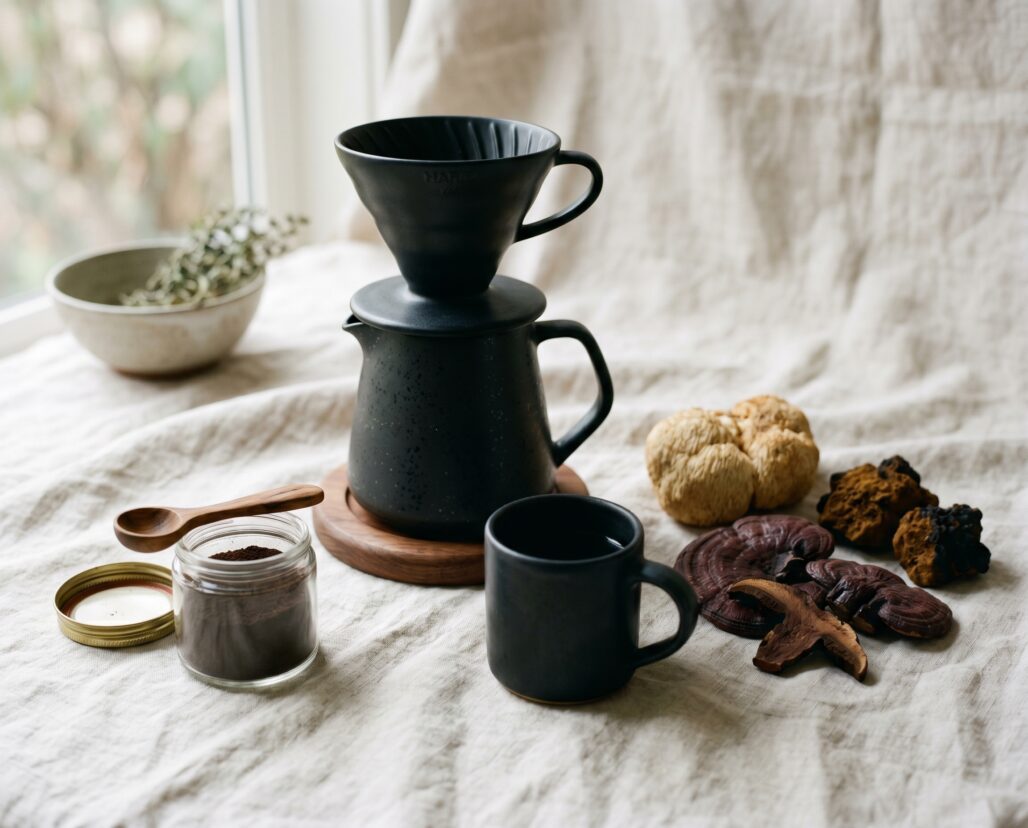
Summary / Quick Answer: which mushroom coffee is worth buying?
If mushroom content is your priority, Real Mushrooms Coffee is the only mainstream option using certified fruiting body extracts with disclosed beta-glucan percentages — though even it delivers functional doses only if you consume more than one serving.
- Best for: People who already drink coffee and want to add a low-dose mushroom supplement in a convenient format; anyone who values sourcing transparency and fruiting-body certification over per-cup cost
- Not ideal for: Anyone expecting clinical adaptogen doses from a single cup; people sensitive to caffeine who are hoping mushroom adaptogens help with stress (caffeine blunts some of those effects); people on anticoagulant medication given reishi and cordyceps interaction risks
- What to look at before buying: Total mg of mushroom per serving, whether it specifies fruiting body vs mycelium, any disclosed beta-glucan percentage, and whether the mushroom is an extract or a raw powder
- Decision shortcut: A serving label that reads "500mg mushroom blend" without specifying fruiting body, beta-glucan content, or the species breakdown is telling you almost nothing useful about what you're getting
What you'll find in this guide
- Why mushroom dose per cup is the central question
- Fruiting body vs mycelium-on-grain: why it matters more than brand
- Four brands compared by actual mushroom content
- Caffeine and adaptogens: a real tension
- Side effects and drug interactions
- Frequently asked questions
- Related reading
Why dose per cup is the central question in mushroom coffee {#dose-is-the-question}
Functional mushroom research has produced a handful of serious human trials. The best-known lion's mane RCT — Mori et al., 2009 (PMID 18844328) — used approximately 750mg of fruiting body extract per day in a n=30, 16-week trial with older adults showing mild cognitive impairment. A 2019 follow-up study (Saitsu et al., PMID 31339332) used a higher-dose design with 3.2g per day. Cordyceps research, particularly the exercise-performance trial by Hirsch et al., 2017 (PMID 27408987), used 1g of Cordyceps militaris per day in a 3-week crossover study (n=28).
These are the numbers that define what "functional dose" means for these species. Now consider what a typical serving of mushroom coffee delivers: anywhere from 250mg to 1,000mg of a blended mushroom extract across multiple species. When that total is split among six mushrooms, the per-species dose may be 50mg to 170mg — a fraction of what any single-ingredient trial used.
This isn't automatically a problem. Micro-doses taken consistently over months may have effects that acute high doses don't. But no human trial currently tests that hypothesis for mushroom coffee blends. The honest position is that the evidence for mushroom coffee specifically — not individual mushroom extracts at trial doses — is essentially absent.
Actionable takeaway: Before buying any mushroom coffee, divide the listed mushroom content by the number of species in the blend and compare that per-species number to the dose used in the relevant RCT. If you can't do that calculation because the label doesn't break down species dosing, you have no way to evaluate whether the product is delivering anything meaningful.
Fruiting body vs mycelium-on-grain: why it matters more than brand {#fruiting-body-vs-mycelium}
Functional mushrooms contain their key active compounds — beta-glucans, hericenones (lion's mane), ganoderic acids (reishi), cordycepin (cordyceps) — primarily in the fruiting body, which is the above-ground mushroom structure you recognize by appearance. Mycelium is the root-like network from which the fruiting body grows. Both contain beta-glucans, but the ratio, potency, and profile differ significantly.
The specific problem with most supplement-grade mycelium is the production method: mycelium-on-grain, where mycelium is grown on a starch substrate (rice, oats, or grain), then dried and powdered without separating the mycelium from the grain. The result is a powder that contains a high percentage of starch from the grain substrate alongside a lower concentration of beta-glucans and other active compounds compared to a fruiting body extract. A 2017 analytical study published in Frontiers in Microbiology found that the beta-glucan content in mycelium-on-grain products averaged 5-7% compared to 25-30% in fruiting body extracts of the same species.
Buying mushroom coffee without checking whether it specifies fruiting body is like buying fish oil labeled only "marine-sourced omega-3s" — the label tells you an ingredient category but hides the quality variable that determines whether it does anything.
The NCCIH overview on dietary supplements flags that manufacturing process dramatically affects active-compound content across botanical supplements, and that label claims are not FDA-verified for accuracy or potency.
Actionable takeaway: Any product that does not specify "fruiting body" explicitly, or that lists "mycelium" without a beta-glucan percentage from a certificate of analysis (COA), should be treated as an unknown quantity regardless of how prominently mushrooms appear in its marketing.
Four brands compared by actual mushroom content {#four-brands-compared}
Four Sigmatic Mushroom Coffee
Four Sigmatic is the brand that popularized mushroom coffee. Its core instant blend combines arabica coffee with lion's mane and chaga extracts, each at 250mg per serving. The brand specifies dual-extracted fruiting body for its lion's mane, which is a real credential. At 250mg of lion's mane fruiting body extract, you're at roughly a third of the lowest-dose human RCT. Chaga at 250mg is harder to benchmark against clinical evidence, because high-quality chaga RCTs in humans remain very limited as of 2026.
Four Sigmatic has published third-party testing certificates on its website, which matters. The blind spot is that 250mg of each species is a light dose — consistent daily use over months may or may not produce accumulation-type benefits that single-dose thinking misses, but no trial has tested this in the context of coffee.
Skip if: You want a product with evidence-backed doses rather than a convenient low-dose format. Also skip if you have kidney stones or kidney disease — chaga is high in oxalates (see interaction section below).
Ryze Mushroom Coffee
Ryze delivers approximately 1,000mg of total mushroom blend per serving, divided across six species: lion's mane, cordyceps, reishi, shiitake, turkey tail, and king trumpet. At roughly 167mg per species (if evenly distributed, which is not specified), this is marginally better per-species than Four Sigmatic but still below single-ingredient RCT doses.
Ryze does not publish beta-glucan percentages for its mushroom blend, and its website does not clearly specify fruiting body versus mycelium sourcing across all species. The brand has grown rapidly on social media, and its marketing emphasizes the total blend weight rather than per-species active compound content. An adaptogen brand can have impressive marketing and still miss third-party testing for the active marker compound.
Skip if: You want to confirm fruiting-body sourcing and beta-glucan content before purchasing. The 1g total blend sounds more substantial than Four Sigmatic's 500mg, but without species-by-species breakdown and beta-glucan disclosure, the comparison is largely superficial.
Mud\Wtr
Mud\Wtr is technically a coffee alternative, not coffee. Its base is masala chai-style (cacao, cinnamon, turmeric, ginger, cardamom, black pepper, sea salt) with four mushrooms (lion's mane, reishi, chaga, cordyceps) and ashwagandha, all at low combined doses. Total functional mushroom content is listed at around 1,000mg for the full serving of the blend, though the specific per-species mushroom dose is low given how many botanicals are sharing that weight.
Mud\Wtr contains significantly less caffeine than coffee (~35mg per serving vs ~100-150mg for a cup of drip coffee), which is relevant for the caffeine-adaptogen tension discussed below. It is the only product reviewed here that approaches a legitimate "low-caffeine + mushroom adaptogen" positioning. The masala spice base makes it a different drinking experience and may not satisfy coffee drinkers specifically.
The ashwagandha inclusion adds an adaptogen interaction flag: ashwagandha can interact with thyroid medication and immunosuppressants (see interaction section below).
Real Mushrooms Coffee
Real Mushrooms is the brand most focused on mushroom sourcing quality. Its mushroom coffee blend uses certified organic fruiting body extracts with disclosed beta-glucan percentages — lion's mane at 30% beta-glucans and reishi at 15% triterpenes, verified by COA. At 500mg of lion's mane fruiting body extract per serving (two servings give 1g), this is the closest any mainstream mushroom coffee product gets to what Mori 2009 used.
The brand's sourcing transparency is meaningfully better than the other three reviewed here. It publishes COAs, specifies fruiting-body certification, and uses organic-certified extract rather than mycelium-on-grain. The tradeoff: it costs more per serving and its coffee flavor is more muted compared to a straight specialty coffee.
Actionable takeaway: For readers who specifically want mushroom coffee with the highest available sourcing quality and closest proximity to RCT-level fruiting body extract doses, Real Mushrooms is the defensible pick among these four. For everyone else, the category delivers convenience and branding more than it delivers clinical adaptogen doses.
Caffeine and adaptogens: a real tension {#caffeine-tension}
Most mushroom coffees contain standard coffee caffeine levels — 50-150mg per serving depending on formulation. This creates a physiological tension that most product marketing ignores.
Reishi is used in traditional Chinese medicine as a calming and sleep-supporting herb, and some animal and limited human data suggest it may affect GABAergic pathways. Caffeine directly antagonizes adenosine receptors, which are part of the sleep-pressure signaling pathway. Combining a calming mushroom at sub-clinical doses with a stimulant that actively disrupts sleep-pressure signaling may not be the synergy the label implies. No human RCT has studied the specific combination of reishi with caffeine on sleep or anxiety outcomes.
Lion's mane is studied for cognitive support rather than for calming, so the caffeine conflict is less direct. But the most common reason people buy mushroom coffee is stress reduction or cognitive calm — goals that caffeine directly works against at moderate-to-high doses.
The real question is not whether mushroom coffee is good or bad. It's whether the dose of mushroom extract in a caffeinated beverage is large enough to register against the dominant pharmacological effect of the caffeine. At 250-500mg per species, the evidence that it does is thin.
Side effects and drug interactions {#side-effects-and-interactions}
Lion's mane
Lion's mane is generally well tolerated at doses used in human trials. One case report documented a hypersensitivity reaction (skin rash and difficulty breathing) in a person taking lion's mane supplements; individuals with mushroom allergies should exercise caution. No significant drug interactions are established in the current literature, though Memorial Sloan Kettering's integrative herbs database notes theoretical antiplatelet activity and advises caution before surgery.
Chaga
Chaga is high in oxalates — among the highest of any dietary supplement. For individuals with a history of calcium oxalate kidney stones, or those with reduced kidney function, regular chaga consumption may increase stone risk. The NCCIH general supplement guidance does not yet have a dedicated chaga fact sheet, but oxalate content is well-documented in compositional analyses. People with kidney disease should avoid chaga.
Drug interaction note: chaga may have anticoagulant properties in vitro. While human evidence is limited, the theoretical interaction with warfarin, aspirin, or other antiplatelet drugs warrants discussion with a prescriber.
Reishi
Reishi (Ganoderma lucidum) has the clearest drug interaction profile in this category. Per Memorial Sloan Kettering's integrative herbs database, reishi has demonstrated anticoagulant and antiplatelet effects in both in vitro and limited human data. Anyone taking warfarin, heparin, aspirin therapy, clopidogrel, or other blood-thinning medications should not add reishi-containing products without discussing it with their prescriber.
Reishi may also interact with immunosuppressants such as cyclosporine, tacrolimus, and biologics used in autoimmune conditions, through its immune-modulating properties. The effect direction is uncertain, and the clinical significance at mushroom coffee doses (typically 50-200mg per cup) is unknown, but the interaction category is real.
Cordyceps
Cordyceps has shown anticoagulant activity in in vitro studies, and some animal data suggest effects on platelet aggregation. Like reishi, it warrants caution with anticoagulant or antiplatelet medication. There is also theoretical interaction with immunosuppressant drugs given cordyceps' immune-modulating properties.
People taking calcineurin inhibitors or other transplant-related immunosuppressants should consult a physician before using any cordyceps-containing product.
Ashwagandha (Mud\Wtr only)
Mud\Wtr contains ashwagandha alongside its mushroom blend. Ashwagandha has documented interactions with thyroid medication (it has stimulated TSH changes in case reports), immunosuppressants, and benzodiazepines. Per the NCCIH ashwagandha fact sheet, it should not be used during pregnancy. If you take any thyroid, psychiatric, or immunosuppressant medication, the Mud\Wtr formulation specifically adds a layer of complexity the other products do not have.
Pregnancy and breastfeeding
None of the mushroom species in these products have adequate human safety data for pregnant or breastfeeding individuals. Avoidance is the appropriate default unless directed otherwise by a physician.
Frequently asked questions {#faq}
Does mushroom coffee actually work?
The best answer is: individual mushroom species have limited but real human evidence at specific doses and for specific outcomes (lion's mane for cognitive support in older adults at 750mg+ fruiting body daily; cordyceps for exercise tolerance at 1g daily). Mushroom coffee products typically deliver 50-500mg per species per cup, often in mycelium-on-grain form with unverified beta-glucan content. Whether those doses in a coffee matrix produce measurable effects has not been studied in a controlled trial.
How much mushroom extract do I actually need?
For lion's mane, the two human RCTs used 750mg and 3.2g of fruiting body extract per day, respectively. For cordyceps, the Hirsch 2017 exercise trial used 1g per day. For reishi, available human data are more limited; the Tang 2005 RCT (PMID 15857210) used a polysaccharide extract at 5.4g/day for neurasthenia symptoms, which is far above what coffee products contain. Most mushroom coffees deliver 250-500mg total per species per serving — below established trial doses.
Is fruiting body better than mycelium?
For most species, fruiting body extracts have higher concentrations of the active marker compounds (beta-glucans, hericenones, ganoderic acids) and have been used in the human trials that generated functional evidence. Mycelium-on-grain products contain grain starch in the powder, diluting the active fraction. This is not a marketing claim — it is reflected in analytical chemistry data published in peer-reviewed journals.
Can I take mushroom coffee every day?
At the doses found in most mushroom coffee products, daily use has no established safety concerns for healthy adults without the interaction conditions described above (kidney disease, anticoagulant therapy, immunosuppressant therapy, thyroid medication). The caffeine is the more pharmacologically active daily exposure for most users.
Does the caffeine cancel out the adaptogen effects?
There is genuine physiological tension between caffeine (a stimulant, adenosine antagonist, and cortisol-spiking compound) and adaptogenic mushrooms marketed for calm or stress support. No human trial has tested the combination directly. The mismatch is most pronounced with reishi (associated with calm/sleep in traditional use) co-formulated with coffee-level caffeine.
Which mushroom coffee has the most actual mushroom?
By disclosed milligrams per serving, Ryze and Real Mushrooms both claim around 1,000mg total blend per serving. Real Mushrooms has the higher quality credential: certified organic fruiting body with published beta-glucan percentages. For per-species transparency, Real Mushrooms publishes more information than the other brands reviewed here.
Can I take mushroom coffee if I'm on blood thinners?
No, not without talking to your prescriber. Reishi and cordyceps both have demonstrated anticoagulant properties in laboratory and limited human data. If you are taking warfarin, heparin, aspirin therapy, or any other antiplatelet or anticoagulant drug, adding reishi or cordyceps without medical guidance creates a real interaction risk.
For a broader look at the evidence base for medicinal mushrooms, including lion's mane, reishi, chaga, and cordyceps as standalone supplements, see Medicinal Mushrooms: A Complete Evidence-Based Guide.
If you're deciding between powdered mushroom supplements and tinctures for a specific outcome, Mushroom Tincture vs Powder: Which Format Is More Effective? breaks down the extraction and bioavailability differences. For the fruiting body versus mycelium sourcing question in more depth, see Lion's Mane Fruiting Body vs Mycelium: What the Evidence Says.
When you're ready to look at individual species in depth, Lion's Mane: A Complete 2026 Guide and Chaga for Immune Support: What the Research Actually Shows provide detailed breakdowns of the evidence and dosing data for each.
Conclusion: the bottom line on mushroom coffee
Mushroom coffee occupies an awkward position in the supplement market: it's a real and enjoyable category of coffee product, and the functional mushroom ingredients in it have genuine — if limited — evidence at the right doses and extract quality. The gap is that most products deliver 250-500mg per species of often-unverified extract, while the human trials that generated functional evidence used 750mg to 3.2g of fruiting-body extract per day in standalone formats.
The brand that comes closest to bridging that gap with sourcing transparency is Real Mushrooms Coffee. The brand that built the category and still offers genuine dual-extracted fruiting body at a lower per-serving dose is Four Sigmatic. Ryze offers more total milligrams but less sourcing clarity. Mud\Wtr is best positioned for people who want very low caffeine alongside mushroom adaptogens, but adds ashwagandha interaction complexity.
If you want clinical-range mushroom supplementation, standalone fruiting body supplements will deliver more per dollar than any coffee product in this category. If you want to add a small amount of functional mushroom extract to your existing coffee routine with transparent sourcing, Real Mushrooms is the defensible pick.
Next steps:
- Read the species profiles before picking a mushroom: Lion's Mane: A Complete 2026 Guide and Chaga for Immune Support
- If you're on any prescription medication, review the interaction section above and consult your prescriber before starting any mushroom supplement
- Check any product's COA for beta-glucan content and fruiting-body certification before buying
As an Amazon Associate, I earn from qualifying purchases. Product recommendations are based on real reviews and independent research.
Related reading {#related-reading}
- Medicinal Mushrooms: A Complete Evidence-Based Guide
- Mushroom Tincture vs Powder: Which Format Is More Effective?
- Lion's Mane Fruiting Body vs Mycelium: What the Evidence Says
- Lion's Mane: A Complete 2026 Guide
- Chaga for Immune Support: What the Research Actually Shows
This article is for informational purposes and not medical advice. Herbal adaptogens and functional mushrooms — even traditional ones — can interact with anticoagulants, immunosuppressants, thyroid medication, and other prescription drugs. Reishi and cordyceps specifically have documented anticoagulant properties; chaga is high in oxalates and raises kidney-stone risk in susceptible individuals. Consult a licensed physician before starting any mushroom supplement, particularly if you are pregnant, nursing, taking prescription medications, or managing a chronic condition.
As an Amazon Associate, I earn from qualifying purchases. Product recommendations are based on real reviews and independent research.
This article is for informational purposes and not medical advice. Herbal adaptogens, even traditional ones, can interact with thyroid medication, antidepressants, anticoagulants, immunosuppressants, blood-pressure drugs, and more. Consult a licensed physician before starting any adaptogen, particularly if you are pregnant, nursing, taking prescription medications, or managing a chronic condition.
