
If you're comparing lion's mane fruiting body vs mycelium, the short answer is: the distinction matters enormously for supplement quality, and most products on store shelves fail the quality test. This article breaks down how the two forms differ biologically, which was used in the major human RCTs, and how to distinguish a legitimate extract from a product that is mostly grain starch. You'll also get a practical guide to reading a COA, an explanation of why hericenones and erinacines are not interchangeable, and what the evidence base actually supports.
Affiliate disclosure: this article contains affiliate links. As an Amazon Associate, UsefulVitamins.com earns from qualifying purchases at no extra cost to you.
Summary: quick answer on fruiting body vs mycelium
Fruiting body extracts standardized to a disclosed beta-glucan percentage are what the human clinical trials used. Most cheap mycelium-on-grain products contain more starch than active mushroom compounds, and the label alone will not warn you.
Best for: Anyone who has already decided to try lion's mane and wants to understand whether they are buying something the research actually tested.
Not ideal for: Shoppers relying solely on brand marketing claims ("full-spectrum," "dual extract," "whole mushroom") without verifying the beta-glucan content on a certificate of analysis.
What to look at before buying: Explicit "fruiting body" declaration; beta-glucan percentage disclosed (typically 20-30% in quality fruiting body extracts); third-party COA showing the alpha-glucan (starch) fraction is low relative to total polysaccharides.
Decision shortcut: If the label shows total polysaccharides but no beta-glucan breakdown, and does not specify fruiting body, treat it as an uninformative label until a COA says otherwise.
What you'll find in this guide
- How the mushroom life cycle creates two very different materials
- What the RCTs actually used: fruiting body in both key trials
- Hericenones vs erinacines: who makes what
- Mycelium-on-grain: why the substrate problem is serious
- Beta-glucan testing and how to read a COA
- Who it's for and who should skip it
- Dosing: what the trials used
- Side effects and drug interactions
- Frequently asked questions
How the mushroom life cycle creates two very different materials
Lion's mane (Hericium erinaceus) passes through two distinct biological stages that produce chemically different material.
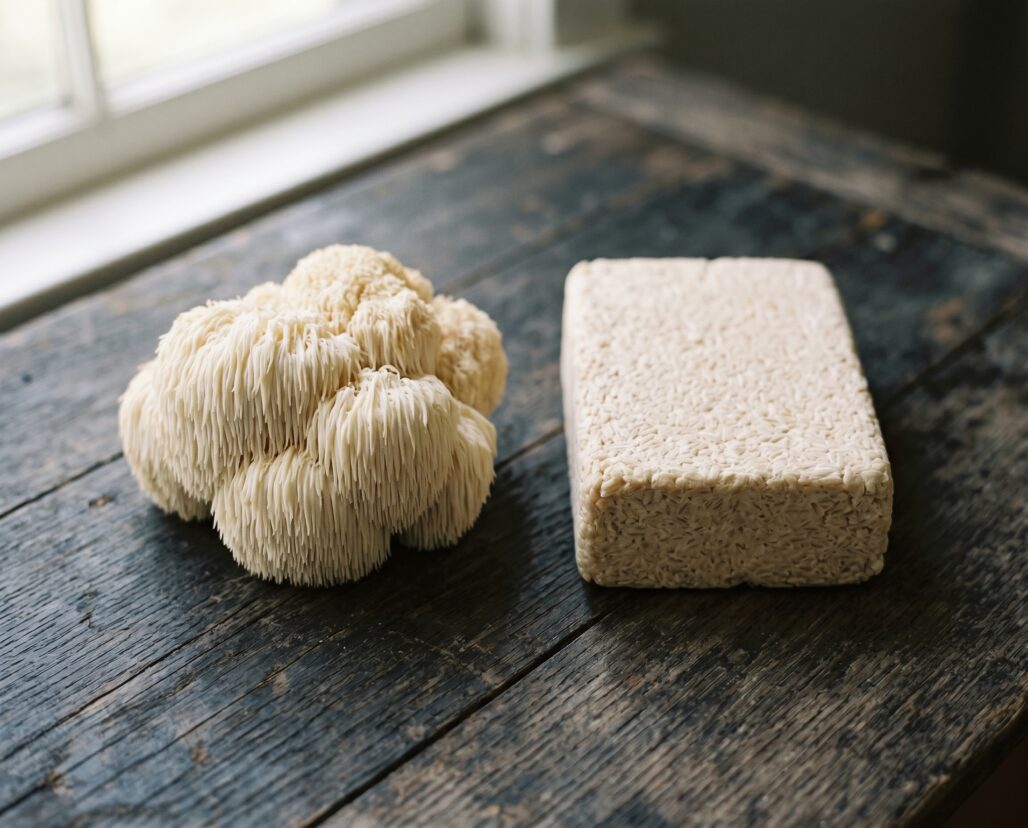
The fruiting body is the visible mushroom: the cascade of white spines you see in specialty grocers and supplement photography. Fruiting bodies are dense with beta-glucan polysaccharides and contain hericenones — aromatic compounds unique to the fruiting stage.
The mycelium is the vegetative network: thread-like hyphae that grow through the mushroom's substrate. In nature, that is hardwood. Commercially, fruiting body production requires a full hardwood-cultivated fruiting cycle — slower and more expensive. Mycelium production is faster: inoculate sterilized grain (rice, oats), let the network colonize it, harvest before fruiting occurs, dry and grind. The entire grain-plus-mycelium mass becomes the powder.
That distinction — hardwood-cultivated fruiting body versus grain-colonized mycelium — is the source of almost every quality dispute in the lion's mane supplement market. A 2015 review of H. erinaceus bioactive compounds (Friedman, PMID 26244378) identified approximately 70 bioactive secondary metabolites including polysaccharides, erinacines, hericenones, and sterols. These compounds are not uniformly distributed between the two stages, and the substrate the mycelium grows on becomes part of the product.
Buying mushroom supplements without checking fruiting-body content is like buying olive oil labeled "Mediterranean blend" — the label tells you everything except what's actually in it.
Actionable takeaway: The single most important piece of information on a lion's mane label is whether it specifies "fruiting body" and discloses the beta-glucan percentage. Everything else is secondary.
What the RCTs actually used
The two most-cited human clinical trials on lion's mane both used fruiting body preparations. This is not an accident — it reflects how the mushroom has historically been consumed in East Asian medicine, and where the pharmacological research was concentrated.
In a 2009 double-blind, placebo-controlled RCT (Mori et al., n=30), participants with mild cognitive impairment received four 250-mg tablets of 96% dried H. erinaceus fruiting body powder three times daily (total: 3 grams per day) for 16 weeks. Cognitive function scores on the Revised Hasegawa Dementia Scale were significantly higher in the lion's mane group at weeks 8, 12, and 16. Notably, scores declined significantly in the four weeks after supplementation was discontinued — suggesting the effect requires continued use.
In a 2010 double-blind, placebo-controlled RCT (Nagano et al., n=30), menopausal women consumed cookies containing 0.5 grams of fruiting body powder per cookie, four times daily (approximately 2 grams total per day) for 4 weeks. CES-D and anxiety (Indefinite Complaints Index) scores were significantly lower in the lion's mane group versus placebo at 4 weeks.
A 2019 RCT (PMID 31413233) confirmed this direction: participants taking supplements containing fruiting body of H. erinaceus for 12 weeks showed significant improvement on the Mini Mental State Examination (MMSE).
All three trials used fruiting body, not mycelium-on-grain. No comparable human RCT has tested a mycelium-on-grain product as the sole intervention for cognitive or mood outcomes.
The real question isn't whether lion's mane works — it's whether the product you're holding contains anything resembling what the research actually tested.
Hericenones vs erinacines: who makes what
One of the more nuanced points in the fruiting body vs mycelium debate is that both parts of the mushroom contain distinct bioactive compounds, and the distinction is worth understanding before writing off mycelium entirely.
Hericenones are aromatic compounds found in the fruiting body. They are unique to the fruiting stage and have been identified as direct stimulators of nerve growth factor (NGF) synthesis in neuronal cells. The 2015 review (Friedman, PMID 26244378) lists them among the primary bioactive metabolites of H. erinaceus. Hericenones are not present in measurable amounts in mycelium grown on grain.
Erinacines are diterpene compounds found primarily in the mycelium. They are smaller molecules than hericenones and are reported to cross the blood-brain barrier more readily in animal models. Erinacine-A in particular has been studied for NGF-stimulating activity in cell culture work (Lai et al., 2013, PMID 24266378). A subset of premium supplement brands grow mycelium specifically on liquid or semi-liquid media (not grain) to concentrate erinacines, then combine this with a fruiting body extract to produce what is marketed as a "dual-extract" product.
The key implication: erinacines are a legitimate reason to include mycelium in a formulation — but only if the mycelium was grown in a substrate-controlled environment where the erinacine fraction can actually be documented. Mycelium grown on rice and harvested with the grain intact is not erinacine-rich mycelium. It is rice flour with fungal threading.
In vitro work (Lai et al., 2013, PMID 24266378) demonstrated that aqueous extract of H. erinaceus promoted NGF synthesis in neuroblastoma cells and achieved a 60.6% increase in neurite outgrowth when combined with exogenous NGF. This is cell-culture data, not a human pharmacokinetic trial. It tells us the compounds can stimulate NGF production under controlled conditions — not that consuming a supplement delivers those compounds to your neurons in equivalent form or quantity.
Actionable takeaway: Hericenones belong to fruiting body. Erinacines belong to mycelium. Both can contribute to the mechanism — but only when the substrate contamination problem is solved. For most commercial products, it has not been.
Mycelium-on-grain: why the substrate problem is serious
Commercial lion's mane mycelium products have a structural flaw: there is no practical separation between the fungal biomass and the grain it grew on. The mycelium colonizes rice or oats but never fully consumes them. After drying and grinding, the resulting powder contains mycelium and undigested grain starch in the same mass. Independent quality testing has documented that some products labeled as lion's mane mycelium contain 50-80% starch (alpha-glucan) by weight, with minimal measurable beta-glucan content.
Beta-glucans are the polysaccharides linked to the immunomodulatory and neuroprotective activities of medicinal mushrooms. A 2017 study (PMID 28266682) found that H. erinaceus fruiting body polysaccharide extract demonstrated immunomodulatory effects through intestinal mucosal regulation in mice; alpha-glucan (grain starch) does not carry those properties.
This is why total polysaccharides alone is a misleading number. A product showing "30% polysaccharides" on its label might be almost entirely grain starch if the beta-glucan fraction is not separately disclosed. Starch-derived and fungal polysaccharides require separate assays to distinguish.
Why even some "premium" brands hedge
Several brands sell "full-spectrum" or "dual-extract" blends combining fruiting body and mycelium biomass. The rationale is valid in principle: erinacines from mycelium complement hericenones from the fruiting body. The concern is documentation. Unless a brand discloses erinacine concentration and beta-glucan content per fraction, with a COA showing controlled alpha-glucan, there is no way to distinguish a genuine dual-extract from grain-colonized mycelium sold at a premium.
An adaptogen brand can have impressive marketing and still miss third-party testing for the active marker compound. The lion's mane category is one of the clearest examples of this problem in the supplement industry.
Beta-glucan testing and how to read a COA
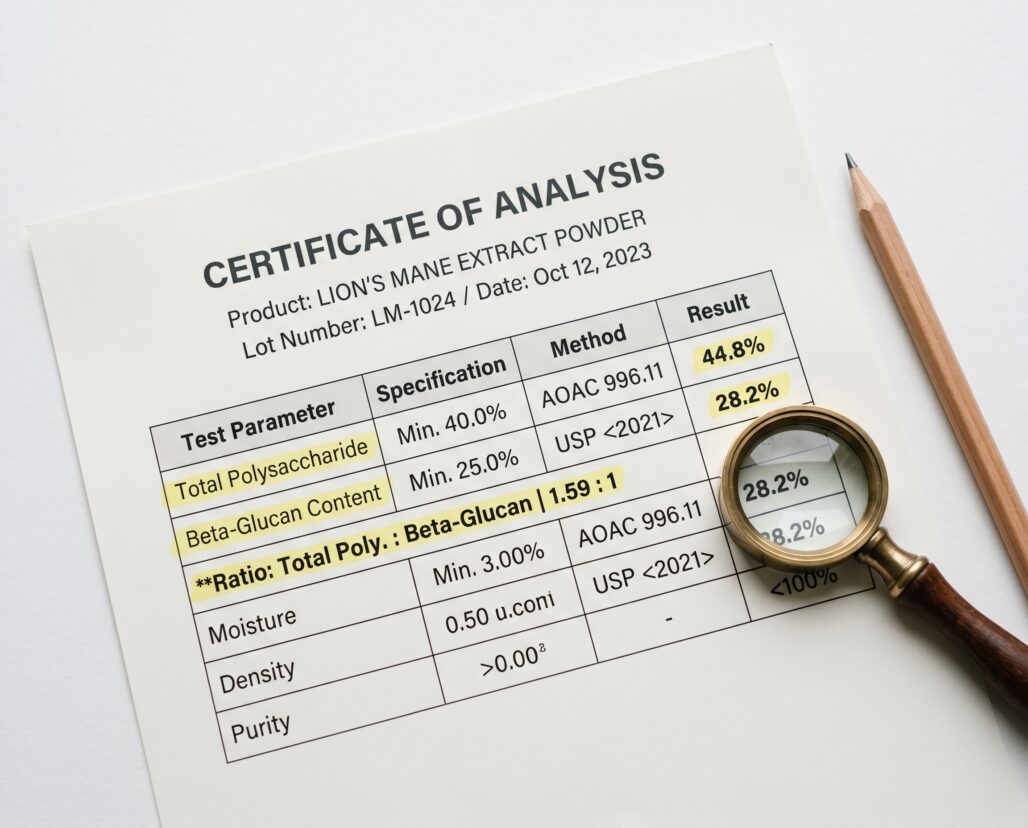
A Certificate of Analysis (COA) is a third-party laboratory document that quantifies specific compounds in a supplement batch. For lion's mane, the relevant values are:
Total polysaccharides: Useful only alongside the beta-glucan breakdown. Starch is also a polysaccharide.
Beta-glucans: The specific fungal fraction — the bioactive component. Quality fruiting body extracts typically show 20-30% beta-glucan by dry weight. If this number is absent from the COA, the total polysaccharide claim is not actionable.
Alpha-glucans (starch): In a pure fruiting body extract, this should be minimal. The calculation: beta-glucans + alpha-glucans approximately equals total polysaccharides. A product showing 30% polysaccharides with 25% alpha-glucan and 5% beta-glucan is predominantly starch.
Heavy metals and microbial contamination: Mushrooms bioaccumulate metals from their substrate. Any reputable COA includes lead, arsenic, cadmium, and mercury panels. Grain-based products have elevated mold contamination risk and should include microbial testing.
| COA element | What it tells you | Red flag |
|---|---|---|
| Total polysaccharides | Very little on its own | Using this as the only polysaccharide metric |
| Beta-glucan % | The active mushroom fraction | Below 15% in a product claiming potency |
| Alpha-glucan % | The starch (grain) fraction | High relative to beta-glucan |
| Fruiting body confirmation | Whether the material is actual mushroom | "Hericium erinaceus" without further specification |
| Heavy metals panel | Safety and substrate quality | Missing entirely |
| Batch-specific COA | Real testing, not evergreen certificate | Undated or no batch number |
A simple way to judge a lion's mane product without a PhD: ask for the COA, look for the beta-glucan number, and divide it by the total polysaccharide number. If that ratio is below 0.5 (meaning more than half the polysaccharides are not beta-glucans), ask the brand what the alpha-glucan fraction is.
Who it's for and who should skip it
Strong fit
Adults interested in the cognitive or mood effects documented in the Mori 2009 and Nagano 2010 RCTs who want a product that matches what those trials tested: a fruiting body extract with disclosed beta-glucan content at 2-3 grams of dried fruiting body equivalent per day.
Skip or defer
Anyone expecting rapid results: the Mori 2009 cognitive trial showed improvement at 8 weeks, not day one. Anyone relying on a "full spectrum" label without verifying beta-glucan content. People with mushroom allergies should avoid entirely — allergic reactions including skin rash and respiratory symptoms have been documented.
For broader context on how lion's mane fits the medicinal mushroom category, see the medicinal mushrooms complete guide.
Dosing: what the trials used
All three human trials used fruiting body material:
- Mori 2009: four 250-mg tablets of 96% dried fruiting body powder three times daily (3,000 mg/day) for 16 weeks.
- Nagano 2010: approximately 2,000 mg/day of fruiting body powder (via cookies) for 4 weeks.
- 2019 RCT (PMID 31413233): fruiting body capsules, 12 weeks.
These were dried powder studies, not standardized extracts. Commercial extracts concentrate active compounds, but without a disclosed beta-glucan percentage, any extraction ratio claim is unverifiable. In clinical trials, the dose was grams of dry fruiting body per day — whether your product's extraction ratio delivers equivalent active compounds depends entirely on what the COA shows.
What to look for on the label: Explicit "fruiting body" statement; extraction ratio if applicable; beta-glucan percentage disclosed; batch-specific COA available on request. A label stating "standardized to 25% beta-glucan" is the most informative single claim for medicinal mushroom quality.
Side effects and drug interactions
Lion's mane has a favorable safety profile in clinical trial literature. Mori 2009 (PMID 18844328) and Nagano 2010 (PMID 20834180) reported no significant adverse events. Mild gastrointestinal symptoms have been reported in the broader literature. Allergic reactions — skin rash, respiratory symptoms — have been documented in people with mushroom sensitivities.
Drug interactions: condensed and specific
Anticoagulants (warfarin, heparin, aspirin, clopidogrel): Preclinical data suggests lion's mane polysaccharides have some platelet-aggregation-inhibiting activity. The theoretical risk is increased bleeding when combined with anticoagulants. If you take a blood thinner, discuss with your prescriber before adding lion's mane.
Immunosuppressants (tacrolimus, cyclosporine, mycophenolate, biologics): Fruiting body polysaccharides from H. erinaceus have demonstrated immune-modulating activity in animal models (PMID 28266682). Theoretically, immune stimulation could counteract immunosuppressant therapy in transplant patients or people with autoimmune conditions on biologics. The direction and magnitude of this interaction in humans is not established — but the precautionary approach is to inform your prescriber.
Sedatives, anxiolytics, antidepressants (SSRIs, SNRIs, benzodiazepines): Proposed serotonergic and GABAergic mechanisms create a theoretical interaction. No human pharmacokinetic studies have quantified this. Disclose lion's mane use to any prescriber managing CNS medications.
Pregnancy and breastfeeding: No human safety data. Avoid during pregnancy and lactation.
Frequently asked questions
what is the actual difference between fruiting body and mycelium in lion's mane supplements?
Fruiting body is the visible mushroom structure grown to completion. Mycelium is the earlier vegetative stage. The bioactive compounds differ: hericenones are fruiting-body-specific, while erinacines are primarily found in mycelium. More practically: fruiting body grown on hardwood produces concentrated beta-glucan polysaccharides with minimal starch. Mycelium grown on grain (the common commercial method) produces a powder that is partly mycelium and partly undigested rice or oat starch. The starch fraction can account for 50-80% of the dry weight in some products, diluting the active compound concentration substantially.
why does mycelium-on-grain have so much starch?
Commercial mycelium production inoculates sterilized grain (rice, oats) with fungal spores and harvests before fruiting occurs. The mycelium threads colonize the grain but do not fully consume it. When the colonized block is dried and ground, the powder contains both fungal biomass and intact undigested grain starch, with no commercially practical way to separate them. The result: polysaccharide content that includes substantial alpha-glucan (starch) alongside any beta-glucan from the mycelium itself.
can I trust a label that says "full spectrum lion's mane"?
Not without more information. "Full spectrum" is unregulated and typically means the product includes both fruiting body and mycelium — but does not specify ratios or quality. A COA showing the beta-glucan fraction and the alpha-glucan (starch) fraction separately is the only way to distinguish a genuine dual-extract from grain-colonized mycelium with a small fruiting body addition.
what beta-glucan percentage should I look for?
Quality fruiting body extracts typically show 20-30% beta-glucan content. A product below 15% from claimed fruiting body deserves scrutiny. More importantly: if the label shows only "total polysaccharides" without a beta-glucan breakdown, the number is not actionable — starch is also a polysaccharide.
were the RCTs done on fruiting body or mycelium products?
Mori 2009 (PMID 18844328), Nagano 2010 (PMID 20834180), and the 2019 cognitive RCT (PMID 31413233) all used fruiting body preparations. No comparable placebo-controlled human trial has been published using a mycelium-on-grain product as the sole intervention.
As an Amazon Associate, I earn from qualifying purchases. Product recommendations are based on real reviews and independent research.
Related reading
- Lion's Mane: The Complete Evidence Guide (What the Research Actually Shows)
- Best Lion's Mane Supplement: Fruiting Body vs. Mycelium, Tested Brands, and What to Actually Buy
- Medicinal Mushrooms: The Complete Evidence Guide
Conclusion: the bottom line on fruiting body vs mycelium
The fruiting body vs mycelium question is not abstract mycology — it is a practical quality screen that filters out a significant portion of the lion's mane supplement market. The human RCTs that form the evidence base for lion's mane cognition and mood effects (Mori 2009, Nagano 2010, and the 2019 MMSE trial) all used fruiting body preparations. Hericenones, the fruiting-body-specific bioactive compounds, have been identified in preclinical work as NGF stimulators. Erinacines, found in mycelium, offer a complementary mechanism, but only when the mycelium is grown in a controlled substrate — not on grain.
The mycelium-on-grain problem is structural: commercial production economics favor grain colonization, the substrate cannot be separated from the fungal biomass, and the resulting product can be 50-80% starch while still legally carrying the mushroom's name on the label. Total polysaccharide claims do not resolve this, because starch is also a polysaccharide. Beta-glucan content, separately disclosed and verified on a batch-specific COA, is the only reliable signal.
Standardized to polysaccharides alone is meaningless. Standardized to 25% beta-glucan from fruiting body, with a COA showing low alpha-glucan, tells you something you can use.
Next steps:
- Before buying any lion's mane supplement, request the COA and verify the beta-glucan percentage and the alpha-glucan (starch) fraction.
- If you're researching the full clinical evidence base — cognitive effects, mood effects, the NGF mechanism in detail — start with the lion's mane complete guide.
- If you're ready to compare specific brands by their COA quality and beta-glucan content, see the best lion's mane supplement roundup for picks with documented standardization.
- If you take anticoagulants, immunosuppressants, or any CNS-active medication, involve your prescriber before adding lion's mane — theoretical interactions exist even where head-to-head pharmacokinetic data do not.
This article is for informational purposes and not medical advice. Herbal adaptogens — even traditional ones — can interact with thyroid medication, antidepressants, anticoagulants, immunosuppressants, blood-pressure drugs, and more. Consult a licensed physician before starting any adaptogen, particularly if you are pregnant, nursing, taking prescription medications, or managing a chronic condition.
As an Amazon Associate, I earn from qualifying purchases. Product recommendations are based on real reviews and independent research.
